Because The 20B Is So Last Year...










Trending Topics

Joined: Dec 2002
Posts: 3,791
Likes: 3
From: Kitchener Ontario Canada
Hey Aaron....I hope that is a multi peice shaft.....cause it looks pretty awkward to have to keep sliding irons over all those lobes lol.
So why isn't it built yet? j/k!
So why isn't it built yet? j/k!

Thread Starter
Joined: Feb 2001
Posts: 29,798
Likes: 128
From: London, Ontario, Canada
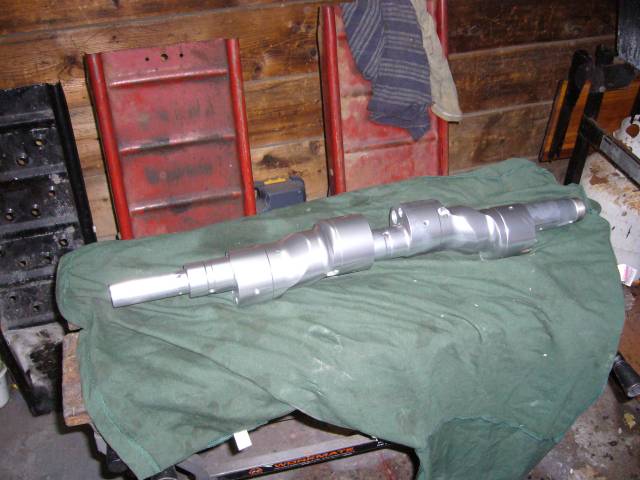
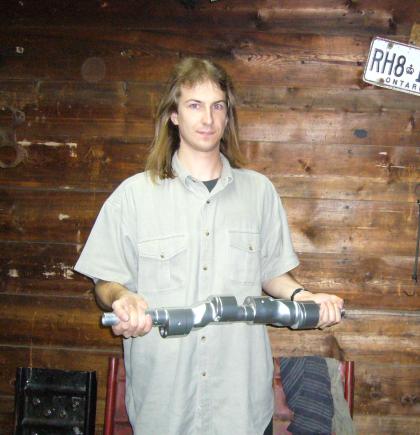
This shaft is sort of a mockup or prototype for the final version. As such, this particular shaft will never see the inside of an engine. It was a very worthwhile exercise because it's really cleared up the methods of joining eccentrics. It's one thing to think about it for almost 7 years, but quite another to actually put your hands on some shafts and start tinkering. I'd say that any machine shop worth it's salt is capable of making a 4 rotor eccentric from two 13B eccentrics for less then $1000. The thick center bearing iron is actually the challenge, but not huge...

While I know this will probably be intended for Tiina (have to rename her!)... tell us, do you get an evil grin when you look at this and your newly acquired RX-5 cosmo together? That'd be one hell of an original pairing!




Thread Starter
Joined: Feb 2001
Posts: 29,798
Likes: 128
From: London, Ontario, Canada
 I want a turn-key car that almost anyone can drive, with decent mileage, quiet exhaust and a slight bit of go when necessary.
Mazda of course uses a taper and key which is probably the best way to do it. But it's hard for a "backyard engineer" to create a good taper that will be precise enough. In my opinion, the best way to create a backyard 4 rotor shaft is to use a set of splines. The Mazda piece already provides a thinner snout that will fit into the rear of the "front" shaft after the hole (which is conveniently perfectly centered...) for the oil passage is bored out. The end of the spline then seals with an o-ring. Most machine shops can create splines without any issue, as can better driveline shops. The key is keeping the lobe phasing at exactly 90 degrees but as luck would have it, the lightening holes in the lobes are very convenient as a reference for jigging.

Thread Starter
Joined: Feb 2001
Posts: 29,798
Likes: 128
From: London, Ontario, Canada
Looks like the GSL-SE 13B will bolt right in for the most part. I may need to make my own headers but that's no big deal. Also I'd like to run a cat so fuel injection is a must.


That's wicked! A four rotor shaft in Ontario! Haha.
I have a few questions about the "design". I'm assuming you're going to modify a single intermediate plate to hold the single middle bearing and you're probably going to run some sort of double sided stationary gear off that at the same location as well. So that means that single bearing is going to have to support the centrifugal force of the 4 off-balance rotors as well as the torque induced on the stat gears by two rotors. Now I haven't done any of the math to calculate the magnitude of these loads, but I would seem very cautious of leaving the single "short" bearing having to support it.
All of the four rotor shafts I've seen have four bearings. They lack the fifth bearing in the place where you have your centre bearing. This way, two rotors have a bearing on both sides, two rotors have a bearing on one side (like in an OEM rotary), and each bearing has a single stat gear.
How are the two shafts coupled?
I'm just curious as this is something I want to do as soon as I have a chance, and I want to know as much as possible before I tackle the project!
I have a few questions about the "design". I'm assuming you're going to modify a single intermediate plate to hold the single middle bearing and you're probably going to run some sort of double sided stationary gear off that at the same location as well. So that means that single bearing is going to have to support the centrifugal force of the 4 off-balance rotors as well as the torque induced on the stat gears by two rotors. Now I haven't done any of the math to calculate the magnitude of these loads, but I would seem very cautious of leaving the single "short" bearing having to support it.
All of the four rotor shafts I've seen have four bearings. They lack the fifth bearing in the place where you have your centre bearing. This way, two rotors have a bearing on both sides, two rotors have a bearing on one side (like in an OEM rotary), and each bearing has a single stat gear.
How are the two shafts coupled?
I'm just curious as this is something I want to do as soon as I have a chance, and I want to know as much as possible before I tackle the project!
Thread Starter
Joined: Feb 2001
Posts: 29,798
Likes: 128
From: London, Ontario, Canada
I have a few questions about the "design". I'm assuming you're going to modify a single intermediate plate to hold the single middle bearing and you're probably going to run some sort of double sided stationary gear off that at the same location as well. So that means that single bearing is going to have to support the centrifugal force of the 4 off-balance rotors as well as the torque induced on the stat gears by two rotors. Now I haven't done any of the math to calculate the magnitude of these loads, but I would seem very cautious of leaving the single "short" bearing having to support it.
The original Mazda 2002 4 rotor design used three bearings with a majorly thick center section and a double wide bearing. They abandoned that for several reasons.
As we all know, the 787B had one bearing per rotor, but then again it was designed for endurance racing at constant high RPMs.
For a street driven 4 rotor firing at 90 degrees (instead of those "bastard" 4 rotors that fire like two 2-rotors) it should be fine. Any more bearings and the engine becomes very thick.
That said, the Kiwi-RE kit uses two "inner" main bearings, not unlike Scoot.
How are the two shafts coupled?
A much improved version of that is to just bore the front shaft to accept the keyway of the rear shaft. That's probably the easiest approach.
My personal favourite would be to spline the rear shaft and front shaft to match, seal the oil passage with an o-ring at the front of the spline and then secure with pins or have a slight taper machined.
I'm just curious as this is something I want to do as soon as I have a chance, and I want to know as much as possible before I tackle the project!
I've thought about that a bit as well. Scoots 4 rotor used 4 bearings, one bearing, a lobe, another bearing, two lobes, another bearing, the last lobe, then another bearing. That's a LOT of bearings and also would make the engine quite long. Though his was made up of 12A parts so that compensated for the length somewhat.
My personal favourite would be to spline the rear shaft and front shaft to match, seal the oil passage with an o-ring at the front of the spline and then secure with pins or have a slight taper machined.
Joined: Dec 2002
Posts: 3,791
Likes: 3
From: Kitchener Ontario Canada
I was wondering the same thing...there shouldn't be any difference in the engine length if you used 5 bearings (whic his what I would want to do). Have a bearing supporting the e-shaft in between each rotor.
Thread Starter
Joined: Feb 2001
Posts: 29,798
Likes: 128
From: London, Ontario, Canada
There would be no difference in length since the bearings are all housed within the centre bore of the intermediate irons, or at least they are that way in all multi rotor applications I've seen. The length of the engine is determined by the types of rotor housings obviously (12A or 13B), but your 50mm intermediate plates are always going to be the same width whether there is a bearing in them or not. If you take a look at the centre plate bearing modifications that Jeff Bruce does, then you'll know what I mean.
It's a bit of a brain fart on my part, but by thicker I keep thinking of two main bearings side to side like the 2002.
Another one of my plans was to machine a thick center iron like the 20B and have the engine assembled in two halves (two sets of tension bolts both meeting on the center most plate. But for obvious reasons this is a stupid idea.
But I'm assuming you're going to be using a modified centre iron to house your centre bearing, a la Jeff Bruce (and Steve from MPS... if you need local help with the machine work from someone who knows these things inside and out),
The original plan was to machine a new center plate from scratch, but its far easier to machine a double ended stationary gear with bearing to fit perfectly within the opening of a stock center plate. Then pin it from the sides much like the rotor stationary gears. It's then easy to feed oil to it via a line that follows the stock filler passage.
but I could be off on this assumption. Perhaps you have something else in mind as a bearing carrier that's different from what's be traditionally used.
That's a good idea, but how are you going to hold them together? The only option I can think of would be to thread the end of one shaft and have a long tension bolt running through the centre of the shaft. But then you may run into oil supply problems with that.
The only reason I would want to stay away from tapers is that they are hard to machine for the backyard builder.