When you click on links to various merchants on this site and make a purchase, this can result in this site earning a commission. Affiliate programs and affiliations include, but are not limited to, the eBay Partner Network.
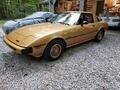
Today I used my Rx7 to go to a local path for a bike ride. The hatch is just big enough for a folding bike (or whatever these things are called, it doesn't really fold):
My legs are killing me since it's fixed gear, but the ride was nice. Nicer is that the car is reliable enough to just get in and go. That's the kind of reliability I'm going to try to maintain after the turbo swap, which is part of the reason my power goals are so mild. It doesn't matter how fast the car is if it's always on jack stands.
Speaking of which, another few parts came in today:
Awhile back forum member Carsebuco and his wife were looking to install the stock intake box back on their 10th Anniversary and remove this turbo inlet duct and aftermarket filter. Now I had some spares so I sent them an airbox and snorkel for the cost of shipping. Then after this Turbo II engine fell into my lap, I really needed a TID. I prefer the OEM unit but it's expensive, and also requires me to keep the MAF in the system. They kind enough to send me the aftermarket TID for the cost of shipping (thanks again!), which saves me a ton of time trying to chase down the stock parts.
They included the TID itself:
An adapter for the MAF (which has a square outlet):
And a cone filter:
Now once I have the standalone sorted out I will be running speed-density. This lets me eliminate the MAF. However, we all know that a cone filter exposed in the engine bay is really a hot-air intake. For startup and testing I can install the TID with the cone filter, but long-term I really want to connect the TID to the stock intake somehow. I may be able to using that MAF adapter in reverse (connected to the airbox instead of the MAF), but if not I will design and 3d print an adapter to fill the same purpose. The stock airbox can already flow plenty of air, and it includes a snorkel to inhale cold air from the front of the rad.
So the latest thing that's been bothering me has been the deflector for the sunroof. If you don't know what this is, yours is probably broken too. See the black bar at the front of the sunroof opening?
That's supposed to pop up on it's own to deflect wind noise. Mine is unfortunately suffering from ejectile dysfunction. To diagnose the problem, two JIS screws need to be removed per side. There are two silver ones here:
And two black ones under the bar. Remind me to clean up all this lithium grease...
Once the deflector is out, the problem is pretty obvious:
Both of the black plastic pieces are broken. Now, I did look to see what this part costs. Apparently it's only sold with the entire bracket. Left side is NLA, right side is available from Atkins for $80 USD. That means even if you could get them, it would be $160 USD before shipping. Highway robbery, when all you need is the black plastic piece. To take it out, there's one small retaining clip and then it comes apart:
After some time in Blender:
The part looks simple, but there are about 6 revisions in this part. The bevelled corners are necessary to prevent it interfering with the mount on the body of the car, the small step in the "arm" part is necessary to seat in the flat part of the linkage, etc. Overall (including test fitting and printing) it only took about 3 hours. The only post-processing required for the part is drilling the holes for the pin. See the following blurry picture:
That's actually a prototype, which is why the corner is bevelled with sandpaper instead of in the model.
Installed. I'm not sure if this is actually the correct orientation for the spring. I can however say that this does work perfectly:
Installing the deflector can be tough since it's spring-loaded and wants to pop itself free. Once the new plastic piece is screwed in on either side, the best thing to do is to gently manipulate the linkage where it needs to be until the rear screws are partially threaded. Then gently tighten them while making sure nothing is binding. The black deflector piece will also want to be tilted away from the front of the car, so you need to gently roll it the other way until the rear screw holes line up.
All done:
Does it make a difference? I'm not sure, I actually have yet to drive it. Will report back once I find out. For a cumulative 3 hours work and probably 10g of ABS filament, it's worth it just to know the part is fixed. I'll post the STL file with a brief write-up shortly. I anyone needs it before I end up doing that, shoot me a PM.
Until next time
Last edited by WondrousBread; Jul 6, 2022 at 08:53 PM.
Awesome! Now you're going to make me check my deflector lol.
Regarding your spring orientation. I think you do have it flipped. From your photos it looks like the springs are different for L and R. One coils clockwise, other coils counter. They way you have it reinstalled looks like the springs are working in tension. Previously they were working in compression (idk if these are the correct terms for a torsion spring lol. loosening vs tightening the coil). But if it works then hey. lol
I think you do have it flipped. From your photos it looks like the springs are different for L and R. One coils clockwise, other coils counter. They way you have it reinstalled looks like the springs are working in tension. Previously they were working in compression (idk if these are the correct terms for a torsion spring lol. loosening vs tightening the coil). But if it works then hey. lol
Looking at the photo from Atkins, I think you're right. I tried a few different orientations since the springs are mirrored and the only one that felt right was this one so I went with it. I checked today and it was still springing up and retracting like it should. I'm going to take it for a test drive as soon as I have time, since the real test will be if it stays up at speed. I'll also try pushing it down manually and see if it changes the sound / pressure in the cabin with the sunroof open.
I've had power locks controlled by my alarm system for a few years. Installing them was fairly simple: The alarm itself has outputs that it pulses + / - depending on whether it's a lock / unlock command, and that switches a set of 5 pin relays arranged as an H-bridge which is hidden inside the hollowed-out factory speaker under the dash. These relays then control the lock actuators I installed in the doors, giving me remote lock and unlock.
I never actually made use of the hatch-popping function though, since I couldn't find a good place to mount the actuator at the time and then I put it on the back-burner. I decided today was the day, so armed with some wiring, a relay, and some bicycle cables I set out to make the remote controlled hatch a reality.
Wiring was easy; the AUX output from the alarm runs to the back, then meets this relay I tucked behind this support:
The alarm switches ground, so I needed a +12V source as well as a ground for the actuator. I found them both in the same area:
The +12V comes from the NC terminal of my fuel-pump relay. This is really nifty, since it also prevents using the trunk popper by accident if the car is running. The ground is a ground of course, and the connector is a factory-correct Yazaki that I had around.
Then armed with my bicycle cables, I went to find an inventive and out-of-the-way place to tuck the actuator and make some brackets for the cable. So I'll admit I was a bit disappointed to find a perfect factory location, with existing holes for the self-tappers:
Yup. No fancy cable-actuation needed. Not sure why I didn't see that years ago. Anyways, I bent the rod to match and it seemed to work fine for the dry run. Now time to test it:
I've basically known for awhile that my engine management solution for the Turbo swap would be a Megasquirt. As far as cost-effective solutions for ECUs, there are basically three options:
- An Apexi Power FC, using an adapter harness.
- An older used Haltech unit
- Megasquirt.
An Apexi PFC works, and it works well, but the reason people choose it is usually that it's a drop-in swap. But it's only officially available for FDs. For FCs, you either need a non-standard AP-Engineering modified unit or an adapter. Then consider that you have to add in the cost of the adapter, the FC-Datalogit to tune it, FD coils, and the cost advantage vanishes. Let alone that it is relatively limited compared to modern options as far as I/O and engine protection.
The Haltechs that can be readily found used for a similar price to a Megasquirt are quite old. As in, old enough they need to be tuned with a DOS emulator. While it would be cool to tune my car with my Toshiba T3100e, the novelty of lugging a 286 computer out to the car every time would wear out quickly. Even with an emulator, it's just a bit too clunky for my taste.
So Megasquirt it is then. I was all prepared to buy a kit and build myself an MS3 (as building it yourself is still the cheapest way to do it), but then this popped up nearby on Kijiji. The seller and I found a fair price, and I picked it up this morning:
It's an MS3X on the 3.57 board. For the uninitiated this means that its a MS3 with eXpander, which is why it has two connectors. 3.57 is just the board revision, but the 3.57 boards all come factory-assembled instead of as a kit. The bottom connector includes the basic functions (power, CLT, MAT, TPS, etc) whereas the top connector adds extra I/O, injector and spark channels, and (importantly) a second trigger input which is needed for the stock CAS. And all for a lot less than it would have cost me to build one.
I've also created something nifty, although it will not be used once the turbo swap is done:
Ignore the grounds, this photo does not reflect some of the things I've learned about grounding. They will be altered before I actually install. I gutted a bad ECU for its connector, raided a pile of beautiful wiring my dad pulled from a Maserati Quattroporte parts-car, and made an adapter that makes it almost 100% plug-and-play with the stock S4 FC harness. Add a fresh dedicated ground for the ECU on top of the engine, disconnect the original harness ground from the engine (it is now redundant), vacuum line for MAP, and add the wideband connection. Hypothetically that should be all I need to do. We'll see how well theory translates to reality.
This is not going to be used for the Turbo engine as I will be making my own custom harness with fresh connectors and converting to the more common GM temp sensors. This adapter is to let me learn the ropes on my NA engine while keeping the installation reversible. I will be happy to provide the pinouts once I have tested to make sure I didn't make any errors, if anyone wants to replicate this setup.
I won't have time to actually install it for a few days, so that's it for now. Until next time
Last edited by WondrousBread; Jul 14, 2022 at 09:03 PM.
it was a good move to skip the DOS based Haltechs, they are really stone age stuff.
the PFC has some limitations, but it is really good. i've been running the FC Tweak software on mine, and its really never run better
it was a good move to skip the DOS based Haltechs, they are really stone age stuff.
the PFC has some limitations, but it is really good. i've been running the FC Tweak software on mine, and its really never run better
The Haltechs seem to hold their value like crazy. An E6K still sells for around the price I paid for the MS3X, despite the limitations of the system.
The PFC is an attractive option, but the price of the add-ons makes it more expensive. I've seen used PFCs with commander average around $700 CAD near me. Then add the Banzai harness (350USD + exchange & duties) = $500 CAD, the FC-Datalogit, and a set of FD coils or another set of FC coils to modify. Quickly it's approaching the cost of newer ECUs.
I do love that cool OLED commander though. It's a neat little solution for monitoring readings and basic tuning on the go.
I left off saying that I wouldn't have time to install the MS3X for a few days. Unfortunately COVID protocols had other ideas. I'm fairly sure I just have a bad cold, but even with negative tests I need to isolate for 5 days from the start of symptoms. And I feel like garbage, but I was able to make some progress on the MS3X installation. Like I said, my little adapter harness made it almost plug-and-play.
Step 1 was to remove the stock ECU and replace with MS3X + adapter:
Step 2: Run MAP sensor line and a fresh 10 gauge ground wire through the firewall grommet to the engine:
Step 3: Disconnect original ECU ground from top of engine and insulate it. Connect new ground in it's place:
Sorry, best photo I could get. The main ECU ground lives on top of the engine under the intake manifold.
After that I was ready to start, but found I had no spark and no tach reading on the MS3X. I realized I had connected one pin wrong: One side of the MS3X CAS input was connected to the "Mileage switch" input on the stock harness instead of the appropriate CAS output. It was a 5 minute fix, followed by 30 minutes of checking all the other pins. No other issues found.
The next steps are to remove the thermowax and let the Megasquirt control idle with the BAC valve, and then to recalibrate the TPS. Right now the calibration is off since the thermowax is physically nudging the throttle open when cold. I should have done this beforehand, but I like keeping things reversible as long as possible. After that I'll need to make some brackets and mount the ECU properly. For now I'm just going to sleep this cold off...
One thing I noticed before I stepped away from the car yesterday was that the "lost sync" counter on the Tunerstudio dash was filling quickly. A "lost sync" is what happens when the MS3 expects to see the tooth in the CAS and doesn't. In about 3 seconds, it would max out at 300 and then overflow. That's a lot of lost syncs. Incidentally, the person who sold me the MS3 told me he also had a lot of trouble with the stock CAS, and he ended up just buying the Full-Function Engineering hall sensor & wheel. While it looks like a quality piece, I would prefer to save the $400 for something else. Let alone the fact that it would require modifying the whole belt-drive spacing to be able to run PS or AC. Forum member Malic (who built a similar adapter) also provided some really helpful advice on avoiding lost-sync.
Anyways, the first suspect (as always) is the shield on the CAS cable. From the factory it has a pretty robust shield due to the very low output of the VR-based CAS at idle. I am of course using the factory harness, but I did have a spare 4-wire shielded cable around. Perfect for the CAS. I also have a spare CAS connector on the Turbo II engine I picked up, because the yard cut the harness and left all the engine side connectors:
There are two little tabs on the side that release a hinged section:
Which lets you remove the rubber seal:
Then everything got a good scrub. It was oily and covered in grime (is there an Rx7 harness that isn't? ) but otherwise in very good shape. Then it was time to make the connections to the 4-wire cable:
Conveniently, the colours are very similar. The only difference is the blue on the connector side corresponds to black on the cable side. Then everything got some nice marine heat-shrink to seal it:
Then it runs along the engine harness into the cabin to meet the MS3. I'm quite happy with it. Except that Mazda decided to arbitrarily change the wire colours between Series 4 and Series 5... And that's ignoring that I replaced a cracked wire on my CAS with the orange one here awhile back. Luckily I connected the ECU end with bullet-connectors, so it was quite easy to swap them around. The shield gets one ground to the body by the ECU, and that's it.
After that I checked the sync counter again and found no improvement. I took a look at the composite log (the way MS3 shows you the crank / cam signals):
I'm no expert, but even I know there's a problem with that. Anyways, we'll get back to the log in a minute. I saw when searching that Aaroncake suggested gapping the CAS pickups. He suggested the "thickness of a business card" which is around .020". Popping off the CAS cover:
Loosening those screws let me use feeler gauges to adjust. I tried .013" first, and there was a bit of an improvement. But .020" was excellent. It completely removed the lost-sync issue when running at idle. Here's the same log after gapping:
18/07/2022 - Fixing Sync Errors & Tidying Up Continued
Continued:
I noticed there were a few conditions under which I still lost sync. When cranking, when the BAC valve saw duty, and when the e-fan activated. This was a fairly good indicator that I had a noise-related issue. I had already run a brand new cable, which should help minimize the issue. I made sure not to run it too close to anything noisy (like the alternator). One of the things Malic mentioned though was that the potentiometers in the MS3 may need adjusting, and he sent me a link that explains it pretty well for a layman like me.
There are two potentiometers. By default they should be turned all the way counterclockwise according to Aaroncake's excellent guide, but under certain conditions they do need adjusting. In my case the hysteresis pot can be used to help filter noise. So I removed the top case from the MS3X and tried adjusting:
It's the tiny beige box with a screw on it, on the bottom right. I tried turning clockwise a half-turn at a time. I thought there might be an improvement, but after a long (and tedious) time I realized it wasn't doing much if anything. But then I remembered something; Here's that log from earlier:
The blue signal is the crank, which is connected to the VR input on the MS3 Mainboard.
But the green signal, with the obvious problems, was the cam input. This is on the VR input on the MS3 Expander board. Instead of adjusting the pot on the blue circuit board, I should have been adjusting it on the green circuit board. After about 2.5 turns, the problem completely went away. No sync loss when idling, when blipping the throttle, when cranking, or any other time. I may need to fine-tune it some more once I actually drive the car, but for now it's fixed.
The next job was to remove the now-redundant thermowax:
Mine was already modified a bit when I removed the secondary throttle blades. Now it's functions can be entirely replicated using the MS3 idle control system. Conveniently I put some RTV on the black plastic plate that sits under the thermowax, so it already seals the passage and I don't have a vacuum leak. I'm going to cut down the thermowax mounting bolts and use them to hold the plate in place permanently.
Then I had to reroute the coolant hose that used to go to the thermowax. It could be deleted entirely by capping it and the return nipple on the water pump housing. However, clearance for the nipple on the housing is tight, so I decided to just leave it as-is. This means that the coolant from the rear nipple still needs to reach the front. Simple enough:
Done. Mazda apparently ran the hose along the BAC valve to prevent icing. Not sure if that's a real problem but for now it'll still have it's coolant feed.
I also removed this thing. I know Mazda has a name for it, but I always call it the "big air solenoid". It behaves sort of like the BAC valve, except I think it's a simple on/off type valve. It's used for heavier engine loads like power-steering, but the MS3 again renders it redundant:
The air supply nipples were capped off, and then I did some more neatening up in the area:
If the spark plug wire routing looks a bit unusual, that's because it is. One side-effect of Mazda's love-affair with bracketry is that everything really only wants to fit one way. The leading spark plug wires are really long because they used to clip to the coolant expansion tank, for example. Conveniently since the leading is a waste-spark setup I can just zip-tie them together and forget about it. I had to be careful to route the trailing wires farther apart.
A couple zip-ties vastly improve the new wiring I've run. Not perfect, but presentable.
Not presentable, however, is the inside of the car:
It sucks that you also had noise issues with the stock CAS. It seems like most people on the older MS boxes do. When I went from an MS2 to MS3X, I bought the FFE trigger kit also, but I didn't have PS/AC to contend with.
The MS3X was pretty powerful for it's time, just much more DIY than what a lot of people are comfortable with. Good for you for getting in there and figuring things out. The DIY MS units definitely give you a crash course in trouble shooting and diagnostics! People that start on more dumbed-down EFI like Holley Terminators don't really get that kind of education lol.
It sucks that you also had noise issues with the stock CAS. It seems like most people on the older MS boxes do. When I went from an MS2 to MS3X, I bought the FFE trigger kit also, but I didn't have PS/AC to contend with.
It's unfortunate they didn't use a better VR circuit, but overall it wasn't too big a deal. It only took a few hours to sort everything out. Fingers crossed it doesn't show up again at higher rpm. Apparently the MS3Pro uses improved circuitry, but it's approximately 2x the cost.
Originally Posted by Shainiac
The MS3X was pretty powerful for it's time, just much more DIY than what a lot of people are comfortable with. Good for you for getting in there and figuring things out. The DIY MS units definitely give you a crash course in trouble shooting and diagnostics! People that start on more dumbed-down EFI like Holley Terminators don't really get that kind of education lol.
The MS3 has some clunkiness to it. The trim pots are just one example, aspects of Tunerstudio are another. Overall though it really provides a lot of value for what you pay, as long as you're willing to DIY much of the setup and learn about electronics. DB37 connectors are lame though. If they were on a cable instead of soldered directly to the motherboards, I would have made a custom case with waterproof connectors.
I've had MS2v3, MS3X, and a MS3Pro Ultimate and can say you definitely get what you pay for. I don't regret doing the budget DIY boards, but time is money and it's nice to just pin a connector and be done with it. MS3Pro still packs a lot of value, but my biggest gripe is MS's stale development. I think they've had one official firmware release in the last 5 years, when it used to be multiple per year. It can still do a ton and I honestly still prefer Tuner Studio's simplicity and layout to other softwares I've used. MS3's C02 boost control is still one of the better systems on the market, even with little recent development. For an NA rotary, it'll do all you need and then some.
The heat the past two days has been oppressive. My area doesn't actually get that hot (I think it was 33 C yesterday), but it tends to get quite humid which makes it quite stuffy. This is aggravated when you're working in the cabin of a sports-car with a glass hatch and no window tint. A moving blanket over the windshield makes it about 1% better.
Before driving the car, the ECU had to be mounted solidly. Taking a look at the stock ECU bracket, it gives us a few options. I chose the one that felt most logical:
The stock orientation puts the connector at the bottom. The harnesses then make their way down before curling up to meet the ECU. If I were to mount the Megasquirt in this orientation, the adapter would make it impossible to stretch the stock harnesses to meet it due to the added length.
So instead, I mounted it with the DB37 connectors facing the right. Positioning it further left on the bracket gives me clearance for the adapter, and there's plenty of space on the left for the USB connector still.
I made a cardboard template and transferred that to a piece of sheet steel:
Drilled the mounting holes and did a test-fit:
After that it got a coat of paint. While waiting for it to dry, I decided to neaten up the wiring a bit. I had stripped back some of the stock harnesses while investigating the sync issue, so it was time to re-tape them:
While I'm in here, anyone know what that grey box does? I've never seen it on a diagram.
I'm going to have to revise this a bit in the near future, for two reasons. First, there's a lot of extra length in the CAS wiring and the Megasquirt ground. I'm out of the necessary connectors so for now I'll need to leave it as-is. Second, the kick panel that fits over the ECU doesn't bolt down due to the height of the Megasquirt case. It floats on the studs and is quite secure once the carpet is down, but it's not a proper solution. I can't use washers as the top & bottom mount holes are at different angles, so I can't space out one without rendering the other useless. I will need to make a new case for the MS3X that is shorter, mount it in a different location, or find a way to modify the kick panel without leaving the ECU exposed to bumps from the passenger's feet.
The last thing I did yesterday was wire the electric fan to the Megasquirt instead of the coolant switch I was using before. I have it set to turn on at 195, off at 185. This is a lot better than the 185/175 of the switch I was using.
Then today I was able to get out there and do some tuning. I had a few obstacles though. The Series 4 TPS is narrow-range, which makes the accel-enrichment less than ideal. Going to play with the MAP-dot based enrichment a bit since the narrow range TPS doesn't acknowledge throttle openings greater than about 25%. I do have a full-range TPS in my basement somewhere that I purchased to try and retrofit, so I'll have to dig that out soon.
I also had some trouble getting a consistent idle because the throttle cable was over-tightened, which meant it wouldn't consistently end up at 0% TPS. Consequently the amount of air at idle was different every time I let off the throttle. After a few minutes adjusting it, I have that fixed.
I was starting from Aaroncake's base maps, and I found I had to do a lot of adjustment. While it was rich at high rpms (to be expected), I had to add lots of fuel in the idle and mid-range. I think this may be a quirk of the way engine size is defined in the version of Tunerstudio that Aaron used to make the maps vs. the current version. I also found that the provided timing map was fairly aggressive and I saw pretty high coolant temps, so for now I've pulled some out. Especially at idle, where the base map was running +18 degrees of advance (vs. the stock ECUs -5 degrees). I put it back to the stock idle timing since that gave me the smoothest idle (some table smoothing will be required). His maps also had cruise at 14.7-15.2 AFR, which seems high to me. I'm thinking that might work better with the sequential injection tuned properly, but for now I'm targeting richer mixtures like the stock ECU ran.
I did try letting the autotune do it's thing a bit, but noticed it was almost universally richening the cells above idle. So tomorrow I'm probably going to try saving a backup of the current tune, richening the whole map, and then leaning it out from there (whereas right now I spend my time richening). Lastly, despite having a nice solid idle, the moment I try to enable closed-loop idle control the idle starts to oscillate more and more before the car eventually dies. Changing the PID values does not seem to help. Going to take some datalogs and investigate from there, but for now this means the dashpot function doesn't work either and the car will occasionally die when shifting into neutral for a stop.
Overall though the car drives decently. I have to iron out some of these wrinkles, but if I wanted to drive the car to work or for groceries I would have no problem doing so.
It's been several years since I had a 13B and MS3X in my car, but I had good luck with closed loop idle and the stock BAC valve. Send me your email address and I'll send you my old tune file. It's for a 540whp street port 13B, but should get you in the zone.
I wouldn't be worried about lean cruising around stoich. I would probably richen the 100kpa row, since that'll be WOT on an NA car. 12.5:1 would be safe. Also, I woudn't set idle that retarded. It's going to create excess heat and the sharp transition where it goes from -5 to 18* over 5kpa is going to make a huge stumble in driveability and if the idle swings up/down during closed loop.
A nice-driving tune will have smooth transitions from cell to cell. You want to avoid having adjacent cells that are drastically different, the engine doesn't have drastically different needs from 1500 to 2000rpm, so it shouldn't have drastically different timing or VE. When setting up a new car, I'll switch to 3D map occationally to look for big "cliffs" where the values aren't smooth.
I don't recall what my timing was and I don't have TS on this computer to check, but it'll be in my tune file.
I've forgotten what it's called in MS3, but there is an idle mode that uses closed-loop ignition correction and an open loop idle valve table. The table gets it in the ballpark and it uses timing for the corrections, which is faster than PWM valve and air. I used it on my LS and had good luck with it. The CL PWM valve also works fine, it's just a bit slower to react.
With some help from Shaniac (thanks again!) and using his maps as a reference, I've made a lot of progress today. I spent a lot of time on the idle and figured out the closed-loop issue. All I had to do was add a few degrees of advance below the idle bins to "catch" it, and richen the high-vacuum row along the bottom left as well. I added timing across the whole idle area just to make the transition smoother, and I found that since I got the VE table more dialed in the added advance doesn't hurt the idle as much. The closed-loop idle control is working really well now. I haven't played with the closed-loop advance but it's something I'm going to look into. Using the 3D view was also a really helpful tip; it definitely helps visualize the transition from bin to bin:
The peaks and valleys on the extremes of the graph are because I have yet to touch some of the bins. For example, I have it mapped to 9000rpm but have yet to take it past 7000 (no real reason to on stock ports).
The dashpot function proved unnecessary after I neatened up the idle bins, but I left it enabled just to enhance driveability. I also found that blending MAPdot and TPSdot at a 50/50 ratio got the accel-pump working very well. Overall it's driving really well now. Starts right away, idles better than the stock ECU ever did, and it feels like it may have picked up some power as well.
The only thing I notice is that it runs hotter on average than it did on the stock ECU. I'm still running on the rich side, cruising around 13.8, but for some reason it's hovering around 90C (194F). When I really get into it, it sometimes got as hot as 95C (206 F). On the stock ECU cruise was around 84 C, extended WOT around 91 C. Not sure what's causing this since the timing I'm running is less aggressive than the base map (and Shaniac's map). Going to have to investigate further, but I'm not really worried as long as it doesn't cross 100 C. This does however make me reluctant to try leaning out the map any further.
Glad to hear it's running better! Running less timing will usually put more heat into the cooling system, not the other way around. Even on my LS, I added 3* timing to the high vacuum cruise and saw a reduction in coolant temps on the highway.
Have you verified base timing with a timing light? TS has an option to lock timing so you can verify. It's possible that your entire map could be offset by whatever error there may be in the CAS timing.
Glad to hear it's running better! Running less timing will usually put more heat into the cooling system, not the other way around. Even on my LS, I added 3* timing to the high vacuum cruise and saw a reduction in coolant temps on the highway.
Have you verified base timing with a timing light? TS has an option to lock timing so you can verify. It's possible that your entire map could be offset by whatever error there may be in the CAS timing.
I've verified base timing, twice to be sure. I think I'll try timing similar to the map you sent me and see if there is any improvement.
I drove the car to work today. Still got hot as described before. Nothing too extreme, but 200F is still hotter than it used to run. The weather has been very hot and with direct sunlight for the past week though, so weather may be impacting this as well.
The only other weird thing is that the idle hung at 3000rpm once warmed up. I pulled over and unplugged the BAC valve and it went away, so I know that had something to do with it. Unfortunately I wasn't logging at the time, so I'll need to try and replicate it later to see what was going on. I have a hunch it's something to do with the cold-start high idle, but it had warmed up by that point so more diagnostics will be needed. For now I can leave the BAC unplugged and the car still idles solidly even with all accessories running, I just won't have the cold-start high idle function.
I've installed and configured MSDroid on my phone, so I will probably try adding that timing before my drive home so I can see the change.
I've forgotten what it's called in MS3, but there is an idle mode that uses closed-loop ignition correction and an open loop idle valve table. The table gets it in the ballpark and it uses timing for the corrections, which is faster than PWM valve and air. I used it on my LS and had good luck with it. The CL PWM valve also works fine, it's just a bit slower to react.
interesting, that is kind of how the S5 and FD stock ECU's work. it works really well, although if the actual rpm is too different from the target rpm it gets mad
Out of curiosity, do people generally use the stock MAP nipple for standalones?
One thing that occurs to me is that I was seeing a bit of oscillation on the MAP reading in my datalogs. Thinking about it, the stock location only sources the reading from one primary runner. The stock ECU only uses that sensor for correction though, not for the main load reading.
Is the pressure difference between these runners enough to matter? Should I use a location on the dynamic chamber where the pressures will be more equalized?