


Worst Case Scenario: Turbo damage and possibly engine too



Worst Case Scenario: Turbo damage and possibly engine too
On monday night I took my buddy out for a ride in the 7. Took it up to 4k with plenty of boost and all of a sudden it bucked. Shortly after we noticed the sound of the turbos was not what it used to be.
I was afraid one of the turbos had failed. I took it for a spin today and my fears came true. The noise was worse than ever during boost and then suddenly I had plumes of smoke flowing from the tail pipe. Seal failure...
To make matters worse, I checked the intake piping and there were very small flecks of metal from the compressor in them along with a healthy coating of oil.
I don't know how my engine is affected yet. Compression test this weekend. I had just tested on Sunday and came out with 120 psi both rotors...
The engine and turbos were rebuilt by myself and have under 300 miles on both. The turbos were fine until recently. The engine still holds a solid idle.
Here is my build thread: https://www.rx7club.com/3rd-generation-specific-1993-2002-16/93-touring-going-under-knife-513413/
I was afraid one of the turbos had failed. I took it for a spin today and my fears came true. The noise was worse than ever during boost and then suddenly I had plumes of smoke flowing from the tail pipe. Seal failure...
To make matters worse, I checked the intake piping and there were very small flecks of metal from the compressor in them along with a healthy coating of oil.
I don't know how my engine is affected yet. Compression test this weekend. I had just tested on Sunday and came out with 120 psi both rotors...
The engine and turbos were rebuilt by myself and have under 300 miles on both. The turbos were fine until recently. The engine still holds a solid idle.
Here is my build thread: https://www.rx7club.com/3rd-generation-specific-1993-2002-16/93-touring-going-under-knife-513413/




Yeah, but I'm still anxious for the comp test, however small the metal bits were.
I'm racking my brain trying to figure out what could have caused the turbo to fail like this. I've heard of rebuilt stockers having seal problems, but this seems like a bearing problem... I guess I won't know for sure until I take them apart and check everything.
I'm racking my brain trying to figure out what could have caused the turbo to fail like this. I've heard of rebuilt stockers having seal problems, but this seems like a bearing problem... I guess I won't know for sure until I take them apart and check everything.
Nope, I painted the outside of the manifolds and the outisde of the CHRA's. Ironically, the paint actually held up pretty well, aside from the DP, which wasn't fully dried.
Trending Topics
I found the problem
Well, in the end, my beautifully working rebuilt turbos came down to one shitty nut coming loose. The primary turbo is toast. Luckily the nut was shot back up the intake and was resting on the air filter.
I believe that the reason this happened is because there was not enough contact area between the nut and compressor wheel. The nut eventually worked it's way off. I can see that it only contacted on the outer edge due to shitty quality. No thanks to TURBO CITY's component selection.
The stock nut has a machined contact surface.


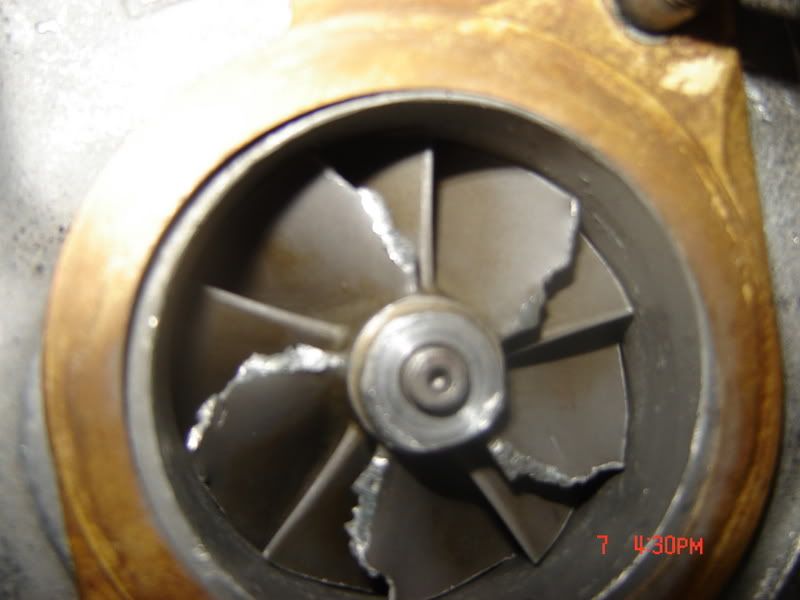
On a good note, I squirted some oil in the lower plug holes and compression tested the engine. Both rotors ran the gauge up to 145 psi and had even sweeps with the valve open. I believe that's a good sign.
I believe that the reason this happened is because there was not enough contact area between the nut and compressor wheel. The nut eventually worked it's way off. I can see that it only contacted on the outer edge due to shitty quality. No thanks to TURBO CITY's component selection.
The stock nut has a machined contact surface.
On a good note, I squirted some oil in the lower plug holes and compression tested the engine. Both rotors ran the gauge up to 145 psi and had even sweeps with the valve open. I believe that's a good sign.


On monday night I took my buddy out for a ride in the 7. Took it up to 4k with plenty of boost and all of a sudden it bucked. Shortly after we noticed the sound of the turbos was not what it used to be.
I was afraid one of the turbos had failed. I took it for a spin today and my fears came true. The noise was worse than ever during boost and then suddenly I had plumes of smoke flowing from the tail pipe. Seal failure...
To make matters worse, I checked the intake piping and there were very small flecks of metal from the compressor in them along with a healthy coating of oil.
I don't know how my engine is affected yet. Compression test this weekend. I had just tested on Sunday and came out with 120 psi both rotors...
The engine and turbos were rebuilt by myself and have under 300 miles on both. The turbos were fine until recently. The engine still holds a solid idle.
Here is my build thread: https://www.rx7club.com/showthread.php?t=513413
I was afraid one of the turbos had failed. I took it for a spin today and my fears came true. The noise was worse than ever during boost and then suddenly I had plumes of smoke flowing from the tail pipe. Seal failure...
To make matters worse, I checked the intake piping and there were very small flecks of metal from the compressor in them along with a healthy coating of oil.
I don't know how my engine is affected yet. Compression test this weekend. I had just tested on Sunday and came out with 120 psi both rotors...
The engine and turbos were rebuilt by myself and have under 300 miles on both. The turbos were fine until recently. The engine still holds a solid idle.
Here is my build thread: https://www.rx7club.com/showthread.php?t=513413


LOL...blames it on a Turbo City nut...good stuff. So whats next? Motor goes bad and you blame Mazda for shitty parts? Hey, learn how to properly build a turbo and there is this great stuff called Loctite.


I'm not even going to go here. Just get out of my thread, *******. You've joined the other *********** in my ignore list.
As far as loctite... can anyone explain whether or not it is ok to use it? I have read that at high temps it acts like a lubricant and should not be used on turbo parts. In fact, the instructions told me not to use loctite.
No big deal....still doesn't solve your problem that you don't know what the **** you are doing....LOL. You screwed up man...its time to grow up and admit that. Don't blame others for your mistakes.

2/4 wheel cornering fiend

Joined: Nov 2002
Posts: 3,090
Likes: 3
From: Pasadena, CA
Not sure about any turbo rebuild instructions saying not to use Loctite, but I don't see how it could "act like a lubricant" at high temperatures; whenever I've seen it used on parts seeing high temperatures, it basically cooks into a glue that is difficult to remove, much less break free. I've seen it used on some parts that would see far higher temps than a primary turbo impeller shaft.

Full Member

Joined: Apr 2006
Posts: 162
Likes: 0
From: St. Louis, MO
Explain how a nut outside the closed intake system can do the damage you suggest. You need to take a more critical and level look at your problem. This may have been a mistake (somewhere along the line) or it may be a sign of a major screwup that might well extend beyond this first incident.
Protect yourself and your car. Think this through.
Protect yourself and your car. Think this through.
Explain how a nut outside the closed intake system can do the damage you suggest. You need to take a more critical and level look at your problem. This may have been a mistake (somewhere along the line) or it may be a sign of a major screwup that might well extend beyond this first incident.
Protect yourself and your car. Think this through.
Protect yourself and your car. Think this through.
So, I could ask you a similar question. Explain to me how the nut from the compressor wheel would exit the intake system.
I know exactly what happened to the turbo. The nut spun off because it isn't reverse thread. I just need to figure out WHY, so this doesn't happen again.
I appreciate everyone trying to help. I just wish there weren't ******** on here that only want to insult and belittle people.
Not sure about any turbo rebuild instructions saying not to use Loctite, but I don't see how it could "act like a lubricant" at high temperatures; whenever I've seen it used on parts seeing high temperatures, it basically cooks into a glue that is difficult to remove, much less break free. I've seen it used on some parts that would see far higher temps than a primary turbo impeller shaft.
I can take a picture of the assembly instructions sent with both kits from Turbo City that said not to use thread locker.
Hopefully someone that has done turbo builds before will chime in here and share their techniques.

Joined: Mar 2001
Posts: 30,804
Likes: 646
From: FL-->NJ/NYC again!
I had a feeling it might have been something like this-----this is why the BNRs have reverse-thread compressor nuts.
Definitely look on the bright side.....I've seen the results when the nut ripped up the comp wheel enough that the motor ingested the metal particles, and the apex seals went south immediately.
Definitely look on the bright side.....I've seen the results when the nut ripped up the comp wheel enough that the motor ingested the metal particles, and the apex seals went south immediately.
I had a feeling it might have been something like this-----this is why the BNRs have reverse-thread compressor nuts.
Definitely look on the bright side.....I've seen the results when the nut ripped up the comp wheel enough that the motor ingested the metal particles, and the apex seals went south immediately.
Definitely look on the bright side.....I've seen the results when the nut ripped up the comp wheel enough that the motor ingested the metal particles, and the apex seals went south immediately.

Joined: Oct 2003
Posts: 11,576
Likes: 27
From: Morristown, TN (east of Knoxville)
As soon as I read the first post I knew this is probably what happened.
Don't feel too bad...I had a professional turbo shop in Nashville build 9 bad hybrid turbos for me (FC's) a few years back and about 4 of them had the nuts spin off. The stock mazda turbochargers do not have the built in reverse thread protection that most turbos do.
I have built a few sets of turbos myself, though I am by no means a professional at this point. I did use loctite, and I did put a fair bit of torque on the little bastards. I have used the turbo city kits on 2 sets of FD twins now, and none of them have come loose in a period of about 1.5 years.
The metal particles shouldnt hurt your engine. In fact, with an intercooler, you are basically protected from stuff entering the engine. You might think, well, boost could blow those tiny shavings through the IC couldnt it? But, think harder...after the point that the shavings got into the piping, you could no longer make any boost because the compressor was no longer spinning, so it's a moot point.
Don't feel too bad...I had a professional turbo shop in Nashville build 9 bad hybrid turbos for me (FC's) a few years back and about 4 of them had the nuts spin off. The stock mazda turbochargers do not have the built in reverse thread protection that most turbos do.
I have built a few sets of turbos myself, though I am by no means a professional at this point. I did use loctite, and I did put a fair bit of torque on the little bastards. I have used the turbo city kits on 2 sets of FD twins now, and none of them have come loose in a period of about 1.5 years.
The metal particles shouldnt hurt your engine. In fact, with an intercooler, you are basically protected from stuff entering the engine. You might think, well, boost could blow those tiny shavings through the IC couldnt it? But, think harder...after the point that the shavings got into the piping, you could no longer make any boost because the compressor was no longer spinning, so it's a moot point.
As soon as I read the first post I knew this is probably what happened.
Don't feel too bad...I had a professional turbo shop in Nashville build 9 bad hybrid turbos for me (FC's) a few years back and about 4 of them had the nuts spin off. The stock mazda turbochargers do not have the built in reverse thread protection that most turbos do.
I have built a few sets of turbos myself, though I am by no means a professional at this point. I did use loctite, and I did put a fair bit of torque on the little bastards. I have used the turbo city kits on 2 sets of FD twins now, and none of them have come loose in a period of about 1.5 years.
The metal particles shouldnt hurt your engine. In fact, with an intercooler, you are basically protected from stuff entering the engine. You might think, well, boost could blow those tiny shavings through the IC couldnt it? But, think harder...after the point that the shavings got into the piping, you could no longer make any boost because the compressor was no longer spinning, so it's a moot point.
Don't feel too bad...I had a professional turbo shop in Nashville build 9 bad hybrid turbos for me (FC's) a few years back and about 4 of them had the nuts spin off. The stock mazda turbochargers do not have the built in reverse thread protection that most turbos do.
I have built a few sets of turbos myself, though I am by no means a professional at this point. I did use loctite, and I did put a fair bit of torque on the little bastards. I have used the turbo city kits on 2 sets of FD twins now, and none of them have come loose in a period of about 1.5 years.
The metal particles shouldnt hurt your engine. In fact, with an intercooler, you are basically protected from stuff entering the engine. You might think, well, boost could blow those tiny shavings through the IC couldnt it? But, think harder...after the point that the shavings got into the piping, you could no longer make any boost because the compressor was no longer spinning, so it's a moot point.
Lesson learned. Thanks for everyone's help.
Just to comment on the thread lock, I've used it before in many RC nitro applications where engines get up to 30,000 rpms and more than 350 degrees F and the stuff still crystallizes at high temps and eventually breaks free. Usually, the bolts and nuts need to be replaced completely and it's considered routine maintenance because once it crystallizes theres no cleaning it. In fact, some people just put their engines in the oven at 500 degrees to get the stuff to break free, replace everything and put some new thread lock on.
I wouldn't hold your breath just with the thread lock, it probably can't hurt, but its not an end all be all for sure and eventually it will fail. Want proof, watch a RC plane or 1/8 scale gas car lose its flywheel in mid flight (plane is toast) or off a jump
I wouldn't hold your breath just with the thread lock, it probably can't hurt, but its not an end all be all for sure and eventually it will fail. Want proof, watch a RC plane or 1/8 scale gas car lose its flywheel in mid flight (plane is toast) or off a jump