

View Poll Results: Have you ever blown your motor as direct result of overboost fuel cut?
Yes


7
10.61%
No


59
89.39%
Voters: 66. You may not vote on this poll
Who has blown their motor as a direct result of overboost fuel cut?


Who has blown their motor as a direct result of overboost fuel cut?
I have noticed that just about every factory turbo car (across manufacturers) has an OEM overboost fuel cut designed/intended to save the engine. Some say it will in fact damage/blow the engine, on the logic that cutting fuel and combustion completely is like any other lean condition. I'm not talking about aftermarket "soft cut" ignition limiters.
So who has firsthand experience with a blown motor directly resulting from overboost fuel cut? Let's say on the stock ECU or Power FC. When I say "direct result," to make it simple I mean that you hit fuel cut and the car had a damaged apex/corner/side seal or a cracked plate almost immediately following the event.
So who has firsthand experience with a blown motor directly resulting from overboost fuel cut? Let's say on the stock ECU or Power FC. When I say "direct result," to make it simple I mean that you hit fuel cut and the car had a damaged apex/corner/side seal or a cracked plate almost immediately following the event.
Everyone who votes yes, please post explaining your modifications and what you were doing when you hit fuel cut. Also explain exactly when you noticed symptoms of engine damage, and what that damage ended up being after the engine was torn down.


Rotaries blow from pre-ignition, without fuel there is no combustion, so no opposing force to pop the apex seal. Although I would prefer an ignition cut over fuel cut, I don’t believe you can blow an apex seal from fuel cut alone.


Joined: Oct 2001
Posts: 6,279
Likes: 728
From: Florence, Alabama
while this is an interesting and legitimate question it may be quite difficult to draw a proper conclusion.
if you hit fuel cut the engine MIGHT be in the process of detonating just prior to the cut. so did the cut or the higher than normal boost cause the failure?
you'd certainly want to have logs of the entire event before drawing a conclusion.
i do know this...
if things go way wrong on a run, the only thig that will save the motor has to happen on the NEXT ROTORFACE. forget boost cut. it takes way too long and the motor will be toast.
the only action to save the motor must be electrical. the best is ignition cut. it does happen on the next rotor face. fuel does not. while the injectors shut down there is a bunch of fuel in the motor moving back and forth between the intake port at the rotor and the throttle plate. probably enough to fire a few more power impulses.
cut the spark and all you have is cooling liquid.
i would be interested in the comments of people that have had boost cut and have been logging..
to those who would say an ignition cut is hard on a motor i say the lack of an ignition cut leads to motor failure which is very hard on a motor
hc
if you hit fuel cut the engine MIGHT be in the process of detonating just prior to the cut. so did the cut or the higher than normal boost cause the failure?
you'd certainly want to have logs of the entire event before drawing a conclusion.
i do know this...
if things go way wrong on a run, the only thig that will save the motor has to happen on the NEXT ROTORFACE. forget boost cut. it takes way too long and the motor will be toast.
the only action to save the motor must be electrical. the best is ignition cut. it does happen on the next rotor face. fuel does not. while the injectors shut down there is a bunch of fuel in the motor moving back and forth between the intake port at the rotor and the throttle plate. probably enough to fire a few more power impulses.
cut the spark and all you have is cooling liquid.
i would be interested in the comments of people that have had boost cut and have been logging..
to those who would say an ignition cut is hard on a motor i say the lack of an ignition cut leads to motor failure which is very hard on a motor
hc
Trending Topics
The question is about hitting "fuel cut", not "boost cut". I don't see how a sudden reduction in boost can hurt anything. A boost reduction lowers pressure. If anything, a sudden reduction in boost could stop an engine from blowing.
while this is an interesting and legitimate question it may be quite difficult to draw a proper conclusion.
if you hit fuel cut the engine MIGHT be in the process of detonating just prior to the cut. so did the cut or the higher than normal boost cause the failure? you'd certainly want to have logs of the entire event before drawing a conclusion.
if you hit fuel cut the engine MIGHT be in the process of detonating just prior to the cut. so did the cut or the higher than normal boost cause the failure? you'd certainly want to have logs of the entire event before drawing a conclusion.
Originally Posted by 1Revvin7
I have seen it. Hit boost cut on the PFC, loss of power; pulled over. Apex seals for lunch.
Originally Posted by Howard Coleman
i do know this...
if things go way wrong on a run, the only thig that will save the motor has to happen on the NEXT ROTORFACE. forget boost cut. it takes way too long and the motor will be toast.
the only action to save the motor must be electrical. the best is ignition cut. it does happen on the next rotor face. fuel does not. while the injectors shut down there is a bunch of fuel in the motor moving back and forth between the intake port at the rotor and the throttle plate. probably enough to fire a few more power impulses.
2nd gen Rx-7's have a fuel cut around 8.5psi (stock boost is 6ish psi). It's not uncommon for n00bs to hit fuel cut a bunch of times when they open the exhaust and have boost creep. Then they get a fuel cut defender box, overboost (because they didn't port the wastegate etc) and pop the engine not much later.
to those who would say an ignition cut is hard on a motor i say the lack of an ignition cut leads to motor failure which is very hard on a motor
hc
hc
I'm not saying ignition cut is or isn't better than fuel cut. It wasn't even intended to be part of this thread, as neither the stock ECU nor the PFC even has it, and that's what most people run on their cars. Ignition cut is probably better for the engine, or certainly no worse. But few people have that capability set up on their car. If you have an overboost ignition cut set up on your car, that's fine by me.
What bothers me is that people turn off their PFC overboost fuel cut thinking that the fuel cut itself will blow the motor, on the logic that a fuel cut is just like running lean. And then they overboost for whatever reason, and THAT is what blows the engine up. This is especially common on 2nd gen cars--on the stock ECU, the factory fuel cut is 8.5psi. People freak out thinking that fuel cut will blow the engine up. Then they buy a fuel cut defender, overboost, and blow their motor because they didn't have everything else set up properly. The cure (eliminating overboost fuel cut) is worse than the disease (hitting fuel cut in the first place).
I suspected that this idea of fuel cut itself blowing up engines on a regular basis is a myth, and I think this poll confirms it.
What bothers me is that people turn off their PFC overboost fuel cut thinking that the fuel cut itself will blow the motor, on the logic that a fuel cut is just like running lean. And then they overboost for whatever reason, and THAT is what blows the engine up. This is especially common on 2nd gen cars--on the stock ECU, the factory fuel cut is 8.5psi. People freak out thinking that fuel cut will blow the engine up. Then they buy a fuel cut defender, overboost, and blow their motor because they didn't have everything else set up properly. The cure (eliminating overboost fuel cut) is worse than the disease (hitting fuel cut in the first place).
I suspected that this idea of fuel cut itself blowing up engines on a regular basis is a myth, and I think this poll confirms it.


The RX7 uses fuel cut 3 different ways:
1 Overboost fuel-cut: fuel is cut to the rear rotor
2 Over Rev fuel-cut: fuel is cut to both rotors
3 Decelration fuel-cut: half throttle fuels is cut to front rotor, fully closed fuel is cut to both rotors.
When you consider the thousands of runs that RX7’s have made autocrossing, which normally will entail hitting the rev limiter at least once, there should be pretty good evidence that fuel-cut blows engines, but its not there and with my experience over the last ten years, I have not encountered one person that has popped a motor autocrossing an RX7 from fuel-cut.
When I was running in ASP (5 years), I would consistently hit boost-cut and the rev limiter. The class rules required no changes to the turbo control system or to the computer as it relates fuel-cut based on boost. Which meant you had to run the stock computer even though the rules allowed opening up the intake and exhaust. I would guess that I probably hit boost-cut well over 200 times and the rev limiter into the thousands. The motor was finally pulled and rebuilt because of a failing water jack o-ring at 68000 miles.
I personally think when someone says they blew their motor to fuel-cut that there was something else going on or that it blew and they just thought it was fuel-cut that caused it.
Dan
1 Overboost fuel-cut: fuel is cut to the rear rotor
2 Over Rev fuel-cut: fuel is cut to both rotors
3 Decelration fuel-cut: half throttle fuels is cut to front rotor, fully closed fuel is cut to both rotors.
When you consider the thousands of runs that RX7’s have made autocrossing, which normally will entail hitting the rev limiter at least once, there should be pretty good evidence that fuel-cut blows engines, but its not there and with my experience over the last ten years, I have not encountered one person that has popped a motor autocrossing an RX7 from fuel-cut.
When I was running in ASP (5 years), I would consistently hit boost-cut and the rev limiter. The class rules required no changes to the turbo control system or to the computer as it relates fuel-cut based on boost. Which meant you had to run the stock computer even though the rules allowed opening up the intake and exhaust. I would guess that I probably hit boost-cut well over 200 times and the rev limiter into the thousands. The motor was finally pulled and rebuilt because of a failing water jack o-ring at 68000 miles.
I personally think when someone says they blew their motor to fuel-cut that there was something else going on or that it blew and they just thought it was fuel-cut that caused it.
Dan
It's been cold out for a while now. As some of you may know, I have a single turbo setup and I use the Power FC to control boost with a factory wastegate/precontrol solenoid. With the settings I have been running, it holds boost very stably until it gets under 40 F out. Unfortunately the Power FC doesn't have a boost control duty cycle based on IAT, and neither does any external controller out there. Only factory ECU's have that, and other standalones like the AEM EMS.
Anyway, fuel cut has been pretty useful. I have my settings set up so that if boost climbs more than .5 psi higher than normal, the fuel cut will engage. Again I do wish it were a soft ignition cut but that's not built into the PFC. I have hit fuel cut a couple times at part throttle recently, warning me to turn my duty cycle down. I think I'd rather fuel cut 20 times than significantly overboost once.
I also have my IAT correction curve set so that the mixture gets a little richer once air temps fall under 10 C.
Anyway, fuel cut has been pretty useful. I have my settings set up so that if boost climbs more than .5 psi higher than normal, the fuel cut will engage. Again I do wish it were a soft ignition cut but that's not built into the PFC. I have hit fuel cut a couple times at part throttle recently, warning me to turn my duty cycle down. I think I'd rather fuel cut 20 times than significantly overboost once.
I also have my IAT correction curve set so that the mixture gets a little richer once air temps fall under 10 C.

most people that claim the engine popped due to fuel cut from overboost likely were way over boost and went deep beyond a lean condition which is what killed the motor.
saying they for sure know it was due to fuel cut, i would like to see some log that show a <11 AFR chart prior to a motor pop.
saying they for sure know it was due to fuel cut, i would like to see some log that show a <11 AFR chart prior to a motor pop.

- Sandro
Yes I recall that. It does present some inconvenience with the boost control system, because boost control and fuel cut are tied together and with my current plumbing the PFC boost control runs stably at about .15 kg/cm^2 higher than my target.

Any more input on this issue?
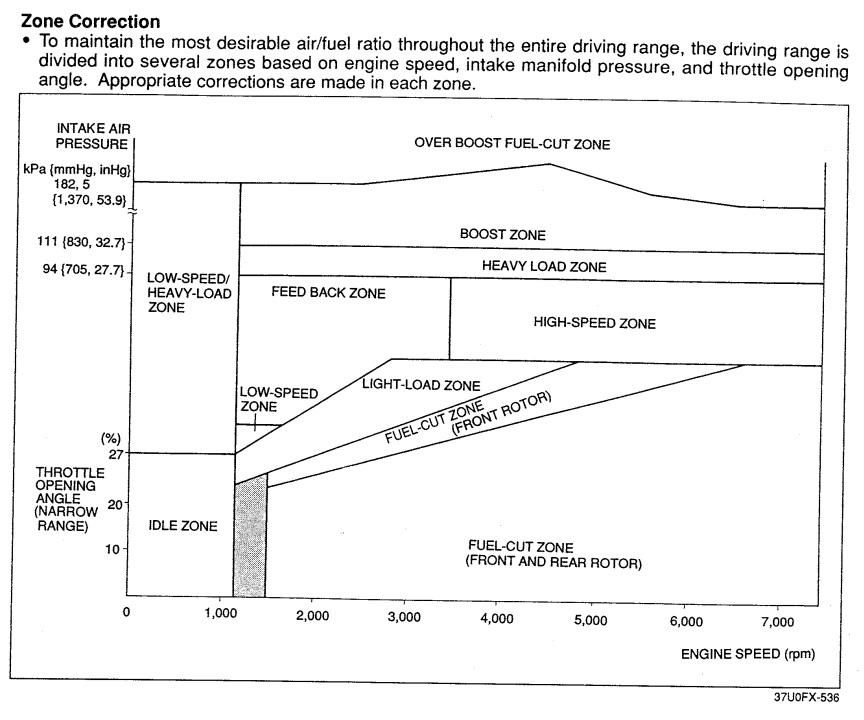
Here is a graph showing the overboost fuel cut on a factory ECU. You can see that additional boost is allowed between 3000 and 5500rpm. I suspect this is because Mazda knew that boost would fluctuate in this range based on ambient conditions. The least amount of boost is allowed near redline. This may linked to the fact that the boost tapers off up top from the factory. Elevated boost levels at high rpm may also be detrimental for converter life.
Here is a graph showing the overboost fuel cut on a factory ECU. You can see that additional boost is allowed between 3000 and 5500rpm. I suspect this is because Mazda knew that boost would fluctuate in this range based on ambient conditions. The least amount of boost is allowed near redline. This may linked to the fact that the boost tapers off up top from the factory. Elevated boost levels at high rpm may also be detrimental for converter life.

I'm not saying ignition cut is or isn't better than fuel cut. It wasn't even intended to be part of this thread, as neither the stock ECU nor the PFC even has it, and that's what most people run on their cars. Ignition cut is probably better for the engine, or certainly no worse. But few people have that capability set up on their car. If you have an overboost ignition cut set up on your car, that's fine by me.
What bothers me is that people turn off their PFC overboost fuel cut thinking that the fuel cut itself will blow the motor, on the logic that a fuel cut is just like running lean. And then they overboost for whatever reason, and THAT is what blows the engine up. This is especially common on 2nd gen cars--on the stock ECU, the factory fuel cut is 8.5psi. People freak out thinking that fuel cut will blow the engine up. Then they buy a fuel cut defender, overboost, and blow their motor because they didn't have everything else set up properly. The cure (eliminating overboost fuel cut) is worse than the disease (hitting fuel cut in the first place).
I suspected that this idea of fuel cut itself blowing up engines on a regular basis is a myth, and I think this poll confirms it.
What bothers me is that people turn off their PFC overboost fuel cut thinking that the fuel cut itself will blow the motor, on the logic that a fuel cut is just like running lean. And then they overboost for whatever reason, and THAT is what blows the engine up. This is especially common on 2nd gen cars--on the stock ECU, the factory fuel cut is 8.5psi. People freak out thinking that fuel cut will blow the engine up. Then they buy a fuel cut defender, overboost, and blow their motor because they didn't have everything else set up properly. The cure (eliminating overboost fuel cut) is worse than the disease (hitting fuel cut in the first place).
I suspected that this idea of fuel cut itself blowing up engines on a regular basis is a myth, and I think this poll confirms it.
I have always believe fuelcut doesn't blow the motor....
not to mention.... no fuel, no combustion....
if you "blow" the motor hitting fuel cut, chances are, it was going to blow either way, maybe even worst if the fuel cut wasn't there!
as far as 1revvin7's claim on hitting boost fuel cut and blowing the engine.... dont you think it is because he is boosting .25 BAR higher than the map was tuned for?... .25 BAR higher boost, with .25 BAR lower fuel.... hmmmmm
as far as 1revvin7's claim on hitting boost fuel cut and blowing the engine.... dont you think it is because he is boosting .25 BAR higher than the map was tuned for?... .25 BAR higher boost, with .25 BAR lower fuel.... hmmmmm
Also, there are techniques for fuel and spark mapping so that, should boost climb a little higher than expected, the engine would be more likely to run safely (provided that your fuel system isn't maxed out). If your wastegate fails on you then there is always the fuel cut as last resort.

I was just checking my AEM EMS and I have both rev limiters (launch and high rev) set with an ignition and fuel cut with a 100rpm spread.
The over-boost protection ONLY has a fuel cut. Hrm. Maybe they figured the speed of an ignition cut wasn't as crucial when dealing with an overboost vs overrev.
I've hit fuel and ignition cuts on the dyno countless times for the rev limiter and I've hit the fuel cut overboost more times than I want to admit on my engine, this is with a half bridge single turbo. My engine is still running fine.
It is amazing that the few people that have voted that they have blown their engines are not speaking up.
I have thought about switching to an ignition only cut for my launch limiter, but I'm sure I'd blow apart my cat. Which is why I think factory setups use fuel cuts, so you aren't igniting fuel on your turbo or cat.
The over-boost protection ONLY has a fuel cut. Hrm. Maybe they figured the speed of an ignition cut wasn't as crucial when dealing with an overboost vs overrev.
I've hit fuel and ignition cuts on the dyno countless times for the rev limiter and I've hit the fuel cut overboost more times than I want to admit on my engine, this is with a half bridge single turbo. My engine is still running fine.
It is amazing that the few people that have voted that they have blown their engines are not speaking up.
I have thought about switching to an ignition only cut for my launch limiter, but I'm sure I'd blow apart my cat. Which is why I think factory setups use fuel cuts, so you aren't igniting fuel on your turbo or cat.
It's getting colder outside. Your boost is about to climb at least a little bit.
A public service announcement: Don't end up like this guy: https://www.rx7club.com/single-turbo-rx-7s-23/blew-engine-need-help-diagnosing-924962/ he overboosted 5psi which could have been prevented if he had used a fuel cut or some other form of overboost protection on his Haltech. The final result was a blown motor.
A public service announcement: Don't end up like this guy: https://www.rx7club.com/single-turbo-rx-7s-23/blew-engine-need-help-diagnosing-924962/ he overboosted 5psi which could have been prevented if he had used a fuel cut or some other form of overboost protection on his Haltech. The final result was a blown motor.

Thread
Thread Starter
Forum
Replies
Last Post
jetlude
Single Turbo RX-7's
4
Aug 18, 2015 04:53 PM
armans
3rd Generation Specific (1993-2002)
5
Aug 15, 2015 09:08 PM
