


What does this vacuum hose do @ Primary Inlet Elbow? (pic)



What does this vacuum hose do @ Primary Inlet Elbow? (pic)
...shown below on the primary inlet elbow in dark blue. Looks to be routed to the housings. What is it? Thanks in advance!




Joined: Mar 2001
Posts: 30,817
Likes: 656
From: FL-->NJ/NYC again!
Filtered air source (with no boost) for the oil squirters on the rotor housings.... it's part of the oem Oil Metering System. We retain it on all single turbo builds.


What would be the result if this were not connected on a single turbo motor?

I'm really not sure what advantage you get hooking those OMP nipples up to the inlet duct.
From the factory, anything that can possibly emit some sort of vapor must be routed into the engine to be burned and scrubbed by the cat. That's why the PCV system is routed to the intake, gas tank vapors, etc. It's the evaporative emissions system.
In theory, vapors can escape from the OMP nipples. I don't know if they really emit anything much to make a mess or a gas smell or what have you.
It is safe to leave them open-air vented. You could also pop one of the little filters from a stock solenoid on the injector nipple so it's tidier.
Long and short of it is the turbo intake is just filtered air - there's no vacuum or boost there, just atmospheric pressure. The car and the OMP system will work and run just fine with it open air vented.
Dale
From the factory, anything that can possibly emit some sort of vapor must be routed into the engine to be burned and scrubbed by the cat. That's why the PCV system is routed to the intake, gas tank vapors, etc. It's the evaporative emissions system.
In theory, vapors can escape from the OMP nipples. I don't know if they really emit anything much to make a mess or a gas smell or what have you.
It is safe to leave them open-air vented. You could also pop one of the little filters from a stock solenoid on the injector nipple so it's tidier.
Long and short of it is the turbo intake is just filtered air - there's no vacuum or boost there, just atmospheric pressure. The car and the OMP system will work and run just fine with it open air vented.
Dale


The MOP provides a small amount of metered oil up to the orificed ports. The amount is based upon the position of the MOP metering valve as determined by the ECM. The check valves provide the capability during the intake stroke to draw the oil into the chambers by allowing air to mix. The orifice are very small and any particulate will plug them up or possibly cause the check valves to malfunction. The air must be filtered.
There is some conjecture, however on the function of the air bleeds during times when the engine intake stroke is above atmospheric pressure (on boost)
There is some conjecture, however on the function of the air bleeds during times when the engine intake stroke is above atmospheric pressure (on boost)


Joined: Aug 2004
Posts: 4,497
Likes: 1,487
From: West Coast

Trending Topics


As long as the oil injectors are hooked in before the throttle plates it is fine. It doesn't matter whether it receives boost or not. They receive boost from the factory on all 2nd gen turbo cars--there is a nipple on the back of the UIM which draws the air from right before the throttle plates. The routing on the FD was simply a matter of convenience for the factory engineers.
As for running them open atmosphere, well you can do it but there is still the chance of them getting clogged for whatever reason.
As for running them open atmosphere, well you can do it but there is still the chance of them getting clogged for whatever reason.

Rich is correct, it is to supply filtered air to the oil injectors. However on Single turbo applications we just install the small air filters from the solenoid valves to eliminate the need to plumb hoses all the way to the turbo inlet.
You can just make it out in this pic, the oil injectors are Tee'd together with the small solenoid filter
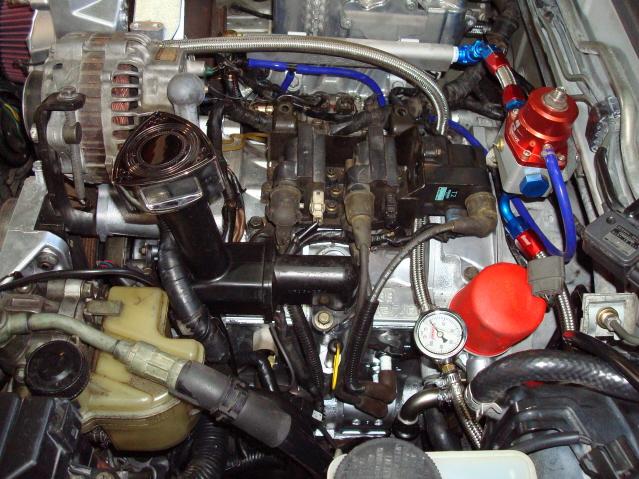
You can just make it out in this pic, the oil injectors are Tee'd together with the small solenoid filter
The turbo is pulling air from the air filter. For there to be a vacuum there, you would have to have a restriction. The reason you have vacuum in the engine at idle is due to the restriction of the closed throttle plates.
It's like breathing with your mouth wide open versus sucking in through a straw.
The only possible way there could be a vacuum there is if the air filter is VERY clogged or the turbo inlet is kinked shut.
Check it out for yourself - hook your boost gauge up to a nipple on the turbo inlet. You'll see it sit at "zero" the whole time. Tried it myself
 .
.Dale

Thread
Thread Starter
Forum
Replies
Last Post
