


Oil leak issue Again, ofcourse


Oil leak issue Again, ofcourse
Alright guys I know this has been discussed alot I have done some search as well but can't really figure out exactly the issue. My point is I'm wanting to start this thread in hopes that people can upload pix of the "usual" or "common" areas of the leaks. I know there is a leak occuring on the turbo. I see smoke coming out behind the UIM, the area between the UIM and the firewall. As well as from the turbo side. Can someone point out the usual areas so the problem can be solved easier? I'm sure many will find this thread useful.


Joined: May 2003
Posts: 2,096
Likes: 1
From: Dove le cose sono fatte il vecchio moda il senso
It may be that one of the Oil inlet lines (one per Turbo) is loose and thus leaking. Another possibility is that one of the oil lines going out of the Turbos (gravity drop, one per Turbo from underneath) and into the block may be loose as well. So there are 6 seperate areas an external oil leak can develope on the Turbo assembly, not including the main engine inlet oil supply line that connects to the Turbo oil supply line.
Just check under the car and see if you find evidence of oil stained Turbos and/or oil stained block.
Just check under the car and see if you find evidence of oil stained Turbos and/or oil stained block.
Last edited by areXseven; Mar 29, 2004 at 04:13 PM.

Old Rotary Dog

Joined: Feb 2003
Posts: 1,461
Likes: 2
From: Durham, NC
Common areas for oil leaks:
- the turbo supply likes
- the oil pan.
- the engine motor mounts (bolts pass through oil passages)
- the O-rings at the base of the filter pedestal.
- the rear bearing (you will see oil coming out of the access plate on the bell housing).
One thing to note is that any oil that seeps down to the cross member tends to then be blown back onto the plate beneith the tranny and from there onto the cat. A small seep can actually cause quite a bit of smoke that will travel up the transmission tunnel and come out from between the firewall and the UIM.
Often it is difficult to tell the origin of the oil leak because of this. Clean everything off with some degreaser and keep checking to try and determine the source of the leak.
-bill
- the turbo supply likes
- the oil pan.
- the engine motor mounts (bolts pass through oil passages)
- the O-rings at the base of the filter pedestal.
- the rear bearing (you will see oil coming out of the access plate on the bell housing).
One thing to note is that any oil that seeps down to the cross member tends to then be blown back onto the plate beneith the tranny and from there onto the cat. A small seep can actually cause quite a bit of smoke that will travel up the transmission tunnel and come out from between the firewall and the UIM.
Often it is difficult to tell the origin of the oil leak because of this. Clean everything off with some degreaser and keep checking to try and determine the source of the leak.
-bill

Originally posted by areXseven
It may be that one of the Oil inlet lines (one per Turbo) is loose and thus leaking. Another possibility is that one of the oil lines going out of the Turbos (gravity drop, one per Turbo from underneath) and into the block may be loose as well. So there are 6 seperate areas an external oil leak can develope on the Turbo assembly, not including the main engine inlet oil supply line that connects to the Turbo oil supply line.
Just check under the car and see if you find evidence of oil stained Turbos and/or oil stained block.
It may be that one of the Oil inlet lines (one per Turbo) is loose and thus leaking. Another possibility is that one of the oil lines going out of the Turbos (gravity drop, one per Turbo from underneath) and into the block may be loose as well. So there are 6 seperate areas an external oil leak can develope on the Turbo assembly, not including the main engine inlet oil supply line that connects to the Turbo oil supply line.
Just check under the car and see if you find evidence of oil stained Turbos and/or oil stained block.
Trending Topics
Originally posted by wrankin
Common areas for oil leaks:
- the turbo supply likes
- the oil pan.
- the engine motor mounts (bolts pass through oil passages)
- the O-rings at the base of the filter pedestal.
- the rear bearing (you will see oil coming out of the access plate on the bell housing).
One thing to note is that any oil that seeps down to the cross member tends to then be blown back onto the plate beneith the tranny and from there onto the cat. A small seep can actually cause quite a bit of smoke that will travel up the transmission tunnel and come out from between the firewall and the UIM.
Often it is difficult to tell the origin of the oil leak because of this. Clean everything off with some degreaser and keep checking to try and determine the source of the leak.
-bill
Common areas for oil leaks:
- the turbo supply likes
- the oil pan.
- the engine motor mounts (bolts pass through oil passages)
- the O-rings at the base of the filter pedestal.
- the rear bearing (you will see oil coming out of the access plate on the bell housing).
One thing to note is that any oil that seeps down to the cross member tends to then be blown back onto the plate beneith the tranny and from there onto the cat. A small seep can actually cause quite a bit of smoke that will travel up the transmission tunnel and come out from between the firewall and the UIM.
Often it is difficult to tell the origin of the oil leak because of this. Clean everything off with some degreaser and keep checking to try and determine the source of the leak.
-bill
Junior Member

Joined: Mar 2001
Posts: 36
Likes: 0
From: Bellevue, WA, USA
Originally posted by wrankin
Common areas for oil leaks:
One thing to note is that any oil that seeps down to the cross member tends to then be blown back onto the plate beneith the tranny and from there onto the cat. A small seep can actually cause quite a bit of smoke that will travel up the transmission tunnel and come out from between the firewall and the UIM.
Often it is difficult to tell the origin of the oil leak because of this. Clean everything off with some degreaser and keep checking to try and determine the source of the leak.
-bill
Common areas for oil leaks:
One thing to note is that any oil that seeps down to the cross member tends to then be blown back onto the plate beneith the tranny and from there onto the cat. A small seep can actually cause quite a bit of smoke that will travel up the transmission tunnel and come out from between the firewall and the UIM.
Often it is difficult to tell the origin of the oil leak because of this. Clean everything off with some degreaser and keep checking to try and determine the source of the leak.
-bill
I had an engine rebuilt just a few weeks ago which I had hoped would cure this problem, but alas after taking a 2000 mile trip last week the problem is still there.
Is there a danger of actually causing a fire this way?
Old Rotary Dog
Joined: Feb 2003
Posts: 1,461
Likes: 2
From: Durham, NC
Originally posted by SWAT81
thanks for the info Bill, I'm a little confused on what you mean by "cross member" though
thanks for the info Bill, I'm a little confused on what you mean by "cross member" though
-bill
Joined: May 2003
Posts: 2,096
Likes: 1
From: Dove le cose sono fatte il vecchio moda il senso
Originally posted by SWAT81
there is definitely oil stains under the turbo and the whole right side but no oil leak on the engine block. Wish someone would upload pix, would you recommand just trying to tighten all the oil lines?
there is definitely oil stains under the turbo and the whole right side but no oil leak on the engine block. Wish someone would upload pix, would you recommand just trying to tighten all the oil lines?
The two "outlet" oil lines each have a flange with two 10mm nuts. The flange/nuts are located directly beneath the Turbos on the Bearing Housing. Those are a little easier to get to. If you follow those lines to the Block you'll see the flanges/nuts secured to the Block. The Block flange in the rear is easy to get to, but the Block flange located in the front will require a ittle more skill and patience. Might make the job a little easier if you use 1/4" ratchet, extension, universal swivel adapter with 10mm socket. Good Luck.
-Jimmy
exactly how many of you guys had this problem solved after tightening the bolts and oil lines? is it possible to just replace these oil lines and perhaps the oil leaks wont occur anymore due to new washers?

Joined: May 2003
Posts: 2,096
Likes: 1
From: Dove le cose sono fatte il vecchio moda il senso
Originally posted by SWAT81
exactly how many of you guys had this problem solved after tightening the bolts and oil lines? is it possible to just replace these oil lines and perhaps the oil leaks wont occur anymore due to new washers?
exactly how many of you guys had this problem solved after tightening the bolts and oil lines? is it possible to just replace these oil lines and perhaps the oil leaks wont occur anymore due to new washers?
Bottom line is that they need to be tightened pretty good.
Joined: May 2003
Posts: 2,096
Likes: 1
From: Dove le cose sono fatte il vecchio moda il senso
Originally posted by SWAT81
hmmm alright then perhaps on a nice day out I will take out my intakes and heat shield off to take a looksie
hmmm alright then perhaps on a nice day out I will take out my intakes and heat shield off to take a looksie

just did some of this over the weekend. the secondary oil supply bolt is accesable from the top w/o removing the heat shield and I'm pretty sure the primary is too. I don't know if you could replace the washers though.

R1derful
Joined: Feb 2004
Posts: 702
Likes: 0
From: N Cali
If you're having trouble isolating the source of the leak, you can try this:
1) Clean all suspected leak locations thoroughly.
2) Spray the locations with aerosol athletes foot spray/jock itch or aerosol powder deodorant.
When the oil comes out, it will turn the powder into a gray syrup.
I used the above method to locate an oil leak on an engine that I had just rebuit. The leak was driving me crazy!
Here is a pic of the spray after I covered the head/block mating surface (piston engine).
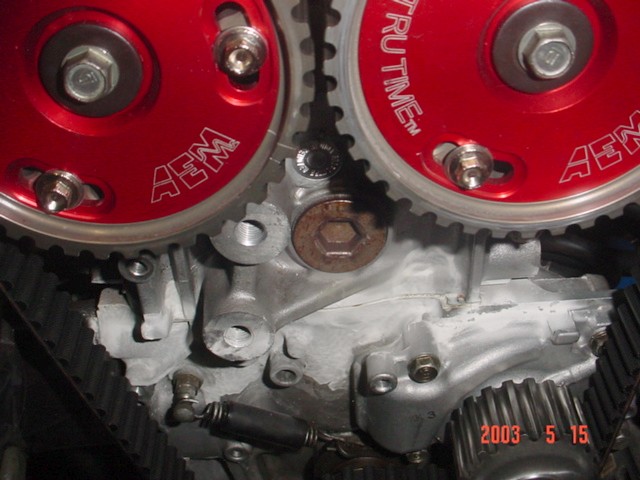
I was 99% certain that it was the headgasket. I was wrong. The leak was actually where the oil pump met the block. The spray helped me find it after pulling my hair out for about a month!
Sonny
1) Clean all suspected leak locations thoroughly.
2) Spray the locations with aerosol athletes foot spray/jock itch or aerosol powder deodorant.
When the oil comes out, it will turn the powder into a gray syrup.
I used the above method to locate an oil leak on an engine that I had just rebuit. The leak was driving me crazy!
Here is a pic of the spray after I covered the head/block mating surface (piston engine).
I was 99% certain that it was the headgasket. I was wrong. The leak was actually where the oil pump met the block. The spray helped me find it after pulling my hair out for about a month!
Sonny


Powered by** Rotary

Joined: Feb 2002
Posts: 2,369
Likes: 0
From: St. Louis
Originally posted by SWAT81
exactly how many of you guys had this problem solved after tightening the bolts and oil lines? is it possible to just replace these oil lines and perhaps the oil leaks wont occur anymore due to new washers?
exactly how many of you guys had this problem solved after tightening the bolts and oil lines? is it possible to just replace these oil lines and perhaps the oil leaks wont occur anymore due to new washers?
 I had a leak at the top of the turbo. The oil line that goes from one turbo to another. It's not hard to get to it if you remove the y-pipe, no need to remove the shield in my case.
 Also, I wouldn't tighten that too much, Cause i broke 2 of those screws. The best thing would be to get those copper washers and replace them, they are around 40c at the car quest stores. Those damn screws are so soft it's like they are made of plastic or something. Probably because they have holes in them

Anyway, it shouldn't take you more then 30 minutes to replace washers, unless you brake one of them or something goes wrong.
Amel
Pix of these progress may be helpful for the new ones to this topic This is going well, thanks for all of those who have chimed in on this thread. Lets keep it going
This is going well, thanks for all of those who have chimed in on this thread. Lets keep it going
Originally posted by Sonny
If you're having trouble isolating the source of the leak, you can try this:
1) Clean all suspected leak locations thoroughly.
2) Spray the locations with aerosol athletes foot spray/jock itch or aerosol powder deodorant.
When the oil comes out, it will turn the powder into a gray syrup.
I used the above method to locate an oil leak on an engine that I had just rebuit. The leak was driving me crazy!
Here is a pic of the spray after I covered the head/block mating surface (piston engine).
I was 99% certain that it was the headgasket. I was wrong. The leak was actually where the oil pump met the block. The spray helped me find it after pulling my hair out for about a month!
Sonny
If you're having trouble isolating the source of the leak, you can try this:
1) Clean all suspected leak locations thoroughly.
2) Spray the locations with aerosol athletes foot spray/jock itch or aerosol powder deodorant.
When the oil comes out, it will turn the powder into a gray syrup.
I used the above method to locate an oil leak on an engine that I had just rebuit. The leak was driving me crazy!
Here is a pic of the spray after I covered the head/block mating surface (piston engine).
I was 99% certain that it was the headgasket. I was wrong. The leak was actually where the oil pump met the block. The spray helped me find it after pulling my hair out for about a month!
Sonny

Thread
Thread Starter
Forum
Replies
Last Post
trickster
2nd Generation Specific (1986-1992)
25
Jul 1, 2023 04:40 PM
