


Koyo N-FLO (dual pass) radiator question




For anyone interested here is the reply I got from Koyo:
"Thank you for contacting us. You do live in a pretty hot climate, therefore you may want to consider getting the N-FLO version R1443N. I have many street driven RX-7s that use either the Normal or the N-FLO version as an extra measure of precaution. I hope that answers your questions. Thanks. "
-------------------------------------------------
So now the N-FLO is for an extra measure of precaution I'm still leaning towards the normal version though.
"Thank you for contacting us. You do live in a pretty hot climate, therefore you may want to consider getting the N-FLO version R1443N. I have many street driven RX-7s that use either the Normal or the N-FLO version as an extra measure of precaution. I hope that answers your questions. Thanks. "
-------------------------------------------------
So now the N-FLO is for an extra measure of precaution
I'm still leaning towards the normal version though.I will offer some useful information:
Under a wide range of conditions, the standard downflo and the N-flo will have nearly identical heat rejection capacities. In these applications, it is likely that either will be entirely satisfactory. The probable exceptions are as follows:
1) If airflow through the radiator tends to be concentrated in a specific area(s) or is severely occluded over a substantial portion of the core, then a N-FLO may prove beneficial for you; and,
2) If coolant flow is high (and airflow is uniform), as it might be if you're tracking you car (e.g., high rpm/long periods of time), then the traditional parallel flow (aka downflow) will likely perform better.
I hope this helps.



Unfortunately, KOYO didn't provide any information useful to differentiating between the two. An N-FLO isn't an extra measure of protection, it's just an N-FLO.
I will offer some useful information:
Under a wide range of conditions, the standard downflo and the N-flo will have nearly identical heat rejection capacities. In these applications, it is likely that either will be entirely satisfactory. The probable exceptions are as follows:
1) If airflow through the radiator tends to be concentrated in a specific area(s) or is severely occluded over a substantial portion of the core, then a N-FLO may prove beneficial for you; and,
2) If coolant flow is high (and airflow is uniform), as it might be if you're tracking you car (e.g., high rpm/long periods of time), then the traditional parallel flow (aka downflow) will likely perform better.
I hope this helps.
I will offer some useful information:
Under a wide range of conditions, the standard downflo and the N-flo will have nearly identical heat rejection capacities. In these applications, it is likely that either will be entirely satisfactory. The probable exceptions are as follows:
1) If airflow through the radiator tends to be concentrated in a specific area(s) or is severely occluded over a substantial portion of the core, then a N-FLO may prove beneficial for you; and,
2) If coolant flow is high (and airflow is uniform), as it might be if you're tracking you car (e.g., high rpm/long periods of time), then the traditional parallel flow (aka downflow) will likely perform better.
I hope this helps.
In the points you outlined, are there any drawbacks in particular to the N-FLO? For only $25 extra it seems like a better deal, I mean if there are no drawbacks.
For daily and/or street or drag use, probably no significant drawbacks; although the FD radiator has that necked-down tank region that I think is more of a restriction in the N-Flo configuration.
For track use and/or extended high rpm operation, I definitely think the standard down flow is a better choice:
1) High coolant flow rates may cause coolant to move through portions of the rad too fast reducing heat transfer efficiency somewhat;
2) It will take a significantly higher water pump head pressure to establish a given rate of coolant flow through the radiator. This is due to the increased resistance offered by the longer effective length of the core and less rows. This requires additional power to drive the pump and the extra pressure can stress hoses and other cooling system components. (Has anyone ever noticed that weak hoses will often fail during a high rpm run?) There are portions of the cooling system that will be at greater than the absolute [cap] pressure due to the pump head pressure. The amount of power it takes to pump the coolant is primarily determined by two things: The weight of the coolant pumped vs time, i.e., the rate of flow; and, the head pressure that a give flow must be established against (which in a closed system is the pump's differential pressure I/O).
There are likely specialized situations where a N-Flo could be helpful to solve a particular problem. For most of us, I think any difference is inconsequential, and the N-flo is really a solution looking for a problem. Sometimes less really is more....
I hope this helps answer your question.


That is correct. The regular Koyo poses challenges in fitment with some/many SMIC setups b/c of the extra thickness (compared to the Fluidyne, Ron Davis etc). The 3 pass Koyo N-FLO/N-FLOW whatever is a bit thicker than the regular Koyo so you can expect some extra challenges in getting it to fit with some SMIC setups.


Banned. I got OWNED!!!
Joined: Mar 2009
Posts: 1,045
Likes: 0
From: NC
I've had a Fluidyne in my car for at least seven years and never had a problem with it. However, when I was pushing the car hard climbing a very long mountain road under boost in 4th gear this weekend, with the AC on ambient temps in the 90s, I saw coolant temps get up to 97 C, which is the highest I have ever seen in the car, they usually never get above 92 with the AC on
Koyo N-flo is the same thickness as the regular Koyo. We never have any installation issues with either. Page 1, I posted multiple pictures of installs we have done with both FMICs and SMICs.
Have you installed any ASP or large stock mount IC's with Koyos? If so any pics?

Banned. I got OWNED!!!
Joined: Mar 2009
Posts: 1,045
Likes: 0
From: NC
But it may interfere with the IC intake duct. I have the M2 fiberglass duct which sits right on the radiator fan bracket as it is, with a Fluidyne....as Jason said previously, unless you're tracking the car there probably isn't much here to bicker about, perhaps a few degrees C

I have the M2 Carbon Fiber Air box and the M2 Medium IC. The Koyo definitely makes things tight, but both fit appropriately. I never see higher than 89C as long as I am moving above 25MPH. The N-Flo has been a phenominal upgrade, and the Oil Cooler addition makes this the right cooling setup. BTW, I have also filled any gaps to ensure I am being as efficient as possible with my stock bumpers ( I like the original look).
The m2 Airbox does sit right on top of the coolant hose but it doesn't pinch the hose. The Air duct shroud for the Medium IC does take some manuevering but it fits, and the hood rod fits to its stock location.
The m2 Airbox does sit right on top of the coolant hose but it doesn't pinch the hose. The Air duct shroud for the Medium IC does take some manuevering but it fits, and the hood rod fits to its stock location.

Junior Member
Joined: Nov 2009
Posts: 12
Likes: 0
From: Italy
Heres what i've been taught at the automotive engineering course
Output temperatures from twin pass, double pass radiators are lower than single pass ones. As with nearly all performance parts, the gains become more significant with intensive use. It is reasonable to expect upto a 30% additional drop in temperatures compared to a single pass.
Advantages (other than the one i just mentioned):
Uniform pressure - twin pass radiators create a sectioned flow that ensures the coolant moves at a uniform speed and pressure throughout the radiator sections. Single pass radiators have efficiency losses in areas where coolant is moving faster through the radiator near the inlet port. OEMs usually compensate by adding turbulence in that area.
Disadvantages:
Low output pressure - basic CFD shows that a constricted flow is slower than free flow. The loss in speed equates to a loss in pressure.
Coolant stagnation - in areas near the U turns coolant is forced to slow down abruptly. this also disrupts the speed of the surrounding flow. Consequently speed and pressure decrease in "steps" within each section.
This can cause problems when specifying filler cap pressure. The output pressure can mislead people to bump the system pressure. The radiators can break if this is spec'd too high.
In other words: yes the radiator is better, but some parts of the radiator are hotter than others.
Output temperatures from twin pass, double pass radiators are lower than single pass ones. As with nearly all performance parts, the gains become more significant with intensive use. It is reasonable to expect upto a 30% additional drop in temperatures compared to a single pass.
Advantages (other than the one i just mentioned):
Uniform pressure - twin pass radiators create a sectioned flow that ensures the coolant moves at a uniform speed and pressure throughout the radiator sections. Single pass radiators have efficiency losses in areas where coolant is moving faster through the radiator near the inlet port. OEMs usually compensate by adding turbulence in that area.
Disadvantages:
Low output pressure - basic CFD shows that a constricted flow is slower than free flow. The loss in speed equates to a loss in pressure.
Coolant stagnation - in areas near the U turns coolant is forced to slow down abruptly. this also disrupts the speed of the surrounding flow. Consequently speed and pressure decrease in "steps" within each section.
This can cause problems when specifying filler cap pressure. The output pressure can mislead people to bump the system pressure. The radiators can break if this is spec'd too high.
In other words: yes the radiator is better, but some parts of the radiator are hotter than others.
Last edited by Gladius; Jun 15, 2010 at 11:42 PM.
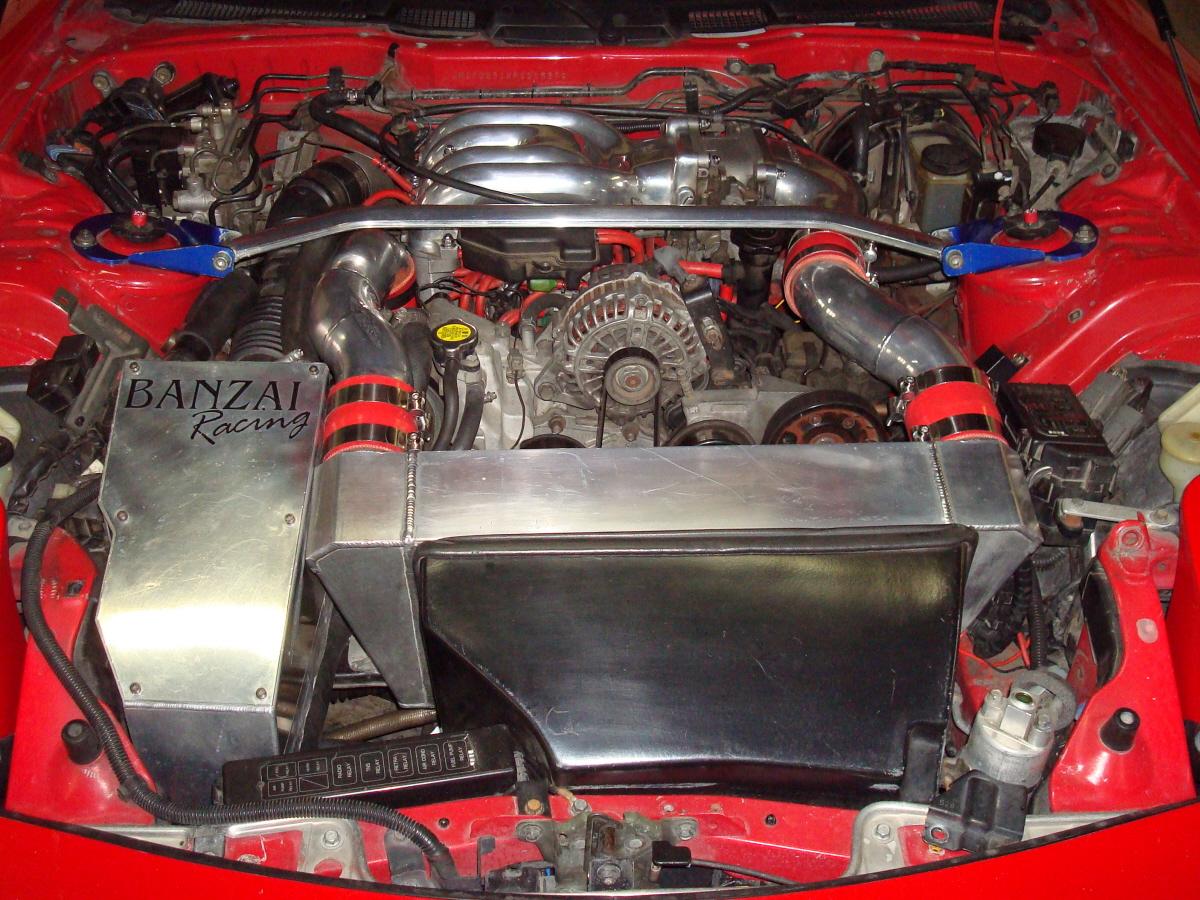
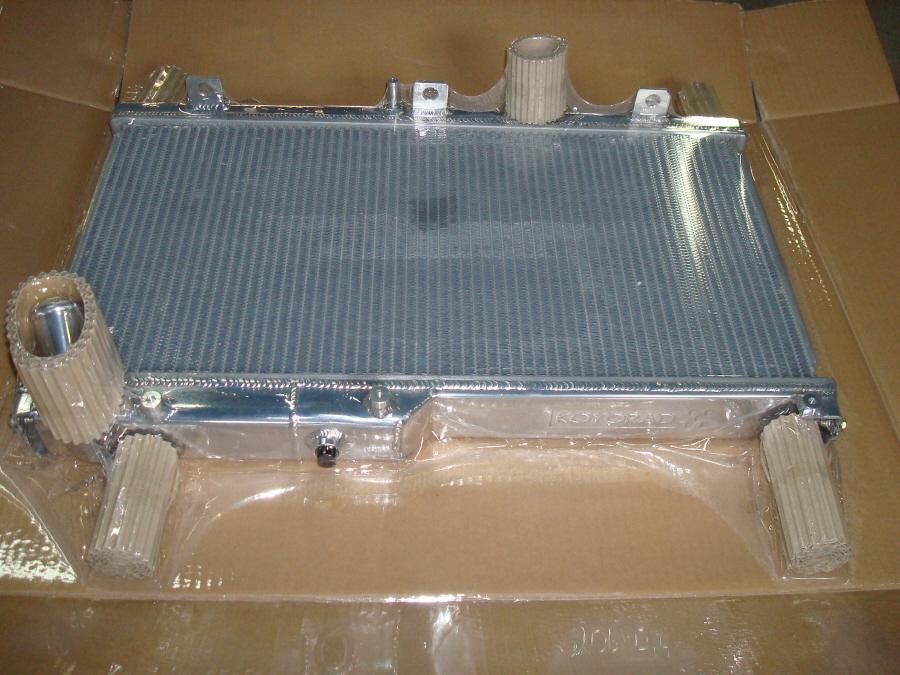
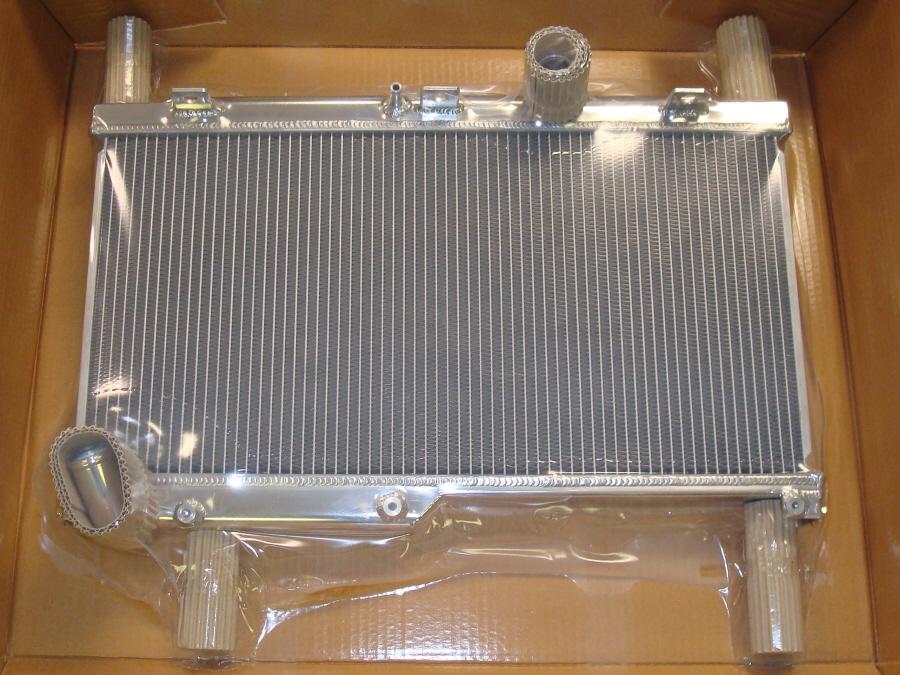
M2 Large SMIC. If you want to see more pics go look around our customer galleries, there are 1000's of pics of different configurations http://www.banzai-racing.com/fd_gallery.htm
Thanks for answering my question and also posting the pic.
Last edited by Mr rx-7 tt; Jun 16, 2010 at 12:26 PM.

subscribed!
very intresting debate. i have been wondering about this topic for a while and this thread is very useful because i am buying a koyo soon.
thanks
i'll chime back in once i have one
very intresting debate. i have been wondering about this topic for a while and this thread is very useful because i am buying a koyo soon.
thanks
i'll chime back in once i have one

Senior Member

Joined: Feb 2009
Posts: 290
Likes: 1
From: Victoria B.C.
Bottom line : Dual core > single core
flow rates remain the same, speed of coolant through the rad will be slightly faster (due to smaller 'area', introducing larger turbulence thus increasing cooling capacity.
Dual pass always more efficient in terms of cooling. Single pass is fine for nearly all needs.
You can look up all the information you want. I'm not an engineer or anything....
oh wait, i am.
feel free to PM me if you want to discuss this further.
Cheers~~~
flow rates remain the same, speed of coolant through the rad will be slightly faster (due to smaller 'area', introducing larger turbulence thus increasing cooling capacity.
Dual pass always more efficient in terms of cooling. Single pass is fine for nearly all needs.
You can look up all the information you want. I'm not an engineer or anything....
oh wait, i am.
feel free to PM me if you want to discuss this further.
Cheers~~~

I couldn't fit my M2 Large SMIC with a regular Koyo w/o cutting a piece off the duct to allow clearance for the duct to sit lower/normally. In order for it to fit w/o touching the duct, I would have had to modify the rear (swaybar) and or front radiator brackets for the rad to sit differently (perhaps lower). YMMV.


I'm running a M2 large with the Koyo N-flo. It's a tight fit but it works without modifying anything.

I love the radiator and can't imagine driving a FD without it. I hated having to worry about overheating with the A/C on in the summer. If you don't get the results your looking for from the radiator alone, try upgrading your oil coolers also. Oil accounts for 40% of the total engine cooling.

I love the radiator and can't imagine driving a FD without it. I hated having to worry about overheating with the A/C on in the summer. If you don't get the results your looking for from the radiator alone, try upgrading your oil coolers also. Oil accounts for 40% of the total engine cooling.
I couldn't fit my M2 Large SMIC with a regular Koyo w/o cutting a piece off the duct to allow clearance for the duct to sit lower/normally. In order for it to fit w/o touching the duct, I would have had to modify the rear (swaybar) and or front radiator brackets for the rad to sit differently (perhaps lower). YMMV.
Typically it is the driver's side that is bent the worst, but we have seen some p-side just as bad
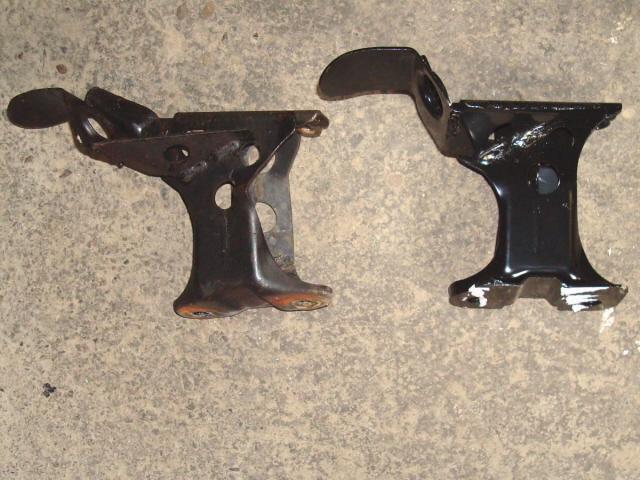
I have a car in the shop right now that we will be installing the N-flo and a Pettit SMIC in. I am thinking that it might be helpful to many members for us to put together a how-to with some hints and tips.