When you click on links to various merchants on this site and make a purchase, this can result in this site earning a commission. Affiliate programs and affiliations include, but are not limited to, the eBay Partner Network.
Retained it here and just used an output to run the purge solenoid - probably based off throttle position or map, seems better to keep the tank breathers operating, rather than plugging them or worrying about fuel coming out under G. Surprised PFCs seemingly don't, thought the whole point was plug and play to retain stock features.
I don't think anyone has actually checked to see the Power FC's behavior regarding the evaporative purge solenoid. I assume it activates the solenoid, because I would think that you would smell vapors at some point? and all the vapors built up in hot conditions. I don't think the purge solenoid is a loggable parameter. Somebody would have to hook up equipment to read duty cycle on the solenoid output and try to log it.
I mean it controls the sequential turbo system, the emissions air pump, both unusual rotary specific features, but it doesn't have even basic control for evaporative emissions solenoid, a system found on basically every 90s or newer car?
Has anyone here driven around with an FD that has the solenoid hooked up plumbing wise but unplugged or otherwise disabled electrically?
I thought that too, but in the sensor check screen there is also FPD - Fuel Pump Operation and FPR - Fuel Pump Control. But, those could just be "fuel pump on" and "fuel pump 9v/12v switchover".
Seems odd the PFC wouldn't control it, never thought about that before!
I'm pretty sure it only results in smells if the check valve is broken and the system gets pressurized.
The vapors it's dissipating or likely not noticeable, otherwise all the single turbo cars would smell. They usually only smell if they used AN hose that isn't the right material.
There is a switch output on the PFC called PRC, the manual calls it Pressure Regulator Control. wonder if that's it?
Dale
just to hijack this, why are there two for the exhaust overheat? the JDM cars have a thermocouple in the exhaust, and then a separate pin for the light, seems like you wouldn't look at the screen unless HWL (Heat Warning Light?) was on? (the US cars have a switch, with the light in series, so only 1 pin, JDM has two)
seems like the double throttle is the other one that is missing, besides the purge
just to hijack this, why are there two for the exhaust overheat? the JDM cars have a thermocouple in the exhaust, and then a separate pin for the light, seems like you wouldn't look at the screen unless HWL (Heat Warning Light?) was on? (the US cars have a switch, with the light in series, so only 1 pin, JDM has two)
seems like the double throttle is the other one that is missing, besides the purge
I believe CAT is the input to the ECU from the thermocouple and HWL is just whether or not the light on the dash is lit. One is input, one is output. Kind of overkill showing both, but I think since they are a separate input and output to the ECU pin-wise they went ahead and included it.
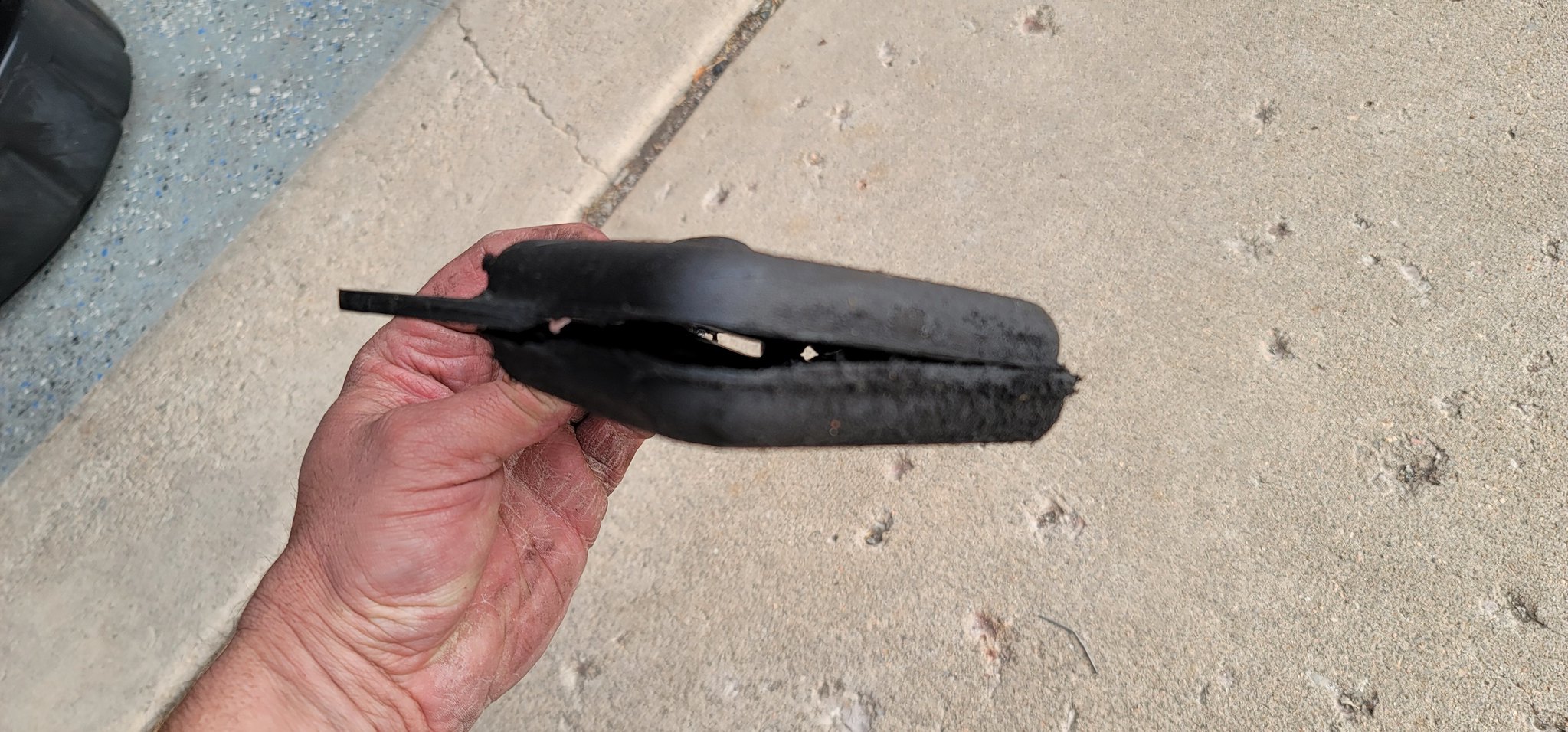
Against my better instincts actually cut a catch tank open tonight. Found two fuzzy discs inside, which I assume sit at either end of the tank. Like the fuzzy side of velcro. They did the trick because the tank was full of little black crystals. Heaven forbid those little buggers got into the UIM.
We were curious because another member has an S8 with a different part number. Yahoo Japan says they are the same thing.
Against my better instincts actually cut a catch tank open tonight. Found two fuzzy discs inside, which I assume sit at either end of the tank. Like the fuzzy side of velcro. They did the trick because the tank was full of little black crystals. Heaven forbid those little buggers got into the UIM.
We were curious because another member has an S8 with a different part number. Yahoo Japan says they are the same thing.
But how would you know without cutting them open?
the N3F1-13-978 is available (in Japan) and its cheap. also not the charcoal canister
There are several things I want to touch on that I hope I don't forget. Here goes.
I removed everything years ago and left the line from the tank where it was. I used the EVAP line as a return line and had two fuel feed lines, and I used teflon-lined braided lines because I was planning on using E85. I smelled raw fuel, so I routed the line out the back bumper. That almost made it worse, so I put the charcoal canister back in and let it vent from there, hoping the charcoal would at least filter the smell. Wrongo. I could even smell the raw fuel with the windows up and AC on during a fun drive through mountain roads one day. I didn't always smell it, but it was often enough to try to fix it. I've been planning on 3D scanning the canister and printing one with a removable top so the charcoal can be changed, hoping maybe the charcoal in mine just wasn't effective enough anymore. I still plan on doing that actually.
So now I'm back to adding the whole system back in with the swap to an Elite 1500. One problem I'm having is routing the vacuum lines and using the metal check valve. I was thinking the valve went between the catch tank and solenoid, so that's how I was trying to make it work for over an hour, only to discover that the valve goes between the solenoid and UIM. D'OH! I'm really not trying to step up and down in vacuum lines in the small space I'm trying to put all this in. So could I maybe leave the valve between the catch tank and solenoid? I figure it would still be serving its purpose, unless it's supposed to be protecting the solenoid also. Or I was wondering about using one of Dale's check valves. That sounds like it works.
Regarding the separator tank, I noticed mine had a broken nipple also. Then when I was trying to pull it out, I noticed it had another broken nipple. After I got it out, I realized it would not be salvageable lol.
Single turbo, time to restore evap emissions to eliminate fuel stink!
Time for me to add to this thread... I'm running a single turbo FD managed by a Link G4+. Currently my evaporative emissions system consists of everything in the OEM system, minus the all the OEM stuff highlighted in yellow in the diagram below. So basically when the fuel vapor pressure in the my charcoal canister/fuel tank gets high enough, like on a hot day, the vapors find their way to the open vented hard pipe that dumps out on the driver's side firewall - and it STINKS! Bad enough that it has me hunting for fuel leaks that don't exist on some days. Anyway, I want to do away with the stink and wanted to run some ideas against the forum brain trust for comment...
My initial thought was to replicate how Mazda did evaporative emissions in the FC - a simple mechanical system that just adds a check valve & some hose between the charcoal canister outlet port and the turbo inlet duct (TID). BUT that option is a non-starter on my FD, since I don't have a TID - due to packaging issues, my air filter is right on the compressor inlet, so there's no where for me to plumb a fitting for the evap emissions hose. Which means I'll need to try to replicate how it's done on the FD, where it plumbs into the UIM past the throttles. Fortunately, my Link G4+ has a few spare outputs that I can set up to do simple on/off solenoid control or PWM duty cycle control. I also brought all my spare I/O out to connectors for future expansion, so adding the needed wiring to drive an OEM type purge control valve wouldn't be too hard.
Questions:
1. Is it really necessary to add that "catch tank" shown in the above diagram? About how big is the OEM catch tank, and does it have more charcoal in it? I noticed that the FD's charcoal canister is substantially smaller than the FC version, so maybe that's why Mazda put it there - perhaps to provide adequate fume storage volume?
2. The check valve is definitely needed to keep positive boost out of the evaporative emissions plumbing, and I'm guessing one of Dale's Viton check valves would work in this application - question is are Dale's check valves rated to handle fuel vapors, or should I be hunting down the OEM part?
3. Doing some reverse engineering informed by the FSM/Service highlights, it appears the OEM ECU opens up the purge control solenoid only in vacuum, from 1500~3300 RPMs. Which probably ties to how the EPA tests for emissions. Anyway, I need to research my Link ECU further to see how much control flexibility I really have here, but I think a simple on/off (non PWM) control that opens the solenoid to purge fumes during low load/high vacuum at cruising RPMs will solve the stink problem. This would likely richen my AFRs when it purges, but the Link's closed loop lambda control should be able to deal with that and keep AFRs on target. I could also set it up to have the purge open during cranking, which would pull any accumulated vapors on startup, and assist with cranking enrichment.
1. The FD catch tank is small, outer dimensions of the canister part are about 1.25" diameter by 3.5" length.
2. Not sure about the check valve.
3. I've been running the OEM purge control solenoid on my FD using one of the PWM outputs on the ECU, it does seem to help with the fuel smell when the car sits. It doesn't seem to affect the measured fuel ratio much when cruising, but it did make the engine idle weird if I activated it at idle. Changing lambda feedback didn't fix it, so I think it's more than just the fuel vapor causing idle problems. Here's a screenshot of my table, x-axis is engine speed and y-axis is manifold pressure. Idle and cruise might be around 40-70kPa, deceleration is below 25kPa, and atmospheric pressure here is around 90 kPa. I think simple on/off control logic should work fine if you get the conditions right.
I haven't done anything as science-y as checking to see what's in the catch tank or adding sensors. Modern cars use pressure sensors to check if the evap system is working properly, that's how the cars can know to trip a check engine light if the gas cap isn't fully tightened.
3b. This is random, but I've heard of piston-cars with standalone ECU configurations that left the evap purge control valve open when the engine was off, and it would cause starting problems after refilling the gas tank. The solution was to change the calibration to avoid opening the evap purge valve when the engine was off. So it's probably best to avoid opening the valve when cranking the engine.
I was comparing my settings with yours and mine look like they're only at idle. These are the base map settings in NSP, so I assume they're supposed to be stock, but they're way off from your settings. I've noticed pressure in my tank when I open the gas cap, so I'm wondering if I need to mirror your settings.
10% duty cycle on my car didn't seem like enough to do anything. I tested by adding duty cycle at idle until the measured lambda got rich and the engine sounded weird, that was at least 40% duty for my car at idle. I set the solenoid to run at 200Hz frequency, I don't remember details but I think I looked it up in the Mazda service manual.
1. The FD catch tank is small, outer dimensions of the canister part are about 1.25" diameter by 3.5" length.
That's a pretty small volume. Even if it is packed with charcoal like the canister by the tank, I don't think the extra fume storage capacity it provides would be enough for me to bother replicating it in my FD. I'll just use hose then.
Originally Posted by scotty305
2. Not sure about the check valve.
I'll reach out to Dale to ask about the Viton check valves, the OEM ones should be easy enough to find used, and may still be available from Mazda/Ray Crowe.
Originally Posted by scotty305
3. I've been running the OEM purge control solenoid on my FD using one of the PWM outputs on the ECU, it does seem to help with the fuel smell when the car sits. It doesn't seem to affect the measured fuel ratio much when cruising, but it did make the engine idle weird if I activated it at idle. Changing lambda feedback didn't fix it, so I think it's more than just the fuel vapor causing idle problems. Here's a screenshot of my table, x-axis is engine speed and y-axis is manifold pressure. Idle and cruise might be around 40-70kPa, deceleration is below 25kPa, and atmospheric pressure here is around 90 kPa. I think simple on/off control logic should work fine if you get the conditions right.
I haven't done anything as science-y as checking to see what's in the catch tank or adding sensors. Modern cars use pressure sensors to check if the evap system is working properly, that's how the cars can know to trip a check engine light if the gas cap isn't fully tightened.
Thanks for sharing! I did a bit of research on the Link ECU support forum, and I've got lots of control options for a purge valve. For hardware, I'm thinking a 3 way MAC valve (plug the NO port; use the NC & common port) will be a relatively easy install, somewhere around the firewall near where the currently open evap vent hard line ends. I'll be using one of my unused injector or ignition outputs, which the Link allows you to repurpose for a multitude of available general purpose outputs. As far as when my FD makes the most fuel stink, I've noticed that when the car sits unused for a long time, I'll smell it in the cabin when I hop in. And lately in the very hot weather (90*+ ambient), I've really noticed the fuel stink while driving around with less than a 1/2 tank of fuel. I suspect what is going on is the fuel naturally heats as it circulates thru the rails & returns to the tank, but with less than a 1/2 tank left, there's less of a heat sink to cool it down. So the fuel temp and it's vapor pressure keeps going up, overwhelms the charcoal canister's ability to store it, and and it vents out the open hard line at the firewall - right into my nose sitting a couple of feet behind it.
Couple of general tips on purge control I've gathered from the Link support forums, applicable to any car:
1 - Don't open the purge at idle. Even with closed loop lambda (CLL) control running, the additional fuel vapors will cause problems with the CLL control over/under compensating. That's because at idle speed, exhaust gas flow from the point of combustion out to where your WBO2 sensor resides in the exhaust takes a finite amount of time, which is significantly slower time than when running at higher RPMs/load.
2 - You'll probably want to disable purge openings when the car is in overrun/deceleration fuel cut - lots of folks had reported issues with exhaust backfires when purge was allowed to happen under decel fuel cut conditions.
3 - This might be specific to the Link G4+, but some guys have reported wacky CLL control performance hiccups in cases where the conditions that caused the purge to open stopped, and then rapidly recurred with little to no delay in between them. Example - simple setup opens purge valve (PWM duty OR simple on/off valve, doesn't really matter) at RPMs between 1700-3300, and MAP between 30-80Kpa; you're cruising along at a pretty steady RPM between 3000~3100, but due to the road/terrain effecting load, your MAP might be fluctuating between 70~95Kpa, causing the purge control to switch on/off rapidly with the MAP condition. The fix to this in the Link is to add a "activation/re-activation delay" to your purge control of say 3 seconds - this prevents the CLL control from having to respond to rapid changes in fueling induced by the purge function.
Originally Posted by scotty305
3b. This is random, but I've heard of piston-cars with standalone ECU configurations that left the evap purge control valve open when the engine was off, and it would cause starting problems after refilling the gas tank. The solution was to change the calibration to avoid opening the evap purge valve when the engine was off. So it's probably best to avoid opening the valve when cranking the engine.
Not sure why that would happen, but it won't be possible on my setup. Using the MAC valve as described above, since it will only be powered on when the car is running, it will never be open when the engine is off.
Originally Posted by scotty305
10% duty cycle on my car didn't seem like enough to do anything. I tested by adding duty cycle at idle until the measured lambda got rich and the engine sounded weird, that was at least 40% duty for my car at idle. I set the solenoid to run at 200Hz frequency, I don't remember details but I think I looked it up in the Mazda service manual.
I think what I'm going to do with solenoid control is start simple - when purge conditions exist, the valve opens 100%, when they don't, valve closes (0%), and insert that activation/re-activation delay Link support recommends. I'll have to double check my logs to see where MAP is at when my overrun/decel fuel cut engages, and get ballpark MAP ranges of where typical cruising resides. Then based on that, it will be an RPM between 2000 - 3100 AND within the MAP range I get from my logs. If that setup results in any CLL control wackiness when purge engages/disengages, then I'll soften the purge transitions by PWM controlling the solenoid - smaller duty cycles at the edges where the transitions in/out of purge occur, and a higher duty cycles in the middle/rest of the PWM map
Pete, I believe I have a spare catch tank, and you can still buy the solenoid valve and I'm using one of Dale's viton check valves, if you want to get the setup similar to stock.
Also, you should check your vacuum chamber, could be cracked like mine was haha. It didn't matter what I did, such an overwhelming raw fuel smell no matter what. But not anymore.
Originally Posted by scotty305
10% duty cycle on my car didn't seem like enough to do anything. I tested by adding duty cycle at idle until the measured lambda got rich and the engine sounded weird, that was at least 40% duty for my car at idle. I set the solenoid to run at 200Hz frequency, I don't remember details but I think I looked it up in the Mazda service manual.
I just realized mine is set to 5hz, so that might be part of the problem too lol. But I'll try adding duty cycle. And then maybe changing it so it's not at idle.
Pete, I believe I have a spare catch tank, and you can still buy the solenoid valve and I'm using one of Dale's viton check valves, if you want to get the setup similar to stock.
Also, you should check your vacuum chamber, could be cracked like mine was haha. It didn't matter what I did, such an overwhelming raw fuel smell no matter what. But not anymore.
I just realized mine is set to 5hz, so that might be part of the problem too lol. But I'll try adding duty cycle. And then maybe changing it so it's not at idle.
Yeah, you definitely don't want it purging @ idle. IIRC, the OEM FD ECU purges between 1700~3300 RPMs, so outside of idle, easy cruising RPM range. I'll let you know on the catch tank, I'm going to just try it with out one as it will be one less thing to figure out where to mount/package it. I checked the charcoal canister by the fuel tank for cracks/damage, and that looks good fortunately.
Originally Posted by TwinCharged RX7
OEM check valves new are $72 each, just FYI. (If you are talking about the ones on top of the fuel tank)
Nope, not the ones on the gas tank, it's the check valve that goes between the intake mani and the purge solenoid in the FSM diagram. I reached out to Dale, and he confirmed the Viton check valves he sells are compatible with the fuel vapor exposure they would see in this application - he's been running them for 25 years with no problems.
This is the aluminum check valve, they really rarely fail. It's a ball and spring design inside, typical worst case if it's nasty inside is just clean with brake cleaner.
But if you don't have it you can use one of my Viton valves no sweat.
I have a couple of those metal check valves too. I chose to use a Viton one because it's much smaller and uses the same size vacuum line as the solenoid, so no need to step up and then back down in size, nor take up so much extra room.
I did some testing yesterday, changing the frequency and driving around. I had already changed the duty cycle to 40 all across and changed frequencies between 5hz, 100hz, and 200hz, and then removing the fuel cap. I had pressure come out on 5hz and 100hz after driving around, but forgot to check on 200hz so I'll have to go back.
Last edited by speedjunkie; Jul 31, 2023 at 11:56 PM.
I've skimmed through the service manual, but I haven't found reference to the evap solenoid frequency. I don't remember why I chose 200Hz. For what it's worth, I have the OE boost control and precontrol solenoids running at 30 Hz and the OE idle solenoid running at 240 Hz.












 What lies inside?