When you click on links to various merchants on this site and make a purchase, this can result in this site earning a commission. Affiliate programs and affiliations include, but are not limited to, the eBay Partner Network.
There is plenty of gap there (I made sure it wasn't rubbing), though I'm not sure what normal is. Would you expect more or less gap with a pinched needle bearing?
My guess from looking at the first diagram is a wider gap as the whole assembly would be pushed forward by the width of the dropped needle bearing.
I could be mistaken.
Refer to the description for the second to last diagram on page C-77.
Whelp, I'm stumped. Went on the warpath today and was completely fruitless.
First I did get a good measurement on endplay before tearing in. With the car on the lift I was able to get a dial setup measuring off the flywheel through the lower inspection port on the trans. It definitely has endplay and was in spec (0.05mm). Fired it up again, using a hose to the ear this time confirmed sound is def loudest from behind the crank pulley. Seeing as I have a massive pan oil leak to fix and that REWs are so damn expensive I figured it's time to pull it and take a look.
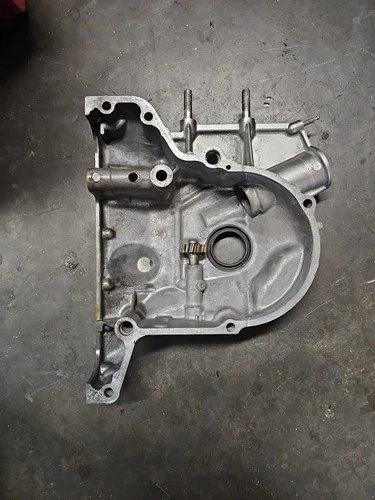
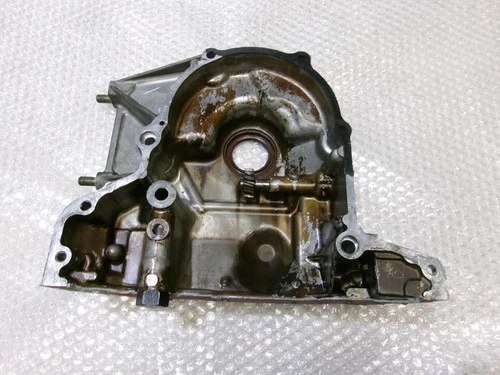
Thrust bearing stack was perfect. Oil pan perfect. Front cover perfect. Driveshaft to the OMP perfect. No witness marks on anything showing signs of rubbing. Oil was still shimmery which is concerning but the oil pan had no chunks or anything in it. Rotary builder friend said my rear stationary bearing wear was pretty normal assuming it was a used bearing reused on the build. No idea if that was the case though.
When I installed twin oil cooler with flexible lines, they vibrated like crazy, like a bee buzzing.
When I replaced the flexible with the stock hard lines, the noise went away. Later when my engine was being rebuilt ,the builder reported the oil pan was dented up against the oil intake.
That was likely the cause of the vibration.
I wondered why my oil pressure never went above 60 psi.
Just a long shot.
How did you rule out the water pump?
How well burped was the motor after the coolant was put in?
(The sound sounds somewhat like fluid being sprayed internally at high pressure.)
++++++
In another recent local case, the oil uptake was found to be clogged with RTV from sealing the oil pan.
This, again, was discovered upon a rebuild for a blown motor.
I've heard they start with no endplay and eventually progress into all of the endplay once the pinched bearing is ground down. I'm hoping I'm still in the early stages on this one.
The torrington bearing sits on a thicker section of the E shaft than the spacer. When you take the front hub bolt off when the E shaft is horizontal the bearing is able to wedge itself in between the thicker section of the E shaft and the engine spacer. This essentially makes the engine spacer thicker by one torrington bearing (or at least thicker by one crushed torrington bearing LOL). Thicker engine spacers make for more endshaft play.
You’ll need to take some better pictures of the front bearing, and the rollers of the torrington. Spray them down with brake clean and wipe with a clean cloth. Take the thrust plate and see if you can feel the marking with your nail. Sometimes closing your eyes while doing this will help you feel if it’s got a groove. From your pictures, the rollers on the one look like spalling. Take a magnifying glass and look at those close-up.