


Buy A Fire Extinguisher!



One of the first things I bought for my car was a fire extinguisher. And out of many cars I had this is the only one I ever boought and felt the need for an extinguisher. I keep it in the bin behind the passenger seat. My only concern is if that small bottle will be enough to extinguish a fire and looks like in similar situation OP's bottle (probably similar to mine) was not enough.

My buddy had the same problem, his fuel pulsation dampner went bad and caught his engine bay on fire. Luckily for him he was right next to a fire department. Plenty of damage under the hood was done though, and the insurance company paid Peter Farrell to rebuild everything, so in the long run it was a blessing in disguise.
Last edited by GoodfellaFD3S; Jun 2, 2010 at 03:52 PM.



http://www.summitracing.com/parts/HTR-HG250C/
Fire Extinguisher, H3R Performance HalGuard, B and C Rated Fires, Chrome, 2.5 lb. Bottle,
Leaves no residue and is designed for gas or electrical fires. Cost is a little high at $157 but well worth it. I just put mine in the driver's side back bin and forget about it until I need it. No projectiles was it is stored away.
I had a fire a few years ago during the 20B conversion and vowed from that point on to always carry an extinquisher.
Fire Extinguisher, H3R Performance HalGuard, B and C Rated Fires, Chrome, 2.5 lb. Bottle,
Leaves no residue and is designed for gas or electrical fires. Cost is a little high at $157 but well worth it. I just put mine in the driver's side back bin and forget about it until I need it. No projectiles was it is stored away.
I had a fire a few years ago during the 20B conversion and vowed from that point on to always carry an extinquisher.

Right in front of Passenger seat under their legs is where mine is going. Mounts bolted to the floor. And yes, getting hit the head with a fire extinguisher would suck, I can see the headlines now. "35 mph fender bender results in death"
http://www.summitracing.com/parts/HTR-HG250C/
Fire Extinguisher, H3R Performance HalGuard, B and C Rated Fires, Chrome, 2.5 lb. Bottle,
Leaves no residue and is designed for gas or electrical fires. Cost is a little high at $157 but well worth it. I just put mine in the driver's side back bin and forget about it until I need it. No projectiles was it is stored away.
I had a fire a few years ago during the 20B conversion and vowed from that point on to always carry an extinquisher.
Fire Extinguisher, H3R Performance HalGuard, B and C Rated Fires, Chrome, 2.5 lb. Bottle,
Leaves no residue and is designed for gas or electrical fires. Cost is a little high at $157 but well worth it. I just put mine in the driver's side back bin and forget about it until I need it. No projectiles was it is stored away.
I had a fire a few years ago during the 20B conversion and vowed from that point on to always carry an extinquisher.
Consider throwing that one out and getting a HALON extinguisher. If you look at the ratings for halotron vs halon (if i remember correctly) the halotron is rated for half the time for the same bottle size/weight. Basically its half as powerful and will last half the time. If you look up the rating for it, it wont be equivalent to halon. You think youre getting the good one cause its "automotive" but really the aviation grade HALON ones are what you want. They are rated the same as the same size powder type.
I really should look up the ratings for all of this but I'm feeling kinda lazy today... but if memory serves, the halotron ones are half power per volume compared to halon, or powder. You don't want that.
 I think my h3r halon was $200? The downside to halon is that it is a CFC and is quite bad for the atmosphere. Like the r12 refrigerant, when the law was passed to ban production of halon, the law stipulated what whatever the current supply was at the time the law went into effect, the last remaining amounts of halon could be sold. The law also allows old halon to be recycled into new, and since not many people are out there spraying away their extinguishers, there is still a readily available supply in circulation. When the extinguisher expires however, you really got to find a local halon recycler to take out your old stuff (to be recycled) and put in new.
 -Heath
PS ok I looked it up cause I wanted to make sure I was remembering correctly. For comparisons sake:
http://www.h3raviation.com/halon_1211_c352tsc.htm
that one is halon 1211 and is rated 5B:C 9-15 ft. 10 sec. full discharge
http://www.h3rperformance.com/hg250c.htm
that one is halotron and is rated at 2B:C (which I believe is half the power, or half the time... i cant find the specs)
and lastly, powder type
http://www.h3rperformance.com/mx250c.htm
this powder type is rated 1A:10B:C (which i believe is twice the power of the HALON)
and just for fun... guess what beauty h3r wants to model their extinguisher with??? Yeah that's right, even they know you'll need an extinguisher for the FD



Indelible.

Joined: Aug 2004
Posts: 140
Likes: 0
From: Australia
Sorry to hear mate.
I've been meaning to install my fire extinguisher for a while now, was going to mount it on a bracket somewhere on the passenger side but i may just throw it in my bins or something!
I've been meaning to install my fire extinguisher for a while now, was going to mount it on a bracket somewhere on the passenger side but i may just throw it in my bins or something!

My "thinking outside the box" solution would be to install a fire suppression system instead of using a hand held unit. It requires a lot of work though, but you install a few nozzles under the hood that will extinguish the fire without even popping the hood. Obviously this solution is much more expensive and complicated then a hand held unit.
example: link
example: link



Joined: Feb 2002
Posts: 1,171
Likes: 0
From: MI
 . By oh **** handle do you mean the door handle? How short are these ladies, even my kid nephew doesn't have any trouble reaching the door handle (not that I wouldn't mind keeping people away from it!
  ).
).Since this thread is about the importance of having an extinguisher, and how to keep it in the car lets discuss mounting them. When did I ever say you needed to use existing bolt holes? I've got a 5pt harness bolted into my car and use backing plates to install the eye bolts in the floor pan... easy and safe. If you've got a welder you would be in even better shape for making custom mounting points.
When did I ever say you needed to use existing bolt holes? I've got a 5pt harness bolted into my car and use backing plates to install the eye bolts in the floor pan... easy and safe. If you've got a welder you would be in even better shape for making custom mounting points.

But for arguments sake, pretend you've got an extinguisher mount that is magnetic... let me know where else you could mount the extinguisher that would be easy to reach and quick to get to when time is of the essence? With the caveat that it's not dangerous in an accident). I started thinking out of the box on this one but ended up with a single location (in front of the passenger seat) for lack of any other usable locations. Does your out of the box thinking include the roof, a pillar, trunk, or mounted to the top of the hood? Lets hear your other solutions for mounting locations and talk about em cause we can all agree that we need an extinguisher in our car and a place to safely put it.
Lets hear your other solutions for mounting locations and talk about em cause we can all agree that we need an extinguisher in our car and a place to safely put it.My "thinking outside the box" solution would be to install a fire suppression system instead of using a hand held unit. It requires a lot of work though, but you install a few nozzles under the hood that will extinguish the fire without even popping the hood. Obviously this solution is much more expensive and complicated then a hand held unit.
example: link
example: link
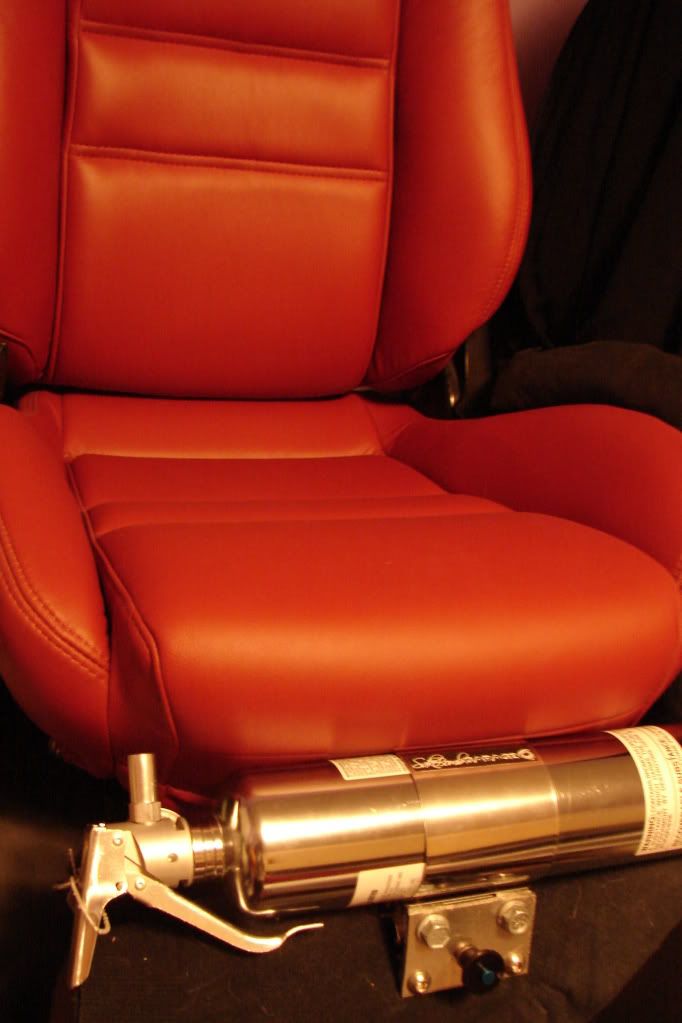
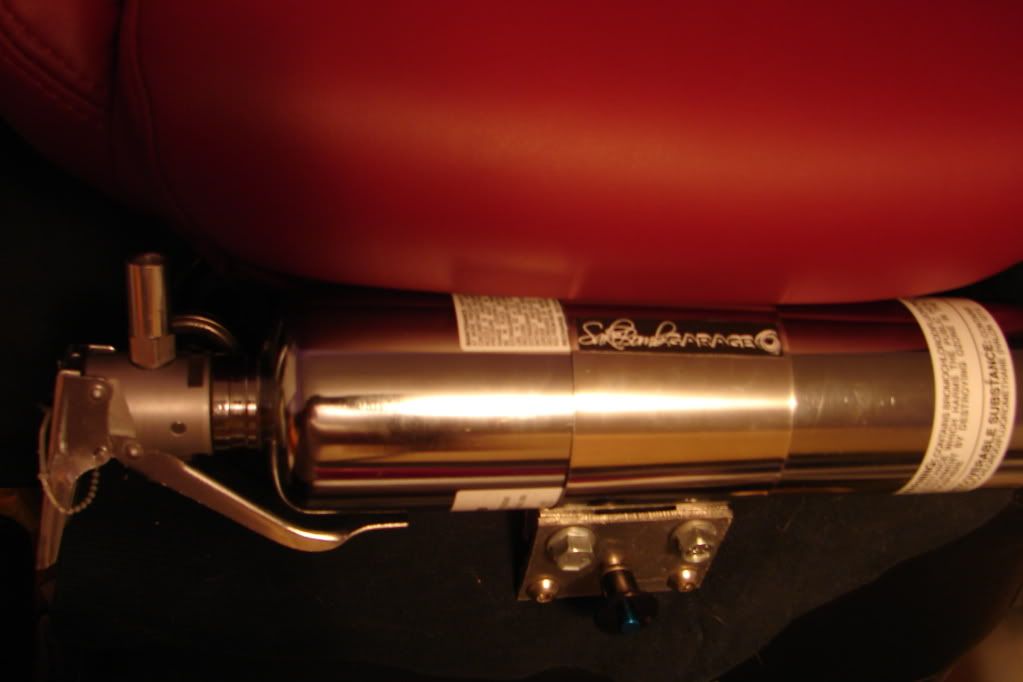
. Easily mounted out of sight out of mind, and you don't even have to get out of the car to extinguish the fire. Seems like the best option to me, if ease of use and cabin safety are a priority that is.I just got done mounting mine permanently, will still take it out at some point to paint the bracket but it's working great so far and took me less than 10 minutes to make. Yours looks good too though, any pictures of how it's mounted under the seat?
This was also what I was getting at, glad someone likes to think outside the box
. Easily mounted out of sight out of mind, and you don't even have to get out of the car to extinguish the fire. Seems like the best option to me, if ease of use and cabin safety are a priority that is.I just got done mounting mine permanently, will still take it out at some point to paint the bracket but it's working great so far and took me less than 10 minutes to make. Yours looks good too though, any pictures of how it's mounted under the seat?
Yeah the remote extinguisher is great... if the fire happens to be in the spot where the nozzles are
if something else happens to catch fire (dash etc) then you're SOL. It's also 600 bucks lol
David,
Consider throwing that one out and getting a HALON extinguisher. If you look at the ratings for halotron vs halon (if i remember correctly) the halotron is rated for half the time for the same bottle size/weight. Basically its half as powerful and will last half the time. If you look up the rating for it, it wont be equivalent to halon. You think youre getting the good one cause its "automotive" but really the aviation grade HALON ones are what you want. They are rated the same as the same size powder type.
I really should look up the ratings for all of this but I'm feeling kinda lazy today... but if memory serves, the halotron ones are half power per volume compared to halon, or powder. You don't want that. I think my h3r halon was $200? The downside to halon is that it is a CFC and is quite bad for the atmosphere. Like the r12 refrigerant, when the law was passed to ban production of halon, the law stipulated what whatever the current supply was at the time the law went into effect, the last remaining amounts of halon could be sold. The law also allows old halon to be recycled into new, and since not many people are out there spraying away their extinguishers, there is still a readily available supply in circulation. When the extinguisher expires however, you really got to find a local halon recycler to take out your old stuff (to be recycled) and put in new.
-Heath
PS ok I looked it up cause I wanted to make sure I was remembering correctly. For comparisons sake:
http://www.h3raviation.com/halon_1211_c352tsc.htm
that one is halon 1211 and is rated 5B:C 9-15 ft. 10 sec. full discharge
http://www.h3rperformance.com/hg250c.htm
that one is halotron and is rated at 2B:C (which I believe is half the power, or half the time... i cant find the specs)
and lastly, powder type
http://www.h3rperformance.com/mx250c.htm
this powder type is rated 1A:10B:C (which i believe is twice the power of the HALON)
Consider throwing that one out and getting a HALON extinguisher. If you look at the ratings for halotron vs halon (if i remember correctly) the halotron is rated for half the time for the same bottle size/weight. Basically its half as powerful and will last half the time. If you look up the rating for it, it wont be equivalent to halon. You think youre getting the good one cause its "automotive" but really the aviation grade HALON ones are what you want. They are rated the same as the same size powder type.
I really should look up the ratings for all of this but I'm feeling kinda lazy today... but if memory serves, the halotron ones are half power per volume compared to halon, or powder. You don't want that.
I think my h3r halon was $200? The downside to halon is that it is a CFC and is quite bad for the atmosphere. Like the r12 refrigerant, when the law was passed to ban production of halon, the law stipulated what whatever the current supply was at the time the law went into effect, the last remaining amounts of halon could be sold. The law also allows old halon to be recycled into new, and since not many people are out there spraying away their extinguishers, there is still a readily available supply in circulation. When the extinguisher expires however, you really got to find a local halon recycler to take out your old stuff (to be recycled) and put in new. -Heath
PS ok I looked it up cause I wanted to make sure I was remembering correctly. For comparisons sake:
http://www.h3raviation.com/halon_1211_c352tsc.htm
that one is halon 1211 and is rated 5B:C 9-15 ft. 10 sec. full discharge
http://www.h3rperformance.com/hg250c.htm
that one is halotron and is rated at 2B:C (which I believe is half the power, or half the time... i cant find the specs)
and lastly, powder type
http://www.h3rperformance.com/mx250c.htm
this powder type is rated 1A:10B:C (which i believe is twice the power of the HALON)
- Any of the above mentioned products will have the SAME discharge time. So, a 2.5 lb. Halo unit has a roughly 10 second discharge time but so does the 2.5 lb. Halotron unit (the one I have) and the dry chemical one. No difference in the amount of spray time so to speak.
- You are correct that the Halo unit offers a "wider" area of spray. The Halo unit can put out a 5 ft. square fire versus the 2 foot square fire of the Halotron unit. Not sure what the dry chemical one does but that is irrelevant to me as I don't want to spray stuff all over the engine bay or rest of the car that will then need to be cleaned up. However, either the Halo or the Halotron should work well on the size of a fire we'd encounter on the RX7 - if it is really big, we're screwed anyway. If a 10 second blast of a 2 foot square fire doesn't put it out, well, I don't think the 5 foot square one would either.
So, to conclude the above, the Halotron unit has the same discharge time as the Halo (roughly 10 seconds each) but Heath is correct the Halo unit is a bit better at the coverage area of the fire which I contend becomes irrelevant if it is too large anyway.
As H3Performance points out, you should not be purchasing the Halo units anyway as they by law are restricted to "critical use" only, meaning you are not supposed to be using them for anything but aviation use as it is against the law. The company says their distributors are supposed to ensure this happens but if Heath has one we know you can get them.
Finally, H3 indicates the Halotron units (not Halo) are used exclusively by many race car drivers with great results and it is these units they recommend for the RX7 crowd. So I think I'll keep mine thank you
So you want me to throw out the fire extinguisher that is rated as the best for automotive use?? To clarify some of your statements (and my info comes directly from the manufacturer of the systems Heath has linked, H3Performance):
- Any of the above mentioned products will have the SAME discharge time. So, a 2.5 lb. Halo unit has a roughly 10 second discharge time but so does the 2.5 lb. Halotron unit (the one I have) and the dry chemical one. No difference in the amount of spray time so to speak.
- You are correct that the Halo unit offers a "wider" area of spray. The Halo unit can put out a 5 ft. square fire versus the 2 foot square fire of the Halotron unit. Not sure what the dry chemical one does but that is irrelevant to me as I don't want to spray stuff all over the engine bay or rest of the car that will then need to be cleaned up. However, either the Halo or the Halotron should work well on the size of a fire we'd encounter on the RX7 - if it is really big, we're screwed anyway. If a 10 second blast of a 2 foot square fire doesn't put it out, well, I don't think the 5 foot square one would either.
So, to conclude the above, the Halotron unit has the same discharge time as the Halo (roughly 10 seconds each) but Heath is correct the Halo unit is a bit better at the coverage area of the fire which I contend becomes irrelevant if it is too large anyway.
As H3Performance points out, you should not be purchasing the Halo units anyway as they by law are restricted to "critical use" only, meaning you are not supposed to be using them for anything but aviation use as it is against the law. The company says their distributors are supposed to ensure this happens but if Heath has one we know you can get them.
Finally, H3 indicates the Halotron units (not Halo) are used exclusively by many race car drivers with great results and it is these units they recommend for the RX7 crowd. So I think I'll keep mine thank you
- Any of the above mentioned products will have the SAME discharge time. So, a 2.5 lb. Halo unit has a roughly 10 second discharge time but so does the 2.5 lb. Halotron unit (the one I have) and the dry chemical one. No difference in the amount of spray time so to speak.
- You are correct that the Halo unit offers a "wider" area of spray. The Halo unit can put out a 5 ft. square fire versus the 2 foot square fire of the Halotron unit. Not sure what the dry chemical one does but that is irrelevant to me as I don't want to spray stuff all over the engine bay or rest of the car that will then need to be cleaned up. However, either the Halo or the Halotron should work well on the size of a fire we'd encounter on the RX7 - if it is really big, we're screwed anyway. If a 10 second blast of a 2 foot square fire doesn't put it out, well, I don't think the 5 foot square one would either.
So, to conclude the above, the Halotron unit has the same discharge time as the Halo (roughly 10 seconds each) but Heath is correct the Halo unit is a bit better at the coverage area of the fire which I contend becomes irrelevant if it is too large anyway.
As H3Performance points out, you should not be purchasing the Halo units anyway as they by law are restricted to "critical use" only, meaning you are not supposed to be using them for anything but aviation use as it is against the law. The company says their distributors are supposed to ensure this happens but if Heath has one we know you can get them.
Finally, H3 indicates the Halotron units (not Halo) are used exclusively by many race car drivers with great results and it is these units they recommend for the RX7 crowd. So I think I'll keep mine thank you
The use Halon is very loosely regulated, it's not like the EPA is going to come knocking at your door if your car bursts into flames and a Halon extinguisher is used to put it out. Yes Halon is very bad for the ozone layer and "restricted" to "critical use" only meaning Marine or Aviation use but you don't need to be a pilot or ship captain to obtain it. If Halotron was a better suppressant it would be used on airplanes as opposed to Halon. The government put a regulation on Halon so people aren't using it in their kitchens and in houses to put out grease fires and other non critical situations.
I would speculate the reason Halotron is used in certain motor sports as opposed to Halon is because of regulations by the sanctioning body, not because it's better. For the record, Halon is also used in motor sports. Personally I'm not a firefighter nor do I have enough knowledge about the topic of Halon/Halotron to intelligently argue about fire suppressants; but from what I've read Halon is absolutely a better way to suppress a fire. Maybe someone who has some actual knowledge of chemical fire suppression systems can chime in.
I'll use your 2.5lb bottle as an example.
Halon = 5 foot square fire (UL rating)
Halotron = 2 foot square fire (UL rating)
I don't know about you, but I'd rather be able to put out a monster fire and have leftover suppressant then not enough; so you're standing around with an empty extinguisher bottle to bash yourself in the head with.

I'm pretty sure there are also laws restricting us from modifying our emissions control systems on our vehicles.... do you have a catalytic converter?

At the end of the day neither you or I can intelligently debate this subject so just let it be.
-Dan
Joined: Feb 2002
Posts: 1,171
Likes: 0
From: MI
. Obviously there will be flaws with just about any setup, if you truly wanted to be safe you'd run both a fire suppressant system AND a backup extinguisher.The one Scrub linked was only $330.
I'd like to post my .02
The use Halon is very loosely regulated, it's not like the EPA is going to come knocking at your door if your car bursts into flames and a Halon extinguisher is used to put it out. Yes Halon is very bad for the ozone layer and "restricted" to "critical use" only meaning Marine or Aviation use but you don't need to be a pilot or ship captain to obtain it. If Halotron was a better suppressant it would be used on airplanes as opposed to Halon. The government put a regulation on Halon so people aren't using it in their kitchens and in houses to put out grease fires and other non critical situations.
I would speculate the reason Halotron is used in certain motor sports as opposed to Halon is because of regulations by the sanctioning body, not because it's better. For the record, Halon is also used in motor sports. Personally I'm not a firefighter nor do I have enough knowledge about the topic of Halon/Halotron to intelligently argue about fire suppressants; but from what I've read Halon is absolutely a better way to suppress a fire. Maybe someone who has some actual knowledge of chemical fire suppression systems can chime in.
I'll use your 2.5lb bottle as an example.
Halon = 5 foot square fire (UL rating)
Halotron = 2 foot square fire (UL rating)
I don't know about you, but I'd rather be able to put out a monster fire and have leftover suppressant then not enough; so you're standing around with an empty extinguisher bottle to bash yourself in the head with.
I'm pretty sure there are also laws restricting us from modifying our emissions control systems on our vehicles.... do you have a catalytic converter?
At the end of the day neither you or I can intelligently debate this subject so just let it be.
-Dan
The use Halon is very loosely regulated, it's not like the EPA is going to come knocking at your door if your car bursts into flames and a Halon extinguisher is used to put it out. Yes Halon is very bad for the ozone layer and "restricted" to "critical use" only meaning Marine or Aviation use but you don't need to be a pilot or ship captain to obtain it. If Halotron was a better suppressant it would be used on airplanes as opposed to Halon. The government put a regulation on Halon so people aren't using it in their kitchens and in houses to put out grease fires and other non critical situations.
I would speculate the reason Halotron is used in certain motor sports as opposed to Halon is because of regulations by the sanctioning body, not because it's better. For the record, Halon is also used in motor sports. Personally I'm not a firefighter nor do I have enough knowledge about the topic of Halon/Halotron to intelligently argue about fire suppressants; but from what I've read Halon is absolutely a better way to suppress a fire. Maybe someone who has some actual knowledge of chemical fire suppression systems can chime in.
I'll use your 2.5lb bottle as an example.
Halon = 5 foot square fire (UL rating)
Halotron = 2 foot square fire (UL rating)
I don't know about you, but I'd rather be able to put out a monster fire and have leftover suppressant then not enough; so you're standing around with an empty extinguisher bottle to bash yourself in the head with.
I'm pretty sure there are also laws restricting us from modifying our emissions control systems on our vehicles.... do you have a catalytic converter?
At the end of the day neither you or I can intelligently debate this subject so just let it be.
-Dan
 Lot's of opinions but little facts.
I could give my opinion but instead of doing that I wanted the facts so I called up the company that are the actual experts, H3R Performance. Go ahead and give them a call at (800) 249-4289 and ask them which fire extinguisher type they recommend for use in our cars. HINT: It's not a Halon one and remember they sell both types.
The fire extinguisher that I have uses HalGuard™ a "premium clean agent fire extinguisher line containing Halotron 1. Halotron 1 is a clean fire-extinguishing agent intended to replace Halon 1211 in streaming applications. NFPA 2001, "Standard on Clean Agent Fire Extinguishing Systems" defines a "Clean Agent" to be "electrically non-conducting, volatile, or gaseous fire extinguishant that does not leave a residue upon evaporation." Halotron is a safe, effective, environmentally acceptable replacement for Halon 1211. It is discharged as a liquid that rapidly evaporates. Halotron is a proprietary three-component chemical blend based on HCFC-123."
So, what I have is the replacement for Halotron, it is legal, and it doesn't harm the environment. It is also quite good and top-rated when it comes to putting out fires. And your example of the 5 foot fire versus the 2 foot fire is not quite right. It's not like the 2 foot capability is limited to 2 square feet only. That's the max you can do at one time. Yes, bigger is better for sure but show me a 5 foot square flame problem on an FD and I'll show you a cooked car no matter which technology you are using.
I guess Halo can still be used in other motor sports as you contend but it has been outlawed in NASCAR since 2007 (http://www2.dupont.com/FE/en_US/scie...ew_hammel.html). I guess those guys don't need good protection right? As a matter of fact, not opinion, as of January 2008, Halon cannot be used for any onboard fire suppression system for auto racing (http://www.nfpa.org/assets/files//PD...ngs/Hammel.pdf).
Finally, don't forget Halo is dangerous to humans, particularly when discharged in a confined occupied space such as a car cockpit. In addition, the fact should not go unrecognized that Halon is both highly corrosive to metal surfaces, dissolves plastic components on contact and is an ozone-depleting substance (http://www.nmradigital.com/forums/sh...ad.php?t=22622).
So I'll stick with facts and keep my fire extinguisher.
I actually called H3R performance BEFORE posting my last post, which is where I got some of my information from.
Fact: Halon is more effective then Halotron PER the rep I talked to at H3Rperformance DONE!
But just to make you feel better and so I don't have to read anymore books you write in response. I don't have the time or the desire to continue responding to this thread.
YOU'RE THE

Fact: Halon is more effective then Halotron PER the rep I talked to at H3Rperformance DONE!
But just to make you feel better and so I don't have to read anymore books you write in response. I don't have the time or the desire to continue responding to this thread.
YOU'RE THE

When I used to fly Cessnas pretty regularly (3+ flights per week), I always had a Halon extinguisher on board.
I think what it comes down to is that Halon is better at putting out fire, period. The only reason we're told to stay away from it is because of "environmental concerns" and like Dan said, "The government put a regulation on Halon so people aren't using it in their kitchens and in houses to put out grease fires and other non critical situations."
David, that website you links to claims that, "In addition, the fact should not go unrecognized that Halon is both highly corrosive to metal surfaces, dissolves plastic components on contact and is an ozone-depleting substance." I find this extremely hard to believe: Halon flood systems have been used by IT departments for decades. I highly doubt a multi-million dollar server room is going to use something "corrosive to metal" that will "dissolve plastic components".
Anyway, I'm sure either would work fine to tackle a small engine fire, but if I was given the option I would take a Halon.
And don't feel bad David - apparently you didn't know that Dan is a volunteer firefighter on the weekends.

^ that may or may not be a tranny over his shoulder...
Cheers.
I think what it comes down to is that Halon is better at putting out fire, period. The only reason we're told to stay away from it is because of "environmental concerns"
and like Dan said, "The government put a regulation on Halon so people aren't using it in their kitchens and in houses to put out grease fires and other non critical situations."David, that website you links to claims that, "In addition, the fact should not go unrecognized that Halon is both highly corrosive to metal surfaces, dissolves plastic components on contact and is an ozone-depleting substance." I find this extremely hard to believe: Halon flood systems have been used by IT departments for decades. I highly doubt a multi-million dollar server room is going to use something "corrosive to metal" that will "dissolve plastic components".
Anyway, I'm sure either would work fine to tackle a small engine fire, but if I was given the option I would take a Halon.
And don't feel bad David - apparently you didn't know that Dan is a volunteer firefighter on the weekends.
^ that may or may not be a tranny over his shoulder...
Cheers.
I don't feel bad at all Tom and don't care to win an argument that I never intended to have. My opinions are always routed in facts and it drives me crazy when people
mix fact with opinion hence the long responses with actual links attached.
Look at the DuPont link and draw your own conclusion as to the effectiveness on Halotron like solutions versus halo.
Now something to agree on - we all like SakeBomb LED taillights so less posting and more work you bastard
mix fact with opinion hence the long responses with actual links attached.
Look at the DuPont link and draw your own conclusion as to the effectiveness on Halotron like solutions versus halo.
Now something to agree on - we all like SakeBomb LED taillights so less posting and more work you bastard

I don't feel bad at all Tom and don't care to win an argument that I never intended to have. My opinions are always routed in facts and it drives me crazy when people
mix fact with opinion hence the long responses with actual links attached.
Look at the DuPont link and draw your own conclusion as to the effectiveness on Halotron like solutions versus halo.
Now something to agree on - we all like SakeBomb LED taillights so less posting and more work you bastard
mix fact with opinion hence the long responses with actual links attached.
Look at the DuPont link and draw your own conclusion as to the effectiveness on Halotron like solutions versus halo.
Now something to agree on - we all like SakeBomb LED taillights so less posting and more work you bastard