


WHY is hot-start a problem?




Joined: Mar 2001
Posts: 31,851
Likes: 3,238
From: https://www2.mazda.com/en/100th/
Originally posted by jacobcartmill
**** man, time to go dig up the other wiring harness.. can you provide any more details about this? since i just CUT the entire solenoid plug section off of my wiring harness i'd have to unwrap that section, connect the solenoid, the plug, and run vac lines. can i get some explanation of where to run the lines to and which solenoid goes with the orange plug?
**** man, time to go dig up the other wiring harness.. can you provide any more details about this? since i just CUT the entire solenoid plug section off of my wiring harness i'd have to unwrap that section, connect the solenoid, the plug, and run vac lines. can i get some explanation of where to run the lines to and which solenoid goes with the orange plug?


look at my pic you can see kind of where the vac lines go.
One goes to the FPR and the other goes to the angled nipple on the UIM.
here is my specific setup.
I kept the FPR and the PCV system(although PCV is currently disconnected for testing purposes)
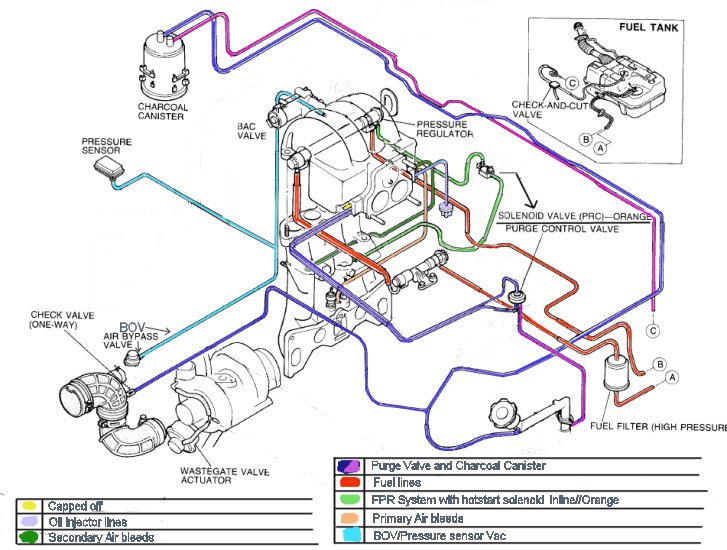
One goes to the FPR and the other goes to the angled nipple on the UIM.
here is my specific setup.
I kept the FPR and the PCV system(although PCV is currently disconnected for testing purposes)

HAILERS

Joined: May 2001
Posts: 20,563
Likes: 27
From: FORT WORTH, TEXAS,USA
Just in case it matters...............On startup the fuel pressure will be HIGHER not lower due to the FPR solenoid.
During normal operation of the engine, the FPR sees the vacuum/pressure in the intake.
During the hot start, the FPR solenoind vents to atmospheric pressure which in turn makes the fpr see atmospheric pressure and go to its approx 38 psi setting.......vs the normal 28psi the FPR is regulating the rail pressure to when idling the engine.
So...HOT START equals rail pressure of approx 38psi and a normal idle has a rail pressure of 28 psi. Both figures plus or minus a couple psi.
Airbleed sockets are below the fuel injectors. The injectors sit in them. They are called air bleeds partly because air is sent to them from the back of the throttle body. And I know everyone would not cap off their air bleed source without a good reason. Uh...surely they would not.
Did I mention the air bleed nipple is the one b/t the two oil injectors on the intake manifold? Yeah, I did. And I'm sure everyone saw the small holes b/t the intake manifold and the intermediate housing that feed the air to the fuel injectors and did not block them off with sealant. Talking series four here. Series five similar.
During normal operation of the engine, the FPR sees the vacuum/pressure in the intake.
During the hot start, the FPR solenoind vents to atmospheric pressure which in turn makes the fpr see atmospheric pressure and go to its approx 38 psi setting.......vs the normal 28psi the FPR is regulating the rail pressure to when idling the engine.
So...HOT START equals rail pressure of approx 38psi and a normal idle has a rail pressure of 28 psi. Both figures plus or minus a couple psi.
Airbleed sockets are below the fuel injectors. The injectors sit in them. They are called air bleeds partly because air is sent to them from the back of the throttle body. And I know everyone would not cap off their air bleed source without a good reason. Uh...surely they would not.
Did I mention the air bleed nipple is the one b/t the two oil injectors on the intake manifold? Yeah, I did. And I'm sure everyone saw the small holes b/t the intake manifold and the intermediate housing that feed the air to the fuel injectors and did not block them off with sealant. Talking series four here. Series five similar.
Last edited by HAILERS; Jul 2, 2004 at 08:56 PM.
Rotary Enthusiast
Joined: Mar 2002
Posts: 827
Likes: 0
From: Lagrange, KY
Originally posted by HAILERS
Did I mention the air bleed nipple is the one b/t the two oil injectors on the intake manifold? Yeah, I did. And I'm sure everyone saw the small holes b/t the intake manifold and the intermediate housing that feed the air to the fuel injectors and did not block them off with sealant. Talking series four here. Series five similar.
Did I mention the air bleed nipple is the one b/t the two oil injectors on the intake manifold? Yeah, I did. And I'm sure everyone saw the small holes b/t the intake manifold and the intermediate housing that feed the air to the fuel injectors and did not block them off with sealant. Talking series four here. Series five similar.
this is jacobcartmill,
uh oh. i have that nipple capped off between the two oil injector holes... so a vac line should go from that nipple, to the hot start solenoid? then the solenoid should be plugged into the orange plug, correct? (talking series5 here)
is it ok to leave it capped off until i can get a solenoid in there? what if i took the cap off it it?
Last edited by Blitz0309; Jul 2, 2004 at 09:17 PM.
HAILERS
Joined: May 2001
Posts: 20,563
Likes: 27
From: FORT WORTH, TEXAS,USA
No. That nipple should go to a source of filtered air prior to the throttle plates. On a series four that nipple is fed off a nipple on the back of the throttle body. Any nipple but the lower nipple on the back of the trottle body. The lower nipple has a vacuum on it. You don't want a vacuum line to go to the nipple b/t the oil injectors, you want a source of filted, ambient air. The *suck* comes from the airbleeds.
HAILERS
Joined: May 2001
Posts: 20,563
Likes: 27
From: FORT WORTH, TEXAS,USA
Got me. I don't have a series five. One way to find out would be to idle the engine. Pull off any capped nipple back there and if the nipple IS NOT sucking vacuum.....use that one. If the nipple is sucking vacuum...DO NOT use that one.
If your not using the oil injector spider and are premixing......use the nipple the spider went to. It'll probably be a touch larger, though.
If your not using the oil injector spider and are premixing......use the nipple the spider went to. It'll probably be a touch larger, though.


Daily Domestic Killer
Joined: Mar 2001
Posts: 2,425
Likes: 0
From: San Antonio, Tx, USA
I am suprised no one has said anything about lower than normal battery voltage, I have found that when the battery is drained not even to a noticiable point, itr causes the ecu to leave the injectors open longer than they should be.
It could also have to do with us removing all the emissions and doing the TB mode can't help......
I have found the main reason the car floods after a rebuilt is because the rotor housings used in the build were not new and apex seals are trying to cope with the slightly used rotor housing and when there hot and bothered they seem to now compress the air as well as they should...
just my 2 cents
It could also have to do with us removing all the emissions and doing the TB mode can't help......
I have found the main reason the car floods after a rebuilt is because the rotor housings used in the build were not new and apex seals are trying to cope with the slightly used rotor housing and when there hot and bothered they seem to now compress the air as well as they should...
just my 2 cents


Thread Starter
Joined: Jul 2002
Posts: 9,387
Likes: 4
From: Nashville, TN
i hate rotaries.
why cant every single rotary engine have 120psi of compression on both rotors? this is what i get for getting a "good deal" on some "remanufactured" rotary engine that has mixed and matched s4 and s5 pieces all over the place.
why cant every single rotary engine have 120psi of compression on both rotors? this is what i get for getting a "good deal" on some "remanufactured" rotary engine that has mixed and matched s4 and s5 pieces all over the place.

Full Member

Joined: Apr 2003
Posts: 228
Likes: 0
From: maryland
heh for a second their I thought I was reading a conversation that someone had with themself because of the reused icons...
But thanks for the thread, Iv been having starting issues too
Ill check out your suggestions and see if I have any luck
thanks
But thanks for the thread, Iv been having starting issues too
Ill check out your suggestions and see if I have any luck
thanks



Thread
Thread Starter
Forum
Replies
Last Post
The1Sun
1st Generation Specific (1979-1985)
7
Sep 18, 2015 07:13 PM
The1Sun
New Member RX-7 Technical
5
Sep 15, 2015 04:45 PM
Adaptronic 1280s Hot Start 3 Rotor 20b RX7
Monsterbox
Adaptronic Engine Mgmt - AUS
5
Sep 11, 2015 03:29 PM
