


There is no such thing as a 3800rpm hesitation....





AutoX Donut Maker

Joined: Feb 2005
Posts: 792
Likes: 1
From: Annville, PA
BTW.. a little fun information for the 3800 Brick Wall.. dunno if this has been gone over before...
I thought that my secondaries weren't kicking on because one of them was broken (at the connector).. turns out the connector I was looking at went to something else and both secondaries were plugged in correctly...
My brother-in-law spotted a cracked plug on the primaries... seems that if the computer can't read the primaries... then it'll run the secondaries instead as the primaries... After fixing the plug and getting the one primary injector back online... zoom zoom baby..
I thought that my secondaries weren't kicking on because one of them was broken (at the connector).. turns out the connector I was looking at went to something else and both secondaries were plugged in correctly...
My brother-in-law spotted a cracked plug on the primaries... seems that if the computer can't read the primaries... then it'll run the secondaries instead as the primaries... After fixing the plug and getting the one primary injector back online... zoom zoom baby..


It is commonly referred to as a "3800" rpm hesitation because of the innacuracy of the stock tachometer which may be anywhere from a hundred to five hundred rpms off at different times throughout the rev range....
- chris
- chris

well... this is a silly thread
food for thought... possibly the reason everyone calls it 3800 is because the problems due to a lack of secondary injectors and diminished output from the primaries don't fully appear until the auxillary ports and/or vdi open shortly after (speculation) and REALLY throw off the A/F ratio.
food for thought... possibly the reason everyone calls it 3800 is because the problems due to a lack of secondary injectors and diminished output from the primaries don't fully appear until the auxillary ports and/or vdi open shortly after (speculation) and REALLY throw off the A/F ratio.


Trending Topics

Rotary Freak

Joined: Jun 2004
Posts: 2,718
Likes: 1
From: Ames, IA
Originally Posted by alexdimen
well... this is a silly thread
food for thought... possibly the reason everyone calls it 3800 is because the problems due to a lack of secondary injectors and diminished output from the primaries don't fully appear until the auxillary ports and/or vdi open shortly after (speculation) and REALLY throw off the A/F ratio.
food for thought... possibly the reason everyone calls it 3800 is because the problems due to a lack of secondary injectors and diminished output from the primaries don't fully appear until the auxillary ports and/or vdi open shortly after (speculation) and REALLY throw off the A/F ratio.
-=Russ=-

HAILERS

Joined: May 2001
Posts: 20,563
Likes: 27
From: FORT WORTH, TEXAS,USA
Originally Posted by J-Rat
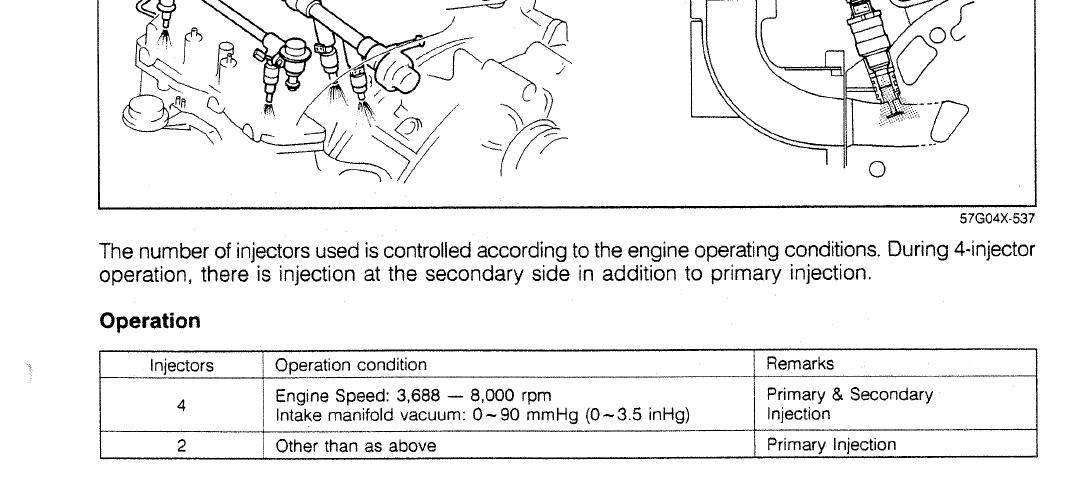
Ooh. So its the 3688 rpm hesitation.. I feel so much smarter today...
I pulled the vac hose off the boost sensor and ran the engine up the scale. Watching the rpms on a Fluke, I could tell the stumble was at around 3600rpm NOT 3800rpm. Although it's maybe trivial, I'm/have been tired of hearing about 3800rpms. It ain't.
This is the first time I've seen it in print. Thank you.
*****Tell you what. XXX, If you will, try this for me. Pull the line off the boost sensor and plug it. Then with a fully warmed up engine, slowly rev above 3500 rpm in your driveway. You'll definitly feel a small stumble when the secondary injectors come on. I've done this with two seperate cars and it comes at approx 3640 rpm (Fluke and SAFC). I'm not making trouble, not being a hardhead (yeah, right), but that is the figure I come up with. Thank you.***********
Last edited by HAILERS; Dec 22, 2005 at 01:24 AM.

BWAAA
Joined: Jan 2004
Posts: 1,167
Likes: 0
From: sofla-this isnt naxxramas
Originally Posted by J-Rat
Ooh. So its the 3688 rpm hesitation.. I feel so much smarter today...


Open up! Search Warrant!
Joined: May 2002
Posts: 3,838
Likes: 3
From: Kicking down doors in a neighborhood near you
Originally Posted by sc0rp7
It is commonly referred to as a "3800" rpm hesitation because of the innacuracy of the stock tachometer which may be anywhere from a hundred to five hundred rpms off at different times throughout the rev range....
- chris
- chris
Originally Posted by HAILERS
Uh, I felt so much smarter a couple of weeks ago when arguing about the point the secondaries came on line. I know I said *around 3600rpm*.
I pulled the vac hose off the boost sensor and ran the engine up the scale. Watching the rpms on a Fluke, I could tell the stumble was at around 3600rpm NOT 3800rpm. Although it's maybe trivial, I'm/have been tired of hearing about 3800rpms. It ain't.
This is the first time I've seen it in print. Thank you.
*****Tell you what. XXX, If you will, try this for me. Pull the line off the boost sensor and plug it. Then with a fully warmed up engine, slowly rev above 3500 rpm in your driveway. You'll definitly feel a small stumble when the secondary injectors come on. I've done this with two seperate cars and it comes at approx 3640 rpm (Fluke and SAFC). I'm not making trouble, not being a hardhead (yeah, right), but that is the figure I come up with. Thank you.***********
I pulled the vac hose off the boost sensor and ran the engine up the scale. Watching the rpms on a Fluke, I could tell the stumble was at around 3600rpm NOT 3800rpm. Although it's maybe trivial, I'm/have been tired of hearing about 3800rpms. It ain't.
This is the first time I've seen it in print. Thank you.
*****Tell you what. XXX, If you will, try this for me. Pull the line off the boost sensor and plug it. Then with a fully warmed up engine, slowly rev above 3500 rpm in your driveway. You'll definitly feel a small stumble when the secondary injectors come on. I've done this with two seperate cars and it comes at approx 3640 rpm (Fluke and SAFC). I'm not making trouble, not being a hardhead (yeah, right), but that is the figure I come up with. Thank you.***********
Hailers,
the common school of thought is "3800". Now that its been proven that it isnt 3800, then thats fine too, but due to the GROSSLY inaccurate nature of the FC tachometer, lots of people may interpret it as 3800. I am not debating your research, but i highly doubt the masses will start calling it the 3688 RPM hesitation overnight. In fact, that little peice of information, although very interesting, doesnt really change the way its handled.
But it is good to know..
Rat



^
(if the FSM does indeed say 3800) typical corporate bureaucrats. one set of idiots has a completely different set of information from another set of idiots, hence two documents from mazda contradicting each other
(if the FSM does indeed say 3800) typical corporate bureaucrats. one set of idiots has a completely different set of information from another set of idiots, hence two documents from mazda contradicting each other
HAILERS
Joined: May 2001
Posts: 20,563
Likes: 27
From: FORT WORTH, TEXAS,USA
Originally Posted by RETed
I thought the FSM stated "3800"...
-Ted
-Ted
It's nearly the same figure I came up with using a digital meter and having the vacuum hose off the pressrue sensor, in a thread some weeks prior to the publishing of the http://wombat.sevarg.net/RX7/RX-7_Training_Manuals/
I'll agree it's RX trivia or a sort. Even the 87FSM indicates in the Fuel section that they come on at 3500 rpm.
Triva like calling a emissions harness a engine harness when they're two seperate items. Like calling Jack Jill.

Lives on the Forum
Joined: Feb 2001
Posts: 26,664
Likes: 23
From: n
"Eliminating" the pressure sensor messes up the fuel delivery, so I dunno why you all are pulling hoses in the first place. :P
That's not a very real-world simulation of what is exactly happening under real driving conditions. :P
-Ted
That's not a very real-world simulation of what is exactly happening under real driving conditions. :P
-Ted
HAILERS
Joined: May 2001
Posts: 20,563
Likes: 27
From: FORT WORTH, TEXAS,USA
The manual at http://wombat.sevarg.net/RX7/RX-7_Training_Manuals/ does not take the vac input from the sensor. It's a statement on how the injectors work. Plus the figure matches what I've seen prior to ever reading that page out of the training manual. Coupled with the 87FSM fuel section info.


Thread
Thread Starter
Forum
Replies
Last Post
Jeff20B
1st Generation Specific (1979-1985)
73
Sep 16, 2018 07:16 PM
Tem120
3rd Generation Specific (1993-2002)
4
Sep 7, 2015 09:53 AM