


show us pics of your an fitting converted fuel system




Here is the start of mine.

some 6 an hose and lots of adapters.
It's the Aeromotive FPR.
This is the bare minimun so far.
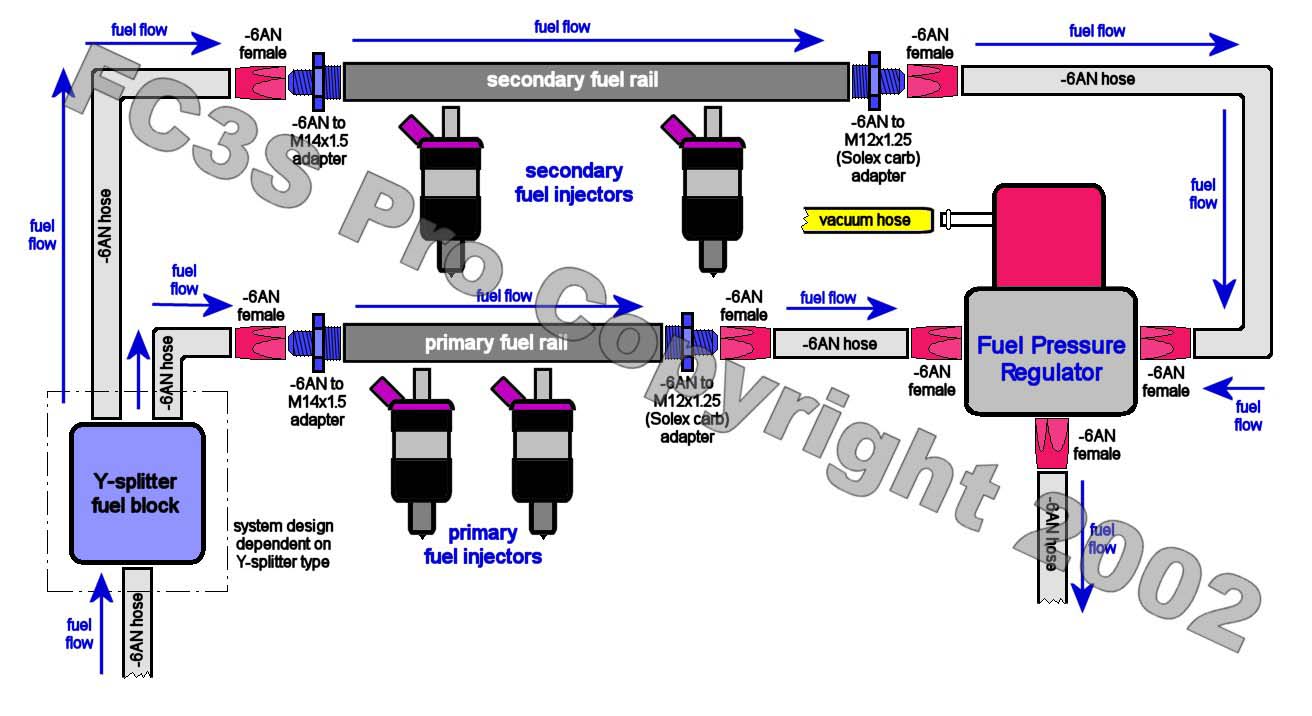
This will replace the lines from the secondary rail to the FPR and then to the return line.
This has cost me $240 so far and It's probably only 1/2 of what's needed.
some 6 an hose and lots of adapters.
It's the Aeromotive FPR.
This is the bare minimun so far.
This will replace the lines from the secondary rail to the FPR and then to the return line.
This has cost me $240 so far and It's probably only 1/2 of what's needed.


Rotary Enthusiast


Joined: Jan 2002
Posts: 845
Likes: 38
From: Oscoda, MI
Marren FPD with -6AN hose from primary to secondary rails
I know this is off-topic, but since my installation used -6 AN fittings and hose, I felt it was noteworthy.
Since the S4 86-88 FPD is notorious for leaking and causing engine fires when not replaced, I decided to go with Marren's FPD and some AN fittings. I wouldn't consider this a converted fuel system since I'm still running stock sized 5/16" hose to and from the fuel rails. But, from the primary to secondary fuel rails I ended up running a length of -6 AN braided stainless steel hose, and used metric to AN adapters on each rail.
The attached pic is of the secondary fuel rail, and I know it's not the best, but it gives you an idea. I already have written a write-up of the installation and what issues to expect, but I'm waiting until I've driven the car some more. I've already run the engine on and off for over a week, and driven the car yesterday, and found no problems. Next up is a walbro 255 pump (already on hand), 550CC injectors, and wet nitrous for the fuel system.
Since the S4 86-88 FPD is notorious for leaking and causing engine fires when not replaced, I decided to go with Marren's FPD and some AN fittings. I wouldn't consider this a converted fuel system since I'm still running stock sized 5/16" hose to and from the fuel rails. But, from the primary to secondary fuel rails I ended up running a length of -6 AN braided stainless steel hose, and used metric to AN adapters on each rail.
The attached pic is of the secondary fuel rail, and I know it's not the best, but it gives you an idea. I already have written a write-up of the installation and what issues to expect, but I'm waiting until I've driven the car some more. I've already run the engine on and off for over a week, and driven the car yesterday, and found no problems. Next up is a walbro 255 pump (already on hand), 550CC injectors, and wet nitrous for the fuel system.
Trending Topics

Lives on the Forum

Joined: Feb 2001
Posts: 26,664
Likes: 23
From: n
AN fittings do NOT use anything.
NPT fittings require teflon tape or equivalent.
Everything else needs a crush washer or o-ring.
A hint between crush washer or o-ring, look at the mating surfaces.
If you can see a chamfer or bevel (usually not on AN fitting), use an o-ring.
If both surfaces are flat, use a crush washer.
If you're rich, use a "stat-o-seal".
-Ted
NPT fittings require teflon tape or equivalent.
Everything else needs a crush washer or o-ring.
A hint between crush washer or o-ring, look at the mating surfaces.
If you can see a chamfer or bevel (usually not on AN fitting), use an o-ring.
If both surfaces are flat, use a crush washer.
If you're rich, use a "stat-o-seal".
-Ted
Last edited by RETed; Oct 4, 2004 at 03:45 PM.




I'm a boost creep...

Joined: Jan 2002
Posts: 15,608
Likes: 8
From: Auckland, New Zealand
Originally Posted by RETed
AN fittings are more expensive.
AN fittings are reuseable.
AN fittings look pretty.
AN fittings typically handle more pressure.
Pick one...or all of the above.
AN fittings are reuseable.
AN fittings look pretty.
AN fittings typically handle more pressure.
Pick one...or all of the above.

People will argue otherwise (and with some justification) but the main reason most people do this is pure bling, bling. Quality rubber EFI hose will handle far more pressure than any automotive fuel system runs at (400psi), and will last for many years in a hot engine bay. And has anyone ever heard of a properly installed quality hose clamp letting a hose pop off? Not me...

I live in an igloo
Joined: Jul 2004
Posts: 2,546
Likes: 0
From: calgary alberta
Originally Posted by NZConvertible
My money's on #3...
People will argue otherwise (and with some justification) but the main reason most people do this is pure bling, bling. Quality rubber EFI hose will handle far more pressure than any automotive fuel system runs at (400psi), and will last for many years in a hot engine bay. And has anyone ever heard of a properly installed quality hose clamp letting a hose pop off? Not me...
People will argue otherwise (and with some justification) but the main reason most people do this is pure bling, bling. Quality rubber EFI hose will handle far more pressure than any automotive fuel system runs at (400psi), and will last for many years in a hot engine bay. And has anyone ever heard of a properly installed quality hose clamp letting a hose pop off? Not me...
My fuel lines and clamps are fully functional after 17 years of use, if anything, they could easily go for about 10 years, they're in mint condition.
If you go out and get some good quality high PSI fuel line like nzonvertable said, you won't ever have any problems.
Rotary Enthusiast
Joined: Jan 2002
Posts: 845
Likes: 38
From: Oscoda, MI
For the record, I only went with SS hose and fittings when I installed the new FPD for two reasons:
1. Relatively easier than fabbing something when AN fittings are available off-the-shelf
2. Safer than trying to force 5/16" fuel hose on a barbed -6AN straight fitting.
I think that if it's functional, necessary, and works as good or better than stock, it's not bling. Besides, you can't see the hose and I use stock sized fuel hose and new clamps for the rest of the system. You want bling, go with the SS-look hose coverings and clamps.
1. Relatively easier than fabbing something when AN fittings are available off-the-shelf
2. Safer than trying to force 5/16" fuel hose on a barbed -6AN straight fitting.
I think that if it's functional, necessary, and works as good or better than stock, it's not bling. Besides, you can't see the hose and I use stock sized fuel hose and new clamps for the rest of the system. You want bling, go with the SS-look hose coverings and clamps.
