When you click on links to various merchants on this site and make a purchase, this can result in this site earning a commission. Affiliate programs and affiliations include, but are not limited to, the eBay Partner Network.
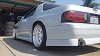
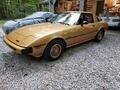
I bought an '86 FC GXL in April this year. The previous owner had already put a lot of work into the car, but had to give it up, since his medical condition didn't allow him to further work on the car. He had replaced the broken enigne with a factory restored engine and a new transmission. Both have about 11k miles on them and worked as intended. Then he decided to get the entire car a new coat of paint. They did a great job with it, even coated the inside of the panels in the original gold paint.
I bought it in a semi reassembled state. So I did some further reassembling, changed all fluids that remained in the car, and got a new battery. All was good so far. When we installed the battery and tired starting the engine the starter shortet out and fried the main relay and the wire connecting the injectors to the resistor pack. So far no problem, since the previous owner sold me the car with an entire garage worth of spare parts he had pulled from other cars. The fuel pump needed replacing, so I did that. Then I replaced all vacuum lines and the injector seals and then tested the injecotrs, which work just fine. I got the car to run by giving the injectors constant ground or by using starter spray. Compression is as far as I could tell good and the ignition certainly works as expected. I measured all sensors and they all show expected values.
Now the question remains, what could possibly be the issue for the injection to not work. I suspect the ECU (N322) was damaged by the short out, but upon opening I couldn't detect any visible damage that would indicate that.
So I'm hoping I can find an answer here. Have I overlooked something? Or should I order a working ECU?
There is a ground located under the upper intake manifold. I would inspect that ground and make sure it is connected properly.
A simpler way to check is to probe 3A or 3G and test for continuity with ground. If it tests open then I would remove the UIM and inspect ground #24 in the FSM.
Post results.
EDIT: I know you had electrical issues but this is still a good place to start. If you do have a fried wire or component these steps would help in the process of deduction.
Last edited by Rotary Alkymist; Sep 29, 2019 at 11:59 AM.
I forgot to mention, I already checked both the ECU grounding and main harness grounding, both being intact. I even removed the ECU ground under intake and sanded of both surfaces slightly. I checked all connecting wires for proper voltage and of course their connection after the issue with the first wire.
This is why I assumed, that damage to the ECU is the only likely issue.
Have you tested to see if the ECU is actually triggering the grounds? You could use a test light to see if the ECU is doing what it's supposed to be doing. Be sure to test the primary grounds.
Then you could say with a good amount of confidence that it is the ECU.
Last edited by Rotary Alkymist; Sep 29, 2019 at 06:33 PM.
Okay, I checked everything, and I am absolutely certain now, that the ECU is fried. Thanks for the support, a replacement is already on its way. I'll send an update, once the new ECU is installed.
So the new ECU arrived and is installed. I'm finally getting the warning lights, but I'm still not getting a pulse. Information on the N322 (1986) ECU seems to be limited, so I only know a few things about the connectors.
I think you have to get your hands dirty man. Take the UIM off and verify that you have power at the injectors. It must be done. I'm always skeptical about the ECU being the culprit. In most cases it isn't.
I'll say it again, take the UIM off and test for power at the injectors. It really doesn't take that long to access them.
I think you have to get your hands dirty man. Take the UIM off and verify that you have power at the injectors. It must be done. I'm always skeptical about the ECU being the culprit. In most cases it isn't.
I'll say it again, take the UIM off and test for power at the injectors. It really doesn't take that long to access them.
Its a NA so I think he can just check for power at the secondaries without removing the LIM?
OP does your tach bounce when youre turning the engine over? Have you double checked the other under hood fuses?
I have checked the injectors for power, both primary and secondary. I actually managed to get the engine to run by giving the ECU outputs constant ground via a homemade wire. And yes the I can see the revs bounce when cranking the engine. I checked the sensors and they seemed to be fine ( according to the factory repair manuals resistance values). So I figure it's probably a case faulty wires connecting one of the sensors. But since I don't know where the sensors actually connect to the ECU I can't check the connection.
I forgot that part. True. I would inspect CAS wiring. There aren't too many things that are gonna cause this issue. I also believe it is a wiring issue. I would be doing some end to end continuity tests on most if not all wires associated the the fuel system and I would also confirm that the CAS wiring is sound and the CAS is functioning properly.
EDIT: I would also test all associated relays.
EDIT: If you are CERTAIN that the injector power and grounds are working(ALL of them), relays included, then I would definitely start thinking CAS.
Last edited by Rotary Alkymist; Oct 11, 2019 at 01:26 PM.
Yes, and the resitor pack is still in good shape. As mentioned before I used a wire to connect the ECU injector pinouts to constant ground and the injectors worked just fine. So I just need to find the reason why the ECU is failing to send out the pulse, which to my knowledge is linked to a missing signal from either the airflow meter or the water temperature sensor. Both had good read outs upon inspection, which was why I presumed the ECU to be at fault. Now I'm quite certain that the connection to one of the two is no longer existant, but since I don't know where they connect to the ECU I can't check, which was why I was searching for information on the pinout of the Denso N322 ECU that is used in the early Euro FC N/A.
EDIT: If you are CERTAIN that the injector power and grounds are working(ALL of them), relays included, then I would definitely start thinking CAS.
If the tach is bouncing wouldnt that rule out the CAS?
Rotary ressurection says "1986 and 1987 model cars used low impedance(2-3 ohm) injectors. Low impedance injectors have a center notch on the plug. The wiring harness used with LI injectors integrates an injector resistor pack, wired inline between the ECU and injectors(under stock air box) to bump overall load seen at the ECU to 12-13 ohms."
But this wiring diagram says the resistor pack is between the main relay and injectors.
Which one is true? Anyone know?
Last edited by FührerTüner; Oct 11, 2019 at 04:34 PM.
Have you tested the Circuit Opening Relay? That is directly connected to the main relay and if you had a short it could've been affected. The air flow meter is powered by this relay.
If the tach is bouncing wouldnt that rule out the CAS?
Rotary ressurection says "1986 and 1987 model cars used low impedance(2-3 ohm) injectors. Low impedance injectors have a center notch on the plug. The wiring harness used with LI injectors integrates an injector resistor pack, wired inline between the ECU and injectors(under stock air box) to bump overall load seen at the ECU to 12-13 ohms."
But this wiring diagram says the resistor pack is between the main relay and injectors.
Which one is true? Anyone know?
I was just really assuming. If the ECU isn't firing the injectors then the CAS could be the culprit. I can't remember if all sensors cause this. Check voltage of brown/white wire at CAS and check it at the air flow meter while you're at it. You should see like 5v or something.
I just checked the colours on my car because I forgot if the brown/white wire went to the CAS and it doesn't. I would still check the brown/white wire at the AFM and the boost sensor.
Looking at the diagram I see that 2A is Vref. I would verify voltage on this pin. I would also test for voltage on all sensors connected to that brown/white wire.
EDIT: Digging deeper I see that you actually test 4.5-5.5V at 2A and 4V at 2E(AFM).
Last edited by Rotary Alkymist; Oct 11, 2019 at 08:22 PM.
Okay, I checked the CAS, which by the way works just fine, but thanks to your heads up. I checked the circuirt opening relais. As it turned out the relais isn't supplying the air flow meter with power. This is due to the fact that the ECU isn't powering the relais. Since the new ECU works perfectly fine I assume the ECU might not be getting power at some point.
I checked the ECU power supply at 3J and 3I, mind you only one actually has a wire connection. Nothing. I presume the connection to the fuse box is non existant, since the fuses are all in good shape, and other functions, that depend on the power from the fuse box still work.
I checked 2A and got nothing.
Thanks for the heads up. I've been chasing this issue for quite some time now, but as it seems the issue was smaller than originally expected. I'll post an update as soon as it is dry enough to fix the wiring issue. But since everything else has been ruled out by either replacing or testing I am now very confident that this might be it.
I checked the ECU power supply at 3J and 3I, mind you only one actually has a wire connection. Nothing. I presume the connection to the fuse box is non existant, since the fuses are all in good shape, and other functions, that depend on the power from the fuse box still work.
I checked 2A and got nothing.
Thanks for the heads up. I've been chasing this issue for quite some time now, but as it seems the issue was smaller than originally expected. I'll post an update as soon as it is dry enough to fix the wiring issue. But since everything else has been ruled out by either replacing or testing I am now very confident that this might be it.
I know you said you checked the fuses but for 3J all you have is the 60a "BTN" underhood fuse and the 7.5a "room" cabin fuse.
Last edited by FührerTüner; Oct 16, 2019 at 08:09 AM.
Yeah, so I checked the connections and realised I had 12 V at the second fuse. The connection from there to the ECU is also still good. But here comes the joke: The wire has somehow found a way to gorund itself before reaching the ECU. I presume the single pin connectors isolation to be at fault, but that's something I'll have to find out. I'll post an update once I checked the connector. If necessary I will replace faulty wires, but his should do the trick.