When you click on links to various merchants on this site and make a purchase, this can result in this site earning a commission. Affiliate programs and affiliations include, but are not limited to, the eBay Partner Network.
Hi,
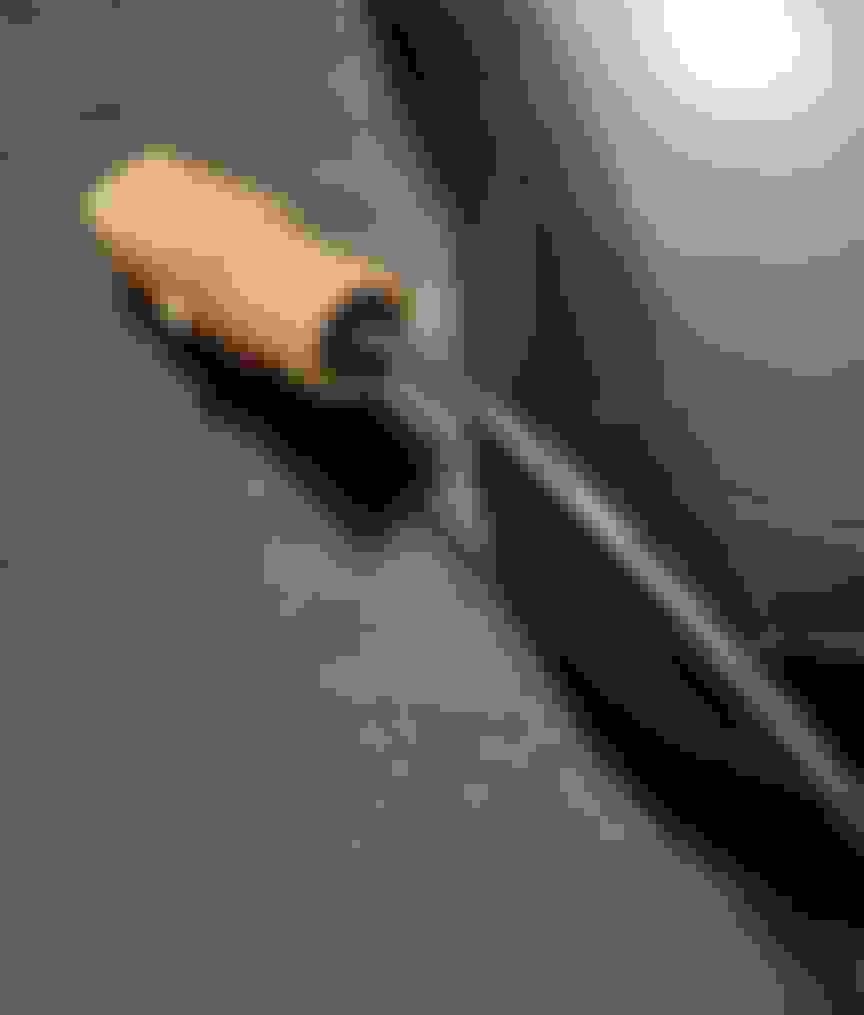
This hanger bolt and nut came stock in this location when I purchased my 88 GXL off the showroom floor. My question is why is it so long and why is the end slotted? A regular flanged bolt and nut would suffice. My only answer is that they had a large quantity of these bolts on hand from a different application and wanted to use them up. Any ideas would be appreciated.
I have another mystery for you, why does the battery box have a plastic window in it? What is its purpose? Rear hanger bracket
Hard to guess what Mazdas intention was, but if I had to guess, it's like a stud that helps align the engine to the transmission on install before you slide the two together far enough for the dowel pins to engage. The slot is pretty bizarre. No idea on that
I've never had the battery box in any of my cars so uh.... no idea lol
+1 that bolt acts like a stud so when you go to mate up the trans its got something to locate on, but its only the one so you're not over constrained.
the slot lets you remove the bolt without having to pull the intake.
+1 that bolt acts like a stud so when you go to mate up the trans its got something to locate on, but its only the one so you're not over constrained.
the slot lets you remove the bolt without having to pull the intake.
Great, it makes sense that starting the transmission alignment on a long bolt, it will constrain any positioning movement to only pivoting. Get the input shaft lined up with the pilot bearing would be very easy this way.
The slotted end starts to make sense when starting the bellhousing hole unto this bolt you need some way to protect the starting treads from getting chewed up from the bellhousing. So you add a smaller sized area at the end of the bolt to help get the hole aligned and take the initial contact.
The slot is a mystery still. It does make it easier to tighten or loosen this very long bolt. It gets pretty tedious using a ratchet on it. Probably saved a whole 2 minutes on the assembly line.
In my haste to remove the engine I just threw the nuts and bolts into sandwich bags without labling where they go! I know better!
Here are five grade 10 bolts and lock washers, I have know idea where they go! The clutch plate takes 6, the transmission mount takes 4. Please help me find where these go.
They have those soft shoulders and no flange!
Two different lengths, The two longer ones have shanks.
The reason for the two different length clutch bolts
Originally Posted by j9fd3s
those are for the pressure plate, if you look there are two different types of holes. no idea why, it just is
As I attached the new pressure plate I noticed that two of the holes in the flywheel have threads that start about 1/4" from the top!
So, I figured the two longer bolts go into these holes.
I checked the depth of all the bolt holes and they were all the same!
Ok, when I attempted start the short bolts they would not reach the holes because of the free height of the pressure plate.
I managed to get one started by pressing the plate inwards but the opposite edge was canted away from the flywheel. I could not push the edge close enough to start another bolt.
But if I just slightly started one of the longer bolts into its hole, I was able to get the other longer bolt started in its hole!
After tightening these two bolts part way I was then able to start the other four shorter bolts.
Once they all were started it was easy to tighten them in a cross ward pattern. Then using a torque wrench I brought them all up to 20 ft/lbs.
It makes sense once you know what is what, do all clutch plates use a similar arrangement? Why not just use longer bolts all the way around, perhaps to keep fast mechanics from mounting the pressure plate slightly canted onto the flywheel?
If I remember correctly, it's a capacitor that's used to smooth out the response from the oil pressure sender so the needle on the gauge doesn't bounce around
why does the battery box have a plastic window in it? What is its purpose?
To check electrolyte levels in the battery. At the time, factory battery bodies were that semi-opaque white plastic and had high/low level indications molded into them, which you could inspect through that window.
>>> It makes sense once you know what is what, do all clutch plates use a similar arrangement?
>>> Why not just use longer bolts all the way around, perhaps to keep fast mechanics from mounting the
>>> pressure plate slightly canted onto the flywheel?
Rather than those special bolts, S5's use dowel pins to center the PP. S5's also use the same length bolts, six in total, to secure the PP to the flywheel.
As pzr2 mentioned, it's a capacitor or otherwise known as a condenser. They both do the same thing. They only react to a varying voltage. They are a open circuit to a DC voltage. There should be two of them on your car. The one that you show that's bolted to the slave cylinder and the other one it bolted next to the igniter. Supposedly, one is for the oil pressure gauge and the other is for radio static suppression. Don't loose them because they are NLA from Mazda.
As pzr2 mentioned, it's a capacitor or otherwise known as a condenser. They both do the same thing. They only react to a varying voltage. They are a open circuit to a DC voltage. There should be two of them on your car. The one that you show that's bolted to the slave cylinder and the other one it bolted next to the igniter. Supposedly, one is for the oil pressure gauge and the other is for radio static suppression. Don't loose them because they are NLA from Mazda.
Great to know these things, is the mounting bracket of the condenser part of the electrical connection? I was considering priming and painting the metal to prevent further corrosion. If it needs to be metal to metal contact I will just put a coat of dielectric grease over it.
Thanks also for the link to get connectors!
Here is one ground wire I found the reason for, you know that wire that clips on the firewall and goes to a bolt on the top of the bellhousing!
It's to ground the AM antenna in the windshield, also those ground straps from the body to the mufflers, to stop radio static from the moving exhaust gases building up a static charge inside the mufflers! Nice to know!
those are for the pressure plate, if you look there are two different types of holes. no idea why, it just is
They double as locators so the pressure plate can only go onto the flywheel one way. The shanked bolts only fit in two holes in the pressure plate and they only fit in two holes in the flywheel. You can't flip the pressure plate 180 degrees because there are three dowel pins.
Great to know these things, is the mounting bracket of the condenser part of the electrical connection? I was considering priming and painting the metal to prevent further corrosion. If it needs to be metal to metal contact I will just put a coat of dielectric grease over it.
Thanks also for the link to get connectors!
Here is one ground wire I found the reason for, you know that wire that clips on the firewall and goes to a bolt on the top of the bellhousing!
It's to ground the AM antenna in the windshield, also those ground straps from the body to the mufflers, to stop radio static from the moving exhaust gases building up a static charge inside the mufflers! Nice to know!
It is a two terminal device. The mounting bracket serves as the ground. Just FYI, in case you need one, a similar condenser is still available for the FD and RX8, but the electrical connector may be different. Here is a link: https://www.atkinsrotary.com/93-11-R...A1-66-991.html
That connector gets used on both the O2 sensor (harness side) and knock sensor (also harness side) if you're turbo. But you said GXL so I'm assuming not.
Not really useless... distributors needed to be adjustable because when you adjust or replace the points, or even as the points wear, the timing changes, so you have to be able to adjust timing as part of your regular tuneup procedure (every thousand miles or so).
With electronic ignition, the breaker plates still wear a little and you need to be able to adjust the timing.
With a crank angle sensor, that sucker is set and forget. Once it's set correctly, it should not ever need to be touched. So, it gets a litte bitty Elizabethan collar over the nut.
And, for what it's worth, TIL why FC front covers have that funny shaped stud! FB/SA covers had bolts, not studs...