


discussion on OMP delete


Thread Starter
Senior Member
Joined: May 2010
Posts: 535
Likes: 0
From: vancouver, bc
discussion on OMP delete
so i have an s4 t2. engine is out ATM and being prepped to return to it's home. long story short, i broke one of the OM lines trying to sneak the turbo oil feed line in long after i should have. so i got to thinking about pros and cons to keeping this system in place.
cons:
-possible future leaks
-possible malfunction
-injection of used engine oil
-engine oil not really meant to be burnt, so can't see it having a great effect on the catalysts
pros:
????
of course i would be running a premix regardless.
if someone can offer me some insight as to how this system would be advantageous, i would love to hear it. i don't mind buying the line. would mean a little more down time, but i don't mind being patient if the ends justify the means.
as always, much appreciated
cons:
-possible future leaks
-possible malfunction
-injection of used engine oil
-engine oil not really meant to be burnt, so can't see it having a great effect on the catalysts
pros:
????
of course i would be running a premix regardless.
if someone can offer me some insight as to how this system would be advantageous, i would love to hear it. i don't mind buying the line. would mean a little more down time, but i don't mind being patient if the ends justify the means.
as always, much appreciated

Thread Starter
Senior Member
Joined: May 2010
Posts: 535
Likes: 0
From: vancouver, bc
i figured it had. my apologies if i'm beating a dead horse here. but i did search and all i came up with was instructions and places that sell block off plates/omp parts. if anyone has a link or two, i'd appreciate that greatly
edit: switched up some of the search words and found a few links. my apologies. thread can be deleted
edit: switched up some of the search words and found a few links. my apologies. thread can be deleted
Last edited by welfare; May 11, 2013 at 10:58 AM.
Best way to do it is search on Google and put in the word rx7club , the search engine on here isn't all that great.
Alot of the premix use is a matter of personal preference.
Rotary > Pistons
Alot of the premix use is a matter of personal preference.
Rotary > Pistons



Joined: Mar 2001
Posts: 31,796
Likes: 3,210
From: https://www2.mazda.com/en/100th/
for the metering system;
pros:
it works, you don't have to fiddle with it after the engine is in.
cons:
the pumps leak.
for premixing;
pros: you control the oil ratio, so if you're racing, you can have a little too much oil instead of too little.
cons: you have to remember to do it, you have to add an extra thing every time you stop for gas. 99% of the time in a street car you're over oiling, except on decel, when you're way under oiling.
i don't mind premixing the race car, but on the street car i just want it to be like a normal car
pros:
it works, you don't have to fiddle with it after the engine is in.
cons:
the pumps leak.
for premixing;
pros: you control the oil ratio, so if you're racing, you can have a little too much oil instead of too little.
cons: you have to remember to do it, you have to add an extra thing every time you stop for gas. 99% of the time in a street car you're over oiling, except on decel, when you're way under oiling.
i don't mind premixing the race car, but on the street car i just want it to be like a normal car
Thread Starter
Senior Member
Joined: May 2010
Posts: 535
Likes: 0
From: vancouver, bc
there's also the fact that you can run synthetic though. and that you aren't injecting spent oil into the housing to be burned.
the only disadvantage that i'm seeing is that, for whatever reason, it's this great pain to dump a little premix in the tank every time you fill up.
well, that and the lack of fuel/mix during decel. but then, the level of lubrication using the premix should be adequate for the short decel period
the only disadvantage that i'm seeing is that, for whatever reason, it's this great pain to dump a little premix in the tank every time you fill up.
well, that and the lack of fuel/mix during decel. but then, the level of lubrication using the premix should be adequate for the short decel period


Joined: Sep 2005
Posts: 25,581
Likes: 136
From: Smiths Falls.(near Ottawa!.Mapquest IT!)
But again,the time de-acellerating is so Small compared to when the engine is actually getting premixed fuel that the 2 stroke/gas mix should have enough lube to protect the engine.
I don't see weedwhackers seizing up when you let the trigger off!
I don't see weedwhackers seizing up when you let the trigger off!
Trending Topics


There's a hill I drive down after I get off work and I am on lean decel for up to 30 seconds, is that too long for no lube? I usually give it some gas because of this question.


That's a big hill, just roll down like he said in neutral, you'll build up more speed that way anyways, at least in my opinion.
I always do that to save gas.
I take it theres no way to stop the fuel cut on decel.
Rotary > Pistons
I always do that to save gas.
I take it theres no way to stop the fuel cut on decel.
Rotary > Pistons
Thread Starter
Senior Member
Joined: May 2010
Posts: 535
Likes: 0
From: vancouver, bc
typically, you wouldn't need to stop fuel cut on decel, as you have very little air entering the chambers.
so far i'm not seeing many advantages to running the stock omp. i dunno. guess it's hard to tell without cracking open a motor that has only run premix it's whole life. and even then, there are many other variables.
so far i'm not seeing many advantages to running the stock omp. i dunno. guess it's hard to tell without cracking open a motor that has only run premix it's whole life. and even then, there are many other variables.
From everything builders say the motors running premix compared to only the stock omp are like comparing night and day.
The motors using premix have less wear and the ones using only the stock omp have more wear.
To ensure I dont forget to pre mix I plan on putting some kind of reminder on the other side of the gas door or something similar.
Rotary > Pistons
The motors using premix have less wear and the ones using only the stock omp have more wear.
To ensure I dont forget to pre mix I plan on putting some kind of reminder on the other side of the gas door or something similar.
Rotary > Pistons

talking head

Joined: Apr 2008
Posts: 2,775
Likes: 15
From: Perth, WA, OZ
From everything builders say the motors running premix compared to only the stock omp are like comparing night and day.
The motors using premix have less wear and the ones using only the stock omp have more wear.
To ensure I dont forget to pre mix I plan on putting some kind of reminder on the other side of the gas door or something similar.
Rotary > Pistons
The motors using premix have less wear and the ones using only the stock omp have more wear.
To ensure I dont forget to pre mix I plan on putting some kind of reminder on the other side of the gas door or something similar.
Rotary > Pistons
i challenge anyone .. anyone .. to show me rotors or turbos that are cleaner than mine....
my turbine wheels are stark white and rotor carbon at 50 000 km in is negligible..
..i have OMP.. lots of it .. i even use dino oil
i dont have stupidly rich mixtures ..
..this is the NO 1 contributer to carbon build up when incomplete combustion leads to many acetylene like by products that leave heavy soot residues
overly rich mixtures also force a viscous cycle of now requiring more oil % in the fuel air mix to retain the same lubrication due to washdown
overly rich mixtures are used ( in the case of wet fuels ) .. for boundary cooling for a preventative detonation control purpose .
modern control strategies using active knock control offer a method to remove the band aid .. but it is seldom utelised in rotors .. where conservative timing and overly rich mixtures are used instead to avoid detonation at all costs
the result is carbon

i build engines and i dispute this .. i also run an LPG car,, where you cant premix on it ... its run fat on the OMP all its time
i challenge anyone .. anyone .. to show me rotors or turbos that are cleaner than mine....
my turbine wheels are stark white and rotor carbon at 50 000 km in is negligible..
..i have OMP.. lots of it .. i even use dino oil
i dont have stupidly rich mixtures ..
..this is the NO 1 contributer to carbon build up when incomplete combustion leads to many acetylene like by products that leave heavy soot residues
overly rich mixtures also force a viscous cycle of now requiring more oil % in the fuel air mix to retain the same lubrication due to washdown
overly rich mixtures are used ( in the case of wet fuels ) .. for boundary cooling for a preventative detonation control purpose .
modern control strategies using active knock control offer a method to remove the band aid .. but it is seldom utelised in rotors .. where conservative timing and overly rich mixtures are used instead to avoid detonation at all costs
the result is carbon
i challenge anyone .. anyone .. to show me rotors or turbos that are cleaner than mine....
my turbine wheels are stark white and rotor carbon at 50 000 km in is negligible..
..i have OMP.. lots of it .. i even use dino oil
i dont have stupidly rich mixtures ..
..this is the NO 1 contributer to carbon build up when incomplete combustion leads to many acetylene like by products that leave heavy soot residues
overly rich mixtures also force a viscous cycle of now requiring more oil % in the fuel air mix to retain the same lubrication due to washdown
overly rich mixtures are used ( in the case of wet fuels ) .. for boundary cooling for a preventative detonation control purpose .
modern control strategies using active knock control offer a method to remove the band aid .. but it is seldom utelised in rotors .. where conservative timing and overly rich mixtures are used instead to avoid detonation at all costs
the result is carbon
does the OMP system work? yes, for people unconcerned with additional maintenance.
do i have pictures of rotors with zero carbon on them from premixed engines with no wear lines? nope(well technically i'm sure i do somewhere but i'm not going to bother since this is a beaten to death topic), but i have seen the differences of engines built using the factory metering system and others with similar scenarios running premix to do comparisons. the metered engines always had carbon stuck to the rotors even after 1,000 miles.
do people actually spec housings for wear lines that aren't visible?(why would you, it's not even in the FSM) most do not, people are more concerned with chrome flaking at the edges but there are more spots where combustion will leak across chambers than just at the edge of a housing. again, many housings i visually would pass years ago i would fail today because i have become more **** about wear lines which cause longer break in time, crowned seals and poorer peak performance. why keep that tradition going when there is an alternative?
but premixing isn't for everyone, we all realize this. premixing is superior, you can argue it all you want. it however is more of a headache and a slight increase in maintenance costs and effort. i hate pulling apart dry OMP carboned up engines, premixed engines always have a nice film of oil on everything.
then there is the often overlooked filling stage of the metering system. the FSM doesn't even make a note that your engine is running completely dry for hundreds of miles before filling the system to actually inject oil. to fight this you either have to manually fill the lines which is nearly impossible or PREMIX temporarily.
do i hate premixing? yeah i do. it's a nuisance but something you sacrifice in order to keep an engine healthier, longer. at 200+k miles on all my turbo internals(minus apex, soft and side seals) i'm not about to switch back. the engine would be even healthier if i had the options 10 years ago that i do now.
you're also running LPG, not dirty pump gasoline.
Last edited by RotaryEvolution; May 12, 2013 at 03:14 PM.
talking head
Joined: Apr 2008
Posts: 2,775
Likes: 15
From: Perth, WA, OZ
yes im running LPG.. not dirty petrol.. thank you for entirely backing up my point
....the source of carbon is excessively rich petrol mixtures
.. BINGO..
should stop this discussion now but i will nail it home for you.. becsaue done do death wrong and spouted as gospel through this forum
.. .. is something i wish to address right now
proves only that at times excessive mixture is reducing the lubrication effect at the housing and in fact completely verifies what i had to say above
...why is it that my OMP injected engines that do not run massively wet mixtures do no have any wear that you have noted above .,.. and has a stark white turbine housing ?
magic??
or could it be that you and most of the forum spouted rubbish about the reasons for carbonisation on this forum are entirely wrong?
going by your theory i would be more worn and more coated in carbon???
but,, simply i am not..completely the opposite
and the pics you ( dont ) have of all these engines??
so you built them and knew of the housing condition before.. and at 50 000 kms in?
and was fully aware of the premix and not history of those engines???
i think not??
the examples i give.. i built.. drove.. i inspected at 50 000 km in and have a fair evaluation of the starting point the housings and rotors are at
.. and the driving conditions all through its life.
NONE of the examples you pull down for other people fit in this boat
..they are ONLY your observation at what the wear and carbon is on pull down
. ..you see neither the starting point or have any clue or quality control of the driving and lubrication history
so why is it from this you draw the conclusion that OMP is bad ?
i see is a terrible 'old school' tuning strategy applied by aftermarket tuners to avoid detonation at all costs ..instead of proper mixture control and active/ effective ignition knock control .. result is overly rich running under load
i see is a terrible warm up strategy from the factory.. all in effort to save a cat,, at great expense of fuel and carbonisation
( and evident with all the cold restart flooding issues from s4 - rx8 )
i see excessively rich mixtures washing the housing lube away and contributing to carbon build up on rotors .
.. also evident where mazda recommend a lube ratio that premix tuners ignore at higher HP.. they are running at 100:1 when they go for higher boosts,, evident that the 10:1 and 11:1 mixtures need more lube to prevent the washdown effect
mazda didnt see the need for 100:1 .. as they didnt tune/ setup OMP for stupid rich 10.5 :1 petrol mixes past 20 psi
....the source of carbon is excessively rich petrol mixtures
.. BINGO..
should stop this discussion now but i will nail it home for you.. becsaue done do death wrong and spouted as gospel through this forum
.. .. is something i wish to address right now
i'll dispute it all day. do i have time to take pictures of dozens upon dozens of rotor
housings with excessive wear lines in the center of the housings to prove it does in fact cause additional wear to prove a point for you? no.
housings with excessive wear lines in the center of the housings to prove it does in fact cause additional wear to prove a point for you? no.
...why is it that my OMP injected engines that do not run massively wet mixtures do no have any wear that you have noted above .,.. and has a stark white turbine housing ?
magic??
or could it be that you and most of the forum spouted rubbish about the reasons for carbonisation on this forum are entirely wrong?
going by your theory i would be more worn and more coated in carbon???
but,, simply i am not..completely the opposite
and the pics you ( dont ) have of all these engines??
so you built them and knew of the housing condition before.. and at 50 000 kms in?
and was fully aware of the premix and not history of those engines???
i think not??
the examples i give.. i built.. drove.. i inspected at 50 000 km in and have a fair evaluation of the starting point the housings and rotors are at
.. and the driving conditions all through its life.
NONE of the examples you pull down for other people fit in this boat
..they are ONLY your observation at what the wear and carbon is on pull down
. ..you see neither the starting point or have any clue or quality control of the driving and lubrication history
so why is it from this you draw the conclusion that OMP is bad ?
i see is a terrible 'old school' tuning strategy applied by aftermarket tuners to avoid detonation at all costs ..instead of proper mixture control and active/ effective ignition knock control .. result is overly rich running under load
i see is a terrible warm up strategy from the factory.. all in effort to save a cat,, at great expense of fuel and carbonisation
( and evident with all the cold restart flooding issues from s4 - rx8 )
i see excessively rich mixtures washing the housing lube away and contributing to carbon build up on rotors .
.. also evident where mazda recommend a lube ratio that premix tuners ignore at higher HP.. they are running at 100:1 when they go for higher boosts,, evident that the 10:1 and 11:1 mixtures need more lube to prevent the washdown effect
mazda didnt see the need for 100:1 .. as they didnt tune/ setup OMP for stupid rich 10.5 :1 petrol mixes past 20 psi
talking head
Joined: Apr 2008
Posts: 2,775
Likes: 15
From: Perth, WA, OZ


when your premix engine returns these light colours .. dont care what fuel... then we will have something to talk about
.. the petrol / aftermarket tuned and premixed turbo is self evident in the pics.. hints,, the OMP fed one is the light coloured one ....
OMP injected. mixtures at idle are lambda.. and under load ..about 0.9... turbo and rotors are very clean .. the housings also show no abnormal wear
stable mixture range of LPG fuel allows me to run in these mixtures with absolute safety
.. a petrol engine is more unstable / fickle with engine timing and thus old school tuning strategy is to run rich and retarded to keep within a safe "no det" zone with as fat a spark as possible ... at 11.5 down to 10.5:1 .. and will make carbon all day long
if you put 70 L of petrol in every 300 km nearly a third of it doesnt burn at 10.5 :1 ...
...yet you add 1 L of direct injected oil every 2000 km
tell me again what is the major source of incompletely combusted carbon through such an engine?
Last edited by bumpstart; May 12, 2013 at 08:04 PM.

This is what my turbine wheel looks like...I premix and tend to run pretty rich at idle/wot. Cruise AFR is around 15. Premium fuel, premix with lucas 2 cycle(.5-1.0 oz /gallon). This part has around 6,000 miles on it. I also inject water above 10psi.
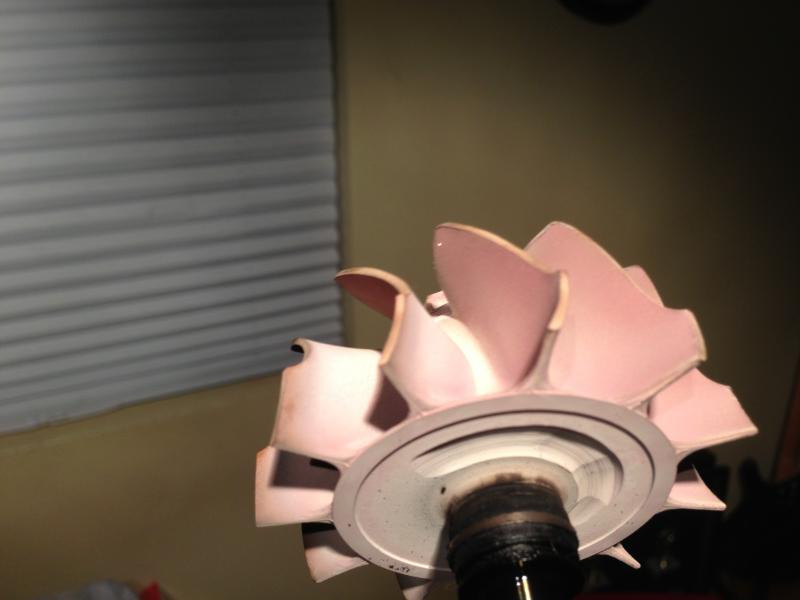
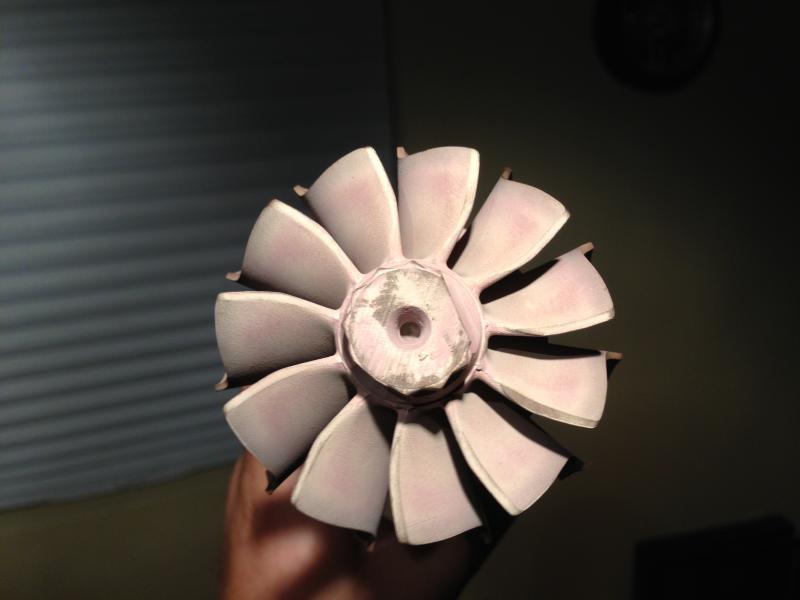
you got me, my turbine wheels never come out cream white because i can't build a stock car that can't dump fuel at all times.
that was sarcasm, and honestly i'm not even going to bother responding.
not really, i'm getting beyond the point of wasting hours trying to convince people that don't want to listen so those who read decide for themselves who to believe, if he wants to believe it then that's his choice. sadly the premixed turbine wheel in his own pictures still had less carbon buildup than the OMP example and really has nothing to do with the combustion chamber anyways because the turbine runs multiple times hotter than rotor faces do, show rotors not turbine wheels.
i've also never seen a turbine wheel covered in premix oil, something is wrong there or premix is being blamed for a faulty turbine shaft sealing ring or stupidly rich premix ratios.
i'll give you a hint: check out what some of the fastest rotary motorsports cars in the world use, come tell me how many oil metering pumps you count up.. all those builds, all wrong.
that was sarcasm, and honestly i'm not even going to bother responding.
not really, i'm getting beyond the point of wasting hours trying to convince people that don't want to listen so those who read decide for themselves who to believe, if he wants to believe it then that's his choice. sadly the premixed turbine wheel in his own pictures still had less carbon buildup than the OMP example and really has nothing to do with the combustion chamber anyways because the turbine runs multiple times hotter than rotor faces do, show rotors not turbine wheels.
i've also never seen a turbine wheel covered in premix oil, something is wrong there or premix is being blamed for a faulty turbine shaft sealing ring or stupidly rich premix ratios.
i'll give you a hint: check out what some of the fastest rotary motorsports cars in the world use, come tell me how many oil metering pumps you count up.. all those builds, all wrong.
Last edited by RotaryEvolution; May 12, 2013 at 10:14 PM.

MECP Certified Installer
Joined: Feb 2009
Posts: 3,176
Likes: 3
From: Mesquite, TX-DFW
Karack, I posted that because I was surprised by Bumpstarts very aggressive and angry sounding response.
I know the OMP isn't the best solution to apex seal lubrication, be cause I have two 165k mile housing on just the OMP sitting around the house to prove it.
I know the OMP isn't the best solution to apex seal lubrication, be cause I have two 165k mile housing on just the OMP sitting around the house to prove it.

Thread
Thread Starter
Forum
Replies
Last Post
renjiv2
3rd Generation Specific (1993-2002)
57
Jan 25, 2024 03:34 AM
