


Air Pump and Emissions: Definitive Results



Air Pump and Emissions: Definitive Results
Over the last ten years of owning my car, I have never had to go through emissions testing... until this year. The car is an S4 NA (86 GXL) and has been well maintained. The engine in the car was rebuilt about 30,000 miles ago and right before the test I changed the spark plugs, replaced the oil, fuel filter, cleaned the air filter and filled it with gas - 87 octane. Nothing special or outside of routine maintenance. As it never needed to go through emissions, when I rebuilt the engine I got rid of the ACV, EGR, The Airpump and cats. Being that I still had the three cats, I bolted them up to the car, went for a drive and headed to the testing centre. With little surprise I failed miserably - here are the results:
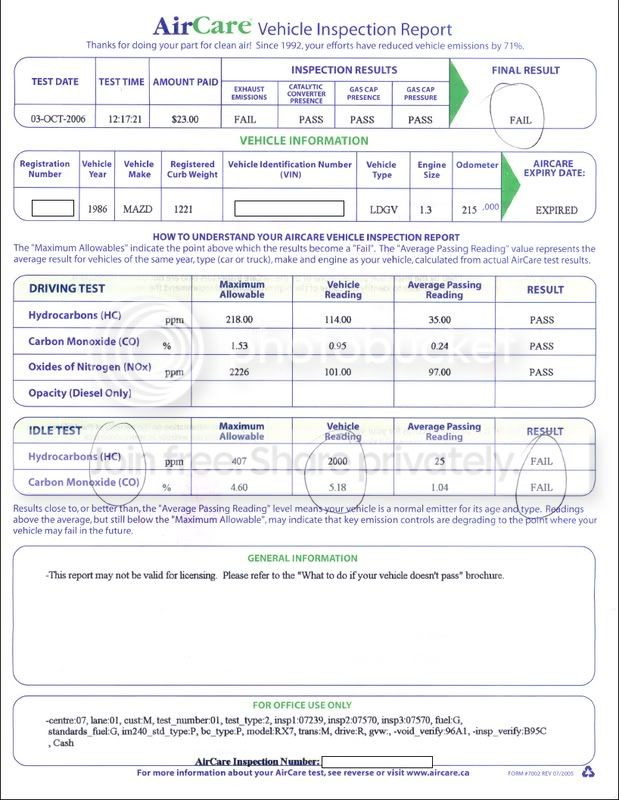
It is interesting to note that I did indeed pass the test on the rolling road, but the idle test was way off the charts. So, the next step was to find a used air pump and bolt it to the car. I picked up one locally, and installed it. With the exact same setup as the previous test and the addition of the air pump, I went in for test number two - here are the results:
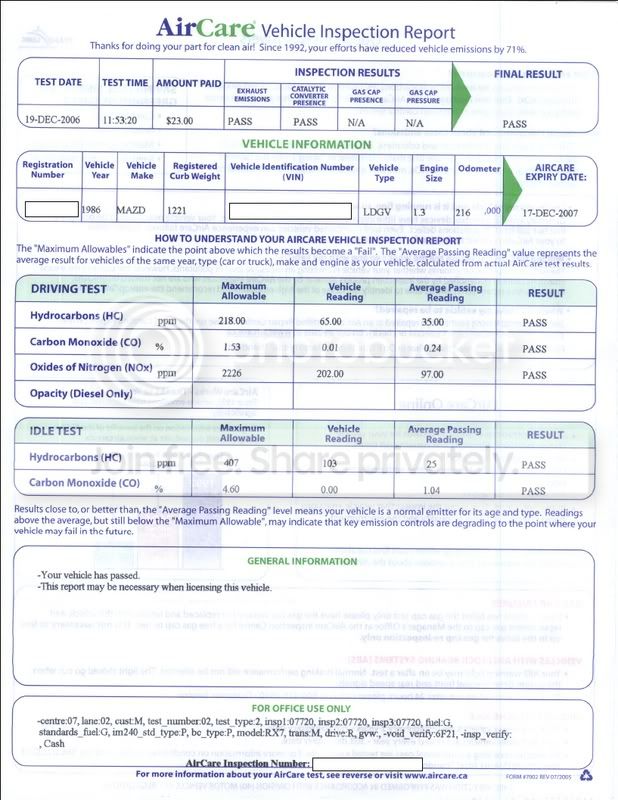
Yup, passed with flying colours. No other tuning, fuel additives, higher octane... nothing. Simply by adding the air pump to the car I was able to cut my emmissions down to low levels. Not only was the idle test down, but the rolling test numbers improved dramatically as well.
So, contrary to some threads I've read - if you need to pass your emissions, an Air Pump is definately a required element with the stock cats. Its effectiveness was dramatic and that is evident with the test results. Just adding it to your system could be a much cheaper alternative to buying all new high performance cats.
It is interesting to note that I did indeed pass the test on the rolling road, but the idle test was way off the charts. So, the next step was to find a used air pump and bolt it to the car. I picked up one locally, and installed it. With the exact same setup as the previous test and the addition of the air pump, I went in for test number two - here are the results:
Yup, passed with flying colours. No other tuning, fuel additives, higher octane... nothing. Simply by adding the air pump to the car I was able to cut my emmissions down to low levels. Not only was the idle test down, but the rolling test numbers improved dramatically as well.
So, contrary to some threads I've read - if you need to pass your emissions, an Air Pump is definately a required element with the stock cats. Its effectiveness was dramatic and that is evident with the test results. Just adding it to your system could be a much cheaper alternative to buying all new high performance cats.

What's weird is that your Oxides of Nitrogen doubled, just by adding the air pump.  Thanks for posting this, that's good stuff!
So this is just running the output of the airpump straight into the air tube on the cat?
Thanks for posting this, that's good stuff!So this is just running the output of the airpump straight into the air tube on the cat?



Joined: Mar 2001
Posts: 31,857
Likes: 3,243
From: https://www2.mazda.com/en/100th/
air pump needs to go to the stock location, the exhaust ports, for it to work best. if you get the acv to do this (if the acv is working then its fine, but lots of em are bad) you dont need anything special on the rest of the car....
I was just curious what the guy that actually passed emissions used, since he said :
Originally Posted by nick86
when I rebuilt the engine I got rid of the ACV, EGR, The Airpump and cats

Yes. I went through the same issue.
I had been running an open exhaust and needed to pass emissions. Thinking I only needed the cat, I installed one temporarily and took the test. I failed.
I added an air-pump and passed with flying colors. Also, you can just route the air-pump directly into the cat using a 1" heater-hose IIRC to connect it to the stock SAP (spit air-pipe) which then feeds into the stock cat. You don't need to install and route it through the ACV if you've removed it.
I had been running an open exhaust and needed to pass emissions. Thinking I only needed the cat, I installed one temporarily and took the test. I failed.
I added an air-pump and passed with flying colors.
Also, you can just route the air-pump directly into the cat using a 1" heater-hose IIRC to connect it to the stock SAP (spit air-pipe) which then feeds into the stock cat. You don't need to install and route it through the ACV if you've removed it.
Originally Posted by Richter12x2
So this is just running the output of the airpump straight into the air tube on the cat?
Originally Posted by j9fd3s
air pump needs to go to the stock location, the exhaust ports, for it to work best. if you get the acv to do this (if the acv is working then its fine, but lots of em are bad) you dont need anything special on the rest of the car....
Awesome! That's what I need to know. Besides, I was pretty sure the airpump stock location feeds the ACV on the intake side. I don't see anything on my exhaust manifold to indicate that a connection from the air pump. I have a nicely painted in cover plate on the intake side though for the ACV valve.
Besides, I was pretty sure the airpump stock location feeds the ACV on the intake side. I don't see anything on my exhaust manifold to indicate that a connection from the air pump. I have a nicely painted in cover plate on the intake side though for the ACV valve.
Trending Topics

Joined: Apr 2005
Posts: 3,785
Likes: 30
From: And the horse he rode in on...
Originally Posted by Nick86
So, contrary to some threads I've read - if you need to pass your emissions, an Air Pump is definitely a required element with the stock cats. Its effectiveness was dramatic and that is evident with the test results. Just adding it to your system could be a much cheaper alternative to buying all new high performance cats.
BTW, I have never read a thread where someone has a claimed that they had personally passed emissions without an air pump and working cat. I might have missed them, but I went through my own emission testing saga a couple of years ago and I researched it pretty thoroughly at that time.
I have seen plenty of threads where some said they had heard you can pass without one, or they know someone who passed without one. We should all be careful to only advise what we know to be true, not what 'someone said'.
Thanks for giving us actual facts.

Rotary enthusiast

Joined: Mar 2006
Posts: 664
Likes: 0
From: Connecticut
Originally Posted by Richter12x2
What's weird is that your Oxides of Nitrogen doubled, just by adding the air pump. Thanks for posting this, that's good stuff!
So this is just running the output of the airpump straight into the air tube on the cat?
Thanks for posting this, that's good stuff!So this is just running the output of the airpump straight into the air tube on the cat?

Rotary Rocket

Joined: Aug 2006
Posts: 395
Likes: 1
From: St.Louis
wow, my emissions were much worse than that when i strapped the stock cats back on. the first time i did it, i had no cats what so ever and the numbers were so high the machine didnt read it. the dude gave me the paper and i just started laughing, hes like "sir, you seem to have a serious problem. do you even have cats on it?" i just nodded laughing my *** of snatched to papers from him and peeled out in a cloud of concentrated toxic emissions in his face. that will be one of the best memories of my FC.
Originally Posted by jackhild59
Congratulations on passing emissions!
BTW, I have never read a thread where someone has a claimed that they had personally passed emissions without an air pump and working cat. I might have missed them, but I went through my own emission testing saga a couple of years ago and I researched it pretty thoroughly at that time.
I have seen plenty of threads where some said they had heard you can pass without one, or they know someone who passed without one. We should all be careful to only advise what we know to be true, not what 'someone said'.
Thanks for giving us actual facts.
BTW, I have never read a thread where someone has a claimed that they had personally passed emissions without an air pump and working cat. I might have missed them, but I went through my own emission testing saga a couple of years ago and I researched it pretty thoroughly at that time.
I have seen plenty of threads where some said they had heard you can pass without one, or they know someone who passed without one. We should all be careful to only advise what we know to be true, not what 'someone said'.
Thanks for giving us actual facts.
Originally Posted by Cpt.Zanzibar
wow, my emissions were much worse than that when i strapped the stock cats back on. the first time i did it, i had no cats what so ever and the numbers were so high the machine didnt read it. the dude gave me the paper and i just started laughing, hes like "sir, you seem to have a serious problem. do you even have cats on it?" i just nodded laughing my *** of snatched to papers from him and peeled out in a cloud of concentrated toxic emissions in his face. that will be one of the best memories of my FC.

Full Member
Joined: Mar 2006
Posts: 110
Likes: 0
From: CINCINNATI
No more emmisions testing here in cincy,yeah I'm glad ya passed,and yeah that's the number one reason to never throw away good parts, ya never know when you'll need them again.wonder why your nox numbers went up that tends to mean your (cylinder temps) for lack of better term,went up and your exaust temps.just curious I wouldn't worrie about it that's probably normal

Lives on the Forum
Joined: Feb 2001
Posts: 26,664
Likes: 23
From: n
Originally Posted by Richter12x2
What's weird is that your Oxides of Nitrogen doubled, just by adding the air pump.
NOx does indeed increase when the HC's plummet.
-Ted


Originally Posted by Richter12x2
What's weird is that your Oxides of Nitrogen doubled, just by adding the air pump. Thanks for posting this, that's good stuff!
So this is just running the output of the airpump straight into the air tube on the cat?
Thanks for posting this, that's good stuff!So this is just running the output of the airpump straight into the air tube on the cat?
If the egr valve were to be reinstalled, it would bring those readings down. Exhaust gasses recirculating into the engine (believe it or not) actually bring the combustion temperatures down. Exhaust entering the engine is not combustible, so it allows the engine to operate at a lower temp.
What this shows us (in addition to that great bit of info) is that there can be some other determining factors in these emissions tests. I.E. the ambient temp, how warm the car is at the time of testing, the way the tech drives the car, etc.
Thanks for the report. It was quite informative
spunout
Joined: Dec 2005
Posts: 1,029
Likes: 1
From: Austin
AGREEN you said a mouthfull! He is absolutely right. THe airpump in all rx-7's has only one purpose and that is to feed oxygen to the cats. This allows a lower ratio of Carbon Monoxide to the final exhaust.
Using a stock or aftermarket Exhaust is not going to be bad unless you remove the airpump entirely. But thats just for emissions use.
On S5 N/A's the airpump serves 2 purposes, 1-emissions and 2 for operating the 5th and 6th port actuators.
The s4s and 1st gen AP's however are strictly for emissions. The rotary is not the first motor to use a A/P either, they where used on alot of cars during the whole fuel crisis/ emissons scare.
But yeah, they do work when functioning properly. And can save your ***, but i always remove mine and wire my ports open because i live in Florida.
I suppose thats why ther are so many left here........they havent been abandoned due to emissions laws.
Using a stock or aftermarket Exhaust is not going to be bad unless you remove the airpump entirely. But thats just for emissions use.
On S5 N/A's the airpump serves 2 purposes, 1-emissions and 2 for operating the 5th and 6th port actuators.
The s4s and 1st gen AP's however are strictly for emissions. The rotary is not the first motor to use a A/P either, they where used on alot of cars during the whole fuel crisis/ emissons scare.
But yeah, they do work when functioning properly. And can save your ***, but i always remove mine and wire my ports open because i live in Florida.
I suppose thats why ther are so many left here........they havent been abandoned due to emissions laws.
Originally Posted by AGreen
That's more than likely to be a coincidence. Oxides of Nitrogen only appear in exhaust when the combustion temps are above 2500 deg. Farenheit. The air pump being on or off the car has no connection with internal combustion temperatures.
If the egr valve were to be reinstalled, it would bring those readings down. Exhaust gasses recirculating into the engine (believe it or not) actually bring the combustion temperatures down. Exhaust entering the engine is not combustible, so it allows the engine to operate at a lower temp.
What this shows us (in addition to that great bit of info) is that there can be some other determining factors in these emissions tests. I.E. the ambient temp, how warm the car is at the time of testing, the way the tech drives the car, etc.
Thanks for the report. It was quite informative
If the egr valve were to be reinstalled, it would bring those readings down. Exhaust gasses recirculating into the engine (believe it or not) actually bring the combustion temperatures down. Exhaust entering the engine is not combustible, so it allows the engine to operate at a lower temp.
What this shows us (in addition to that great bit of info) is that there can be some other determining factors in these emissions tests. I.E. the ambient temp, how warm the car is at the time of testing, the way the tech drives the car, etc.
Thanks for the report. It was quite informative
I had read that pumping air into the cat increases the temperature of the catalyst, which would be what causes the catalytic convertor to work better. Plus logically, since what's being measured is all measured in PPM not gross volume, the ratio of 'bad crud' to fresh air is decreased dramatically by pumping air directly into the exhaust stream. I also would doubt that the presense of an EGR valve would affect combustion temperatures, since I was pretty sure that air and fuel combusted at pretty much the same temperature - but I thought the purpose of the EGR valve (or Exhaust Gas Recirculation valve) is to run exhaust gas back through the engine to burn more bad stuff out of it which would also bring the numbers down. That one came from a less reputable source though, and I reserve judgement on all of it until I see enough logical proof for it to make sense to me.
Originally Posted by Richter12x2
I'll have to wait for the official report on all that, because it doesn't exactly jibe with what little I do know about how it all operates.
The air pumping into the catalytic converter does 2 things. It raises the temp to make it burn hotter, and it supplies fresh air (which is why it's called sometimes a fresh air pump) to combine with the hydrocarbons in the exhaust. When the temps get high enough, the HC and the O2 that was pumped in will bond into other molecules. Safer one's we like to call water and carbon dioxide. And no, CO2 isn't really safe, but it's better than all those HC's our 7's pump out.
As for the egr valve, recirculating the exhaust into the engine wouldn't do jack if all it was trying to do was burn off excess bad stuff. The most aggressive egr systems only supply 6% of the total volume in the combustion chamber with exhaust. When you think about it, that's not very much exhaust at all going back into the system. Like I said, it's there to cool down the combustion temps to reduce the NOx emissions. That's why Ford's new 6.0 litre powerstroke diesel (and numerous other recent diesel engines) has an actual EGR cooler on it. I replace those things constantly because of their high failure rate. Coolant runs through a big tube that has exhaust gasses running inside of smaller tubes inside that. It creates a really weak point in the cooling system for those things. But the reason that the new diesels need egr valves and egr coolers is because emissions standards for diesels are getting really strict. And diesels are the very worst about pumping the NOx out. They have compression ratios normally around 25:1. They run off of compression temperatures to ignite the air/fuel mixture. That means their combustion temps are through the roof! The only way to bring them down to lower their NOx output is to throw an egr and egr cooler in the mix.
Whew. I knew all those fuel/ignition classes and years of experience would pay off one day
-Terrence
No, I know it wasn't a flame. Like I said, I'm just trying to make it make sense in my head - the air pump operation that you just mentioned jibes with what I understood to be true. I'm just trying to understand how recirculating exhaust gas (already hot) makes the combustion temperatures go down vs adding a proportionate amount of cool intake air - is it because you're replacing the oxygen from the intake air with ~6% of exhaust gases that's depleted of oxygen?
Like I said, I'm just trying to make it make sense in my head - the air pump operation that you just mentioned jibes with what I understood to be true. I'm just trying to understand how recirculating exhaust gas (already hot) makes the combustion temperatures go down vs adding a proportionate amount of cool intake air - is it because you're replacing the oxygen from the intake air with ~6% of exhaust gases that's depleted of oxygen?

He probably got more NOx in the 2nd case b/c the cat was removing less of it. A nice rich environment probably got rid of the engine NOx in the cat.
Hmm... EGR. I'll remember that if my NOx emissions ever get lousy. Right now I'm running at half of average, which is good enough for me.
Hmm... EGR. I'll remember that if my NOx emissions ever get lousy. Right now I'm running at half of average, which is good enough for me
.

Would it be possible to use just a high flow generic cat and cut a hole in the side of it and use any generic air pump, electronic possibly? I think that would make things alot easier.
Originally Posted by TehMonkay
Would it be possible to use just a high flow generic cat and cut a hole in the side of it and use any generic air pump, electronic possibly? I think that would make things alot easier.
Catalytic convertors don't remove NOx emissions. I believe the reason it was showing higher in the 2nd run was by sheer coincidence. Probably something ,as stated before, was to blame like a different ambient temp, engine temp, way the tech drove the car, so on and so on.
Universal catalytic convertors usually have a tube pre-made in the pipe upstream of the cat for the air pump to tie into. If not, then like Richter said, drill a hole upstream and flange it.
I know it's kind of a hard concept to grasp, but exhaust gasses cool down on their way out of the engine. But the temperature of the exhaust has nothing to do with its cooling properties. Since the gasses are inert, they won't combust. Filling the combustion chamber with inert gasses prevents it from filling with combustible gasses (ie fuel and air). At any rate, the egr is only supposed to operate at cruising speeds above 35mph with little or no acceleration.
Rotaries aren't prone to dumping NOx anyways, so just pull your egr valve off to save weight. Since the long bathtub design of the rotary's combustion chamber is so long and narrow, it dissipates heat really easily, causing a cooler combustion temp.
Universal catalytic convertors usually have a tube pre-made in the pipe upstream of the cat for the air pump to tie into. If not, then like Richter said, drill a hole upstream and flange it.
I know it's kind of a hard concept to grasp, but exhaust gasses cool down on their way out of the engine. But the temperature of the exhaust has nothing to do with its cooling properties. Since the gasses are inert, they won't combust. Filling the combustion chamber with inert gasses prevents it from filling with combustible gasses (ie fuel and air). At any rate, the egr is only supposed to operate at cruising speeds above 35mph with little or no acceleration.
Rotaries aren't prone to dumping NOx anyways, so just pull your egr valve off to save weight.
Since the long bathtub design of the rotary's combustion chamber is so long and narrow, it dissipates heat really easily, causing a cooler combustion temp.

HAILERS
Joined: May 2001
Posts: 20,563
Likes: 27
From: FORT WORTH, TEXAS,USA
Originally Posted by Nick86
Over the last ten years of owning my car, I have never had to go through emissions testing... until this year. The car is an S4 NA (86 GXL) and has been well maintained. The engine in the car was rebuilt about 30,000 miles ago
So, contrary to some threads I've read - if you need to pass your emissions, an Air Pump is definately a required element with the stock cats. Its effectiveness was dramatic and that is evident with the test results. Just adding it to your system could be a much cheaper alternative to buying all new high performance cats.
So, contrary to some threads I've read - if you need to pass your emissions, an Air Pump is definately a required element with the stock cats. Its effectiveness was dramatic and that is evident with the test results. Just adding it to your system could be a much cheaper alternative to buying all new high performance cats.
Actually this makes good sense if you ever look at how the airpump and ACV work. There's a simplified schematic in each version of the FSM and you can fairly easily figure out how it works.
At IDLE the ACV sends the air to the EXAUST PORTS ON THE ENGINE , not the split air pipe. In the idle test you were missing this air prior to the catalytic converters so the catalytic converter wasn't working at it's best.
If you drive the car at low speeds, like just driving around the block or block to block so to speak, then the passage to the EXAUST PORTS is closed off by the switching valve in the ACV and now the air goes to the split air pipe.
If you drive around the block at engine speeds over 3700 rpm the Relief valve dumps the air into the right front fender but the passage to the split air pipe is still open to what little air pressure is avalilble to it.
While driving, anytime you let off the throttle, then the switching valve in the ACV blocks the passage to the split air pipe and opens the passage to the exaust ports.
But if your on the hwy driving at a steady speed, after about ninty seconds of steady driving, the Relief valve in the ACV opens and dumps most of the airpump air overboard into the right front fenders silencer. But at the same time the switching valve is now blocking the passage to the EXAUST PORTS and allowing whatever airpump air is available to go to the split air pipe.
Now if the relief valve is open and letting the airpump air dump into the right front fender area, I don't see much of any airpump air going to the split air pipe, even if the passage is open to the spit air pipe. I have trouble with understanding that to some extent (the amount of air still being available to go to the split air pipe when the relief valve is open).
Anyway, it makes sense to me why you passed the DRIVING portion of the test the first time but failed the IDLE portion of the test. Mainly because little air goes to the cat under steady driving in the first place. But that air IS needed when just idliing.
I don't claim to be an expert on how cats work, but I've a CLUE how the ACV/Airpump work.
I test without a EGR each year and have no problems or even close to a problem without it. There's a reason the series five don't have one and that reason is that it provided little to no purpose for the cost of having one.
I rigged two LEDS to the TPS test connector and fed the temporary wires to my windshield wipers and tied them there. One light was green indicating the Relief Solenoids actions and the other Red to indicate the Switching Solenoids actions.
Green light ON means there's vacuum going to the relief diaphram therefore the relief valve in the ACV will block the airpump air from being dumped overboard.
Red light ON means there's no vacuum going to the Switching valve diaphram in the ACV which lets the spring loaded switching valve block the passage to the EXAUST PORTS and open the passage to the split air pipe.
Green light OFF means no vacuum going to the relief diaphram in the ACV which relaxes the relief valve in the ACV, which means the airpump air has a passage to be be dumped into the right fenders silencer.
Red light off means theres is vacuum going to the switching valve in the ACV which means the switching valve is pulled up to blockoff the passage to the split air pipe and allow airpump air to go to the EXAUST PORTS.
On the ACV are two solenoids. The Split Air solenoid only open when in FIFTH gear.
The Port Air Solenoid is open...........depends on how many miles on the odometer. Over 20,000 miles its open all the time. Under 20,000 miles and it's closed. A quirk is that if your b/t 100,000 and 120,000 miles then it reverts to being closed again. A flaw in the system/20,000 mile switch. I had this solenoids function *** backwards for some time because I had a car b/t 100,000 and 120,000 miles on it when trying to figure out the 20,000 mile switch.
Neither of those two items seem to have much of anything to do with passing emissions testing. Never go in fifth gear during testing. If you remove the poppet valves inside of those two items they will both be open all the time and would *help* pass emissions, but I'd reinstall both after passing if you do that.
That's a hodge podge of what I THINK I know about the ACV/airpump. I may be wrong in some parts but will never know for sure unless someone shows me where I went wrong (NZ or WaYNE etc).
Last edited by HAILERS; Feb 10, 2007 at 10:00 AM.
Joined: Apr 2005
Posts: 3,785
Likes: 30
From: And the horse he rode in on...
Originally Posted by AGreen
Catalytic converters don't remove NOx emissions.
Originally Posted by AGreen
Rotaries aren't prone to dumping NOx anyways, so just pull your egr valve off to save weight. Since the long bathtub design of the rotary's combustion chamber is so long and narrow, it dissipates heat really easily, causing a cooler combustion temp.
Since the long bathtub design of the rotary's combustion chamber is so long and narrow, it dissipates heat really easily, causing a cooler combustion temp.