


advice on drilling out bolt please


Thread Starter
Junior Member
Joined: Mar 2015
Posts: 5
Likes: 0
From: bc canada
 advice on drilling out bolt please
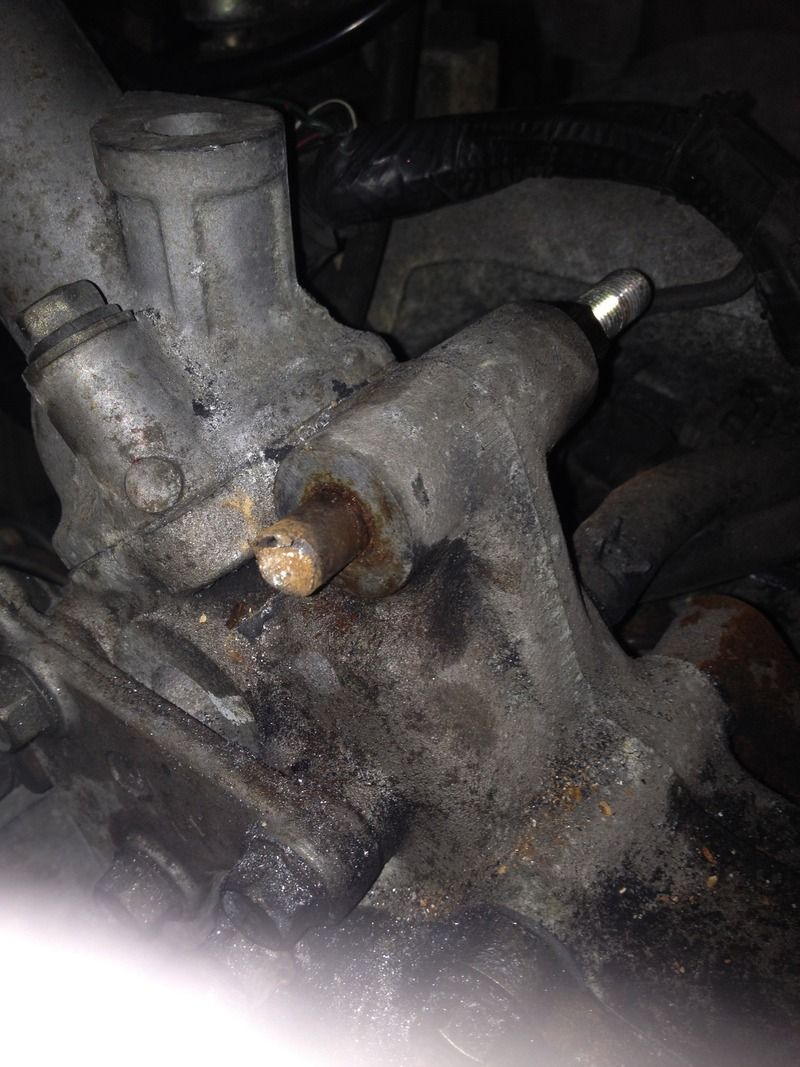
What you are looking at is the bolt that holds the alternator on. I snapped the head off it. It is seized up very nicely. I did manage to split the alt and get it off. Now how should i tackle this ? I do want to leave the housing and water pump alone if I can. Heat? Drill? Drill half way and try and punch out ? start with a smaller bit ? This is a first for me
Thanks guys

Thanks guys


Douse the bolt- from both ends- with a good penetrating lube (PB, Deep Creep) for a day or two.
Grab an end of the bolt with the biggest vice-grips you have, apply heat to the surrounding aluminum, see if the bolt will twist.
Grab an end of the bolt with the biggest vice-grips you have, apply heat to the surrounding aluminum, see if the bolt will twist.

This is what I would do
1) use a small wire wheel and pick and remove as much of the rust so that the penetrating lube gets a head start. Let it sit overnight and live every few hours.
2) heat up the aluminum
3)while hot, knock it out with a hammer. That part is not threaded. You can also try to rotate it with vice grips
1) use a small wire wheel and pick and remove as much of the rust so that the penetrating lube gets a head start. Let it sit overnight and live every few hours.
2) heat up the aluminum
3)while hot, knock it out with a hammer. That part is not threaded. You can also try to rotate it with vice grips


Senior Member
Joined: May 2010
Posts: 535
Likes: 0
From: vancouver, bc
what i'd do: heat that bolt cherry red from both ends. let it cool right to the touch. the bolt will have contracted slightly from the heat and probably spin out by hand almost. key is cherry glow. then cool to touch.
you have 2 dissimilar metals. you'll need heat for sure. that method will work, i guarantee. better than heating the surrounding area. also, being aluminum, you may distort the bracket that way
you have 2 dissimilar metals. you'll need heat for sure. that method will work, i guarantee. better than heating the surrounding area. also, being aluminum, you may distort the bracket that way
Trending Topics
I disagree, you want to heat (and therefore, expand) the aluminum, not the bolt.
I'd be careful banging the bolt end until it has shown indication that it will move, it'd be easy to crack that boss unless the housing was removed and supported on one end.
I'd be careful banging the bolt end until it has shown indication that it will move, it'd be easy to crack that boss unless the housing was removed and supported on one end.


Joined: Sep 2005
Posts: 25,581
Likes: 136
From: Smiths Falls.(near Ottawa!.Mapquest IT!)
That is a "through bolt".It is not threaded into the Pump housing,it just goes through that mounting hole.
It's stuck due to what I call "conflicting metal syndrome"..steel bolt in aluminum creates corrosion.That creates havoc.
So why not just toss some washers,spacer or anything really,plop a nut on, Then after After soaking the thing In a good penetrating oil, TIGHTEN it to draw it out?
It should by rights start to move or spin.
It's stuck due to what I call "conflicting metal syndrome"..steel bolt in aluminum creates corrosion.That creates havoc.
So why not just toss some washers,spacer or anything really,plop a nut on, Then after After soaking the thing In a good penetrating oil, TIGHTEN it to draw it out?
It should by rights start to move or spin.
Thread Starter
Junior Member
Joined: Mar 2015
Posts: 5
Likes: 0
From: bc canada
Im in langley. We have the same ride 86 glx lol
I have the spacer that sits on the threaded side. So i will likely try using that to snug a nut up to it and draw the bolt out. Once its lubed and the area heated up. See what happens. Thanks again everyone for the quick replys !!
I have the spacer that sits on the threaded side. So i will likely try using that to snug a nut up to it and draw the bolt out. Once its lubed and the area heated up. See what happens. Thanks again everyone for the quick replys !!
Last edited by yamadirt 426; Mar 31, 2015 at 12:19 AM.


Senior Member
Joined: May 2010
Posts: 535
Likes: 0
From: vancouver, bc
other methods may or may not work. however this method will for sure
Last edited by welfare; Apr 1, 2015 at 02:50 AM.
Senior Member
Joined: May 2010
Posts: 535
Likes: 0
From: vancouver, bc
That is a "through bolt".It is not threaded into the Pump housing,it just goes through that mounting hole.
It's stuck due to what I call "conflicting metal syndrome"..steel bolt in aluminum creates corrosion.That creates havoc.
So why not just toss some washers,spacer or anything really,plop a nut on, Then after After soaking the thing In a good penetrating oil, TIGHTEN it to draw it out?
It should by rights start to move or spin.
It's stuck due to what I call "conflicting metal syndrome"..steel bolt in aluminum creates corrosion.That creates havoc.
So why not just toss some washers,spacer or anything really,plop a nut on, Then after After soaking the thing In a good penetrating oil, TIGHTEN it to draw it out?
It should by rights start to move or spin.
Last edited by welfare; Apr 1, 2015 at 02:32 AM.
Joined: Sep 2005
Posts: 25,581
Likes: 136
From: Smiths Falls.(near Ottawa!.Mapquest IT!)
My concern about using heat is that it is ON the car.
The thermostat is right there,also that small rubber hose at the back of the pump and the waterthermo sensor at the back of the pump.
DEEP CREEP(by Seafoam) is my "chemical hammer".
I love the stuff..and it's like Frank's Red Hot Sauce..I put that **** on everything!
Senior Member
Joined: May 2010
Posts: 535
Likes: 0
From: vancouver, bc
that's why i suggested to only heat the bolt. however, you are correct, gasoline is nearby. which definitely concerns me. i'm so used to working on diesels now! haha. never reallyget to work on gassers anymore unless it's my own car

You're experiencing the result of uninsulated dissimilar metals (steel and aluminum) in the presence of an electrolyte (dirty water) and a current (grounding of the alternator) reacting. The aluminum and steel have corroded (more aluminum than steel), and there is a salt crust (salt as in non-reactive biproduct of a chemical reaction, not the stuff that fast food is made of) that is physically inhabiting the spaces between the bolt and the housing comprised of the manufacturing tolerances and the material lost to corrosion. It is crusty brittle stuff, so anything you can do to break up the bonds is what you want to focus on.
Heat will help in that it will expand the materials the crust is between, and the change in physical size of the two materials relative to each other (they have differing thermal expansion ratios). I would focus heating efforts on the aluminum since it is both the outside of the structure and has the greater thermal expansion ratio. Don't get it too hot though, because aluminum has a fairly low melting point. The temperatures at which an engine overheats are what they are because the metals distort enough to alter tolerances. 300° is more than enough to wreck an engine, and it's more than enough to expand the joint you're dealing with. Essentially, just hot enough that a drop of water dances vigorously like in a frying pan.
The penetrating oil will help IF it has somewhere to penetrate. It is essentially a barrier to prevent any broken bonds from reforming and potentially carry away some of the salts. Because the surfaces aren't such that they'll really slide over one another, it's not really going to do much as a lubricant.
Since the bonds are brittle, minimal physical distortion is typically sufficient to break them. Twisting (like what snapped the head off the bolt in the first place) could work, but the force is applied gradually. What you want is more percussive forces where the energy is applied more abruptly, and the acceleration (delta speed/direction) is more focused. A heavy duty vibrator of some sort would be your best bet. Think in terms of a pneumatic hammer thingy like a miniature jack hammer, but with a really soft setting. You don't want to hit it so hard you break the aluminum, just a bunch of hard-enough hits to break the brittle salts. Think of this as a game of patience. A million tiny taps are better than a few big ones. Each tap breaks a few bonds. Bigger could break more, but too much force could break things you don't want to break.
Order of operations in my mind is as follows:
-heat the aluminum hot enough that water spits off, no more.
-hit it with something that can impart a lot of rapid percussive force. This can be as simple as tapping it quickly and repeatedly with a hammer with a force like you would a nail into a piece of pine or similar soft wood only a lot faster. You're not breaking the aluminum or steel, just the salts.
-spray penetrating oil so that the bonds don't reform with the next application of heat
-see if you can pull/twist it out
-repeat.
Heat will help in that it will expand the materials the crust is between, and the change in physical size of the two materials relative to each other (they have differing thermal expansion ratios). I would focus heating efforts on the aluminum since it is both the outside of the structure and has the greater thermal expansion ratio. Don't get it too hot though, because aluminum has a fairly low melting point. The temperatures at which an engine overheats are what they are because the metals distort enough to alter tolerances. 300° is more than enough to wreck an engine, and it's more than enough to expand the joint you're dealing with. Essentially, just hot enough that a drop of water dances vigorously like in a frying pan.
The penetrating oil will help IF it has somewhere to penetrate. It is essentially a barrier to prevent any broken bonds from reforming and potentially carry away some of the salts. Because the surfaces aren't such that they'll really slide over one another, it's not really going to do much as a lubricant.
Since the bonds are brittle, minimal physical distortion is typically sufficient to break them. Twisting (like what snapped the head off the bolt in the first place) could work, but the force is applied gradually. What you want is more percussive forces where the energy is applied more abruptly, and the acceleration (delta speed/direction) is more focused. A heavy duty vibrator of some sort would be your best bet. Think in terms of a pneumatic hammer thingy like a miniature jack hammer, but with a really soft setting. You don't want to hit it so hard you break the aluminum, just a bunch of hard-enough hits to break the brittle salts. Think of this as a game of patience. A million tiny taps are better than a few big ones. Each tap breaks a few bonds. Bigger could break more, but too much force could break things you don't want to break.
Order of operations in my mind is as follows:
-heat the aluminum hot enough that water spits off, no more.
-hit it with something that can impart a lot of rapid percussive force. This can be as simple as tapping it quickly and repeatedly with a hammer with a force like you would a nail into a piece of pine or similar soft wood only a lot faster. You're not breaking the aluminum or steel, just the salts.
-spray penetrating oil so that the bonds don't reform with the next application of heat
-see if you can pull/twist it out
-repeat.
Last edited by spectre6000; Apr 1, 2015 at 11:10 AM.


Welfare is using the heat to expand the bolt and crush the salt/corrosion because the aluminum is not heating as fast. When the bolt cools, one gets a bit of clearance. It does work. Ideally, after the bolt cools, heating the aluminum to expand it and loosen the grip would be the berries.
As stated before, with it being on the car, you have to be careful of things near by like fuel lines and also how hot things like gaskets get.
We use a lot of brass pipe plugs in the things we make at work and they are notorious for seizing tight enough that one strips the hex when trying to remove them. I lay on the bottom of the hex with the tig torch till they are good and hot (not glowing, not even close) and after cooling, even the stripped ones come out with very little effort. Like by hand with no force.
As stated before, with it being on the car, you have to be careful of things near by like fuel lines and also how hot things like gaskets get.
We use a lot of brass pipe plugs in the things we make at work and they are notorious for seizing tight enough that one strips the hex when trying to remove them. I lay on the bottom of the hex with the tig torch till they are good and hot (not glowing, not even close) and after cooling, even the stripped ones come out with very little effort. Like by hand with no force.
Last edited by user 893453465346; Apr 1, 2015 at 04:32 PM.

Thread Starter
Junior Member
Joined: Mar 2015
Posts: 5
Likes: 0
From: bc canada
So just an update. Using the spray and a torch I got the bolt out. Took about a hour. Also a little light tapping over the area. Thanks everyone.
Everything back together tonight and it ran fine with the new alt after a 25 min drive. So far so good. Although I did brake the ecu coolant switch.
The car ran perfect in every sense according to the Gages on my test run. My research tells me this switch controls a fan from the ecu ? This is a stock 86 n/a.
I'm going to read some more and I plan on replacing the switch but I have no electric fan so really what does it do ?
Everything back together tonight and it ran fine with the new alt after a 25 min drive. So far so good. Although I did brake the ecu coolant switch.
The car ran perfect in every sense according to the Gages on my test run. My research tells me this switch controls a fan from the ecu ? This is a stock 86 n/a.
I'm going to read some more and I plan on replacing the switch but I have no electric fan so really what does it do ?