


Strut rod conversion

Full Member

Joined: May 2001
Posts: 116
Likes: 0
From: Newark, NY, USA
You do know if you've gone this far on the project, you can align the car yourself too - all the specs are in the manual.

Last edited by djs2571; Oct 22, 2010 at 11:12 AM. Reason: mis-spelling

Senior Member

Joined: Sep 2008
Posts: 622
Likes: 0
From: Seattle, WA
Correct, I was referring to the added resistance or "spring" (I'm sure there is a better term than what i'm using) that is added by using bushings on the stock tension rods. Getting rid of those bushings allows you adjust the spring rate using just the springs. This might be most beneficial for the guys who race and want to really fine tune their setup...
Although I'm sure I've just opened myself up to a huge argument about theoretical numbers etc
Although I'm sure I've just opened myself up to a huge argument about theoretical numbers etc



Originally Posted by 82transam
Correct, I was referring to the added resistance or "spring" (I'm sure there is a better term than what i'm using) that is added by using bushings on the stock tension rods. Getting rid of those bushings allows you adjust the spring rate using just the springs. This might be most beneficial for the guys who race and want to really fine tune their setup...
Although I'm sure I've just opened myself up to a huge argument about theoretical numbers etc
Correct, I was referring to the added resistance or "spring" (I'm sure there is a better term than what i'm using) that is added by using bushings on the stock tension rods. Getting rid of those bushings allows you adjust the spring rate using just the springs. This might be most beneficial for the guys who race and want to really fine tune their setup...
Although I'm sure I've just opened myself up to a huge argument about theoretical numbers etc

Joined: Jun 2008
Posts: 8,376
Likes: 28
From: Chino Hills, CA
Wonder why they didn't use a ball-and-socket joint for the front of the strut rod; would eliminate that tendency to pull rearward, and allow for freer movement.
Answer is probably either "noise" or "expense".
Answer is probably either "noise" or "expense".



Joined: Mar 2001
Posts: 31,851
Likes: 3,238
From: https://www2.mazda.com/en/100th/
Ok, that makes more sense. Althought I feel like even the A-arm style would still want to rotate back a bit, rather than just purely slide, and if bushings are soft enough they'd allow the rotation to occur. It just wouldn't be as drastic as I-arm. Perhaps A-arm bushings have a metal rib inside to keep the rubber from compressing from side to side.
i'm sure there is some twist, but they are trying to show its got more precise geometry with the A arm style
Joined: Mar 2001
Posts: 31,851
Likes: 3,238
From: https://www2.mazda.com/en/100th/
Correct, I was referring to the added resistance or "spring" (I'm sure there is a better term than what i'm using) that is added by using bushings on the stock tension rods. Getting rid of those bushings allows you adjust the spring rate using just the springs. This might be most beneficial for the guys who race and want to really fine tune their setup...
Although I'm sure I've just opened myself up to a huge argument about theoretical numbers etc
Although I'm sure I've just opened myself up to a huge argument about theoretical numbers etc
its why we tighten the suspension with the car loaded and on the ground.
the rubber is nice though as it does allow a multi axis pivot, like the front control arm, it actually has to move slightly forward and backwards as it goes up and down, because the tension rod is in an arc too.
a poly bushing either has to be too loose or bind to do that, although the front to back movement is pretty small, so its again not a problem
Joined: Mar 2001
Posts: 31,851
Likes: 3,238
From: https://www2.mazda.com/en/100th/
probably both? the MPV has something like this too, its just bigger, BIG bushings

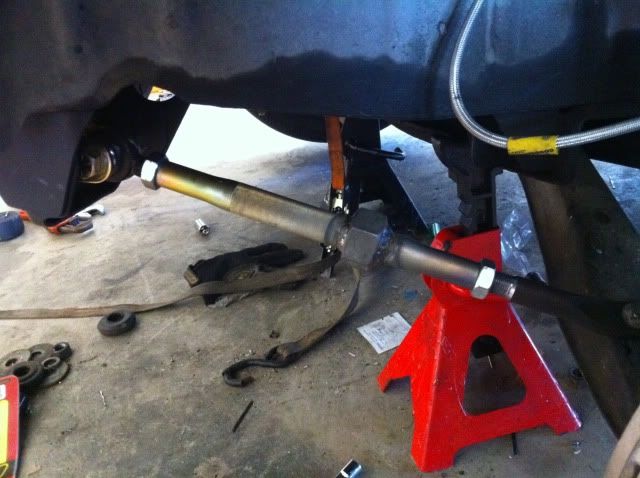


yeah sorta. ideally there is no friction in the suspensions movement, and ALL of the wheels movement is handled by the spring and damper, but in real life yes the rubber bushings do act like little springs, although its a pretty small effect. i think.
its why we tighten the suspension with the car loaded and on the ground.
the rubber is nice though as it does allow a multi axis pivot, like the front control arm, it actually has to move slightly forward and backwards as it goes up and down, because the tension rod is in an arc too.
a poly bushing either has to be too loose or bind to do that, although the front to back movement is pretty small, so its again not a problem
its why we tighten the suspension with the car loaded and on the ground.
the rubber is nice though as it does allow a multi axis pivot, like the front control arm, it actually has to move slightly forward and backwards as it goes up and down, because the tension rod is in an arc too.
a poly bushing either has to be too loose or bind to do that, although the front to back movement is pretty small, so its again not a problem
Well Turns out theres an app for everything. its called ialign its 2.99 on itunes and it saves you buying a 100 dollar caster camber gauge. I got the car all in spec and now time for a test drive...
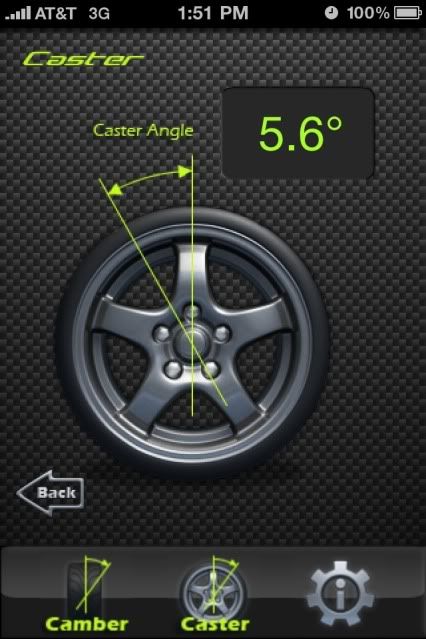
ERRRRRRR.... Correction, Its raining we'll skip the test drive.
ERRRRRRR.... Correction, Its raining we'll skip the test drive.

Hahahaha jeeze Apple does it all!

You calibrate the app to the floor, turn the wheels 20 degrees out and measure from a flat spot on the rim, then turn the wheel back the other direction so the rims 20 degrees in and take a measurement from the same flat spot on the rim and the program does the rest. I ended up with 5.2 degrees of caster and whatever factory camber is, I didn't bother to check it since I can't adjust it.
Joined: Jun 2008
Posts: 8,376
Likes: 28
From: Chino Hills, CA
Full Member
Joined: May 2001
Posts: 116
Likes: 0
From: Newark, NY, USA
That's one damn accurate tilt sensor in the phone to get an accurate reading....
What happened to buying a level, tape measure, and doing some trig? that's what I did for mine. Anyhow, good luck on the test drive.
What happened to buying a level, tape measure, and doing some trig? that's what I did for mine. Anyhow, good luck on the test drive.
Do you know what rotation equals what camber/caster setting?
Also how close do the caster settings need to be from side to side? I'm within .2 degress from one side to another and dont know how close it needs to be.
Joined: Jun 2008
Posts: 8,376
Likes: 28
From: Chino Hills, CA
It's in the FSM, & I don't know if it's the same for FB's as for SA's. On SA's, it's as below:

28 minutes of arc = 28/60 = 0.46 degrees.
Oh, and the tolerance between sides: Specs from the SA FSM are:
Camber: 1*10' +/- 30'
Caster, right: 4*30' +/- 30'
Caster, left: 4*00' +/- 30'
Side-to-side consistency is not spec'ed.
28 minutes of arc = 28/60 = 0.46 degrees.
Oh, and the tolerance between sides: Specs from the SA FSM are:
Camber: 1*10' +/- 30'
Caster, right: 4*30' +/- 30'
Caster, left: 4*00' +/- 30'
Side-to-side consistency is not spec'ed.
I know ive seen it on here, but it was a sheet of alignment numbers hand written, but i cant find it for the life of me. anyone know what im talking about or am i misremembering?

Joined: Jun 2008
Posts: 8,376
Likes: 28
From: Chino Hills, CA
Camber's a flat max differential of 1 degree, the way I read it.