


exhaust ports


Thread Starter

Joined: Aug 2001
Posts: 15,725
Likes: 91
From: Near Seattle
exhaust ports
I've got two engines to build.
One will stay NA because it's going into my MG Midget project.
The other will get a supoercharger some day, but will be NA for a year or two.
Getting technical here, both engines have '74 spec ports. For those who don't know, the '74-'75 13B had intake ports that closed ten degrees later than the '76-'85 carbed 13Bs and all 12As. Only the GSL-SE had different port timing.
'76-'85 had 40° intake port closing
'74-'75 had 50° intake port closing
A typical mild streetport will have around 55° port closing
The Racing Beat streetport template closes at 60°. Y plates have enough casting to support RB ports.
If you want to get super technical, read Paul Yaw's tech articles. All the port openings and closings are listed here. http://www.yawpower.com/dectech.html
One will stay NA because it's going into my MG Midget project.
The other will get a supoercharger some day, but will be NA for a year or two.
Getting technical here, both engines have '74 spec ports. For those who don't know, the '74-'75 13B had intake ports that closed ten degrees later than the '76-'85 carbed 13Bs and all 12As. Only the GSL-SE had different port timing.
'76-'85 had 40° intake port closing
'74-'75 had 50° intake port closing
A typical mild streetport will have around 55° port closing
The Racing Beat streetport template closes at 60°. Y plates have enough casting to support RB ports.
If you want to get super technical, read Paul Yaw's tech articles. All the port openings and closings are listed here. http://www.yawpower.com/dectech.html
Thread Starter
Joined: Aug 2001
Posts: 15,725
Likes: 91
From: Near Seattle
Now that introductions are out of the way, here we go.
Both engines are getting some vintage '74-'75 rotor housings. You know the ones with the cool MAZDA font over the dowel pin area? Yeah, those ones.
Pics are coming soon...
Several years ago, I read something written by Judge Ito on nopistons where he suggested to get a broad torque curve, you want a fast opening, slow closing exhaust port. I interpreted that to mean flat opening with a rounded closing edge.
I cut what later became known as upside down D ports. Imagine the letter D rotated 90° to the left and the highest point was just a couple mm above where a stock T2 port would close.
As you can imagine the sides were very curved and the flow was not good. I tried these rotor housings in my bro's RX-4 and that engine was not very powerful. My stock ported Cosmo with an automatic had more power! He was very depressed which motivated him to purchase the parts to build a Racing Beat single pipe exhaust sytem which I modded to fit the RX-4. It consisted of an RX-4 header, long presilencer, length of 1/8" wall pipe, and the '83-'85 primaflow muffler. A few cuts and welds later, he had a nice sounding single pipe system. The power increase was very nice, and it sounded a lot better too.
Then last summer I did a quickie rebuild and changed out everything except the side plates (they were already mild streetported and in ok shape). The engine got the guts and rotor housings from a GSL-SE and all new seals. We ported the rotor housings to T2 spec, or at least as close as the slightly smaller exhaust sleeves would let us (it was almost a perfect match to T2 I must say, but no real room for anything larger, except maybe alter closing). We went down a few mm and wider by 2mm. The closing edge was already at T2 spec stock. Interesting, that, so we left the closing edge alone. No need for copious amounts of overlap on an engine destined to receive a supercharger some day...
I don't know whether it was the new seals or the better ports, but the fresh rebuild had way more power than the fully broken in one. Again the side plates and intake ports did not change. It picked up a ton more power everywhere in the RPM range (we limited it to 3500 slowly increasing to 4000 as it had hardened stationary gears with new bearings). In other words, the low end torque was amazing for something with such larger-than-stock ports and a stock Hitachi carb (rejetted appropriately).
Was it the old leaky seals causing a loss in power? Or the stupid upside down D ports? Something to think about.
Both engines are getting some vintage '74-'75 rotor housings. You know the ones with the cool MAZDA font over the dowel pin area? Yeah, those ones.
Pics are coming soon...
Several years ago, I read something written by Judge Ito on nopistons where he suggested to get a broad torque curve, you want a fast opening, slow closing exhaust port. I interpreted that to mean flat opening with a rounded closing edge.
I cut what later became known as upside down D ports. Imagine the letter D rotated 90° to the left and the highest point was just a couple mm above where a stock T2 port would close.
As you can imagine the sides were very curved and the flow was not good. I tried these rotor housings in my bro's RX-4 and that engine was not very powerful. My stock ported Cosmo with an automatic had more power! He was very depressed which motivated him to purchase the parts to build a Racing Beat single pipe exhaust sytem which I modded to fit the RX-4. It consisted of an RX-4 header, long presilencer, length of 1/8" wall pipe, and the '83-'85 primaflow muffler. A few cuts and welds later, he had a nice sounding single pipe system. The power increase was very nice, and it sounded a lot better too.
Then last summer I did a quickie rebuild and changed out everything except the side plates (they were already mild streetported and in ok shape). The engine got the guts and rotor housings from a GSL-SE and all new seals. We ported the rotor housings to T2 spec, or at least as close as the slightly smaller exhaust sleeves would let us (it was almost a perfect match to T2 I must say, but no real room for anything larger, except maybe alter closing). We went down a few mm and wider by 2mm. The closing edge was already at T2 spec stock. Interesting, that, so we left the closing edge alone. No need for copious amounts of overlap on an engine destined to receive a supercharger some day...
I don't know whether it was the new seals or the better ports, but the fresh rebuild had way more power than the fully broken in one. Again the side plates and intake ports did not change. It picked up a ton more power everywhere in the RPM range (we limited it to 3500 slowly increasing to 4000 as it had hardened stationary gears with new bearings). In other words, the low end torque was amazing for something with such larger-than-stock ports and a stock Hitachi carb (rejetted appropriately).
Was it the old leaky seals causing a loss in power? Or the stupid upside down D ports? Something to think about.
Last edited by Jeff20B; Mar 18, 2007 at 10:08 PM.
Thread Starter
Joined: Aug 2001
Posts: 15,725
Likes: 91
From: Near Seattle
That RX-4 eventually did get a supercharger and it was then we realized the GSL-SE flywheel was more than we needed. Infact an aluminum flywheel would have been better - even in such a heavy vehicle with such a high geared rear diff. Well, maybe the light steel if you want to split hairs. The reasoning here is the SC actually adds some rotating weight causing the engine to feel like it still had the old stock RX-4 30 pounder. Any benefit gained by going to the lighter GSL-SE flywheel was negated by the added rotating weight of the SC. Live and learn.
Judge Ito also mentioned that turbos like a flat closing port. Since I was staying NA at the time and wanted a wide torque curve, I thought upside down D ports were the best option. It wasn't until later that I found out how crappy they really are.
I can thank rotarygod for that. Thanks man!
So I set out to remedy the situation. The sleeves in '74-'75 rotor housings are the smallest 13B sleeve ever. They look like 12A sleeves. lol
One afternoon and a sore back later, they're a lot better looking (pics coming). The other set of rotor housings are still at stock port timing and I think I'll leave them that way.
The next task is to determine which vehicle they should go to. The choices are a set of old school 3B side plates with stock '74 spec ports which will go into the REPU. The other set will be joined with some 1st gen RX-7 nitrided Y castings ported out to '74 spec with all the attention to port shape and internal finish as I've come to expect from myself. These ports should not have a problem with fuel wetting out during quick stabs of the throttle, and the engine will go into my MG project. It will also get a light steel flywheel with a stock 215mm disc (you don't need 225mm in that car) while the REPU engine will receive a stock 9 bolt heavy duty REPU flywheel and 225mm disc and pressure plate.
The MG will stay NA but the REPU must have the option of going SC some day. Perhaps when that day comes I'll either change to a GSL-SE flywheel or a light steel. No aluminum as this will be used for towing.
Judge Ito also mentioned that turbos like a flat closing port. Since I was staying NA at the time and wanted a wide torque curve, I thought upside down D ports were the best option. It wasn't until later that I found out how crappy they really are.
I can thank rotarygod for that. Thanks man!
So I set out to remedy the situation. The sleeves in '74-'75 rotor housings are the smallest 13B sleeve ever. They look like 12A sleeves. lol
One afternoon and a sore back later, they're a lot better looking (pics coming). The other set of rotor housings are still at stock port timing and I think I'll leave them that way.
The next task is to determine which vehicle they should go to. The choices are a set of old school 3B side plates with stock '74 spec ports which will go into the REPU. The other set will be joined with some 1st gen RX-7 nitrided Y castings ported out to '74 spec with all the attention to port shape and internal finish as I've come to expect from myself. These ports should not have a problem with fuel wetting out during quick stabs of the throttle, and the engine will go into my MG project. It will also get a light steel flywheel with a stock 215mm disc (you don't need 225mm in that car) while the REPU engine will receive a stock 9 bolt heavy duty REPU flywheel and 225mm disc and pressure plate.
The MG will stay NA but the REPU must have the option of going SC some day. Perhaps when that day comes I'll either change to a GSL-SE flywheel or a light steel. No aluminum as this will be used for towing.
Thread Starter
Joined: Aug 2001
Posts: 15,725
Likes: 91
From: Near Seattle
So now that I've discussed my situation at length, here's the question for those of you knowledgeable about exhaust ports.
Which set of ports should go in which vehicle?
I personally would like to recreate in the MG what it had before I pulled the engine. Basically it had 20B-like acceleration on an engine that wasn't even set up right.
Front and rear plates were stock ported 3B '74-'75 40° intake closing while the intermediate plate was an NO casting with tiny little ports from some J-spec engine (30° intake closing?).
Ever compared GSL-SE or S4 NA primaries with a 12A? The 12A had larger ports, didn't it. Well, the NO sized ports are the same an the EFI engines.
That port size is ok for EFI and six ports, but for carbs, it sucks. The other problem here is I had to use a Cosmo manifold with reversed runners because it was the only one that fit the engine bay. Unfortunately the secondaries had a serious port mismatch; large on the manifold but small on the engine. To give you an idea, stock 1st gens have it the other way around.
To recreate the engine but set it up right, I went with three 12A Y plates carefully ported to '74 spec and the intermediate plate has tall ports which are a perfect match for the Cosmo manifold. The plates are lighter too!
I loved the acceleration of this thing on primaries alone. Of course in something this lite, even horribly mismatched secondaries are still going to make noticeable power. However judging the difference from primary to secondary acceleration, I could tell something was missing. That's what I hope to correct by going with all Y plates.
As for the rotor housings and my reason for wanting to go with the stock ported ones, again this thing accelerated quick enough to catch you off guard, and I'm afraid that going with larger exhaust ports might kill some of the low end and replace it with more high end, which this car honestly doesn't need. What's more, the front rotor housing in the old engine had tons of missing chrome (especially at the top in the compression zone) and the exhaust sleeve was missing. It was fully broken in and all that, but really lacked power in the REPU. However it came alive when I put it in the MG! The old exhaust sytem on the REPU, which I purchased from a friend in '97, turned out to be rather restictive and not built very well.
Was the lack of power in the REPU the fault of the exhaust sytem? Or the extra weight? Or how about the dead rotor housing? Why not all three? All I know is the MG was kinda scary with the same engine, even with all its faults - only difference being the significant reduction in weight, the lighter flywheel, and a less restrictive exhaust.
Speaking of exhaust, sorry this is so long by now. I didn't mean to write a book.
Which set of ports should go in which vehicle?
I personally would like to recreate in the MG what it had before I pulled the engine. Basically it had 20B-like acceleration on an engine that wasn't even set up right.
Front and rear plates were stock ported 3B '74-'75 40° intake closing while the intermediate plate was an NO casting with tiny little ports from some J-spec engine (30° intake closing?).
Ever compared GSL-SE or S4 NA primaries with a 12A? The 12A had larger ports, didn't it. Well, the NO sized ports are the same an the EFI engines.
That port size is ok for EFI and six ports, but for carbs, it sucks. The other problem here is I had to use a Cosmo manifold with reversed runners because it was the only one that fit the engine bay. Unfortunately the secondaries had a serious port mismatch; large on the manifold but small on the engine. To give you an idea, stock 1st gens have it the other way around.
To recreate the engine but set it up right, I went with three 12A Y plates carefully ported to '74 spec and the intermediate plate has tall ports which are a perfect match for the Cosmo manifold.
The plates are lighter too!I loved the acceleration of this thing on primaries alone. Of course in something this lite, even horribly mismatched secondaries are still going to make noticeable power. However judging the difference from primary to secondary acceleration, I could tell something was missing. That's what I hope to correct by going with all Y plates.
As for the rotor housings and my reason for wanting to go with the stock ported ones, again this thing accelerated quick enough to catch you off guard, and I'm afraid that going with larger exhaust ports might kill some of the low end and replace it with more high end, which this car honestly doesn't need. What's more, the front rotor housing in the old engine had tons of missing chrome (especially at the top in the compression zone) and the exhaust sleeve was missing. It was fully broken in and all that, but really lacked power in the REPU. However it came alive when I put it in the MG! The old exhaust sytem on the REPU, which I purchased from a friend in '97, turned out to be rather restictive and not built very well.
Was the lack of power in the REPU the fault of the exhaust sytem? Or the extra weight? Or how about the dead rotor housing? Why not all three? All I know is the MG was kinda scary with the same engine, even with all its faults - only difference being the significant reduction in weight, the lighter flywheel, and a less restrictive exhaust.
Speaking of exhaust, sorry this is so long by now. I didn't mean to write a book.
Thread Starter
Joined: Aug 2001
Posts: 15,725
Likes: 91
From: Near Seattle
The exhaust system is very limited on the MG. I can't add any more glasspacks because there simply isn't any room. It consists of a short header, a long length of pipe under the car, then it curves up over the rearend, then curves into a 24" rotary engineering glasspack, then curves into a dual Monza tip. It is surprisingly not that loud and I'd like to keep it that way (larger ports are louder). Part of the center section of pipe is original MG so it's of a smaller size and thinner wall than RB pipe so it needs to be dealt with soon as exhaust noise can emenate through it. Also the curve into the Monza tips is very small too. I could spend a long time correcting the exhaust for even more performance I suppose. Well something's gotta be done because part of the stock pipe cracked and the old donut was leaking. Gotta upgrade to flat flanges and gaskets.
Did I mention I found a rotor housing with similar wear characteristics to the rear one? It's a decent match and a far cry from the dead one. I think it will work out great. Oh, the exhaust sleeve is in great shape too.
I think I've made my case for going with the stock ported rotor housings in the MG. That leaves the ported ones available for the REPU. Now ordinarily I'd have prefered to build a fully stock '74 engine for the '74 REPU but I needed to use up the well seasoned rotor housings in the MG, where even though they were down on power, it was phenominal. And since these old school housings don't grow on trees, and since rotarygod says stock exhaust ports from that era were restrictive, and since I'd like to go with an SC in the REPU some day, and since T2 ports worked out so well in the RX-4 (NA to SC) I'm willing to make an acception.
I think the ported rotor housings should go in the REPU.
They have almost perfect chrome with only a little flaking that looks like it might still be in spec (have to measure it) and some chatter marks too. You think that's bad? You should see the side plates and oil seals. I can't believe they didn't smoke.
Now I bet you think I'm crazy for wanting to build two engines with used parts. Hey, I know they're used. I've driven both and they performed actually pretty well. Infact the one with the dead rotor housing had a perfectly smooth idle whether with the heavy REPU flywheel or the light steel. This info may sound crazy to the noobs out there but I know some of the old timers have seen it all.
Oh I forgot to mention the '74 engine will receive a true '74-'75 3B intermediate plate complete with short ports on the outside and stock '74 spec ports on the inside. That should help with low end torque, right Carl?
Did I mention I found a rotor housing with similar wear characteristics to the rear one? It's a decent match and a far cry from the dead one. I think it will work out great. Oh, the exhaust sleeve is in great shape too.
I think I've made my case for going with the stock ported rotor housings in the MG. That leaves the ported ones available for the REPU. Now ordinarily I'd have prefered to build a fully stock '74 engine for the '74 REPU but I needed to use up the well seasoned rotor housings in the MG, where even though they were down on power, it was phenominal. And since these old school housings don't grow on trees, and since rotarygod says stock exhaust ports from that era were restrictive, and since I'd like to go with an SC in the REPU some day, and since T2 ports worked out so well in the RX-4 (NA to SC) I'm willing to make an acception.
I think the ported rotor housings should go in the REPU.
They have almost perfect chrome with only a little flaking that looks like it might still be in spec (have to measure it) and some chatter marks too. You think that's bad? You should see the side plates and oil seals. I can't believe they didn't smoke.
Now I bet you think I'm crazy for wanting to build two engines with used parts. Hey, I know they're used.
I've driven both and they performed actually pretty well. Infact the one with the dead rotor housing had a perfectly smooth idle whether with the heavy REPU flywheel or the light steel. This info may sound crazy to the noobs out there but I know some of the old timers have seen it all.Oh I forgot to mention the '74 engine will receive a true '74-'75 3B intermediate plate complete with short ports on the outside and stock '74 spec ports on the inside.
That should help with low end torque, right Carl?



I believe in conservate exhaust porting in a s/c application since you want to avoid some of the overlap since the boost builds so early. Use stock ports on the early housings and a mild streetport and you'd have a torque monster with a powerband of idle-5500rpm. Great streetcar, daily driver. More power though, more porting and a turbo is the key.
Trending Topics


Thread Starter
Joined: Aug 2001
Posts: 15,725
Likes: 91
From: Near Seattle
First I need to correct something I said earlier. The old engine in the MG that performed so well actually had 50° (stock '74 spec) intake ports on the end plates and 30° NO/GSL-SE/NA S4 intake ports on the intermediate plate. I accidentally said the '74 ports were 40°. The new engine will have 50° ports all around.
lol I think the question was about which ports to use in which engine. The choices were stock 13B from the '70s and ported out to T2 spec or a couple mm bigger; basically whatever the smallish sleeves would allow while correcting the aweful upside down D ports. The end result looks like a T2 port that closes 1 or 2mm later than stock. The other set is of course stock for '74-'78 US-spec 13Bs.
About two years ago I built an engine similar to the one planned for the MG and dropped it into a friend's REPU. The engine was a J-spec nitrided R5 from the early '80s. It was carbed and had the typical '76-'85 12A intake port timing with US-spec '70s exhaust port timing. The side plates were in good shape as were the rotor housings. The apex seals were above 7mm and had some life left in them. The reason for the rebuild was to go through the engine, replace all the springs, and port it out to '74 spec to match his early REPU and Hitachi carb which was obviously jetted for '74 spec ports. I cleaned up the exhaust ports but did not change port timing. Only the primaries were changed to '74 spec and they received my anti-wetting-out treatment (lol that means a lopsided stone in the dremel spun at the slowest speed to slightly roughen the surface). I also upgraded the ignition from points to DLIDFIS and swapped in an internally regulated alternator.
The end result was nothing short of amazing. Now please realize first that his truck was an automatic model with the 4.111 rear gears. The only other old school automatic I was familier with was my Cosmo which is very slow in the lower RPM and only kinda picks up when the secondaries open. Not so with the REPU. Completely unreal for an automatic. Totally catches you off guard. From idle to however high he revs it in each gear (not sure with an auto, but proably shifts at 6k) the powerband feels perfect for that truck. I wish my REPU was freakishly quick like that.
Well now that I know '74 spec intakes with stock '70s exhaust does indeed perform extremely well together, assuming the carb and exhaust are set up correctly of course, why couldn't I replicate that same setup in at least one of my vehicles? Don't worry, I plan to convert the Cosmo over to a stickshift after the MG is done.
Anyway, why couldn't I have that kind of performance in my MG times ten? Sure I could have it in the REPU, but I think it was rotarygod who said the 13B ports from the '70s were too restrictive. I'm not so sure about that... at least for low RPM operation, which these trucks technically were for; towing etc. But I wanted to have the option of throwing a supercharger on it some day without the need to pull the engine out for porting or whatever.
For this reason I felt I'd compromise. The manual REPUs in '74 had 4.625 diff gearing, which can make up for potentially weak low end from a port job. The heavy REPU flywheel can give it some oomph when towing. The short ports on the outside of the intermediate plate can further help with low RPM on primaries... according to Carl. The '74 spec ports on the inside have already proven to work well on the various engines I've tested with them so far. Well, maybe ultra low RPM is weakened with the real power starting to kick in at around 2k to 2500, which builds up until around 6-7k, which for the REPU, is not that big a deal but I'm sure you RX-7 drivers would prefer more up top with less down low. Ahem.
lol I think the question was about which ports to use in which engine. The choices were stock 13B from the '70s and ported out to T2 spec or a couple mm bigger; basically whatever the smallish sleeves would allow while correcting the aweful upside down D ports. The end result looks like a T2 port that closes 1 or 2mm later than stock. The other set is of course stock for '74-'78 US-spec 13Bs.
About two years ago I built an engine similar to the one planned for the MG and dropped it into a friend's REPU. The engine was a J-spec nitrided R5 from the early '80s. It was carbed and had the typical '76-'85 12A intake port timing with US-spec '70s exhaust port timing. The side plates were in good shape as were the rotor housings. The apex seals were above 7mm and had some life left in them. The reason for the rebuild was to go through the engine, replace all the springs, and port it out to '74 spec to match his early REPU and Hitachi carb which was obviously jetted for '74 spec ports. I cleaned up the exhaust ports but did not change port timing. Only the primaries were changed to '74 spec and they received my anti-wetting-out treatment (lol that means a lopsided stone in the dremel spun at the slowest speed to slightly roughen the surface). I also upgraded the ignition from points to DLIDFIS and swapped in an internally regulated alternator.
The end result was nothing short of amazing. Now please realize first that his truck was an automatic model with the 4.111 rear gears. The only other old school automatic I was familier with was my Cosmo which is very slow in the lower RPM and only kinda picks up when the secondaries open. Not so with the REPU. Completely unreal for an automatic. Totally catches you off guard. From idle to however high he revs it in each gear (not sure with an auto, but proably shifts at 6k) the powerband feels perfect for that truck. I wish my REPU was freakishly quick like that.
Well now that I know '74 spec intakes with stock '70s exhaust does indeed perform extremely well together, assuming the carb and exhaust are set up correctly of course, why couldn't I replicate that same setup in at least one of my vehicles? Don't worry, I plan to convert the Cosmo over to a stickshift after the MG is done.
Anyway, why couldn't I have that kind of performance in my MG times ten? Sure I could have it in the REPU, but I think it was rotarygod who said the 13B ports from the '70s were too restrictive. I'm not so sure about that... at least for low RPM operation, which these trucks technically were for; towing etc. But I wanted to have the option of throwing a supercharger on it some day without the need to pull the engine out for porting or whatever.
For this reason I felt I'd compromise. The manual REPUs in '74 had 4.625 diff gearing, which can make up for potentially weak low end from a port job. The heavy REPU flywheel can give it some oomph when towing. The short ports on the outside of the intermediate plate can further help with low RPM on primaries... according to Carl.
The '74 spec ports on the inside have already proven to work well on the various engines I've tested with them so far. Well, maybe ultra low RPM is weakened with the real power starting to kick in at around 2k to 2500, which builds up until around 6-7k, which for the REPU, is not that big a deal but I'm sure you RX-7 drivers would prefer more up top with less down low. Ahem.
Thread Starter
Joined: Aug 2001
Posts: 15,725
Likes: 91
From: Near Seattle
84stock, I see you mentioned keeping the exhaust ports stock and only mildly streetporting the intake to produce an excellent daily driver with a great powerband. Was that NA or with an SC?
Next question. Would you say T2 spec exahust ports have too much overlap for an SC?
Next question. Would you say T2 spec exahust ports have too much overlap for an SC?


I was thinking of doing the exact same swap. I have a 76 MG midget and I'll be pulling my 85 12A motor and trans for a v8 swap. I figured I'd throw the 12A motor and trans in the MG. Let me know what you end up doing for motor and trans mounts and how much fab work it took. Lots of pics! 


Thread Starter
Joined: Aug 2001
Posts: 15,725
Likes: 91
From: Near Seattle
You're in luck if using a 1st gen tranny and 12A because the MG has a perfect starting point. The rear tranny mount area of the MG has two holes with the correct position and spacing for you to use two long bolts to go up through the stock square tube and into the tranny tail housing. Simply remove the stock rubberized tranny mount (they're usually broken), measure the length of threads of the stock bolts and how thick the square tube is, then find a set of m8 x 1.25 bolts of the correct length and you're good. It's a good idea to lay down a piece of rubber mat between the tranny and square tube (like from a chopped up radiator hose or something) and be sure to add a couple mm to the length of the bolts just in case. If they end up too long, a washer or two will make up the difference. Use a lock washer as well.
Now that the rear tranny mount is sorted, next will be the rest of the engine bay. Be sure to cut and remove the heater core but leave enough there to hold the battery. I've found a group size 51 (which I believe is stock) to be adequate. A group size 24 is too tall.
You can install 1st gen motor mounts in a set of holes up front. At least I think the holes were there stock. Then just mod a stock front mount and use a coupe peices of angle iron. While holding the engine with your engine crane, carefully inspect the closeness of the oil pan to the frame rails. Be sure to remove any fittings or sensors on the side of the pan. Also remove the drain plug (drain the oil too, duh) and try to get th etilt of th eengine as close to stock as possible. Use the top of the Nikki to determine when it's level.
The stock manifold may need to rear heat shield holder to be cut off. Definitely replace the ACV with a block off plate. I had to hammer in the upper section of the passenger's foot box. Then I found a reversed runner intake fits better and chopped off all the ACV part of the casting so I can remove and install it without having to pull the engine. You may be able to find one from an RX-3 SP. That manifold and a Sterling carb would make your car fly!
On to the cooling. I had to cut my alt bracket so I could close the hood. I also used an '84-'85 alt because the outer housing is smaller than the earlier external fan type. I also ground away most of the top of my waterpump to allow the alt top fit lower - this is not mandatory and only offered a couple more mm of alt lowering to fit a shorter belt on. The 30013 (or 13300 depending on manufacturer) is 30 inches long and was snug with the alt lifted not quite high enough to fit the hood, but darn close. After about five minute of run time, it stretched out as new belts do and started to squeal right after firing it up (when the battery calls for more charge right after the starter is used). I think I can now go with a 295 or 297 if I can find one. Oh, I also use a yoohoo belt for peace of mind (even though the alt might slip, at least the waterpump doesn't).
The oil cooler was installed right behind the grill. The '79-'82 short style 2 core rad was modded to fit the car. The lower hose fitting was relocated to the middle of the bottom tank. It did want to overheat with the old '73 12A but seemed ok with the REPU 13B. I may have to run without a thermostat on the new engine for break-in because fresh rebuilds always run hotter than well seasoned engines. I'll of course block off the bypass hole in the waterpump and use a gutted thermostat housing.
The upper rad hose has a temp sender in it. The stock guage sender is mechanical and has a fitting in an aluminum tube like Kim's FB. The stock oil pressure guage is also mechanical and I had to isntall a 45° fitting in the engine and then the little guage tube fitting. In your case with a 12A, you can probably get away with a straight BSP to NPT adaptor fitting. Be sure to carefully block off the heater hose. I got lucky that my rear Y casting is an early one with a threaded fitting which I replaced with the block off bolt from Racin Beat. Of course a short length of hose and the old piston from a slave cylinder works to block off the pressed-in style fittings.
Have you seen Eric Tischer's site? I can't think of anything else.
Now that the rear tranny mount is sorted, next will be the rest of the engine bay. Be sure to cut and remove the heater core but leave enough there to hold the battery. I've found a group size 51 (which I believe is stock) to be adequate. A group size 24 is too tall.
You can install 1st gen motor mounts in a set of holes up front. At least I think the holes were there stock. Then just mod a stock front mount and use a coupe peices of angle iron. While holding the engine with your engine crane, carefully inspect the closeness of the oil pan to the frame rails. Be sure to remove any fittings or sensors on the side of the pan. Also remove the drain plug (drain the oil too, duh) and try to get th etilt of th eengine as close to stock as possible. Use the top of the Nikki to determine when it's level.
The stock manifold may need to rear heat shield holder to be cut off. Definitely replace the ACV with a block off plate. I had to hammer in the upper section of the passenger's foot box. Then I found a reversed runner intake fits better and chopped off all the ACV part of the casting so I can remove and install it without having to pull the engine. You may be able to find one from an RX-3 SP. That manifold and a Sterling carb would make your car fly!
On to the cooling. I had to cut my alt bracket so I could close the hood. I also used an '84-'85 alt because the outer housing is smaller than the earlier external fan type. I also ground away most of the top of my waterpump to allow the alt top fit lower - this is not mandatory and only offered a couple more mm of alt lowering to fit a shorter belt on. The 30013 (or 13300 depending on manufacturer) is 30 inches long and was snug with the alt lifted not quite high enough to fit the hood, but darn close. After about five minute of run time, it stretched out as new belts do and started to squeal right after firing it up (when the battery calls for more charge right after the starter is used). I think I can now go with a 295 or 297 if I can find one. Oh, I also use a yoohoo belt for peace of mind (even though the alt might slip, at least the waterpump doesn't).
The oil cooler was installed right behind the grill. The '79-'82 short style 2 core rad was modded to fit the car. The lower hose fitting was relocated to the middle of the bottom tank. It did want to overheat with the old '73 12A but seemed ok with the REPU 13B. I may have to run without a thermostat on the new engine for break-in because fresh rebuilds always run hotter than well seasoned engines. I'll of course block off the bypass hole in the waterpump and use a gutted thermostat housing.
The upper rad hose has a temp sender in it. The stock guage sender is mechanical and has a fitting in an aluminum tube like Kim's FB. The stock oil pressure guage is also mechanical and I had to isntall a 45° fitting in the engine and then the little guage tube fitting. In your case with a 12A, you can probably get away with a straight BSP to NPT adaptor fitting. Be sure to carefully block off the heater hose. I got lucky that my rear Y casting is an early one with a threaded fitting which I replaced with the block off bolt from Racin Beat. Of course a short length of hose and the old piston from a slave cylinder works to block off the pressed-in style fittings.
Have you seen Eric Tischer's site? I can't think of anything else.
Last edited by Jeff20B; Mar 20, 2007 at 02:32 PM.
Thread Starter
Joined: Aug 2001
Posts: 15,725
Likes: 91
From: Near Seattle
By the way that's a nice looking MG. Here's mine with the old REPU engine. https://www.rx7club.com/forum/showthread.php?t=515846
Scroll down for more pictures detailing what I talked about: manifold, dead front rotor housing, old school MAZDA, 45° fitting, temp sender in the hose and much, much more.
Scroll down for more pictures detailing what I talked about: manifold, dead front rotor housing, old school MAZDA, 45° fitting, temp sender in the hose and much, much more.
Thread Starter
Joined: Aug 2001
Posts: 15,725
Likes: 91
From: Near Seattle
As promised, here are some pictures.
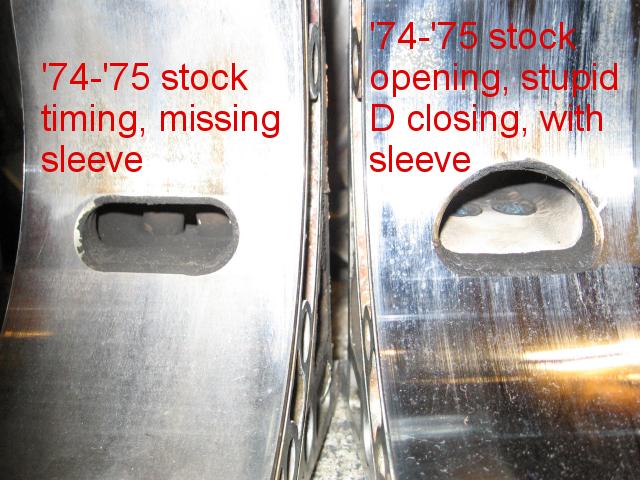
Here we see two '74 rotor housings. Stock on the left and an upside down D port on the right. Note the one on the left is missing its sleeve.
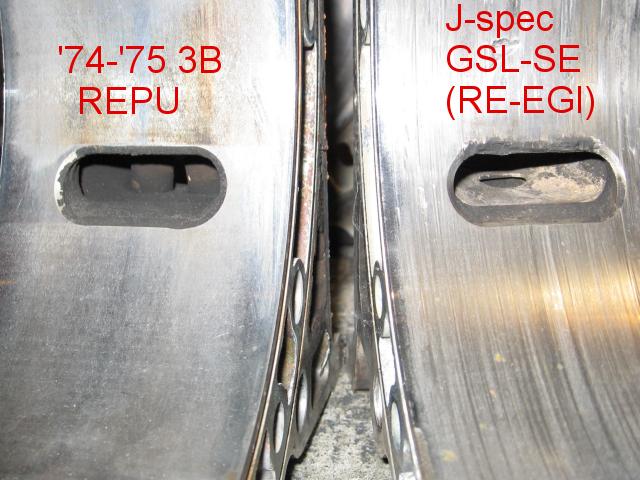
Now we see the same housing on the left with a J-sepc RE-EGI (looks like GSL-SE) from an HC Luce. Little bit of apex seal damage. Notice the timing of both ports looks very similar? A US-spec GSL-SE opens later and closes much later.
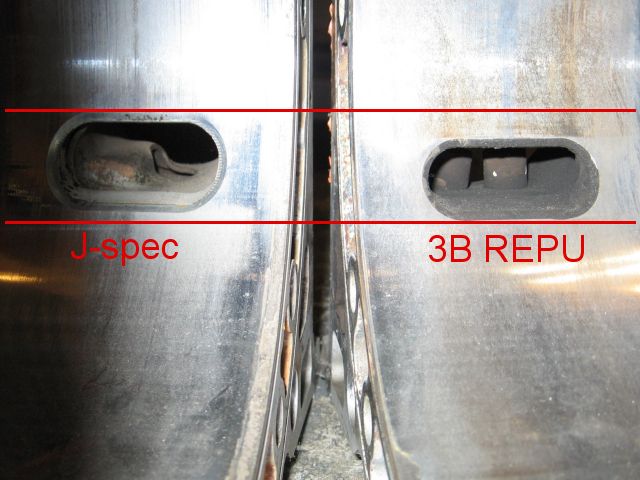
Now we see the '74 rotor housing moved to the right and an early J-sepc port on the left. By the way, the US-spec GSL-SE has the EXACT same port timing as seen here (but without the stupid looking exhaust sleeve). It closes at T2 spec.
Now we see them all together
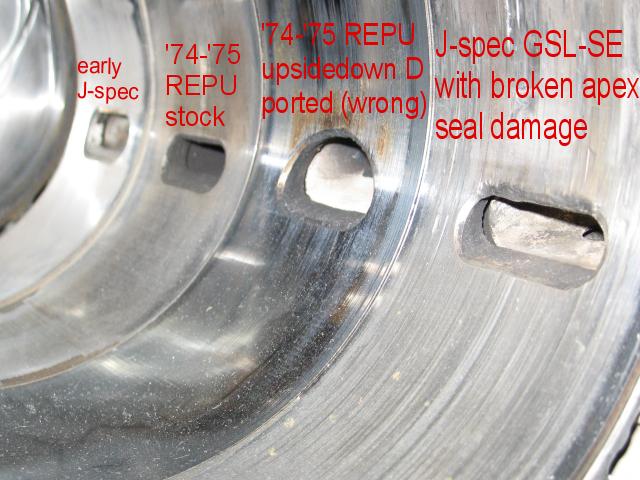
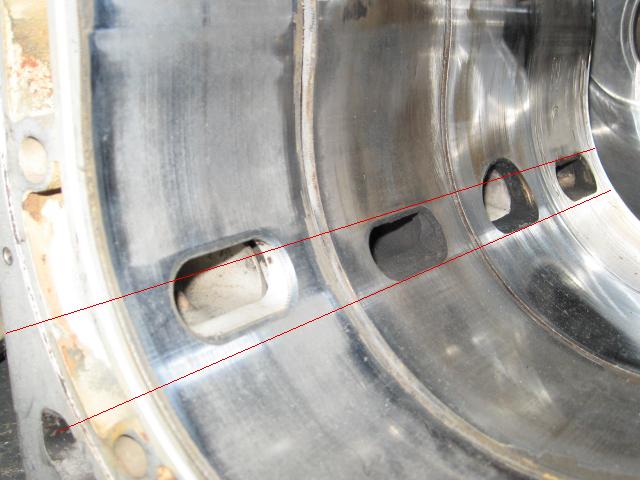
This time with a couple perspective lines to give you an idea just how different each port is.
Here we see two '74 rotor housings. Stock on the left and an upside down D port on the right. Note the one on the left is missing its sleeve.
Now we see the same housing on the left with a J-sepc RE-EGI (looks like GSL-SE) from an HC Luce. Little bit of apex seal damage. Notice the timing of both ports looks very similar? A US-spec GSL-SE opens later and closes much later.
Now we see the '74 rotor housing moved to the right and an early J-sepc port on the left. By the way, the US-spec GSL-SE has the EXACT same port timing as seen here (but without the stupid looking exhaust sleeve). It closes at T2 spec.
Now we see them all together
This time with a couple perspective lines to give you an idea just how different each port is.
Thread Starter
Joined: Aug 2001
Posts: 15,725
Likes: 91
From: Near Seattle
I just noticed something about the picture above. It appears the HC Luce port opens later than the '74 port. I'll have to go back and determine whether I opened the upsidedown D port sooner or left it stock because I could have sworn the HC Luce port opens at the same time as a stock '74 port. Hmm.............
Another big Hmm... I just had has to do with something 84stock said above. It has to do with stock exhaust ports instead of ported ones for low end torque and daily driving. Looking at the pictures above got me thinking about early J-spec/GSL-SE exhaust port timing compared to US-spec '74-'78 port timing.
As some of you know, I have wanted to build an engine for a future rotary baja project for some time now. I've done my research and settled on stock ports in Y plates and GSL-SE exhaust port timing because the later opening ports allow more time for the gasses to push on the rotors and give better low end power at the cost of some of your high end. Paul Yaw said smaller exhaust ports which open later will peak at a lower RPM. Of course header length is important for proper tuning and all that.
Anyway I assumed my set of early J-spec rotor housings with their GSL-SE style ports (thankfully with GSL-SE style sleeves too, woohoo!) would work out best for low RPM driveability, which in a baja, is a good thing. The only problem is these rotor housings are already installed in the engine sitting in my MG. The engine needs to be pulled to fix an oil pan leak (I'll use the Right Stuff this time) and I figured I could do a quickie rebuild and change out the rotor housings at the same time. I was going to throw in the small ported '74 rotor housings and put the J-spec rotor housings in the baja engine.
That would have solved everything! Then why am I having second thoughts?
I think I'm having second thoughts because for one thing, a rebuild takes time and energy, not to mention gasket sets of which are in short supply here at the moment. I only have one complete set and one partial set. I can build the REPU and maybe the Cosmo engine, but I was planning on reusing a bunch of stuff from the MG engine for its quickie rebuild and only replacing the black coolant seals because they always get stretched/crushed, and any gaskets that needed to be replaced too.
So in all honesty, which would be better to do? Should I combine:
MG:
Y plates ported to '74 spec
J-spec rotor housings with US-spec GSL-SE ports
REPU:
3B plates already at '74 spec
T2 ported rotor housings for future SC
Baja:
Y plates NOT ported
'74 rotor housings NOT ported
The end result here is anything with '74 spec ports, which could be considered a very mild streetport, will receive exhaust ports that are larger than stock carbed 13Bs from the '70s. The remaining engine for the baja with stock '76-'78('85) US-spec intake ports will also receive stock sized US-spec exhaust ports and is expected to be a torque monster. But would it actually work out like this?
Does that sound realistic? How do you think the MG and baja engines will perform? Or would things work out better if I just went with my original plan and did the quickie rebuild so the MG would get an engine very much like the old REPU engine, leaving the GSL-SE ported housings available for the baja? Remember the baja needs power from idle up to 4500 but no higher since the VW trannies don't like high RPM....
The bottom line is which set of rotor housings should the MG get?
Another big Hmm... I just had has to do with something 84stock said above. It has to do with stock exhaust ports instead of ported ones for low end torque and daily driving. Looking at the pictures above got me thinking about early J-spec/GSL-SE exhaust port timing compared to US-spec '74-'78 port timing.
As some of you know, I have wanted to build an engine for a future rotary baja project for some time now. I've done my research and settled on stock ports in Y plates and GSL-SE exhaust port timing because the later opening ports allow more time for the gasses to push on the rotors and give better low end power at the cost of some of your high end. Paul Yaw said smaller exhaust ports which open later will peak at a lower RPM. Of course header length is important for proper tuning and all that.
Anyway I assumed my set of early J-spec rotor housings with their GSL-SE style ports (thankfully with GSL-SE style sleeves too, woohoo!) would work out best for low RPM driveability, which in a baja, is a good thing. The only problem is these rotor housings are already installed in the engine sitting in my MG. The engine needs to be pulled to fix an oil pan leak (I'll use the Right Stuff this time) and I figured I could do a quickie rebuild and change out the rotor housings at the same time. I was going to throw in the small ported '74 rotor housings and put the J-spec rotor housings in the baja engine.
That would have solved everything! Then why am I having second thoughts?
I think I'm having second thoughts because for one thing, a rebuild takes time and energy, not to mention gasket sets of which are in short supply here at the moment. I only have one complete set and one partial set. I can build the REPU and maybe the Cosmo engine, but I was planning on reusing a bunch of stuff from the MG engine for its quickie rebuild and only replacing the black coolant seals because they always get stretched/crushed, and any gaskets that needed to be replaced too.
So in all honesty, which would be better to do? Should I combine:
MG:
Y plates ported to '74 spec
J-spec rotor housings with US-spec GSL-SE ports
REPU:
3B plates already at '74 spec
T2 ported rotor housings for future SC
Baja:
Y plates NOT ported
'74 rotor housings NOT ported
The end result here is anything with '74 spec ports, which could be considered a very mild streetport, will receive exhaust ports that are larger than stock carbed 13Bs from the '70s. The remaining engine for the baja with stock '76-'78('85) US-spec intake ports will also receive stock sized US-spec exhaust ports and is expected to be a torque monster. But would it actually work out like this?
Does that sound realistic? How do you think the MG and baja engines will perform? Or would things work out better if I just went with my original plan and did the quickie rebuild so the MG would get an engine very much like the old REPU engine, leaving the GSL-SE ported housings available for the baja? Remember the baja needs power from idle up to 4500 but no higher since the VW trannies don't like high RPM....
The bottom line is which set of rotor housings should the MG get?
Last edited by Jeff20B; Mar 20, 2007 at 04:29 PM.
Thread Starter
Joined: Aug 2001
Posts: 15,725
Likes: 91
From: Near Seattle
One last thing. We know the GSL-SE had the greatest low RPM torque of any 13B. The S4 had larger exhaust ports but I think the intake ports were the same size. The S4's dynamic chamber was better too. Were the later opening exhaust ports of the GSL-SE key?
Will I waste my time pulling the engine out of the MG to change the rotor housings? Would the baja engine benefit more from the J-spec rotor housings? They have decent chrome in better condition than the '74 rotor housings. I figured that alone was enough reason to use them in the baja. All these engines are getting built on a budget, of course.
Maybe I'm just lazy and looking for an easy way out. Nothing worth while is ever easy. Well, rarely so.
Ah crap maybe I should just go for the quickie rebuild. I'll probably thank myself in the end.
Ok, last question. I promise. Will GSL-SE ports work out better in the baja with stock intake ports than in the MG with '74 spec intake ports?
Once I put these engines together I won't want to take them apart to try it the other way. I gotta get this right the first time.
Thanks for reading and I look forward to your replies.
Will I waste my time pulling the engine out of the MG to change the rotor housings? Would the baja engine benefit more from the J-spec rotor housings? They have decent chrome in better condition than the '74 rotor housings. I figured that alone was enough reason to use them in the baja. All these engines are getting built on a budget, of course.
Maybe I'm just lazy and looking for an easy way out. Nothing worth while is ever easy. Well, rarely so.
Ah crap maybe I should just go for the quickie rebuild. I'll probably thank myself in the end.
Ok, last question. I promise.
Will GSL-SE ports work out better in the baja with stock intake ports than in the MG with '74 spec intake ports?Once I put these engines together I won't want to take them apart to try it the other way. I gotta get this right the first time.
Thanks for reading and I look forward to your replies.





Joined: Mar 2001
Posts: 31,857
Likes: 3,243
From: https://www2.mazda.com/en/100th/
Originally Posted by Jeff20B
MG:
Y plates ported to '74 spec
J-spec rotor housings with US-spec GSL-SE ports
REPU:
3B plates already at '74 spec
T2 ported rotor housings for future SC
Baja:
Y plates NOT ported
'74 rotor housings NOT ported
Y plates ported to '74 spec
J-spec rotor housings with US-spec GSL-SE ports
REPU:
3B plates already at '74 spec
T2 ported rotor housings for future SC
Baja:
Y plates NOT ported
'74 rotor housings NOT ported
Thread Starter
Joined: Aug 2001
Posts: 15,725
Likes: 91
From: Near Seattle
lol yeah.
Mike, thanks for the advice. That means all I have to do is pull the recently rebuilt but never fired up engine out of the MG to fix the leaky oil pan, and put it back in.
That's a lot less time consuming than a rebuild.
I really don't know how the MG engine will run with those ports. Anyone care to guess?
As for the baja, maybe I was going about it all wrong before. Maybe it's best to use some older parts because there is a real chance of overheating here. One nice thing about those housings with the stock ports is they're already kinda worn. If I manage to overheat them or break some seals, I won't be out much.
So I guess this is the list I'm going with:
I'd appreciate anyone elses opinion on the subject.
Thanks.
Mike, thanks for the advice. That means all I have to do is pull the recently rebuilt but never fired up engine out of the MG to fix the leaky oil pan, and put it back in.
That's a lot less time consuming than a rebuild.
I really don't know how the MG engine will run with those ports. Anyone care to guess?
As for the baja, maybe I was going about it all wrong before. Maybe it's best to use some older parts because there is a real chance of overheating here. One nice thing about those housings with the stock ports is they're already kinda worn. If I manage to overheat them or break some seals, I won't be out much.
So I guess this is the list I'm going with:
MG:
Y plates ported to '74 spec
J-spec rotor housings with US-spec GSL-SE ports
REPU:
3B plates already at '74 spec
T2 ported rotor housings for future SC
Baja:
Y plates NOT ported
'74 rotor housings NOT ported
Y plates ported to '74 spec
J-spec rotor housings with US-spec GSL-SE ports
REPU:
3B plates already at '74 spec
T2 ported rotor housings for future SC
Baja:
Y plates NOT ported
'74 rotor housings NOT ported
Thanks.

Thread
Thread Starter
Forum
Replies
Last Post
Skeese
Adaptronic Engine Mgmt - AUS
65
Mar 28, 2017 03:30 PM
msilvia
3rd Generation Specific (1993-2002)
28
Apr 14, 2016 12:58 PM
