


technical minded flow map question


technical minded flow map question
im taking a s4 n/a motor with a full bridge port and putting twin turbos on it the turbos are garrett T3 50 trims i plan on trying to push them to 15 lbs( i know they are kinda small) im having trouble with the flow map i was wondering if anyone could help. im useing the following formulas. im not a math major or anything like that so plz feel free to correct me if i am wrong
Engine Air Flow Requirements
(CID × RPM x VE%) ÷3456 = CFM
(80 × 7500 x 0.85) ÷ 3456 = 147.56 CFM (assuming 85 % VE)
Pressure Ratio
(15 + 14.7) ÷ 14.7 = 2.020 pressure ratio
Temperature Rise
T2 = T1 (P2 ÷ P1)to the .283 power
Where:
T2 = Outlet Temperature °R
T1 = Inlet Temperature °R
°R = °F + 460
P1 = Inlet Pressure Absolute
P2 = Outlet Pressure Absolute
assuming 75 degree inlet temp T1 = 75 + 460 = 535°R
P2 = 14.7 + 15 = 29.7 psi
pressure will be the outlet pressure of the turbo
T2 = 535 (29.7 ÷ 14.7)0.283 = 652.81°R
convert from degree R to degree F
652.81-460=192.81
which would give me a ideal temp rise of 117.81 degrees F
Adiabatic Efficiency
IOTR ÷ AE = AOTR
Where:
IOTR = Ideal Outlet Temperature Rise
AE = Adiabatic Efficiency
AOTR = Actual Outlet Temperature Rise
assumeing 70% adiabatic efficiency
117.81 ÷ 0.7 = 168.3 °F Actual Outlet Temperature Rise
now i add the temp rise to the inlet temp
75 + 168.3 = 243.3 °F Actual Outlet Temperature
Density Ratio
(Inlet °R ÷ Outlet °R) × (Outlet Pressure ÷ Inlet
Pressure) = Density Ratio
(535 ÷ 652.81) × (29.7 ÷ 14.7) = 1.655 Density Ratio
Compressor Inlet Airflow
Outlet CFM × Density Ratio = Actual Inlet CFM
147.56 CFM × 1.655= 244.211 CFM Inlet Air Flow
convert to lbs/min by
244.211 CFM × 0.069 = 16.85 lbs/min
no using all the information above considering that im useing 2 turbos i cut the flow in half to 8.425lbs/min
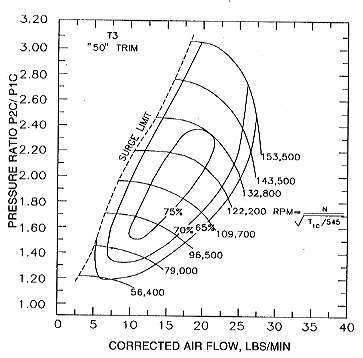
when i map it on the map below it seems like one turbo this size would be more efficent then two, or that two turbos will put me in the surge limit
any help with this would be great
thanks
-joe
Engine Air Flow Requirements
(CID × RPM x VE%) ÷3456 = CFM
(80 × 7500 x 0.85) ÷ 3456 = 147.56 CFM (assuming 85 % VE)
Pressure Ratio
(15 + 14.7) ÷ 14.7 = 2.020 pressure ratio
Temperature Rise
T2 = T1 (P2 ÷ P1)to the .283 power
Where:
T2 = Outlet Temperature °R
T1 = Inlet Temperature °R
°R = °F + 460
P1 = Inlet Pressure Absolute
P2 = Outlet Pressure Absolute
assuming 75 degree inlet temp T1 = 75 + 460 = 535°R
P2 = 14.7 + 15 = 29.7 psi
pressure will be the outlet pressure of the turbo
T2 = 535 (29.7 ÷ 14.7)0.283 = 652.81°R
convert from degree R to degree F
652.81-460=192.81
which would give me a ideal temp rise of 117.81 degrees F
Adiabatic Efficiency
IOTR ÷ AE = AOTR
Where:
IOTR = Ideal Outlet Temperature Rise
AE = Adiabatic Efficiency
AOTR = Actual Outlet Temperature Rise
assumeing 70% adiabatic efficiency
117.81 ÷ 0.7 = 168.3 °F Actual Outlet Temperature Rise
now i add the temp rise to the inlet temp
75 + 168.3 = 243.3 °F Actual Outlet Temperature
Density Ratio
(Inlet °R ÷ Outlet °R) × (Outlet Pressure ÷ Inlet
Pressure) = Density Ratio
(535 ÷ 652.81) × (29.7 ÷ 14.7) = 1.655 Density Ratio
Compressor Inlet Airflow
Outlet CFM × Density Ratio = Actual Inlet CFM
147.56 CFM × 1.655= 244.211 CFM Inlet Air Flow
convert to lbs/min by
244.211 CFM × 0.069 = 16.85 lbs/min
no using all the information above considering that im useing 2 turbos i cut the flow in half to 8.425lbs/min
when i map it on the map below it seems like one turbo this size would be more efficent then two, or that two turbos will put me in the surge limit
any help with this would be great
thanks
-joe

Rotary Enthusiast

Joined: Jan 2002
Posts: 859
Likes: 0
From: 15143
Sorry, but I stopped reading at this point...
so considering that i am useing two turbos i would have to cut the 160cid in half which is 80cid what the above calc are set up for, correct? which would set me almost dead nuts in the 75% island.
Rotary Enthusiast


Joined: Aug 2004
Posts: 1,326
Likes: 9
From: Australia - Perth
wouldn't you use 160cid and then half your final lbs/min, like you already have ?
(you halved your cid at the start and again at the end, so ending up with a lesser figure.)
I dont know, just the way I read it
Also you are bridge ported so you will flow more then calced anyway.
Why not do a search and see what other people have done quite a few twin setup about.
(you halved your cid at the start and again at the end, so ending up with a lesser figure.)
I dont know, just the way I read it
Also you are bridge ported so you will flow more then calced anyway.
Why not do a search and see what other people have done
quite a few twin setup about.
Rotary Enthusiast
Joined: Jan 2002
Posts: 859
Likes: 0
From: 15143
Feel free to get detailed in your calcs, but there's an easy way to check that you're in the ballpark: expected RWHP divided by 7.5 = lbs/min of air. So your 17 lbs/min turbos will give about 250rwhp on a 13b, which sounds like a bad idea for your bridgeport IMO.


Joined: Oct 2001
Posts: 6,279
Likes: 728
From: Florence, Alabama
according to the map each turbo will make 27 lbs/min max.
27*2=54/1.3=41.5*10= 415 max rear wheel rotary hp.
or 54*14.471= 781 cfm/1.92= 406 max rear wheel rotary hp.
take your pick.
as to the turbos, being T3s... you will need either the .63 or .82 hotside housings w a stage 3 turbine wheel or you will split the housings due to backpressure and heat. do not run the .48 housings.
i currently have over 10,000 miles on my twin setup.
27*2=54/1.3=41.5*10= 415 max rear wheel rotary hp.
or 54*14.471= 781 cfm/1.92= 406 max rear wheel rotary hp.
take your pick.
as to the turbos, being T3s... you will need either the .63 or .82 hotside housings w a stage 3 turbine wheel or you will split the housings due to backpressure and heat. do not run the .48 housings.
i currently have over 10,000 miles on my twin setup.

Thread
Thread Starter
Forum
Replies
Last Post
Skeese
Adaptronic Engine Mgmt - AUS
65
Mar 28, 2017 03:30 PM
msilvia
3rd Generation Specific (1993-2002)
28
Apr 14, 2016 12:58 PM
rx8volks
Canadian Forum
0
Aug 13, 2015 04:55 AM