


Heat Shielding an FD wiring harness


Thread Starter
Darkside FD

Joined: Jan 2004
Posts: 1,175
Likes: 0
From: AZ
Heat Shielding an FD wiring harness
I have a brand new wiring harness sitting in my living room that I just got from Malloy. I also have a bunch of the left over Thermo-tec thermo flex tubing that I used in my original single turbo install. I was thinking that after I remove all of the unnessecary wiring from the harness that I would re-loom it using only the thermo flex tubing that I have.
Do you think this thermo flex will be a good way to keep the harness from the baked wire syndrom we all to commonly find on these FDs after 12 years? My main harness wasn't too bad, but some of the connections were getting bad so if I was going to do it, I would have to go all the way and shield everything...
Do ya'll think this would be worthwhile? I saw in Atilla's thread that he did some heatshielding, I searched a ton of threads to see if anyone else had written anything up about it, but I haven't found anything.
To me it sounds like a good idea, since that Thermo Flex stuff is almost exactly like wire loom (have to slice it down the center to get it on the wires then use zip ties or self adhearing silicone tape to keep it closed.) It would definately drop the temps the wires see by a lot more than standard loom...just be more expensive and time consuming to perform.
I just wanted to open up this thread to anyone's ideas on how to better heat shield the wiring harness itself.
FWIW...everything in my engine bay is ceramic coated.
Do you think this thermo flex will be a good way to keep the harness from the baked wire syndrom we all to commonly find on these FDs after 12 years? My main harness wasn't too bad, but some of the connections were getting bad so if I was going to do it, I would have to go all the way and shield everything...
Do ya'll think this would be worthwhile? I saw in Atilla's thread that he did some heatshielding, I searched a ton of threads to see if anyone else had written anything up about it, but I haven't found anything.
To me it sounds like a good idea, since that Thermo Flex stuff is almost exactly like wire loom (have to slice it down the center to get it on the wires then use zip ties or self adhearing silicone tape to keep it closed.) It would definately drop the temps the wires see by a lot more than standard loom...just be more expensive and time consuming to perform.
I just wanted to open up this thread to anyone's ideas on how to better heat shield the wiring harness itself.
FWIW...everything in my engine bay is ceramic coated.

Rotary Enthusiast
Joined: Feb 2001
Posts: 1,094
Likes: 0
From: Orange County, CA
For the wiring harness I did a few things.
1. Removed excess wires.
2. Used the plastic wiring loom tubing and wrapped that with high temp electrical tape.
3. Then I wrapped it with high temp self fusing silicone tape.
4. For the engine wiring harness, I used a Thermotec heat shielding sleeve that uses velcro to close.

As you saw on your harness, the wires that go into the connectors sometimes get hard / brittle and crack. I saw this on many connectors, so what I did with the new harness was to wrap the silicone self fusing tape all the way onto the connector as far as it would go without making it impossible to remove.
Any heat protection you can give the harness you are better off. Especially with the main engine harness going right over the downpipe / exhaust side of the turbo.
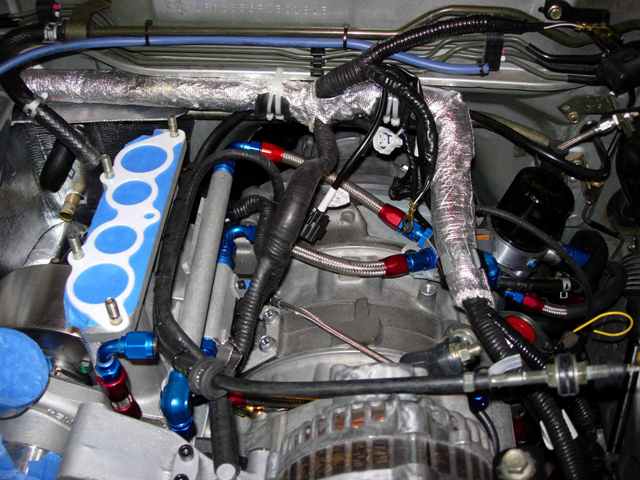
Expensive and time consuming, well yes. But in another 10 years (if you are like me and want to keep the car for a long time), you won't be shelling out another $700. Actually by then I'm sure it will be almost impossible to get a new harness.
1. Removed excess wires.
2. Used the plastic wiring loom tubing and wrapped that with high temp electrical tape.
3. Then I wrapped it with high temp self fusing silicone tape.
4. For the engine wiring harness, I used a Thermotec heat shielding sleeve that uses velcro to close.
As you saw on your harness, the wires that go into the connectors sometimes get hard / brittle and crack. I saw this on many connectors, so what I did with the new harness was to wrap the silicone self fusing tape all the way onto the connector as far as it would go without making it impossible to remove.
Any heat protection you can give the harness you are better off. Especially with the main engine harness going right over the downpipe / exhaust side of the turbo.
Expensive and time consuming, well yes. But in another 10 years (if you are like me and want to keep the car for a long time), you won't be shelling out another $700. Actually by then I'm sure it will be almost impossible to get a new harness.
Thread Starter
Darkside FD
Joined: Jan 2004
Posts: 1,175
Likes: 0
From: AZ
I read your writeup inside of your thread and I thought it was a great thing to do. So I was just trying to see how I could take it a few steps further with left over materials and perhaps a few more materials purchases from Thermotec.
I agree with you on the investment side. I doubt you will even be able to source the connectors in 10-15 years so if your harness is done you would have to piece together multiple used ones to get a good one (NO THANK YOU!) I will protect this $730 investment the best I can.
What do you think of using the thermo-flex tubing as additional loom over those other sprawling areas of the harness?
I am definately going to purchase that sleeve you used. The turbine area is by far the most important to shield.
I agree with you on the investment side. I doubt you will even be able to source the connectors in 10-15 years so if your harness is done you would have to piece together multiple used ones to get a good one (NO THANK YOU!) I will protect this $730 investment the best I can.
What do you think of using the thermo-flex tubing as additional loom over those other sprawling areas of the harness?
I am definately going to purchase that sleeve you used. The turbine area is by far the most important to shield.
Rotary Enthusiast
Joined: Feb 2001
Posts: 1,094
Likes: 0
From: Orange County, CA
I like the flex tubing, but if you don't cut it down the side then it's almost impossible to put on... I tried. 
If you cut it then it will work but then you have exposed sharper edges of the tubing, so that's why I didn't use it.
You could first use the plastic split wiring loom, then some silicone tape, and then put the flex tubing over that... I think the wiring would be protected quite well. Just don't forget to protect the wires where they enter the plugs.
If you cut it then it will work but then you have exposed sharper edges of the tubing, so that's why I didn't use it.
You could first use the plastic split wiring loom, then some silicone tape, and then put the flex tubing over that... I think the wiring would be protected quite well. Just don't forget to protect the wires where they enter the plugs.

almost done

Joined: Dec 2001
Posts: 1,049
Likes: 0
From: 250 HZ
i would use this before the heat stuff.

Wiring Harness Wrapping Tape Vinyl
This difficult-to-find dry vinyl tape does not have adhesive on the back but holds to itself by friction. If you make a mistake, simply unwrap, straighten it out and re-wrap. No more wads of stuck-together unusable tape.
http://www.eastwoodco.com/jump.jsp?i...emType=PRODUCT
Wiring Harness Wrapping Tape Vinyl
This difficult-to-find dry vinyl tape does not have adhesive on the back but holds to itself by friction. If you make a mistake, simply unwrap, straighten it out and re-wrap. No more wads of stuck-together unusable tape.
http://www.eastwoodco.com/jump.jsp?i...emType=PRODUCT


my advice is eactly what i did with my brand new harness. wrap it with the thermotech as far forward as you can. yet leave all the connectors on it! god forbid you crash the car but if you do you can easily sell a complete harness much easier than a hacked up single harness. everyone has different setups when they go single some still have the aws some have double throttle. so if you take them out someone might not want it. i only utilise about 7 connectors on the whole thing and it looks crammed but the resale value will be easy if i decide i need to part out. hope this helps some what.
-Lance
-Lance
Rotary Enthusiast
Joined: Feb 2001
Posts: 1,094
Likes: 0
From: Orange County, CA
I think that the silicone self fusing tape is better:
Self-Fusing Silicone Rubber Tape
No need for adhesive, this tape fuses to itself in 24 hours for a permanent seal. Simply wrap or apply tape to object—it stretches to fit virtually any form. Ideal for high-temperature applications such as electrical coil insulation, splices, cable harnesses, powder-coating, masking applications, and bus bar insulation. Also useful as a substitute for heat shrink tube coverings and for sealing hot air ducts. Has a tensile strength of 700 psi and an elongation of 300%. Temperature range is -76° to +392° F (apply at temperatures from 70° to 100° F). Tape has a peel-off liner and is supplied on a cardboard spool with a 1" ID. To Order: Please specify color: black, clear, gray, or red.
Rectangular— Flat tape with uniform thickness. Commonly used as an electrical insulator. Meets MIL-A-A-59163 Type I standards.
Triangular— Thicker in the middle and tapering at each edge. Middle also has an extruded ridge that acts as a guide to ensure a smooth wrap. Meets MIL-A-A-59163 Type II standards.
Also, it's better to put the wiring into the plastic loom and then wrap it, instead of just wrapping the wires together. Then put the aluminized loom on top of that. This is because if you wrap the wiring, it makes it much more difficult to bend / route it, possibly causing kinks in the wiring. I found that out when I first tried to do that...
Self-Fusing Silicone Rubber Tape
No need for adhesive, this tape fuses to itself in 24 hours for a permanent seal. Simply wrap or apply tape to object—it stretches to fit virtually any form. Ideal for high-temperature applications such as electrical coil insulation, splices, cable harnesses, powder-coating, masking applications, and bus bar insulation. Also useful as a substitute for heat shrink tube coverings and for sealing hot air ducts. Has a tensile strength of 700 psi and an elongation of 300%. Temperature range is -76° to +392° F (apply at temperatures from 70° to 100° F). Tape has a peel-off liner and is supplied on a cardboard spool with a 1" ID. To Order: Please specify color: black, clear, gray, or red.
Rectangular— Flat tape with uniform thickness. Commonly used as an electrical insulator. Meets MIL-A-A-59163 Type I standards.
Triangular— Thicker in the middle and tapering at each edge. Middle also has an extruded ridge that acts as a guide to ensure a smooth wrap. Meets MIL-A-A-59163 Type II standards.
Also, it's better to put the wiring into the plastic loom and then wrap it, instead of just wrapping the wires together. Then put the aluminized loom on top of that. This is because if you wrap the wiring, it makes it much more difficult to bend / route it, possibly causing kinks in the wiring. I found that out when I first tried to do that...
Last edited by atihun; Oct 21, 2006 at 02:02 PM.
Trending Topics
Thread Starter
Darkside FD
Joined: Jan 2004
Posts: 1,175
Likes: 0
From: AZ
I use the self fusing silicone tape in all my stereo installs. I love that stuff. It may be a little overkill for a stereo install but...eh...while you are in there, you might as well make it RIGHT. I have plenty of that stuff.
Atilla - I will probably do almost exactly how you have done, but then add the thermoflex to the sprawling parts of the harness (i.e. the injector clips, coolant level/temp, and tps sensor off shoots)
That should probably be enough. I just wanted to see what others have used as far as the heat shielding materials and tape. I am glad to see the self fusing silcone tape, and thermo tec products...cause I already have those!
Atilla - I will probably do almost exactly how you have done, but then add the thermoflex to the sprawling parts of the harness (i.e. the injector clips, coolant level/temp, and tps sensor off shoots)
That should probably be enough. I just wanted to see what others have used as far as the heat shielding materials and tape. I am glad to see the self fusing silcone tape, and thermo tec products...cause I already have those!
Thread Starter
Darkside FD
Joined: Jan 2004
Posts: 1,175
Likes: 0
From: AZ
Originally Posted by mono4lamar
my advice is eactly what i did with my brand new harness. wrap it with the thermotech as far forward as you can. yet leave all the connectors on it! god forbid you crash the car but if you do you can easily sell a complete harness much easier than a hacked up single harness. everyone has different setups when they go single some still have the aws some have double throttle. so if you take them out someone might not want it. i only utilise about 7 connectors on the whole thing and it looks crammed but the resale value will be easy if i decide i need to part out. hope this helps some what.
-Lance
-Lance
But rest assured your point doesn't fall on deaf ears.

Coyote
Joined: Nov 2004
Posts: 953
Likes: 0
From: Malta. Europe
i would open the harness, elongate the sockets you are not using and bundle them to a side. I removed all the useless sockets, harnessed them to the side and taped/sheilded them to be part and functional of the main harness. I use those as outputs and inputs for my wolf.

Thread
Thread Starter
Forum
Replies
Last Post
