


Crankcase evacuation with highboost


I have the Cusco catch can on my car with -6 lines to and from. That would be large enough right? This is something that's been done for ages and it does work. I've done it on all my piston cars with great results
What a great thread! Threads like this one is what keeps me coming back
What a great thread! Threads like this one is what keeps me coming back
Rotary Freak

Joined: Jan 2002
Posts: 1,643
Likes: 0
From: l.a.
why wouldn't suction from the turbos be adequate enough to necessitate a mechanical pump? say you're running 30psi, that's a lot of vacuum pressure sucking on the catch can. what some of you guys are saying is even this isn't enough? also do any of you guys have any pics as to where you attached your line on the turbo inlet?
Full Member
Joined: Aug 2002
Posts: 248
Likes: 0
From: on track
I run the Jaz catch can on road racing tracks. it is attachec to a tube tapped into the middle of my oil filler cap with a 1/4" plastic barbed ell. The catch can resides on the shock tower area above the igniter. Been using it for years and it works great. FWIW, all other nipples on the filler neck are plugged. twokrx7 and I stared at this problem a few years ago and he came up with this solution.

Full Member
Joined: Oct 2001
Posts: 62
Likes: 0
From: Melbourne, Australia
very interesting thread
I can see many advantages in pulling a vacuum on the crankcase i have done some surfing and they are very common on high hp V8's etc, alot of them really on the exhaust to pull a vacuum, by fitting a peice of tube that runs at a 45 degree angle to the exhaust pipe which forms a vacuum, though i belveive the most you would get from that would be about 5 - 6 inches of vacuum which i don't reckon is a whole lot when you compare it to the big boys, They normally run the moroso vacuum pump which depending on how you configure the pulleys will pull 15 inches of vacuum or more, and they often gain about 25hp (dependent on rings etc)
I imagine a turbo pumping 30psi would be able to create a resonable vacuum provided the fitting you use was plummbed in on a 45 degree angle, though i still prefer the idea of using the exhaust
I am planning on refitting my air pump and making up a new catch can etc, as even if it doesn't give me anymore power it will, reduce the chance of oil leaks, help the turbo drain better, and also help stop any fuel mixxing in with the oil. Thoughts?????
cheers
Lance
I can see many advantages in pulling a vacuum on the crankcase i have done some surfing and they are very common on high hp V8's etc, alot of them really on the exhaust to pull a vacuum, by fitting a peice of tube that runs at a 45 degree angle to the exhaust pipe which forms a vacuum, though i belveive the most you would get from that would be about 5 - 6 inches of vacuum which i don't reckon is a whole lot when you compare it to the big boys, They normally run the moroso vacuum pump which depending on how you configure the pulleys will pull 15 inches of vacuum or more, and they often gain about 25hp (dependent on rings etc)
I imagine a turbo pumping 30psi would be able to create a resonable vacuum provided the fitting you use was plummbed in on a 45 degree angle, though i still prefer the idea of using the exhaust
I am planning on refitting my air pump and making up a new catch can etc, as even if it doesn't give me anymore power it will, reduce the chance of oil leaks, help the turbo drain better, and also help stop any fuel mixxing in with the oil. Thoughts?????
cheers
Lance

Senior Member

Joined: Aug 2001
Posts: 445
Likes: 0
From: houston
<< cach22>>I imagine a turbo pumping 30psi would be able to create a resonable vacuum provided the fitting you use was plummbed in on a 45 degree angle, though i still prefer the idea of using the exhaust
since the turbo is already pulling vacuum you do not need to have your fittings at 45 degrees. the exhaust is pushing so the 45 creates a vacuum. the exhaust on a high psi turbocharged car is still pressurized through the exhaust so trying to use the exhaust to pull a vacuum would be difficult at best.
MWW
since the turbo is already pulling vacuum you do not need to have your fittings at 45 degrees. the exhaust is pushing so the 45 creates a vacuum. the exhaust on a high psi turbocharged car is still pressurized through the exhaust so trying to use the exhaust to pull a vacuum would be difficult at best.
MWW
Full Member
Joined: Oct 2001
Posts: 62
Likes: 0
From: Melbourne, Australia
Originally posted by turbostreetfighter
<< cach22>>I imagine a turbo pumping 30psi would be able to create a resonable vacuum provided the fitting you use was plummbed in on a 45 degree angle, though i still prefer the idea of using the exhaust
since the turbo is already pulling vacuum you do not need to have your fittings at 45 degrees. the exhaust is pushing so the 45 creates a vacuum. the exhaust on a high psi turbocharged car is still pressurized through the exhaust so trying to use the exhaust to pull a vacuum would be difficult at best.
MWW
<< cach22>>I imagine a turbo pumping 30psi would be able to create a resonable vacuum provided the fitting you use was plummbed in on a 45 degree angle, though i still prefer the idea of using the exhaust
since the turbo is already pulling vacuum you do not need to have your fittings at 45 degrees. the exhaust is pushing so the 45 creates a vacuum. the exhaust on a high psi turbocharged car is still pressurized through the exhaust so trying to use the exhaust to pull a vacuum would be difficult at best.
MWW
On the info i read whilst surfing they stated that for the exhaust setup to work they advised to not use mufflers, which i suppose if you are running 30psi boost you would have the exhaust off. Have you measured how much vacuum your setup pullscheers
Lance
Originally posted by fdracer
hey, how important is the breather? most of the catch cans, like the greddy or cusco, are totally sealed. is there an advantage to venting the catch can to the atmosphere?
hey, how important is the breather? most of the catch cans, like the greddy or cusco, are totally sealed. is there an advantage to venting the catch can to the atmosphere?

Thread Starter
Freedoms worth a buck o'5

Joined: May 2001
Posts: 2,544
Likes: 1
From: Calgary Alberta Canada
Hmm, I had kinda given up trying to get across what I was saying, but I will go at it again...
Yes the inlet of the turbo would make a considerable vacuum, however, back to my original post, apparently its the oil and oil vapour which can pre ignite and cause detonation, by pulling oil and oil vapour back in through the motor, you are back to square one. Engine oil lowers the knock resistance of gasoline, also carbon buildup results in engine hot spots and potentially higher compression ratio if it builds up enough therefore we are trying to get away from burning oil and oil vapour in the engine, hence the reasoning behind using a seperate vacuum pump with a free air discharge, it keeps the oil from being ingested internally, by minimizing crankcase pressure, and also means you don;t have to rely on the intake air tract as your vacuum source, so oil is not pulled in that way either.
Also, oil film inn the intercooler totally kills heat transfer as well..Max
Yes the inlet of the turbo would make a considerable vacuum, however, back to my original post, apparently its the oil and oil vapour which can pre ignite and cause detonation, by pulling oil and oil vapour back in through the motor, you are back to square one. Engine oil lowers the knock resistance of gasoline, also carbon buildup results in engine hot spots and potentially higher compression ratio if it builds up enough therefore we are trying to get away from burning oil and oil vapour in the engine, hence the reasoning behind using a seperate vacuum pump with a free air discharge, it keeps the oil from being ingested internally, by minimizing crankcase pressure, and also means you don;t have to rely on the intake air tract as your vacuum source, so oil is not pulled in that way either.
Also, oil film inn the intercooler totally kills heat transfer as well..Max
Senior Member
Joined: Aug 2001
Posts: 445
Likes: 0
From: houston
Max, you are correct and i understand your point but if you use a "catch can" in between the line going to the turbo inlet you will not ingest any oil or vapors.also using a motor driven pump is going to slow the engine performance.
i am using both a free vent and vacuum pull in my system, and after the car is turned off you can see the fumes come out of the vent/filter so i know it is working!
MWW
i am using both a free vent and vacuum pull in my system, and after the car is turned off you can see the fumes come out of the vent/filter so i know it is working!
MWW

no
Joined: Apr 2001
Posts: 2,295
Likes: 0
From: Dallas, TX / Tokyo, Japan currently
maybe this is a stupid question, but i dont see how y'all are still getting any efficient pull from the intake to the catch can when there is a filter on the catch can. wouldnt that allow the air just to flow through the filter and not supply any or at least not as great of a vacuum to the oil filler neck (crankcase)??
-Nic
-Nic
Thread Starter
Freedoms worth a buck o'5
Joined: May 2001
Posts: 2,544
Likes: 1
From: Calgary Alberta Canada
I don't know if a evac pump really use that much power, in all the publish tests, motors running mechanical crankcase scavenging, make more power than those that don't run due to better volumetric efficiency and less intake charge dilution from blowby of crankcase gases..
The crankcase catch can breather kits I have seen,use the filter to filter air that is going to pulled through the motor by the evacuation source, the air going to the vacuum source from the engine is not filtered but uses a u tube configuration as a simple "phase seperator" (which is a TRANE air conditioning term for a liquid trap, sorry), the whole point though is to totally stop any oil or oil vapour ingestion..Max
The crankcase catch can breather kits I have seen,use the filter to filter air that is going to pulled through the motor by the evacuation source, the air going to the vacuum source from the engine is not filtered but uses a u tube configuration as a simple "phase seperator" (which is a TRANE air conditioning term for a liquid trap, sorry), the whole point though is to totally stop any oil or oil vapour ingestion..Max

Senior Member
Joined: Jul 2001
Posts: 360
Likes: 0
From: Kalifornia
Originally posted by Maxthe7man
Hmm, I had kinda given up trying to get across what I was saying, but I will go at it again...
Yes the inlet of the turbo would make a considerable vacuum, however, back to my original post, apparently its the oil and oil vapour which can pre ignite and cause detonation, by pulling oil and oil vapour back in through the motor, you are back to square one. Engine oil lowers the knock resistance of gasoline, also carbon buildup results in engine hot spots and potentially higher compression ratio if it builds up enough therefore we are trying to get away from burning oil and oil vapour in the engine, hence the reasoning behind using a seperate vacuum pump with a free air discharge, it keeps the oil from being ingested internally, by minimizing crankcase pressure, and also means you don;t have to rely on the intake air tract as your vacuum source, so oil is not pulled in that way either.
Also, oil film inn the intercooler totally kills heat transfer as well..Max
Hmm, I had kinda given up trying to get across what I was saying, but I will go at it again...
Yes the inlet of the turbo would make a considerable vacuum, however, back to my original post, apparently its the oil and oil vapour which can pre ignite and cause detonation, by pulling oil and oil vapour back in through the motor, you are back to square one. Engine oil lowers the knock resistance of gasoline, also carbon buildup results in engine hot spots and potentially higher compression ratio if it builds up enough therefore we are trying to get away from burning oil and oil vapour in the engine, hence the reasoning behind using a seperate vacuum pump with a free air discharge, it keeps the oil from being ingested internally, by minimizing crankcase pressure, and also means you don;t have to rely on the intake air tract as your vacuum source, so oil is not pulled in that way either.
Also, oil film inn the intercooler totally kills heat transfer as well..Max
My entireRX7 project has been put on hold for over a month - just too busy. If anyone has basic welding skills this is what I plan on doing for a cheap / kool bottle. The vapor trap as a new addition.
MRS Aluminum fuel bottle. If you buy 2 or more they can be cut and welded together - REI $7 to $10
K&N Type filter W/ hose clamp - Sumitt Racing $13.50
1-1/2" Aluminum tube 2" long to clamp the filter to, welded to top of cut bottle - scrap pile
3/8" Aluminum tube. 2 flared and bent prices - scrap pile
Fine stainless steel wire would be similar to a SOS soap pad with the soap[ removed - ?
This will make a nice strong catch can for almost nothing the only problem I have is trying to figure out how to take the red powder coating off the can. I will paint mine black.
Rotary Freak
Joined: Jan 2002
Posts: 1,643
Likes: 0
From: l.a.
Originally posted by silvr94r2
What do you mean by totally sealed?......i've got one and it came with the little filter to put off of one of the fittings. I added another to run to the inlet side of the turbo and it's a done deal.
What do you mean by totally sealed?......i've got one and it came with the little filter to put off of one of the fittings. I added another to run to the inlet side of the turbo and it's a done deal.


Originally posted by Maxthe7man
, by pulling oil and oil vapour back in through the motor, you are back to square one
, by pulling oil and oil vapour back in through the motor, you are back to square one

no
Joined: Apr 2001
Posts: 2,295
Likes: 0
From: Dallas, TX / Tokyo, Japan currently
Originally posted by 80-CU.IN.T
I think you are right about vaporized oil being pulled back into the motor. I hadn't thought of that. An air / oil line separator would work consisting of fine wire to trap the suspended oil and have it drip back down into the container.
My entireRX7 project has been put on hold for over a month - just too busy. If anyone has basic welding skills this is what I plan on doing for a cheap / kool bottle. The vapor trap as a new addition.
MRS Aluminum fuel bottle. If you buy 2 or more they can be cut and welded together - REI $7 to $10
K&N Type filter W/ hose clamp - Sumitt Racing $13.50
1-1/2" Aluminum tube 2" long to clamp the filter to, welded to top of cut bottle - scrap pile
3/8" Aluminum tube. 2 flared and bent prices - scrap pile
Fine stainless steel wire would be similar to a SOS soap pad with the soap[ removed - ?
This will make a nice strong catch can for almost nothing the only problem I have is trying to figure out how to take the red powder coating off the can. I will paint mine black.
I think you are right about vaporized oil being pulled back into the motor. I hadn't thought of that. An air / oil line separator would work consisting of fine wire to trap the suspended oil and have it drip back down into the container.
My entireRX7 project has been put on hold for over a month - just too busy. If anyone has basic welding skills this is what I plan on doing for a cheap / kool bottle. The vapor trap as a new addition.
MRS Aluminum fuel bottle. If you buy 2 or more they can be cut and welded together - REI $7 to $10
K&N Type filter W/ hose clamp - Sumitt Racing $13.50
1-1/2" Aluminum tube 2" long to clamp the filter to, welded to top of cut bottle - scrap pile
3/8" Aluminum tube. 2 flared and bent prices - scrap pile
Fine stainless steel wire would be similar to a SOS soap pad with the soap[ removed - ?
This will make a nice strong catch can for almost nothing the only problem I have is trying to figure out how to take the red powder coating off the can. I will paint mine black.
as far as answering my earlier question:
so you need the filter to bleed away the oil fumes and other gases in the crankcase that would lower octane??
Originally posted by fdracer
you got pics of how you installed the cusco? i've actually never seen one, and i'd like to see how it looks installed.
you got pics of how you installed the cusco? i've actually never seen one, and i'd like to see how it looks installed.
We started making our own catch cans and overflows lately because it's cheaper and we can custom fit them with no problems.
This is one for my radiator before polishing and the right fittings were put in......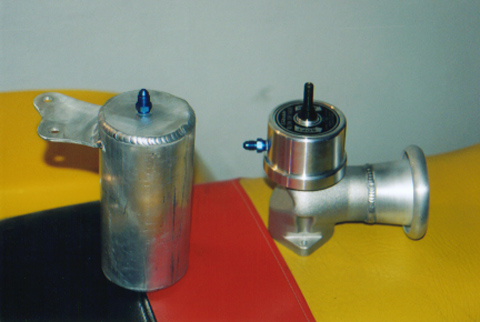
This is one for my radiator before polishing and the right fittings were put in......
Full Member
Joined: Aug 2002
Posts: 248
Likes: 0
From: on track
Originally posted by turbostreetfighter
wassup Brad???? how have ya been? i saw that pic of your car after the paint job, it looks good!
MWW
wassup Brad???? how have ya been? i saw that pic of your car after the paint job, it looks good!
MWW
Here is an image of my catch can, fwiw. Works great.
Senior Member
Joined: Jul 2001
Posts: 360
Likes: 0
From: Kalifornia
suganuma -
I don't have a scanner or digital camera so posting pics are a pain. When I get time to make it, I will barrow a camera. Unfortunately I don't work out of my garage. Don't have one now. I work out of a friends and it is about a 45min. drive 1 way without trafic. I sold almost everything to get enough capital to start my business a little over 1 year ago. Divorce sucks. They say everything is 50/50. It is. She gets the house, you get the payments, she gets the money you get the car that isn't payed for yet. ECT.-ECT -ECT.
I don't think the ss wire will work under low boost 14 -15 LBS that I will be running with the configuration that I described using an open air filter. Higher boost should work 20+ LBS. I am considering making one also with no open air filter. At around 2 to 5 LBS. of boost the crank case will probably be pressurized ( not a good thing.) Above this the vaccume should pull the gasses thought the screen and back into the turbo inlet after they have been filtered partially by the fine wire.
The type of filtering system that I have described has been used for more that 40 years in compressor systems to remove the oil from the air you breath or whatever. These systems are under pressure 25 to 1000 or more psig. The vaccume sorce I will be using is nowhere near that so the wire can not be as tightly packed. It will work just not 100%. How much I don't know.
Hell I just might screw the vaccume and mesh and vent to the atmosphere. We'll see when I get some time.
I don't have a scanner or digital camera so posting pics are a pain. When I get time to make it, I will barrow a camera. Unfortunately I don't work out of my garage. Don't have one now. I work out of a friends and it is about a 45min. drive 1 way without trafic. I sold almost everything to get enough capital to start my business a little over 1 year ago. Divorce sucks. They say everything is 50/50. It is. She gets the house, you get the payments, she gets the money you get the car that isn't payed for yet. ECT.-ECT -ECT.
I don't think the ss wire will work under low boost 14 -15 LBS that I will be running with the configuration that I described using an open air filter. Higher boost should work 20+ LBS. I am considering making one also with no open air filter. At around 2 to 5 LBS. of boost the crank case will probably be pressurized ( not a good thing.) Above this the vaccume should pull the gasses thought the screen and back into the turbo inlet after they have been filtered partially by the fine wire.
The type of filtering system that I have described has been used for more that 40 years in compressor systems to remove the oil from the air you breath or whatever. These systems are under pressure 25 to 1000 or more psig. The vaccume sorce I will be using is nowhere near that so the wire can not be as tightly packed. It will work just not 100%. How much I don't know.
Hell I just might screw the vaccume and mesh and vent to the atmosphere. We'll see when I get some time.
Rotary Freak
Joined: Jan 2002
Posts: 1,643
Likes: 0
From: l.a.
i'm still confused as to what the advantages are of the catch cans that are vented to the atmosphere, like that jaz can w/ the breather on top. does venting to the atmosphere help w/ vaccuum to pull more vapors into the catch can or is it simply to relieve excess pressure in the can?

Hey, where did my $$$ go?
Joined: Feb 2001
Posts: 4,413
Likes: 0
From: Bimingham, AL
Ok, I have heard people talking about catch cans over the years but dont know the exact importance of them. I've read the thread and it has a ton of info about how to make one but I'm still not sure I understand what is actually causing this need.
Can someone please give me a "lesson" on what is causing the need for a catch can???
Also, from the sound of it I think I need one. I'm running BNR hybrids daily at 17-18psi making over 400rwhp.....judging from this thread it sounds like I need one.
I just want to make sure i understand all this.
Thanks guys,
STEPHEN
Can someone please give me a "lesson" on what is causing the need for a catch can???
Also, from the sound of it I think I need one. I'm running BNR hybrids daily at 17-18psi making over 400rwhp.....judging from this thread it sounds like I need one.
I just want to make sure i understand all this.
Thanks guys,
STEPHEN
Originally posted by fdracer
i'm still confused as to what the advantages are of the catch cans that are vented to the atmosphere, like that jaz can w/ the breather on top. does venting to the atmosphere help w/ vaccuum to pull more vapors into the catch can or is it simply to relieve excess pressure in the can?
i'm still confused as to what the advantages are of the catch cans that are vented to the atmosphere, like that jaz can w/ the breather on top. does venting to the atmosphere help w/ vaccuum to pull more vapors into the catch can or is it simply to relieve excess pressure in the can?
The vent would be something to even out the pressure right? I'm just taking a stab at this so someone can feel free to jump in and tell me i'm wrong
On the one's that we've been doing lately we've been putting baffles in the catch can. I don't know if it helps but it seems like it would stop any fluids from getting sucked back in. Maybe just overkill......but that's the way we love to do things