


What are you doing to vent your oil? (removed emissions)


Thread Starter


Joined: Oct 2005
Posts: 1,899
Likes: 4
From: Willamette Valley, OR
What are you doing to vent your oil? (removed emissions)
Looking for some ideas on venting the oil system on an engine with removed emissions.
I have seen people use a nice oil catch can, or even drill a hole in the oil cap.
Lets see what you guys have done.
I have seen people use a nice oil catch can, or even drill a hole in the oil cap.
Lets see what you guys have done.

Senior Member

Joined: Oct 2005
Posts: 352
Likes: 0
From: Bloomington, Illinois
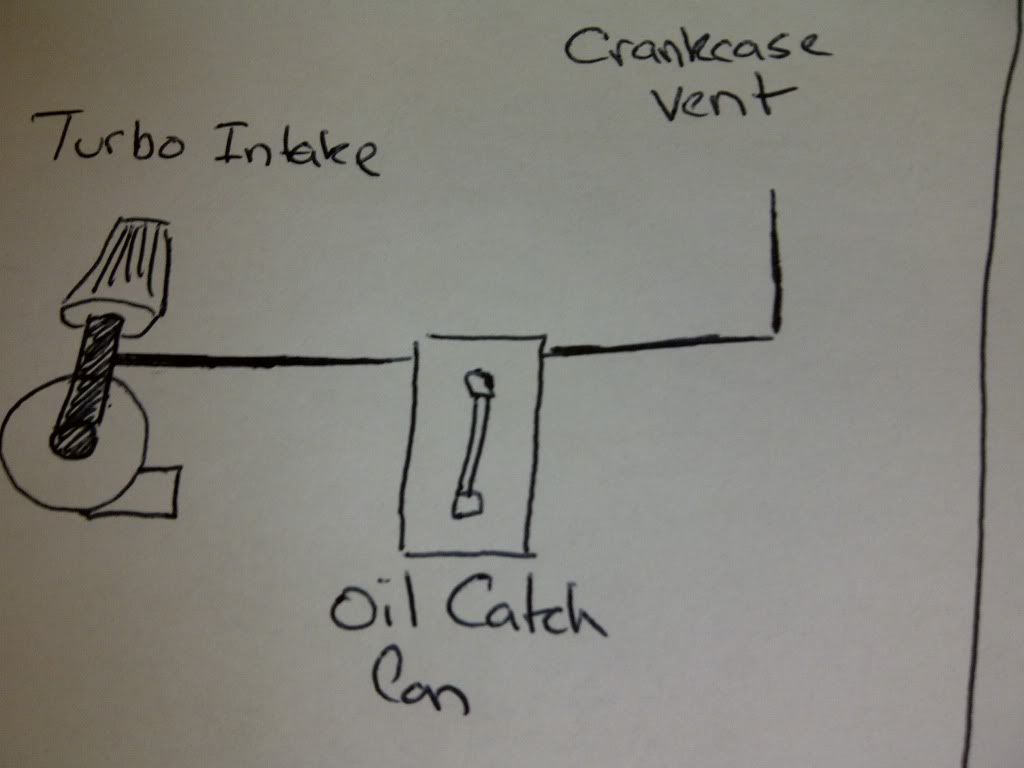
I recently posted this same topic. I have a S4 TII and I'll be running a catch can from my crank case vent and oil fill tube vent. I am hoping this will help cut down on some of the smoking issues I'm having with my project.

Joined: Feb 2001
Posts: 29,798
Likes: 128
From: London, Ontario, Canada
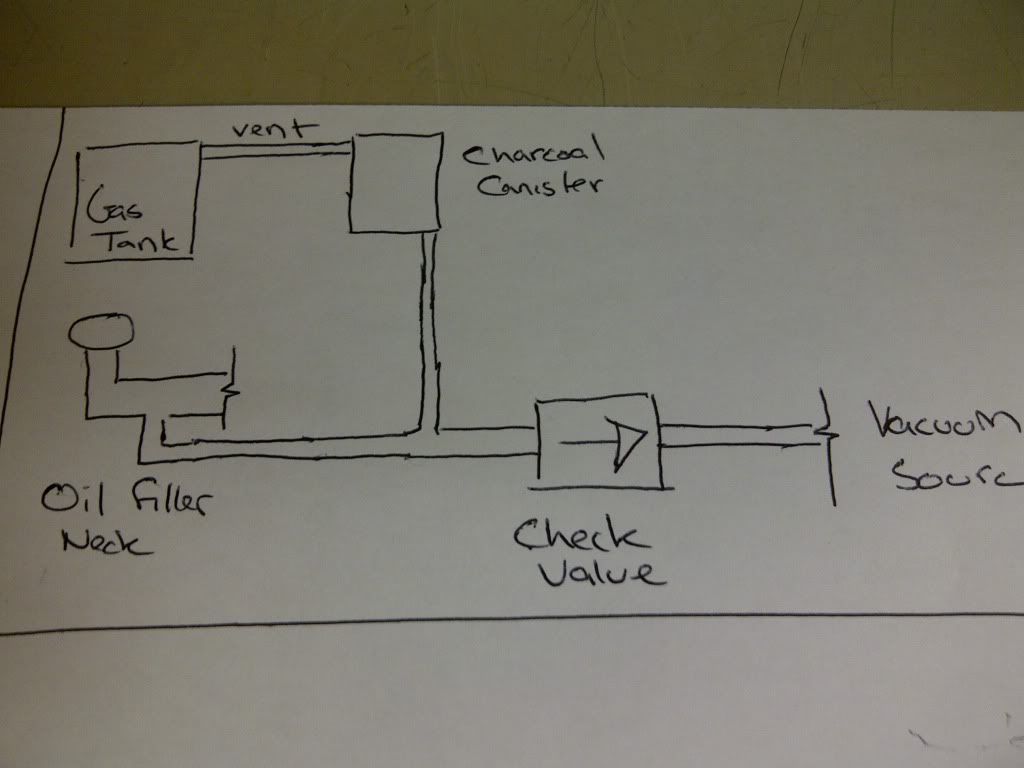
Leave the purge valve in place. Or install a generic PCV valve from the parts store.
Plumb the upper nipple on the oil filler through the purge/PCV valve to a vacuum port on the intake.
Connect the lower nipple on the middle iron to a line running to the catch can. If you have as standalone, just stick a filter on the catch can and be done with it. Stock ECU, you'll need to run the vent line for the catch can to after the AFM on the TID/intake tube.
Done and done.
Plumb the upper nipple on the oil filler through the purge/PCV valve to a vacuum port on the intake.
Connect the lower nipple on the middle iron to a line running to the catch can. If you have as standalone, just stick a filter on the catch can and be done with it. Stock ECU, you'll need to run the vent line for the catch can to after the AFM on the TID/intake tube.
Done and done.

Bone stock system. Just re-plumbed with silicon hoses. Never had any issues whatsoever. Unless you are running 10psi of boost or more i have found the stock system to work just fine. If you track the car regularly, get a baffled, oil pan.
Senior Member
Joined: Oct 2005
Posts: 352
Likes: 0
From: Bloomington, Illinois
Leave the purge valve in place. Or install a generic PCV valve from the parts store.
Plumb the upper nipple on the oil filler through the purge/PCV valve to a vacuum port on the intake.
Connect the lower nipple on the middle iron to a line running to the catch can. If you have as standalone, just stick a filter on the catch can and be done with it. Stock ECU, you'll need to run the vent line for the catch can to after the AFM on the TID/intake tube.
Done and done.
Plumb the upper nipple on the oil filler through the purge/PCV valve to a vacuum port on the intake.
Connect the lower nipple on the middle iron to a line running to the catch can. If you have as standalone, just stick a filter on the catch can and be done with it. Stock ECU, you'll need to run the vent line for the catch can to after the AFM on the TID/intake tube.
Done and done.


Any explanation?

Joined: Feb 2001
Posts: 29,798
Likes: 128
From: London, Ontario, Canada
Doesn't make sense.... I trust you've done the research, but I don't get why it'd work. If one nipple was open to manifold vacuum and the other is open to atmosphere (even through a filter) that's still a vacuum leak, right? Standalone or not... hell even taking the air from after the AFM will still be a vacuum leak. It's bypassing the throttle body, right?
Any explanation?
Any explanation?
Air from after the AFM is not a vacuum leak because it is metered air. The stock setup draws air for the purge system from this location. All air is accounted for by the AFM and thus won't effect the fuel mixture.
Except Mazda complicates things a little by also tying the evap system into the PCV, which is annoying.
Trending Topics
Right, I guess "vacuum leak" wouldn't be the correct term for it, but it's still air bypassing the throttle body, effectively doing what the idle adjust screw does on the S4 NA engine, or turning the screw on the BAC on a TII engine. It's all metered, but it's air getting around the butterflies that will raise the idle, right?
Good info here. I was wondering about that. I found this drawing a while ago and thought that it'd be kind of stupid if there was no passage or baffle to aid in drawing fresh air. Otherwise, it'd just be sucking air from the lower nipple straight through the filler neck to the intake, and that wouldn't do a damn thing for removing vapors.
Originally Posted by Aaron Cake
The lower nipple leads to a passage that ends down deep in the center iron by the eccentric shaft. In the stock setup, air is sucked into that passage, circulated around the crankcase, then drawn from the upper nipple.

Original message: AGreen, can you post a more visible jpeg? I'd like to see that catchcan set-up.
Nevermind. Searched "crankcase ventilation" and found it.
I've realized there's TONS of crankcase ventilation information.
Nevermind. Searched "crankcase ventilation" and found it.
I've realized there's TONS of crankcase ventilation information.
Last edited by dwb87; Jul 13, 2011 at 12:29 AM. Reason: Found more visible jpeg.

Joined: Feb 2001
Posts: 29,798
Likes: 128
From: London, Ontario, Canada
Right, I guess "vacuum leak" wouldn't be the correct term for it, but it's still air bypassing the throttle body, effectively doing what the idle adjust screw does on the S4 NA engine, or turning the screw on the BAC on a TII engine. It's all metered, but it's air getting around the butterflies that will raise the idle, right?
Good info here. I was wondering about that. I found this drawing a while ago and thought that it'd be kind of stupid if there was no passage or baffle to aid in drawing fresh air. Otherwise, it'd just be sucking air from the lower nipple straight through the filler neck to the intake, and that wouldn't do a damn thing for removing vapors.


I used to have mine routed the wat Aaron Cake suggests, but I found that it actually made my car smoke. No doubt my pcv valve was shot or something. So I just capped the hole that leads into the intake to prevent a vac leak and let the line that used to go there just hang. I now have no smoke, and I had a solid Idle. Also no oil ever came out of that line so I never put in a catch can.
I changed my vac line setup when I did this btw. Now the vent from the center iron and the oil neck t together and just lead over toward the intake and vent to atmosphere. still no oil comes out and my car doesnt smoke... super simple
I changed my vac line setup when I did this btw. Now the vent from the center iron and the oil neck t together and just lead over toward the intake and vent to atmosphere. still no oil comes out and my car doesnt smoke... super simple

Thread
Thread Starter
Forum
Replies
Last Post
trickster
2nd Generation Specific (1986-1992)
25
Jul 1, 2023 04:40 PM
streetlegal?
New Member RX-7 Technical
13
Mar 17, 2022 02:46 PM