


Rtek more questions


Thread Starter

Joined: Jun 2007
Posts: 584
Likes: 1
From: san antonio TX
more questions
ok so last night i did some runs and im right on track where i want to be. 6psi i am great. still need to tune 6-10psi since i saw some lean spot.
duty cycle isnt over 48% at 8psi still lean from 8-10.
i had a question though..... what is "boost based timing" in the ecu settings?
right now i am pretty safe if i run lean under boost , since i am on stock timing. if i run lean i have less chance of having my engine blow. more of a fail safe mode on stock timing..
but what if i switch to boost based timing? now i understand split, trailing and leading. but if you toss numbers at me i'll just
so in lame mans term. what is the pro's and cons of checking the box for boost based timing, and will it increase the danger of accidentally running lean while i am tuning.
oh yes, and also. do we have no fuel cut on decel? i know it automatically fuel cuts on decel, but for once, i'd like to throw flames like i usto, when i was n/a.. just once.. i want to throw flames again.
duty cycle isnt over 48% at 8psi still lean from 8-10.
i had a question though..... what is "boost based timing" in the ecu settings?
right now i am pretty safe if i run lean under boost , since i am on stock timing. if i run lean i have less chance of having my engine blow. more of a fail safe mode on stock timing..
but what if i switch to boost based timing? now i understand split, trailing and leading. but if you toss numbers at me i'll just
so in lame mans term. what is the pro's and cons of checking the box for boost based timing, and will it increase the danger of accidentally running lean while i am tuning.
oh yes, and also. do we have no fuel cut on decel? i know it automatically fuel cuts on decel, but for once, i'd like to throw flames like i usto, when i was n/a..
just once.. i want to throw flames again.
Last edited by fc3schick87; Oct 22, 2010 at 03:12 PM.


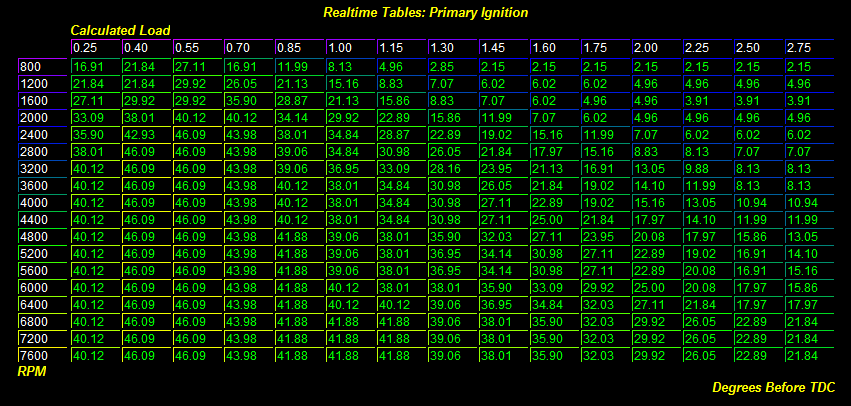
On airflow based timing (stock timing on FC, timing maps for the STi) the load is proportional to the amount of airflow divided by the rpm. So as load increases, more air is being measured as entering the combustion chamber. So we can see some basic trends here:
1) high load, low rpm has the least timing advance (lowest numbers)
2) low load, high rpm has the most timing advance (highest numbers)
3) at a given rpm, timing advance decreases (lower number) as airflow increases
4) at a given airflow, timing advance increases as rpm increases.
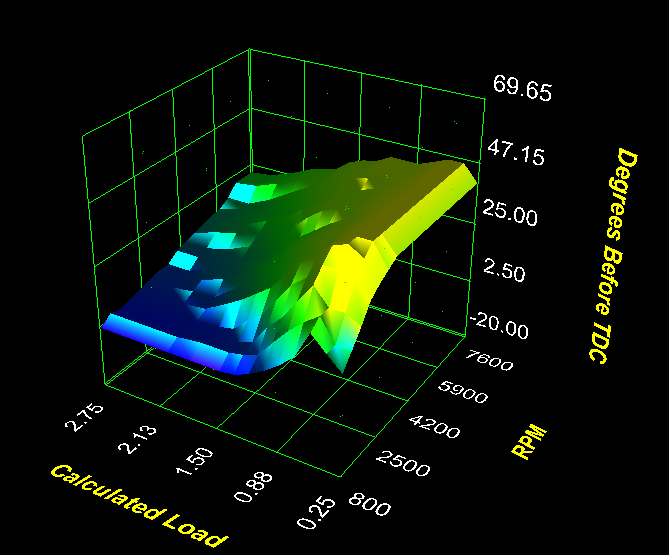
Here's a 3D representation of the above STi airflow/load based timing map:
It works the same basic way on a piston engine and a rotary. Here is the stock s4 T2 timing map (load based):
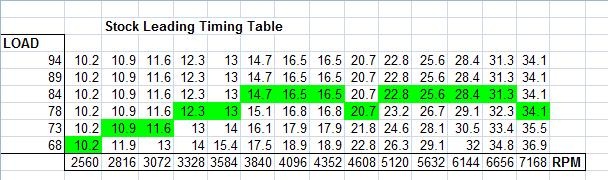
The green shows the actual cells the ECU was using on that particular pull. As you look up the Y axis the airflow/load increases and timing goes down [some]. As you look right across the X axis, rpm increases and timing up.
what is the pro's and cons of checking the box for boost based timing
The cons: well, you have to enter the whole map into the Rtek. Also, when you measure based on boost you can't directly account for changes in the engine's efficiency because you aren't directly measuring how much air is entering. You are just measuring pressure in the manifold. I don't want to go into the ideal gas law so I'll leave it at that. On a practical level, I have supplied some base maps that a number of people are using successfully. You would most likely pick the basemap that fits your setup and your tolerance for risk. Then you can go to a dyno and try changing the numbers in there to see how much power you pick up (if any). Rx-7's don't have very good knock control systems so you have to be careful.
Here is one of the base maps I have supplied for boost-based timing:

Looking up across Y axis you see manifold pressure increasing, while looking right on the X axis shows rpm increasing. In some ways the boost-based maps can still look a lot like the airflow based maps. I mean that in the sense that as boost increases timing goes down (less advance, lower number), and as rpm increases timing goes up (more advance, higher number). Boost doesn't directly measure how much air is entering the motor though. The problem is, the stock AFM doesn't go a good job of accurately measuring how much air is entering the motor (except for cruising around) once you modify the engine enough.
will it increase the danger of accidentally running lean while i am tuning.
i want to throw flames again.
Thread Starter
Joined: Jun 2007
Posts: 584
Likes: 1
From: san antonio TX
The pros: the problem with the stock timing (load based) is that the factory AFM cannot measure accurately the amount of air entering a modified engine. It can't figure out how much air is entering the combustion chamber to calculate timing, because we are pushing it beyond its design. On other cars with various types of airflow meters (Camaro, STi, whatever) when modifying the car they are changing the sensor out or doing some other modification so that it will read better. When you switch to boost-based timing on the Rtek you are bypassing the limitation of the factory AFM. The Rtek can't directly measure the airflow accurately with the stock AFM, so we use the boost sensor instead.
The cons: well, you have to enter the whole map into the Rtek. Also, when you measure based on boost you can't directly account for changes in the engine's efficiency because you aren't directly measuring how much air is entering. You are just measuring pressure in the manifold. I don't want to go into the ideal gas law so I'll leave it at that. On a practical level, I have supplied some base maps that a number of people are using successfully. You would most likely pick the basemap that fits your setup and your tolerance for risk. Then you can go to a dyno and try changing the numbers in there to see how much power you pick up (if any). Rx-7's don't have very good knock control systems so you have to be careful.
Here is one of the base maps I have supplied for boost-based timing:
Looking up across Y axis you see manifold pressure increasing, while looking right on the X axis shows rpm increasing. In some ways the boost-based maps can still look a lot like the airflow based maps. I mean that in the sense that as boost increases timing goes down (less advance, lower number), and as rpm increases timing goes up (more advance, higher number). Boost doesn't directly measure how much air is entering the motor though. The problem is, the stock AFM doesn't go a good job of accurately measuring how much air is entering the motor (except for cruising around) once you modify the engine enough.
They're not directly related. You could run lean on stock timing or boost-based timing. The air to fuel ratio is important but timing is also important, especially for safety. My timing maps are generally speaking safer than the stock maps, but custom dyno tuning would be needed to optimize everything fully. And if you have some kind of major fuel system failure you can still lean out and cause damage, regardless of what timing map you are using.
The cons: well, you have to enter the whole map into the Rtek. Also, when you measure based on boost you can't directly account for changes in the engine's efficiency because you aren't directly measuring how much air is entering. You are just measuring pressure in the manifold. I don't want to go into the ideal gas law so I'll leave it at that. On a practical level, I have supplied some base maps that a number of people are using successfully. You would most likely pick the basemap that fits your setup and your tolerance for risk. Then you can go to a dyno and try changing the numbers in there to see how much power you pick up (if any). Rx-7's don't have very good knock control systems so you have to be careful.
Here is one of the base maps I have supplied for boost-based timing:
Looking up across Y axis you see manifold pressure increasing, while looking right on the X axis shows rpm increasing. In some ways the boost-based maps can still look a lot like the airflow based maps. I mean that in the sense that as boost increases timing goes down (less advance, lower number), and as rpm increases timing goes up (more advance, higher number). Boost doesn't directly measure how much air is entering the motor though. The problem is, the stock AFM doesn't go a good job of accurately measuring how much air is entering the motor (except for cruising around) once you modify the engine enough.
They're not directly related. You could run lean on stock timing or boost-based timing. The air to fuel ratio is important but timing is also important, especially for safety. My timing maps are generally speaking safer than the stock maps, but custom dyno tuning would be needed to optimize everything fully. And if you have some kind of major fuel system failure you can still lean out and cause damage, regardless of what timing map you are using.
seems more hastle right now then i would like. i need to do much more research before i attempt timing myself. i was hoping it was a pre-set map that i could just use over stock. if thats not what it is then i guess i wont use it quite yet untill i do alot more reading.
It's not throwing flames with no cat and an open vented BOV ???
as far as timing numbers and all that, im not ready yet. its really difficult for me to comprehend all the numbers, im not going to lie, its going to take alot of studying and understanding before i get into it. i really do understand the basics . but all the numbers get confusing. and the mathmatics.
Thread Starter
Joined: Jun 2007
Posts: 584
Likes: 1
From: san antonio TX
yes. like i said there are base maps out there. see this thread: https://www.rx7club.com/showthread.php?t=885556

i'm going to the track wednesday night to see what i can get out of this stuff. wish me luck
Trending Topics

Thread
Thread Starter
Forum
Replies
Last Post
Adaptronic S5 Turbo PNP Unit questions
_Tones_
Adaptronic Engine Mgmt - AUS
10
May 25, 2021 05:37 AM
Nosferatu
2nd Generation Specific (1986-1992)
7
Sep 5, 2015 02:13 PM
