


Learn something the hard way today...





Joined: Oct 2003
Posts: 11,576
Likes: 27
From: Morristown, TN (east of Knoxville)
I can't see how gas or pressure penetrate under the seals, especially in a running engine with carbon buildup adjacent to the seals and in the grooves.

Joined: Apr 2002
Posts: 4,232
Likes: 0
From: Rotaryland, New Hampshire
Ok well my scanner still doesent work so please excuse the roughness of my diagram
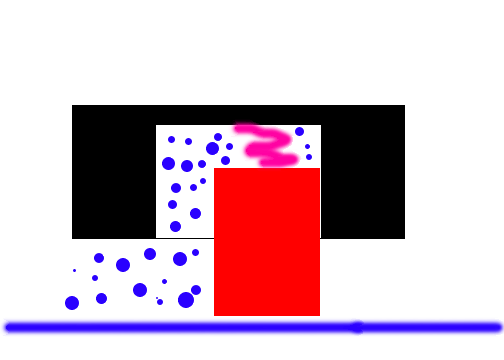
The black would be the rotor near the side seal grove, red would be the side seal, pink is the spring, and the blue dot's represent combustion pressure
the spring keeps a light load pushing the side seal against the iron, pressure from the combustion and exhaust stroke will first push the seal inwards and then the only area left to push pressure would be the top, which increases sealing pressure against the iron
-Jacob
The black would be the rotor near the side seal grove, red would be the side seal, pink is the spring, and the blue dot's represent combustion pressure
the spring keeps a light load pushing the side seal against the iron, pressure from the combustion and exhaust stroke will first push the seal inwards and then the only area left to push pressure would be the top, which increases sealing pressure against the iron
-Jacob
Joined: Oct 2003
Posts: 11,576
Likes: 27
From: Morristown, TN (east of Knoxville)
Sorry, I can't buy into that. IF the blue dots represent combustion pressure, they also represent carbon particles. Thus, the seals would carbon lock almost immediately after the engine ran, if said pressure/components were penetrating under the seal to the degree being stated here. There'd be just as much carbon under the seals as there is on the rotor faces, which is never the case on the hundreds of engines I've torn down.






CrackHeadMel,
thanks for that illustration. call me gullible, but it makes sense and answers my question as to how the combustion gases get under the seal and how clearances can make a difference.
for the record, i'm not looking to argue, but why would you think there would be just as much carbon buildup in the seal grooves? i find carbon in the seal grooves and like you, it's nowhere near the amount on the rotor faces, but i don't expect it to be. just curious.
thanks for that illustration. call me gullible, but it makes sense and answers my question as to how the combustion gases get under the seal and how clearances can make a difference.
for the record, i'm not looking to argue, but why would you think there would be just as much carbon buildup in the seal grooves? i find carbon in the seal grooves and like you, it's nowhere near the amount on the rotor faces, but i don't expect it to be. just curious.

Rotary Enthusiast

Joined: Feb 2001
Posts: 867
Likes: 0
From: Union, NJ
Did it happen same time?
JD

MazdaTruckin.com Founder

Joined: Mar 2003
Posts: 402
Likes: 0
From: East Charlotte, NC
Ok well my scanner still doesent work so please excuse the roughness of my diagram
The black would be the rotor near the side seal grove, red would be the side seal, pink is the spring, and the blue dot's represent combustion pressure
the spring keeps a light load pushing the side seal against the iron, pressure from the combustion and exhaust stroke will first push the seal inwards and then the only area left to push pressure would be the top, which increases sealing pressure against the iron
-Jacob
The black would be the rotor near the side seal grove, red would be the side seal, pink is the spring, and the blue dot's represent combustion pressure
the spring keeps a light load pushing the side seal against the iron, pressure from the combustion and exhaust stroke will first push the seal inwards and then the only area left to push pressure would be the top, which increases sealing pressure against the iron
-Jacob
I was working on trying something similar with my rotary while I had access to all the machinery, I was going to get 3 mm apex seals and lap them down to a tighter than stock clearance and then gas port the groove. I was hoping this would lessen chatter. With the shitty season we where having though I got layed off though

Last edited by Kyrasis6; Oct 8, 2007 at 10:37 PM.
MazdaTruckin.com Founder
Joined: Mar 2003
Posts: 402
Likes: 0
From: East Charlotte, NC
I believe CrackHeadMel was referring to the second paragraph on page 73:

RotaryResurrection: I've been meaning to ask you...
How did you like the signed Jeri Ryan Photo?
RotaryResurrection: I've been meaning to ask you...
How did you like the signed Jeri Ryan Photo?
Last edited by Kyrasis6; Oct 8, 2007 at 10:32 PM.
MazdaTruckin.com Founder
Joined: Mar 2003
Posts: 402
Likes: 0
From: East Charlotte, NC
arrggg... ok I tried to edit my post and I guess I spent too long writing because I lost it when I tried to save it.
Anyways I'm pretty sure you don't have as much carbon build up in the seal grooves as on the rotor faces for two reasons. The first is you don't really have much, if anything burning in there. The second is unlike the faces of the rotors you don't have much gas movement. When pressure is low you may have a little moving through the apex seal groove but after pressure builds and a seal is made gas flow stops and so would the movement of additional carbon into the apex seal grooves. Kind of like a water faucet, once you shut it off and it seals you still have water behind it but it's not moving anywhere.
Anyways I'm pretty sure you don't have as much carbon build up in the seal grooves as on the rotor faces for two reasons. The first is you don't really have much, if anything burning in there. The second is unlike the faces of the rotors you don't have much gas movement. When pressure is low you may have a little moving through the apex seal groove but after pressure builds and a seal is made gas flow stops and so would the movement of additional carbon into the apex seal grooves. Kind of like a water faucet, once you shut it off and it seals you still have water behind it but it's not moving anywhere.

Thread
Thread Starter
Forum
Replies
Last Post
Donald Hampton
2nd Generation Specific (1986-1992)
16
Nov 23, 2022 06:38 PM
Nosferatu
2nd Generation Specific (1986-1992)
7
Sep 5, 2015 02:13 PM
