When you click on links to various merchants on this site and make a purchase, this can result in this site earning a commission. Affiliate programs and affiliations include, but are not limited to, the eBay Partner Network.
Well it's only been like 4 years since my last post... but I've made some cool progress on my racecar. And I have some info that might be helpful to other people using the FC chassis.
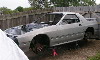
I stripped the car down to the bare shell. No doors, no glass... the only thing still bolted into the car was the front cross member and the steering rack.
And built a torsion test rig for the chassis. The back half of the car was bolted to my garage floor using the rear shock mounts. The front was bolted to the rig through the upper strut mount and the front lower control arm mount in the subframe. So this should be a pretty accurate test, given that all the loads are more or less going through the chassis in the same way as if it were being twisted on a race track.
I used a dial indicator and a bunch of weight, and recorded the change with each plate added.
Did a bunch of math... and learned that the bare chassis is just over 3000 ft/lbs/deg. Which is ok for a car of this age.
Then (many many months later) I built my cage. Just a back half. No plans to go over the doors, or add door bars. No need for autocross.
Reinforced the rear shock towers.
Bent some tubes
Welded on some brackets. They bolt the upper part of the cage to the shoulder belt mounting point
Mitered everything as tight as I could.
Bada-Bing-Bada-Boom Cage!
Rested the car again after and it went up to 4400 ft/lbs/deg! Which is more than I was expecting.
So use this info as you will.
I'll be back again in 4 years when I've made more progress.
I've done a ton of torsional rigidity testing in formula cars, both composite and tube frame. In fact my thesis pertained to racecar chassis design. Ideally, you need to measure the deflection in each corner and calculate its stiffness based on the differences. You'd be surprised how much the chassis will deflect in the rear despite appearing to be solidly anchored to the floor. This often leads to misrepresented stiffnesses. Measuring deflection in more locations along the length of the frame gives you the ability to localize locations of poor stiffness that could be improved.
Nonetheless, I applaud you and this is something I have always wanted to do with my FC for before/after stiffnesses. What you have done is more than I've ever seen anyone else in the community do before and is quite reasonable for comparing the difference from before and after. As you have pointed out, this is bare chassis stiffness. Parts such as doors can have a large impact on overall stiffness and even little things like the front bumper will help. However, measuring stiffness at the hubs with all suspension parts is ideal because then you factor in suspension compliance. Published FC rigidity figures indicate it is 10,500 NM/deg, but who knows under what conditions or parts are included in that. Does any of this matter for a street car? Not in my opinion. What if you're racing? Absolutely.
What you have done is more than I've ever seen anyone else in the community do before and is quite reasonable for comparing the difference from before and after.
i guess i should have led with this, and also thrown a thank you to Travis R in there as well. it's very good (and practical) information to have.
You might be surprised what comes through the seat of the pants- especially when you start jacking the spring rates up over stock.
My RX-8 chassis feels like a tank for rigidity- I would predict the chassis has high torsional rigidity.
Conversely, my ex's NA Miata felt like a noodle 100% stock. So weird seeing the A pillar move in your peripheral vision and feel the whole car bend as you pull into a driveway one front wheel at a time.
Thanks guys.
There is definitely some flex at the back mount. Probably even in the slab. But as limbar noted, it's good for a before/after difference.
One test I forgot to do was to unbolt the top half of the cage from the shell. I have a tab on either side of the main hoop that bolts to the upper shoulder belt mount. Would have liked to see what kind if difference that made.
Thanks guys.
There is definitely some flex at the back mount. Probably even in the slab. But as limbar noted, it's good for a before/after difference.
One test I forgot to do was to unbolt the top half of the cage from the shell. I have a tab on either side of the main hoop that bolts to the upper shoulder belt mount. Would have liked to see what kind if difference that made.
I'm not lifting the weights for us to measure again. It's your turn to collect them.
Was the reinforcement for the rear shock towers to address a point of weakness or just to give a good mounting point?
Holy thread bump... sorry.
A little of both, but primarily to give a good mounting point for the cage. It's good practice to have a reinforcement plate under a tube.
It also reinforces the shock tower for the increased spring rates I plan to run. Nothing crazy, but this is fairly standard built methods when converting a street car into a racecar.




 FC chassis torsional stiffness (WITH NUMBERS)