


Power FC PFC Warning - Acceptable Knock Levels?


Thread Starter
Magnet Boy

Joined: Jan 2007
Posts: 251
Likes: 1
From: NorCal
PFC Warning - Acceptable Knock Levels?
Just finished hooking up my Check Engine Light to my PFC so I can take advantage of the PFC warning features (see Dale's excellent mod detailed in this thread: https://www.rx7club.com/showthread.p...12#post6596112).
I noticed immediatly that my CEL turned on when I switched the ignition on. And it turned off shortly after starting the engine. Great, now I should be able to pass CA emissions without removing my PFC! However, I also noticed my CEL blinking when reving the engine. I entered the PFC commander monitor panel and observed the knock level while it was blinking, the PFC warns when my knock is over 60. I observed knock levels peaking at about 130. I'm pretty sure my motor is not knocking; it sounds sweet and smooth. Does this mean my knock sensor might be in need of replacement?
I went into the Etc. / Functions panel on my PFC commander and found a list of appropriate warnings (knock, injector duty, O2 level, etc.). There is a kanji icon in the right-most column and I determined emperically that with it in the (default) up position, I got the knock warning, and with it in the down position, no more blinking. I presume the two kanji icons are ON (default) and OFF.
I know I can change the trigger levels for these warnings with Datalogit, but I don't have it yet. More importantly, I am wondering what typical knock levels are observed by FD owners and if my description above implies I need a new knock sensor?
I noticed immediatly that my CEL turned on when I switched the ignition on. And it turned off shortly after starting the engine. Great, now I should be able to pass CA emissions without removing my PFC! However, I also noticed my CEL blinking when reving the engine. I entered the PFC commander monitor panel and observed the knock level while it was blinking, the PFC warns when my knock is over 60. I observed knock levels peaking at about 130. I'm pretty sure my motor is not knocking; it sounds sweet and smooth. Does this mean my knock sensor might be in need of replacement?
I went into the Etc. / Functions panel on my PFC commander and found a list of appropriate warnings (knock, injector duty, O2 level, etc.). There is a kanji icon in the right-most column and I determined emperically that with it in the (default) up position, I got the knock warning, and with it in the down position, no more blinking. I presume the two kanji icons are ON (default) and OFF.
I know I can change the trigger levels for these warnings with Datalogit, but I don't have it yet. More importantly, I am wondering what typical knock levels are observed by FD owners and if my description above implies I need a new knock sensor?


Hard to say - I know some people seem to have more knock than others. My car is happy around 30-40 knock count - that's totally normal driving, if I see 60 or above, I know it's a real knock event.
Might be worth tracking down a used knock sensor and swapping it out - can't hurt to try, and I bet you can get a used knock sensor on the cheap.
Dale
Might be worth tracking down a used knock sensor and swapping it out - can't hurt to try, and I bet you can get a used knock sensor on the cheap.
Dale
Thread Starter
Magnet Boy
Joined: Jan 2007
Posts: 251
Likes: 1
From: NorCal
Originally Posted by SPICcnmGT
Is it under load when it hits that or not?? Mine usually reads between 15-25 under cruise and load but when I let off and get a back fire it might go as high as 75+.
Like I said, I don't think this is real. My motor doesn't sound bad at all. I took a peek in the service manual to see about checking the sensor. They've got two procedures in there for testing it. #1 procedure involves hooking up up a mutli-metter and rapping on engine hoist ring with a hammer! It says, if the meter moves, it is good. Not too helpful there. The more sophisticated procedure uses some kind of testing unit I don't have. I think I'm going to get a new knock sensor and see what this does.
Thread Starter
Magnet Boy
Joined: Jan 2007
Posts: 251
Likes: 1
From: NorCal
Drove around a bit today and watched the PFC knock level reading. Seems like it is very low at idle, 1 or so. It increases pretty linearly up to about 3000 rpm which is when it seems to reach 60. If I drive around in a spirited fashion, I see peaks in the 130-140 range. Oddly, if I run WOT under load at high rpm, it actually seems to drop down to less than 60.
Getting a used one from Fritz. Not terribly cheap, but he claims "very good" condition. If it fixes this, I can live with the deal.
 <--- who designs these?
Getting a used one from Fritz. Not terribly cheap, but he claims "very good" condition. If it fixes this, I can live with the deal.
<--- who designs these?

Archie is Gay
Joined: Feb 2006
Posts: 354
Likes: 1
From: San Diego
Good deal man....be sure to keep us informed of what's going on. I'm having the same problem with my FD right now. I can rev the engine in the driveway up to about 3K and get a knock of 85 on my PFC.
BTW...you can buy a new knock sensor from Autozone for about $150
BTW...you can buy a new knock sensor from Autozone for about $150
Senior Member
Joined: May 2005
Posts: 728
Likes: 0
From: Birmingham
Thats about how mine reads except for lower numbers. Basically nothing at idle cruise it may hit 25-30, under full boost/high rpms it is usually around 20ish and most of the time when I get off the gas it jumps to 40+ up to about 80 which is probably caused by the excess unburned fuel exploding late or in the exhaust, but isn't harmful.
Fritz is reliable I got my PFC and some other stuff from him and they were all in excellent condition.
Fritz is reliable I got my PFC and some other stuff from him and they were all in excellent condition.
Trending Topics

Lives on the Forum

Joined: Dec 2001
Posts: 14,716
Likes: 10
From: San Lorenzo, California
You should have at least checked to see if yours was fully tightened and didn't have a wiring issue before buying another one......
The "knock sensor" is just a piezo microphone, they are pretty reliable and durable but can go "bad".
Before my rebuild, I was hitting in the 50s-90s on the default base map...after rebuild and better map, below 10 during all cruise and idle, WOT at 15 psi up to 20-30.
The "knock sensor" is just a piezo microphone, they are pretty reliable and durable but can go "bad".
Before my rebuild, I was hitting in the 50s-90s on the default base map...after rebuild and better map, below 10 during all cruise and idle, WOT at 15 psi up to 20-30.

Thread Starter
Magnet Boy
Joined: Jan 2007
Posts: 251
Likes: 1
From: NorCal
Originally Posted by rynberg
You should have at least checked to see if yours was fully tightened and didn't have a wiring issue before buying another one......
The "knock sensor" is just a piezo microphone, they are pretty reliable and durable but can go "bad".
Before my rebuild, I was hitting in the 50s-90s on the default base map...after rebuild and better map, below 10 during all cruise and idle, WOT at 15 psi up to 20-30.
The "knock sensor" is just a piezo microphone, they are pretty reliable and durable but can go "bad".
Before my rebuild, I was hitting in the 50s-90s on the default base map...after rebuild and better map, below 10 during all cruise and idle, WOT at 15 psi up to 20-30.
You mention things being better after your rebuild. Are you thinking it is because your motor is performing better, or because the sensor was removed/cleaned/reinstalled, or perhaps replaced during the rebuild?
PFC = Apexi Power FC yup.
Lives on the Forum
Joined: Dec 2001
Posts: 14,716
Likes: 10
From: San Lorenzo, California
I'm guessing better map and the fact that the mic was removed and reinstalled. The map is now richer but the timing is not more conservative than before so some of it must have been the actual mic.
Thread Starter
Magnet Boy
Joined: Jan 2007
Posts: 251
Likes: 1
From: NorCal
OK, so I might as well get started looking at my sensor while I wait for the new (used) one to arrive. Looking at the shop manual and a cursory glance in my engine bay, I don't see it. See the attached images from the shop manual. In the first pic, the item #11 is pointing at the knock sensor. In the second pic, it is a close up showing removal/installation.
It seems like it is on the left (drivers) side of the engine. I can't tell from the pics where it is supposed to be relative to the spark plugs. Anybody who's actually removed/installed the knock sensor know?
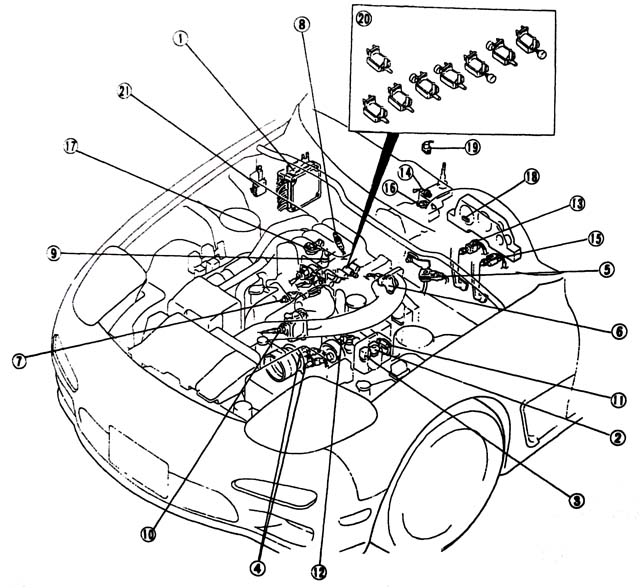
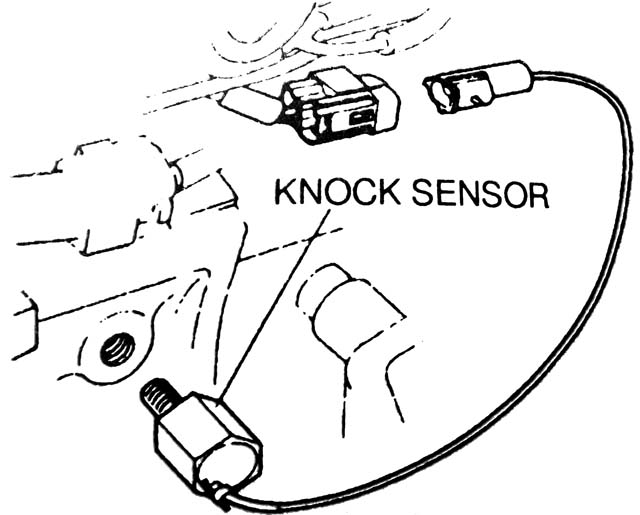
It seems like it is on the left (drivers) side of the engine. I can't tell from the pics where it is supposed to be relative to the spark plugs. Anybody who's actually removed/installed the knock sensor know?
It's DIRECTLY above the front rotor's spark plugs, screwed into the front rotor housing. Pull the throttle body elbow and undo the plug wires for the front rotor, can't miss it.
Dale
Dale
Thread Starter
Magnet Boy
Joined: Jan 2007
Posts: 251
Likes: 1
From: NorCal
This is getting kind of OT since knock sensor replacement is not strictly part of the PFC functioning. But since the PFC and alert functionality clued me in, I will continue with this here.
It was still hard to find Dale! The sensor is actually mounted in the front rotor housing above the lower spark plug and below the upper one. Once I took off the intake elbow and got my flashlight down there, I finally found it (pic #1). Mine does not seem loose.
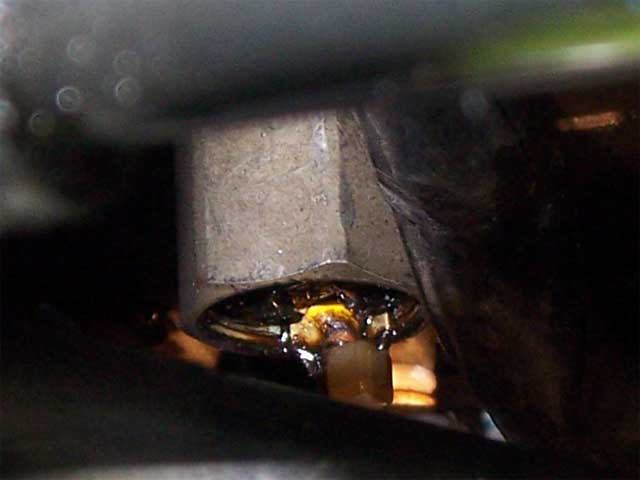
I started trying to figure out how I would deal with disconnecting and reconnecting it so I could pull it out for inspection. But I quickly discovered that the connector is buried way deep between the alternator and the rat's nest under a number of other hoses, pipes and cables (pic #2). I started trying to figure out how to get access to that connector. It looks like I need to remove the alternator or take off the UIM. Anybody got a suggestion?
Given the difficulty of doing this, I took a better closeup of the sensor and inspected my photo (pic #3). Mine looks pretty fried and probably needs replacement. So rather than get in too deep, I decided to wait for my new (used) sensor to arrive. I will get in there and replace mine when that one arrives. In the mean time, if somebody can explain or point me at a procedure to replace it (including hooking it up!) with the least amount of disassembly, I'd appreciate it!
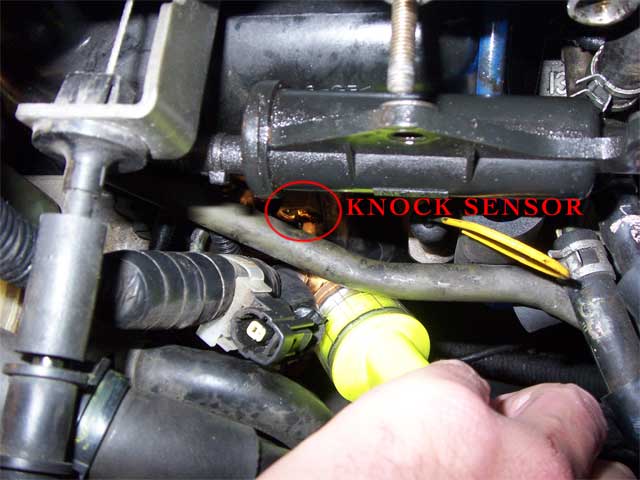
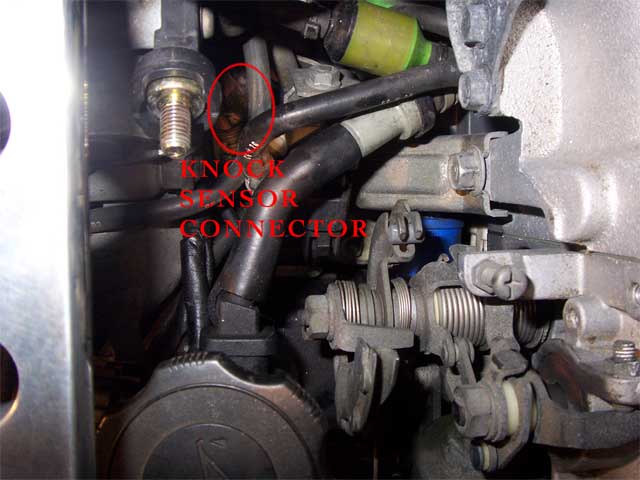
It was still hard to find Dale! The sensor is actually mounted in the front rotor housing above the lower spark plug and below the upper one. Once I took off the intake elbow and got my flashlight down there, I finally found it (pic #1). Mine does not seem loose.
I started trying to figure out how I would deal with disconnecting and reconnecting it so I could pull it out for inspection. But I quickly discovered that the connector is buried way deep between the alternator and the rat's nest under a number of other hoses, pipes and cables (pic #2). I started trying to figure out how to get access to that connector. It looks like I need to remove the alternator or take off the UIM. Anybody got a suggestion?
Given the difficulty of doing this, I took a better closeup of the sensor and inspected my photo (pic #3). Mine looks pretty fried and probably needs replacement. So rather than get in too deep, I decided to wait for my new (used) sensor to arrive. I will get in there and replace mine when that one arrives. In the mean time, if somebody can explain or point me at a procedure to replace it (including hooking it up!) with the least amount of disassembly, I'd appreciate it!
Thread Starter
Magnet Boy
Joined: Jan 2007
Posts: 251
Likes: 1
From: NorCal
Originally Posted by PimpyHand
Get to it from under the car. Make sure to use jack stands. MUCH EASIER.
Thread Starter
Magnet Boy
Joined: Jan 2007
Posts: 251
Likes: 1
From: NorCal
Originally Posted by PimpyHand
Take the ALT off then. 3 bolts and 1 belt is all it takes. Easy as pie.
As far as doing the sensor from below, yeah got put it on jacks and remove the under cover. I need to do some degreesing down there anyway, so I will see about sensor access while I am there.

Junior Member
Joined: Feb 2007
Posts: 31
Likes: 0
From: Smoking a fat one
Originally Posted by rxcited2
Just curious, Pimpy, have you removed the alternator yourself before? I started down this path last night and that too is a bitch. Couldn't seem to remove it without loosening the belt tension, which I'm guessing is handled by the A/C? There is a tensioner that is part of the alternator mounting, but completely removing this and pushing the alternator to it loosest position, does not give enough slack on the belt to get it off any of the pulleys.
As far as doing the sensor from below, yeah got put it on jacks and remove the under cover. I need to do some degreesing down there anyway, so I will see about sensor access while I am there.
As far as doing the sensor from below, yeah got put it on jacks and remove the under cover. I need to do some degreesing down there anyway, so I will see about sensor access while I am there.
Yes I have removed it many times.
1-- Drop the alt down with the adjuster to the right of the alt, (gives you slack in the belt) take the belt off.
2-- Remove the adjuster slide bolt.
3--Unhook the wiring at the back.
4--Take the cross bolt out and wiggle the alt out.
Thread Starter
Magnet Boy
Joined: Jan 2007
Posts: 251
Likes: 1
From: NorCal
OK, that is basically what I thought and what I was doing. I found removing the tension adjuster and pushing the alternator against the engine block did NOT create enough slack to remove the belt.
Archie is Gay
Joined: Feb 2006
Posts: 354
Likes: 1
From: San Diego
Originally Posted by rxcited2
I started down this path last night and that too is a bitch.

Thread Starter
Magnet Boy
Joined: Jan 2007
Posts: 251
Likes: 1
From: NorCal
I've owned the thing for 6 years (got it used with 28k) and have had to do very little work. Now it is nearing 70k miles - time, wear, and tear have been adding up. Hopefully with a little investment now, it won't blow anytime soon.
I looked up the procedure in the shop manual for removing the alternator. They suggest removing the air box and air pump in the middle of the sequence. So I guess they don't expect enough slack to remove the belt just by releasing all the tension in the alternator. Once I get my new (used) sensor, I will attack this again and followup.
I looked up the procedure in the shop manual for removing the alternator. They suggest removing the air box and air pump in the middle of the sequence. So I guess they don't expect enough slack to remove the belt just by releasing all the tension in the alternator. Once I get my new (used) sensor, I will attack this again and followup.
Thread Starter
Magnet Boy
Joined: Jan 2007
Posts: 251
Likes: 1
From: NorCal
Finally did the replacement. In order to remove/replace the sensor itself, you need to remove the elbow. I snipped the sensor wire and tried a socket, but there is a bracket on the back of the power steering pump which makes this impossible. An open end wrench from the engine bay (not under the car) worked best for me. Note a 15/16 wrench works great for this 24 mm sized hex.
You can see from my first pic that the sensor looks bad. But it really is just the gooey sealing material that is partially gone that makes it look so bad.
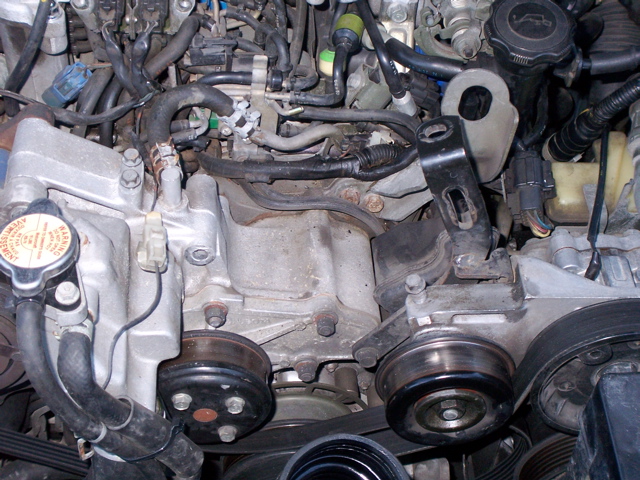
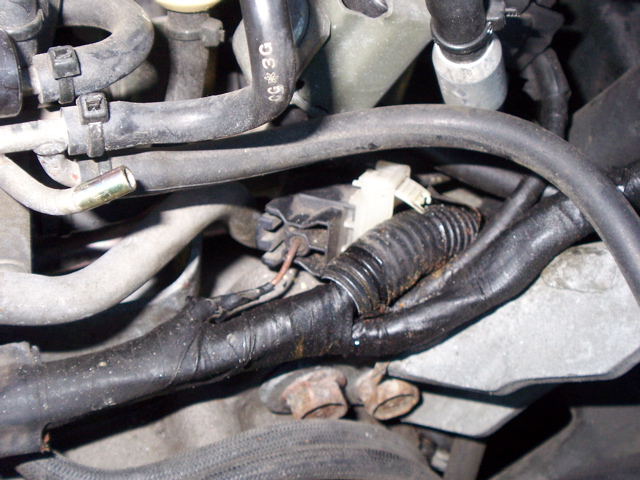
Hooking up the sensor is the bitch part of this. To access the connector, you need to remove the alternator. To remove the alternator, you need to undo the belt. To undo the belt, you need to loosen the air pump. To loosen the air pump, you need to remove the airbox. Once I did all this, I found the alternator was trapped in the pocket where it lives. So I had to remove my flat pipe. To remove my flat pipe, I had to remove my tower brace. Second picture shows all the stuff removed, and the last picture the knock sensor connector.
Here's the bitch: NO CHANGE IN KNOCK READINGS!! As some of the experts predicted, I guess there's not a lot to go wrong with the knock sensor and even though my old looked bad visually, apparently it was fine. So I am back to square one wondering why my knock readings are high and wondering if they are real.
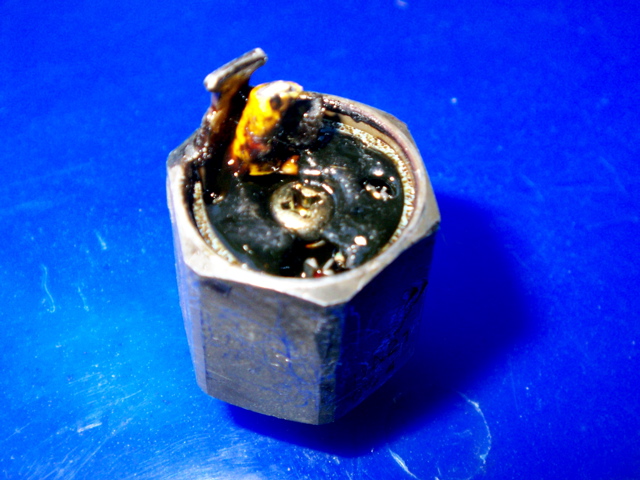
You can see from my first pic that the sensor looks bad. But it really is just the gooey sealing material that is partially gone that makes it look so bad.
Hooking up the sensor is the bitch part of this. To access the connector, you need to remove the alternator. To remove the alternator, you need to undo the belt. To undo the belt, you need to loosen the air pump. To loosen the air pump, you need to remove the airbox. Once I did all this, I found the alternator was trapped in the pocket where it lives. So I had to remove my flat pipe. To remove my flat pipe, I had to remove my tower brace. Second picture shows all the stuff removed, and the last picture the knock sensor connector.
Here's the bitch: NO CHANGE IN KNOCK READINGS!!
As some of the experts predicted, I guess there's not a lot to go wrong with the knock sensor and even though my old looked bad visually, apparently it was fine. So I am back to square one wondering why my knock readings are high and wondering if they are real.
Man, that stink that it didn't fix the problem, but you've at least proven something valuable for the FD community  .
.
I wonder if there's just some general noise in your motor (like a noisy oil pump or something) that the knock sensor is picking up.
Another possibility is if something's goofed up with the wiring from the knock sensor to the ECU. It's a shielded wire to reduce noise - if the core was shorting to the shield, that will goof up the reading. Dunno if you want to get crazy and run a new shielded wire from the knock sensor plug to the ECU. Stock the wire goes from the knock sensor to the connector under the alternator, then a bit back in the harness the braided shield starts. I believe the braid is grounded inside the harness as well. You can get shielded wire at Radio Shack - a buddy got some for an NA FC turbo conversion once.
Dale
.I wonder if there's just some general noise in your motor (like a noisy oil pump or something) that the knock sensor is picking up.
Another possibility is if something's goofed up with the wiring from the knock sensor to the ECU. It's a shielded wire to reduce noise - if the core was shorting to the shield, that will goof up the reading. Dunno if you want to get crazy and run a new shielded wire from the knock sensor plug to the ECU. Stock the wire goes from the knock sensor to the connector under the alternator, then a bit back in the harness the braided shield starts. I believe the braid is grounded inside the harness as well. You can get shielded wire at Radio Shack - a buddy got some for an NA FC turbo conversion once.
Dale