


Snowmobile Rotary?


Thread Starter
Junior Member

Joined: Jul 2005
Posts: 17
Likes: 0
From: your moms bedroom wake me up after she stops screeming
Snowmobile Rotary?
Does anyone have a rotary powered snowmobile that they wanna sell for cheep? I am looking to put the engine in a lawntractor so i can enter in lawntractor pulls.


Trending Topics


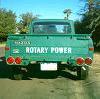

I find them sometimes when I do a search on "vintage rotery". I think the motor is a sachs, and for some reason I keep thinking of the name Johnson so either or both of those might be of use.


someone posted this in the first gen section...
http://cgi.ebay.com/ws/eBayISAPI.dll...ory=64679&rd=1
http://cgi.ebay.com/ws/eBayISAPI.dll...ory=64679&rd=1



Rotary Freak

Joined: Mar 2003
Posts: 1,711
Likes: 0
From: Calgary, Alberta, Canada
Originally Posted by Tmaxx2.5
Hey thanks for all the help i finially got a Sachs 303
Sachs 303cc air/charge-cooled rotary. A big-*** fan bolted directly to the end of the eccentric shaft forces air through fins in the engine core. The intake charge of air/oil/fuel cools and lubricates the e-shaft, bearings and rotor.
Eccentric shaft is supported by roller bearings, and the rotor itself has needle bearings between it and where it mates to the e-shaft.
Both intake and exhaust ports were peripheral, but the intake charge(40:1 premix) was first routed through the center of the engine to cool and lubricate the eccentric shaft, rotor and bearings before being routed through a passage atthe opposite end of the engine from where it entered and then into the intake port. This set-up was ok for cold winter days, but presented cooling problems on warm days. This means this engine would need to have a makeshift heat exchanger added between the charge-cooling exit and the intake port to work properly in any application where ambient temps are above about 30F.
The 303 engine was used in the 1974 Arctic Cat Panther snowmobile. In 1975 Arctic Cat dropped this engine in favor of the 295cc Sachs engine. These sleds were known for being among the fastest available at the time, but were slow to accelerate due to the weak low-end torque. Does this sound familiar?
19.5hp @ 5000 rpm, 28 lb-ft of torque @ 4000 rpm.
Magneto ignition with recoil starter. Only one spark plug is used.
Intake is a single-venturi side-draft Tillotsen carburator.
Weight including big-*** cooling fan, intake, exhaust and centrifugal clutch assembly = approx. 80 lbs.
Fuel required = 40:1 premix. (40 parts gasoline to 1 part 2-cycle oil).
Specific fuel consumption = > 0.55 lbs of fuel per hp per hour (gas weighs approx. 6 lbs per U.S. gallon). This means a fuel burn of about 2 gallons per hour at WOT. This is NOT considered good fuel efficiency, btw.
These engines were every bit as durable (if not more so) as the 2-stroke snowmobile engines of the day--- which isn't really saying much, since 2-stroke engines used for this purpose were usually torn down for rebuilding every two years or so.
Since there's no liquid cooling or conventional oil pan and sump, these engines require no water jacket seals or oil seals. Only apex, corner and side seals are required.
Rotor housing and end plates are aluminum. Rotor housing has no steel liner. Inner surface of rotor housing (where the apex seals make contact) are aluminum.
Rotary Freak
Joined: Mar 2003
Posts: 1,711
Likes: 0
From: Calgary, Alberta, Canada
Originally Posted by rotoryrocket1
My dad used to have a single rotor Evinrude Johnson RC-35-Q. It had a 35hp single rotor air cooled Peripheral Port motor in it. Very cool sled!
This would have been the OMC engine. Very similar in design to the Sachs, but larger and almost twice as powerful. An optional 45hp OMC engine was also available.


Thread
Thread Starter
Forum
Replies
Last Post
datfast1
Old School and Other Rotary
18
Jun 20, 2019 10:53 PM
Under PSI
3rd Generation Specific (1993-2002)
19
Sep 23, 2015 11:47 PM
datfast1
West RX-7 Forum
3
Sep 14, 2015 06:58 PM


