When you click on links to various merchants on this site and make a purchase, this can result in this site earning a commission. Affiliate programs and affiliations include, but are not limited to, the eBay Partner Network.
A Series of Less Than Logical Choices: An S4 Build Thread
Hello all. Figured it was about time to start a build thread, considering I have just finished exams and have more free time and funds this summer for my Rx7. Let's jump right in;
Background:
My car is an early 1986 S4, purchased as my first car in August of 2016 370 000 km or so on the odometer. It has a new engine, though the actual mileage of it is unknown to me (no receipt). Frankly, I didn't care given the price I paid (although in retrospect, that should've been a sign to look a little closer) so I just took it. Checked compression when I got home, had over 100 PSI on all faces, so the gamble paid off. The body was in great shape considering the mileage, though it had been resprayed, with colour matched trim. The interior was a mix of maroon parts and grey parts. Frankly, there were a lot of strange corner cutting choices made by the previous owner. Over the next few months I fixed it. Here is a brief list of the work that was done before I took it down last Fall for this build:
All fluids replaced
Rad hoses replaced
Belts replaced
Complete brake job, all four corners
Front calipers rebuilt
Complete intake and throttle body rebuild, including new silicone vacuum lines
Injectors rebuilt
Aluminum radiator, new water pump, new thermostat
New battery
GXL doors, GXL leather seats, power windows (yes, door panels are still maroon and interior is gray. The interior was already mismatched when I bought it, so I was just happy to have the seats and the power windows even if it still didn't match).
Stereo, amplifiers, speakers, homemade subwoofer
Typical resoldering of internal electronics
New [used] clutch fan
Power antenna replaced with normal antenna
Rear hatch replaced (another colour that doesn't match).
Shift ****, shift boot, shifter bushings
Momo steering wheel, NRG hub
Driveshaft rebuilt with new U-Joints
Wheels and tires
Poly engine and transmission mounts
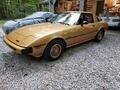
Here is how it looked after the above work was done:
After fixing it, I drove it for a long time with relatively few problems considering the age and mileage of the car. Come this winter my mum convinced me to buy something safer, so I grabbed a Celica as a daily. My Rx7 now gets a comfy garage space, which is a welcome change after forcing it to suffer the slings and arrows of the cold, wet, salty Canadian winter. I decided now was the time to make it into the car I want it to be. Though my relatively low income and the fact that most of my money goes to school expenses and savings will make it a very slow build, I figure now is the time to build it, before I have a family and full-time work to take up my time. My vision for it is to make it into my idea of an "idealized" Series 4 Rx7. What I mean by that is that I want to keep it distinctly Series 4 in both body and interior (with the exception of a few parts, to be elaborated upon later) while updating it slightly and tailoring it to my preferences. Though Series 5's seem to be more sought after, I like the mid to late 80's look of the Series 4 better than the more modern look of the Series 5. I will be retaining and refreshing the power steering and air conditioning systems. Emissions may go at some point as I am no longer e-tested (BAC valve and warmup hardware will be retained).
Plans (Short Term):
Floor: Fix a small hole, clean up all existing undercoat and replace any that is coming off. Car will never be a winter car, but still.
V8 Roadsters reinforced frame rails: Just for good measure, and to make jacking the car up easier.
Full black interior conversion: I will be using a combination of vinyl dies, SEM Color Coat, and some reupholstering to completely convert my interior to black. No, I will not be buying a black S5 interior. No, I will not be buying a 10th AE interior. I will elaborate on this later.
Limited Slip Differential: Ready to swap in a GXL diff I have.
Turbo II Transmission: Though turbocharging my Rx7 is a long term plan I figure rather than going through the work of replacing my already rough N/A transmission with another N/A transmission, I will just go straight to the T2 trans. Already have it waiting to go in.
Associated TII parts to match transmission
Turbo II Mirrors
S5 tail lights: One of only a few S5 parts I will use. Already have them waiting.
Possibly a stock black Sport/Duckbill spoiler
Front caliper conversion to 4 piston brakes, braided stainless brake lines.
New clutch and flywheel
Stereo install: I have a Nakamichi MD-45Z, and a Nakamichi MB-9 CD Changer. Undecided on which amps I will use. Tweeters will be on the door triangles, 6.5" drivers in doors, twin 8" subs in the rear shock towers.
LRB replacement vents: Already installed
Short Shifter
Paint hatch surround black (currently it does not match car, it is Sunrise Red and the car is Maroon)
Redo window tint (outsourcing this)
LED daytime running lights using the FTP lenses
Make the exhaust respectable (more on this after)
Electric fan conversion: I like the clutch fan, but I would like a nice clean engine bay.
Suspension: KYB AGX shocks, Racing Beat springs. Poly mounts and bushings (excludes rear subframe bushings, and diff mounts). DTSS delete.
Replace P/S lines, for good measure.
Replace all A/C O-Rings, have system recharged with R-34
Sound deadening
Bracing
Plans (Long Term):
High compression turbo, retaining auxiliary ports (this is years away), including standalone and all associated upgrades
Have car repainted to a brighter, redder colour. Return trim to original black colour.
5 bolt conversion (have most of the parts, but waiting until I decide I want to change wheels again).
S5 interior doors: Basically a luxury, but I would like having the door speakers molded into the OEM door like the S5s have, rather than an aftermarket setup.
S5 rear cargo cover, S5 rear cargo area light. Basically, some of the interior niceties S4s don't have
What's Been Done:
Front: Wheel hub bearings replaced, front brakes upgraded to 4 piston calipers (yes they are FD calipers), suspension bits painted, wheel wells cleaned and undercoated, poly bushings installed. No pictures of the process, but the results are pictured below.
Exhaust pulled. Remember when I said that I needed to make it respectable?
Yes, it is all one piece. Yes, it is ugly. Yes, it was difficult and painful to pull it out in -30 degrees C weather. Cat will need replacing (failed open), so that gives me an opportunity to turn it into a two/three piece exhaust rather than one piece. I won't put much money into this exhaust, given it will be replaced completely if/when I go turbo.
Acquired some bits:
Test patch of the SEM Color Coat on my carpet (under the seat):
Looks worse than it is, actually it's pretty nice. Left the carpet soft too.
Anticipating some questions/comments:
Why don't you get an S5 interior? - I don't want an S5 interior Why don't you get a 10 AE interior? - I can't find a clean one or an affordable one. Won't either of the above options be cheaper? - Probably. Interior color conversions don't last - Possibly, but if mine doesn't I'll simply acquire the necessary OEM parts to make it seamless. If it does, I don't have to worry. And at least if it doesn't work, others can see where I went wrong and learn. You should get a lower mileage shell - Probably, but I like this one. Why does the Nakamichi HU look strange? - That is a Minidisc deck. Minidiscs were only popular in Japan, but I bought this deck for the D/A converter and the quality hardware, not the MD deck. I also have the CD changer, which has digital output and a 7 disc capacity. Since the CD changer is completely controlled by the HU, it should be pretty seamless. Also, I like this HU because it looks clean and respectable. You should get coilovers - No. I don't mind the humming from the poly mounts, but I don't want to lower my car significantly and I don't like feeling every single bump break my spine. I want some stiffening, but not too much. My car is purely a street car, and coilovers are harsher than I would like. You know the FD calipers don't provide a performance benefit over FC calipers, right? - Yes. They were cheap and available, and I think they look nice. Won't some of your plans add weight? - Yes, but I don't mind if they increase my enjoyment Delete the P/S and A/C, they aren't necessary. - They aren't, but I like them.
I left the quality of the photos in this thread relatively low, because I don't want to take up too much hosting space. Full resolution photos are available in my Flickr, which I will link below. Also included are some pictures of an FD, a Cosmo 110S, and a Miata from the Toronto Auto Show, if anyone is interested. Also some other photos of my Rx7 and Celica.
My build will be very slow, so updates will probably be far between. I work at a slow pace (there's no denying it), and I have to meter my spending on this project (considering it is basically a luxury).
Anyways, thanks for reading (assuming anyone has made it to the end of my overly wordy post). Have a good one
Looks like an awesome project. You are very well committed to this car and I think it will turn out great! Can't wait to see how the interior turns out!
Hello all, time for a small but detailed update. Given my heavy work schedule last week I didn't have much time to crawl under and work on the floor, so I decided to tackle some of the interior. I thought the first thing I should try and convert to black would be the doors, as the carpet and dash are hard to pull when you can't open the doors completely. I also thought trying to remove the dash in a confined space was a recipe for disaster considering how fragile our interior is after all these years. I tried to take detailed photos to document what I did, so if anyone decides to do something similar they can see my process and results.
Here are before pictures:
The first step was to remove every screw on the backside of the door panel (and take pictures so you know where to put them upon reassembly). The vent comes out by removing all of the screws and metal brackets. The top rubber that seals against the window comes out by bending up all of the tabs on the reverse side. This is what you're left with:
I didn't document the process for every single piece, but the process was as follows (for both the vinyl and the plastic):
Step 1: Clean the part. Scrub it with degreaser and warm water. Scrub, scrub scrub. Then scrub some more. I used the back part of a sponge (the rougher part) to scrub every surface as well. A toothbrush is a great tool for getting into the corners that are hard to reach. I found that the degreaser slightly dulled the finish on the vinyl and plastic, but this could be because it removed the Armor-All I applied many months ago. A side note on that, Armor-All does not like to come off, so clean it even further if you applied any such product. I cleaned every part about three times. My degreaser of choice is Super Clean, which I found to be very effective. I used Sunlight dish soap on the carpeted section at the bottom as I didn't know how the degreaser would interact with the glue that holds it to the plastic backing.
Step 2: Apply adhesion promoter. I'm not sure what the results would be if one ignored this step, as I've always used Duplicolor Adhesion Promoter in all my tests. Since my tests turned out well I decided not to bother testing to see what would happen if the adhesion promoter was left out. To apply this effectively (especially to parts that are irregularly/awkwardly shaped) I found the best method is to start with the part upside down:
Wear gloves from this point on. Cleaning the part is pointless if you get body oils all over it before painting. Basically, you want to spray a light coat on the part. Then, rotate it 90 degrees, and apply another light coat. Continue turning and applying light coats until complete coverage of all exposed sections is achieved. Make sure to alter your spraying angle to reach all of the corners. After you're confident you've reached every little corner, place the part right-side-up and continue the process. Spray lightly, turn. Spray lightly, turn. Avoid heavy coats as the adhesion promoter will pool and a slight swirl effect will be noticeable on the finished product. It isn't the most noticeable flaw, but it's better to avoid the problem entirely.
Step 3: Paint. I am using Flat Black Duplicolor Interior Vinyl and Fabric Dye. Some advice before proceeding: This paint does work on plastics as well, but it comes out in a very fine spray and it will run if you try and apply heavy coats. It also seems that if you spray a section, then wait a few seconds and spray again before the first pass has a chance to dry, the aerosol gas coming from the can cools the paint and causes it to flash. Basically it looks milky white. This can be fixed easily by waiting for all of the applied paint to dry and then painting over it with light coats, allowing each coat to dry for the specified time on the can. Spray in an open and well ventilated area. This paint smells very strongly for a few days, plan ahead to have some free garage space for it until the smell dissipates. You do not want this stuff inside your home until it has stopped smelling of chemical. Now that the warnings are out of the way, on to the painting:
This picture is about three coats in. The process is largely the same as the adhesion promoter. I started from underneath, applying very light coats and rotating until coverage was achieved. As indicated above, wait for each coat to dry completely before applying the next, even if it isn't being applied to the same face. Other paints will tolerate painting over existing wet paint and just take longer to dry, but this paint/dye will not. It will flash and it will be ugly. See the vent photos below for the final finish on the plastic parts.
I used the same process for all of the parts, plastic and vinyl. You will find that the paint almost "soaks" into the vinyl, whereas it slowly dries on the plastic. You can tell if the vinyl hasn't been cleaned enough, as the paint will dry "on top" like it does on plastic. This can be deceiving as it will look normal but scratch off easily. I only noticed this problem on the inside section that is covered by the door vent, so I was lucky I cleaned the rest of it as thoroughly as I did. The flake is not visible when assembled but nonetheless I will be even more through cleaning the next parts. While letting them dry for awhile I tried to dye the carpeted section. After making sure it was thoroughly dried, I applied light coats of SEM Color Coat in Landau Black from different angles, and I used a stiff-bristle brush to distribute the Color Coat. No matter how much I applied, how long it dried, or how gentle I was with the brush, it came out in clumps. I'm not sure what makes this fabric different from the carpet fabric, but the SEM can't even touch it. The carpet test patch worked perfectly well, so for some reason the door panel fabric must be of different composition. The color of the maroon is also much stronger in comparison to the gray, so it's possible the black Color Coat simply can't dye it effectively. Luckily I was able to find some factory black S5 door panels with the molded door speaker. This was convenient as it was on my wishlist. I disassembled those doors and took the bottom sections to use on my current dyed doors. I will be sticking with all of the other dyed parts, as I need them to match the dash. Finished product is below:
The maroon leather is staying for now as dying/reupholstering leather will be the last step. I will have to outsource that, although frankly in-person the maroon insert with the black door looks pretty good. The lighting in my basement is very poor, so the maroon looks more orange-y than it does in real life. The black vinyl is also a bit shinier than in-person. What I will probably do is bolt in the maroon GXL seats and these doors and look at it as a complete package after the rest of the interior is dyed black, and then decide if I am sticking with maroon leather on black interior or going full black. I will probably go full black, but there's no harm in testing. I am also including a picture below of the vent:
The parts are laid out in order of reassembly, top to bottom. To do this properly, the vent has to be completely taken apart. The little clips that hold the front plate and elbow section together will break on you, and that is a fact. Be prepared to use epoxy to reassemble them. Once the elbow section at the bottom of the photo is removed, disassembly is self explanatory. I gently cleaned the parts in the sink with degreaser as with all the other parts. Some of the vanes on the louver sections wouldn't come out, so they had to be cleaned and painted as a unit. The same process as above was used, light coats from all angles and directions until covered. After all the parts are painted black, apply a small amount of lithium grease to all of the little channels on the piece at the top of the photo. The vanes will clip into the little half-pipe dimples and rotate as a unit to direct air flow. The lithium grease will lubricate the movement, and leaves the action nice and smooth. Also apply some to the pivoting arm that rotates the left and right direction louvers. Don't forget the screw that holds the pivot on (don't overtighten it). After reassembling (used small dabs of epoxy to hold the elbow section to the front section, as all of the clips broke):
As the black doors I obtained included functional vents, I may end up using those instead of the ones that I have here. However I want to keep all the plastic consistent, meaning my first choice is to retain the dyed part unless it proves unsuitable for long term use. I also intend to paint the plastic section of the bottom door/carpet piece so the colour matches my other painted parts (is appears a bit shinier than the painted plastics).
Finally, here is a comparison between my door and the factory black door:
And a close-up of my dyed vinyl:
My next step will be to duplicate the process on the opposite door. The pictures don't really do the door justice, as it looks a lot better in real life. Frankly, if someone isn't familiar with Rx7 interiors they would probably believe it is a factory finish. The vinyl and plastic also doesn't scratch, which is reassuring. The vinyl soaks up the dye and the only time something scratches or abrades it it when it is something that would have damaged the original vinyl. I don't anticipate any longevity issues. I must emphasize, this relies heavily on cleaning it thoroughly. If you don't clean the vinyl before spraying, the paint will adhere only through surface tension and it will come off very easily. The paint adheres to the plastic like most other paints, and as with the vinyl it is only damaged by something strong enough to damage the original finish. To give you an idea, a fingernail will not scratch either. A wood screw will not damage either unless moderate pressure is applied, in which case it will scratch the plastic (as it would the original colour of plastic). With heavy pressure, the wood screw will scrape up the vinyl as well, but again it is basically scraping up a layer of vinyl, not just the paint itself. I am very satisfied with the durability of the finish, and I am confident it will last for a long time. The paint is also easy to touch up, so even if I damage it somehow, it is a quick fix.
That's all for this update. Once the weather is nicer and I have some time off (I should have a few days this week), the floor work can progress. Higher quality photos are available in the Flickr album linked in post #1. Thanks everyone for reading, and have a good one
EDIT: Strangely, some of my pictures aren't appearing. They appeared when writing the post, and they appear in my edit menu. However, they don't appear in the post itself. I will try and correct the problem, and if not I will add the missing photos in a subsequent post. Until then, please refer to the Flickr linked in post #1.
Last edited by WondrousBread; May 12, 2018 at 11:11 PM.
Just a quick update today, without any pictures. All of the floor repairs are complete, only thing left to do on that front is to finish undercoating and bolt in the V8 Roadsters frame rails. I also dyed the carpet for the rear deck using the SEM Color Coat. Pictures and a detailed update to follow in a few days, once I have given it time to completely air out the aerosol scent. I ended up ordering Tanabe GF210 springs instead of the Racing Beat springs I had originally intended, simply because I got a great deal on them. Should arrive in a few days, which means I can finish up the front-end and start on the rear-end.
I did unfortunately suffer some transmission woes. I had originally intended to install my TII transmission, but in the interest of saving time and money for other parts of the project I made the decision to use the spare NA transmission I have in the meantime. This reduces my costs significantly as I already have the NA clutch kit, transmission, new slave cylinder, rebuilt driveshaft, and I don't need to replace the starter or flywheel + counterweight. I also don't produce enough power to break the NA transmission (yet), so I wouldn't have to worry about reliability. However when I picked up my NA transmission on my driveway, some water dripped out of the tail shaft. Turning it completely upright, water poured out of the tail shaft, probably about 1.5 liters of water mixed with gobs of ugly brown transmission fluid. We got some pretty severe flooding this spring in our backyard, so I assume the transmission was soaked. Part of me wants to disassemble it and inspect inside to see if the damage is severe (given the parts were covered in transmission fluid for their entire life, I don't know if they rusted), but the other part of me doesn't really want to put any time or money into an NA transmission. I also can't think of a good way to get the water out of the gears and bearings, and I'm pretty sure the bearings would fail in short order from the water inside of them, even if they aren't rusted.
Conveniently the TII transmission is perfectly fine (it was in a different part of the shed), so the decision is basically made for me. But there's nothing to lose opening the waterlogged NA transmission, so if I find time and space I might crack it open, even just to see what the insides are like.
I'd also like to thank everyone for their words of encouragement. Projects can be frustrating when they don't go your way (see above), but it's always nice to know others are there for you
Hello all; Following the events of the last update I was able to complete the following:
- Completely dye the rear carpet with the SEM Color Coat (front will have to wait until I can roll the car out of the garage, open the doors all the way, and pull the dash.)
- Finish front suspension, steering, and brake systems.
- Clean the T2 transmission and questionable NA transmission
- Finished acquiring 5-bolt parts
Carpet:
The process for the carpet is largely the same as the vinyl and plastic. Clean the carpet with degreaser. Make a few passes and be sure that it is perfectly clean, and scrub deep into the fibers to free all of the dirt and grease. Next, on a hot sunny day, leave it in direct sunlight for several hours until it is completely bone-dry. I dried it for two days to be extra safe. Just before you dye it, vacuum the carpet with a shop-vac and inspect it to make sure there isn't any dust or particles trapped in it. You really don't want the dye to glue the particles in, because they will never come out again. I chose to dye it in cool weather so the dye wouldn't dry completely until I had scrubbed it in, but I believe it would still work on a warm day (though I would avoid direct sunlight).
Basically, I used the same spray pattern for the carpet as for the vinyl and plastic. Start by kneeling at one side of the carpet and evenly scrubbing all of the fibers away from you (so they are in a uniform direction). Then, starting at the farthest part of the carpet and working towards yourself, begin spraying in wide, light, even strokes. Don't worry if you miss a spot, it will be fixed on another pass. Avoid the temptation to "touch up" a missed spot with a quick shot of dye, as this will lead to a spot where the consistency of the carpet is different (though this can be fixed later). Rotate the carpet, and repeat the above steps. I ended up also spraying from every corner in order to get an even coat. After everything is coated evenly and is dry to the touch, scrub the carpet in every direction with your brush, to re-loosen the fibers. After I did this, I realized that only the top of the fibers were dyed and the bottom was still gray. To remedy this I worked the carpet in sections, spraying a medium coat from directly above the carpet. Before the carpet was dry, I scrubbed every direction with the brush to spread the dye into the fibers. This made it much better, but it still isn't perfect. If you fold the carpet and look closely at the fibers, you can still see that at the bottom the carpet is gray. This doesn't bother me personally, but it does mean that I may one day look into a factory black carpet.
I think it looks pretty good, but I doubt it's as black as a factory carpet.
For comparison, the backside of the carpet is still the original gray colour.
Finish Front Suspension, Brakes, and Steering:
This one doesn't require too much detail because I'm not doing anything ground-breaking or new. Tanabe springs over KYB AGX shocks, new wheel bearings and races, poly bushings, FD calipers, braided stainless brake lines, re-drilled 5 bolt rotors.
Transmission:
I cleaned both transmissions because I had them out and it made sense, but frankly I'm still trying to make a decision as to how to proceed. Part of me wants to go straight to the T2 transmission as originally intended, but that would take funds that can otherwise go to finishing the other parts of my build sooner and being able to drive before the end of the summer. The other part of me wants to just try and run the NA transmission, flush it as best as possible, and then if it breaks due to water damage just perform the swap anyways. All I lose from that plan is time and transmission fluid, considering I already had all of the other parts to do the NA clutch job on hand. Not sure yet, I'll see later on.
Five Bolt Parts: Not to be used until I want/need new wheels, but I finished buying up all of the parts for the 5 bolt wheel setup. Good to put in a box on a shelf and forget about until I need them.
Wrap-Up:
Next up, it's almost time to bolt in the frame rail reinforcements. Once that's done, I can move all of my jack-stands and start working on the rear suspension and brakes. I'll also have to make a call on the transmission and install it. As always, higher resolution pictures are available at the same Flickr linked in post #1, and thanks for reading
Hello everyone. Hard to believe it's been 6 months since I updated, but time flies. Progress on the car has been slow, the limiting factor in the summer was funds and after school started it's been both time and funds. Buying parts isn't easy at nearly minimum wage when also paying for school expenses and putting away savings. However, my exams for semester 1 are done now and I have a few weeks of extra time to work on the car. Progress since the last update is as follows:
Frame rail reinforcement is complete (not pictured), and almost all of the floor pan has been coated with the rubberized undercoat. Next is to repair the rust in my rear wheel wells, paint and coat them and the underside of the hatch. Then the body is basically complete. Also rebuilt and painted the rear calipers (not pictured).
Sub-frame dropped. The motorcycle jack made this job about 10 times easier, I highly recommend it. Also required for this job is a set of decent impact sockets, a torch, lots of PB Blaster, and a compressor. I'm sure it could be done with hand tools, but the Ontario winters and road salt have made that impossible in my case.
Disassembling the rear sub-frame has been the single most difficult part of this entire project. Every single bolt fought me for hours. They all had to be heated until red and then sprayed with PB Blaster, sometimes repeatedly. Our impact wrench received quite a workout. I spent a surprising amount of money on tanks of oxygen for my torch. It easily took over a month for me to finish the disassembly, as I only had an hour or two every few days to do it. Even the sliding sleeves on the knuckles needed to be heated and then pried forwards with a crowbar. Never underestimate the amount of time and money spent on supplies for little things like bolt removal.
I also found something unusual in the front bushings for the trailing arms. Starting with the driver's side, I removed the nut on the outside of the mount. Then I removed the nut on the inside. Every single reference I found, from manuals to threads online, indicated that one side is the head of a bolt. On my car, both sides had a nut on a stud, and a washer that could be rotated to set toe. The stud itself had a D-Shaped cross-section, and it engaged in a D-Shaped channel in the metal sleeve in the bushing. Unfortunately, the stud was seized to the sleeve and had to be sliced out with a sawzall on either side. When I purchased new OEM bolts, they were exactly as everyone had described online. Perhaps this is another weird "quirk" of the early production models.
Here's my bushing removal setup. Not pictured is the bucket of water, which is a necessary safety requisite when burning out bushings. Took about 10 minutes per side. I also recommend doing this on a paved/tiled area after it has been raining, as that reduces the possibility of accidentally starting a fire. Also, make sure to do this over some sort of metal pan to catch the molten rubber, and only heat the outside of the arm, burning the rubber itself is a waste of fuel. The goal is to melt the bushing instead of burning it.
Once the sub-frame was completely freed, I was able to give it a good clean. I welded the diff mount on both sides for reinforcement (though I only have an NA and never launch it, so risk is minimal). I'm pretty sure it will stand up to my typical usage, and I will also install a snubber for some extra protection. If need be, I can always revise the mount design in the future. Afterwards, I cleaned the sub-frame with a wire wheel and painted with VHT Chassis and Roll-Bar paint. Used as directed this paint provides a really durable finish that should last a long time.
Bushing sleeves removed. I notched the arm slightly by mistake, so I'll run a weld bead through the channel and then use a Dremel with a sanding wheel to buff it down.
Trailing arms received a similar treatment.
After that, I had a little bit of a side project that briefly took priority. Back in 1986 my mum's uncle purchased this Toro 521. He used it until he died in '91, and my grandfather has used it until 3-4 years ago. My aunt then used it until the year before last and parked it permanently when she couldn't get the clutch handle to work (blower was always in gear). She purchased a new one, and we brought this one home. I had to make sure it was repaired before the snow began to fall (little did I know that to this day there would still be no snow here, and my rushing was unnecessary). The clutch repair necessitated only a spring being fixed, but as I have a tendency to overdo things I immediately disassembled everything forwards of the engine, removed all the rust on the auger, chute, and housing (there was almost no paint left), and repainted and re-greased everything. Belts are done, carb is clean, starts on the first pull. It is now ready for it's 32nd winter. I used MMO to de-carbon the combustion chamber. A side note: I knew that an MMO soak produced 'a lot of smoke', but I didn't know what 'a lot of smoke' was until I did an MMO soak. Don't do when the neighbors are home if you value their opinion of you.
But I digress; this isn't a snowblower build thread.
Here's a cautionary tale for everyone. I took out the camber link on the driver's side, and noticed the spherical bearings were very stiff. Since I am not dropping the car significantly, I was hoping to get by using just the sub-frame camber adjuster link and leaving the individual links on either side OEM. I pried out the seals on both sides, then cleaned the links with warm water and degreaser. Afterwards I masked the bearings and painted the links, and then used wheel bearing grease for the bearings. After working them back and forth they became smooth but firm, as they should be. Unfortunately, on the other side the bolt had seized to the bearing so severely that it had to be sliced out, and the link wasn't salvageable. Now I have only the one useable link. Finding another used is unlikely (parts cars aren't plentiful around here) and buying new is twice the price of adjustable links.
Moral of the story: Don't invest time in restoring one part of a set, unless you have already determined both parts can be restored. I will be purchasing a set of adjustable links now, but what I can't recover is the wasted time.
And last but not least, here's a picture of some new parts. Racing Beat DTSS eliminators, and new upper bushings for the rear trailing arm.
Hopefully I'll be able to put in lots of time in the next few weeks and make some more progress. As per usual, higher resolution images are available at the Flickr link in post #1. Until next time
EDIT: Here is another calamity that befell my build:
I purchased a replica sport wing on eBay. Purchased back sometime in July, paid immediately. The seller failed to ship for ~ 3 weeks, but I was patient. Eventually they sent me the tracking data. After the package finally arrived (another few weeks), I removed the wing. All looked well until I tried to fit it, and found that the compound curve on the far passenger's side was pulled inwards during production and it didn't fit the car due to warpage. I looked up online if fiberglass can be reshaped, and the simple answer is "not without casting more fiberglass and resanding". I contacted the seller and requested a replacement, to which he replied that since he had indicated that the wing should be fitted by a professional in the item description it was a normal deviation, and not a defect. I clearly stated that it was not normal, and reconstructing the wing is not part of the normal process of fitting it. He asked me to try heating the corner and fitting it, which I did. No dice. As expected, it didn't flex at all. He finally offered to send a replacement, and I accepted. Then he waffled around for a few weeks, always telling me it was "almost ready to ship" until the day the eBay guarantee expired at which point he stopped responding. I then filed a Paypal dispute, in which he claimed that he was just an honest guy and I was "informed that the product should be fitted by a professional" and that he "didn't feel safe using Paypal and sellers are being mistreated." I provided screen captures of his promising to replace the wing (which he conveniently forgot to mention he had done), and Paypal ruled that I was entitled to a refund, but I had to return the wing. I repackaged it, and it cost an enormous amount to ship a ~ 4 lbs package back overseas to Greece. After calling Paypal, they were kind enough to refund me the shipping costs, and I received the full refund to which I was entitled once the wing arrived. I am no longer able to leave feedback on eBay, so in the event anyone attempts to buy something from "cqb-241_fury" on eBay, beware.
Last edited by WondrousBread; Dec 21, 2018 at 01:53 PM.
EDIT: Well I guess there is a maximum post size, as the first chunk of it has vanished! The remaining half follows, but I suppose I've lost everything I wrote before that. Until I can re-type it, here's the latter half of the post.
I decided that instead of having a one-piece exhaust, for ease of later installation and removal, I'd add a flange between the downpipe and the catalytic converter. So I sliced the exhaust in half just before the cat.
Though I thought my catalytic converter was failed open due to the smell of my Rx-7's exhaust, upon later inspection it looks okay to me. I guess that's just the way my car's exhaust smells.
I wire-wheeled the exhaust as best I could from front to back, and then painted with VHT exhaust paint. I re-wrapped my downpipe, but the hose clamp is in an unusual place as the wrap is very long. I started from the cat end and worked my way to the manifold end, before slowly working my way backward until reaching the end of the wrap and clamping it there. That way, the hotter front part of the pipe has more wrap than the rear part. The flange is a Patriot brand 3 bolt flange I bought from Amazon. It's a real bargain, as two flanges, two gaskets, and hardware is available for $13 shipped. I welded it myself, and gave it a skim of exhaust putty just as insurance in case I left pinholes. I'm pretty sure I got everything, and I checked by inspecting with a bright light, but it's better to be safe than to crawl back under the car and remove the exhaust to do it all again.
Re-installed the Cusco under-brace which had to come out to allow the transmission to pivot in. Conveniently the brackets can remain installed as the brace itself unbolts on either side. This way you don't have to disconnect the control arm mounts to remove the brace. Not pictured is the installation of the transmission and driveshaft, as it's been seen before. A piece of advice to anyone tackling that job, the transmission only goes in if the clutch is precisely aligned. I knew this, but despite the clutch alignment tool I had sliding in, it wasn't really "aligned". I had to rotate the clutch, centering it by eye as I went. You can see the alignment of the friction disc through the holes in the pressure plate, and align it with the flywheel surface while gently tightening the bolts.
Then I evicted an uninvited guest from the garage. Mostly for his own safety, as I'd rather he not get hurt in there.
I gave the gas tank a coat of rubberized undercoating, just to protect it from stone-chips.
And the straps received a scrape with a wire brush, a wipe with isopropyl alcohol, and some black rust paint. Long term I'll be looking for some non rusty replacements, but the rust is only superficial for now so they are still safe to use.
And that's where I am for now. The fuel tank undercoat is drying, and once it's solid I'll be able to install it. After that it's miscellaneous clips and body plugs, then I can bolt the wheels on and roll it out of the garage to pull the dash and remaining interior. Though speaking of bolting on the wheels, there's a complication on that front that will be explained in a later update.
High resolution versions of these photos, and some extra photos are on my Flickr, linked in the first post.
As always, thanks for reading. Until next time
Last edited by WondrousBread; Aug 4, 2019 at 04:37 PM.
Update 08/04/19: The part that comes before the preceding post
So, here is a re-typing of the post that was lost:
Work on my Rx-7 has been progressing, despite my lack of updates. I resigned from my job recently for personal reasons which allowed me quite a bit of extra time to work on the Rx-7 while I look for a new job. This update is more of a "bring the thread up to speed" post than a chronological retelling of the work as it was done. A few things to note:
- I went with installing the NA transmission, as it allowed me to use a bunch of parts I already had and save money vs. using the T2 transmission. It will remain in the shed until it's required
- The 5 lug swap happened early, as I obtained a set of wheels that I would like to use that have a 5 bolt pattern. The wheel situation became a bit more complicated, but that is for a later update.
- Not pictured is the rebuild of the rear T2 calipers, and the replacement of bearings / bushings.
- Not all under-car work is pictured, as I didn't want to take my camera and risk damaging it or getting tar/dirt on it.
That said, here is what has transpired since the last update:
Made some rear camber links using the thread archived in the 2nd Gen section, FC cheap rear camber links . I may have shortened them too much, which may result in positive camber. I won't really know until I have the car on the ground, and then I'll decide if I need to make a new set. These links are also far cheaper than factory links, and allow individual adjustment.
Bought a sub-frame camber link to use with the individual links. This way, the individual links can even the camber between the wheels, and this link can be used as a master link to adjust camber on both wheels. I doubt I'll need much adjustment with a modest drop from lowering springs, but it's still good to be able to adjust individually.
The brake situation is sorted, but it took a lot of custom line and quite a bit of time. The line that runs from the Master Cylinder to the rear brake line splitter is still available from the dealer, although the weird shape leads me to believe that like others I was sold the RHD line. It still works, but I'll have to be creative with the mounting brackets to hold it to the frame rail. I bought a generic splitter on Amazon, and bent lines myself from the splitter to the rear calipers. For whatever reason, the front caliper hardlines no longer aligned with the mounting brackets on the struts, so I bought two 12" lengths of line to just make my own.
The old master cylinder was removed and replaced with a fresh rebuild from Rockauto:
And on the strut tower I found an old relay, of unknown purpose. Probably for an alarm, but it connects to something above the clutch pedal and one wire goes into the interior to an unknown destination, so who knows:
The sub-frame, rear suspension, differential, and rear brake system was assembled on the garage floor. I then built a pallet, and my brother was kind enough to help me lift it onto a cart to roll into the corner. When it came time to install it, my father and I put it on the motorcycle jack and slowly lifted it up into place:
You'll notice the rear sway isn't painted, that's because I'm only keeping it until I can get a set of Racing Beat bars. Accordingly, I just gave it a good wash and installed it as-is.
All of the heat shields are installed. Most of them I chose to just scrub until they were shiny aluminum, but as the previous owner had black paint on the muffler shields I just painted them with a fresh coat of flat black.
There is more to come in a few days, including some body work that requires it's own dedicated update, so I hope to have that uploaded as soon as I can.
Just seeing it not up in the air put a big grin on my face. But in the last post I mentioned some complications with the wheel situation, so I'm going to explain that.
The wheels you see on the car right now are a set of CSA rims I purchased from a local classified for a great price. The tires are literal garbage, as in one doesn't hold air (hence the full size spare from my Celica on the rear) and the other three have deep grooves, uneven wear patterns. That doesn't bother me, as I'll be replacing them before I drive on them (they'll be brought to and from the shop in the trunk of another vehicle). The real complication was that the bolt pattern is not 5x114.3, but 5x100. When I purchased them I was under the impression that my Celica had a 5x114.3 bolt pattern after reading that online, but when I brought them home they wouldn't bolt up. I found out that despite the back of the rim being stamped with a 5x114.3 (and in another place, curiously, a 5x120), they are 5x100.
This left me with two options; Sell the rims and hope to recoup my costs to spend on a set of 5x114.3 rims, or make these rims work for me. I decided to do the latter. My reasoning is that though it may cost more to buy the necessary wheel adapters and hub rings in the short term, in the long term it allows me to run a much wider variety of rims. A wheel offset calculator also indicated that adding the adapters would bring the wheel out to be flush with the outside of the rim, which is a bonus. So that's what I did:
The rears ended up perfect, but the fronts have just slightly too much poke out now. I can probably reduce the poke by about 3mm by asking my local machine shop to take down the inner surface of the hub centric section of the spacer, which I may end up doing. It's certainly suitable in terms of driving carefully to and from the alignment place and the like, but before calling it a day on the wheel front I'm going to have to figure something out. The fender will also need rolling, and possibly a pull (although I would very much like to avoid that if possible).
I also experienced a slight issue with the rear strut mounts:
Both sides broke upon lowering the car. Not a terribly expensive or difficult thing to replace, but irritating nonetheless.
In the next few days I'm going to be focusing on cleaning up the garage mess that has grown uncontrollably during the last [almost] two years, and then the next thing to sort out is removing the remaining interior and completing the black conversion.
I hope to update again in a couple days to show some of the bodywork that was done (although in macro detail, as I didn't take many pictures due to dust) and the way I sorted out the fuel and brake line clips.
As always, high res photos are available at the Flickr linked in post #1.
So I decided to lump the bodywork together in one update rather than write it chronologically. Since bodywork is something I don't particularly enjoy (or excel at) I had been purposefully leaving anything that could wait in favour of mechanical work. But once the time came, the work had to be done.
You'll notice I increased the quality of the images. I was keeping them modest in quality to try and limit the amount of hosting space I consume, but since they look so crunchy from the compression, I turned the quality up a bit this time. Full resolution, uncompressed images are still on my Flickr.
Starting with my driver's side rear quarter:
Apologies for the poor picture, but it was taken in my garage several months ago on my phone. Basically, there is a large patch of body filler that had begun to expand. The coin is for scale, you can see it just to the right.
I don't have any in-progress pictures because the amount of dust that is created by wire-wheeling and sanding the body filler is immense. It looks to me like someone cut out rusty metal and welded in a patch, then put body filler over-top and painted. Nothing inherently wrong with that, except that they didn't weld all the way around the patch. A few small pinholes allowed moisture to wick in from the other side of the panel and expand the filler. I wire wheeled down to bare metal, filled the pinholes as best I could with my welder. I then gave them a skim-coat of fiberglass body filler, and sanded that back down (just in case I missed a spot). After that I replaced the filler, sanded, primed, and colour matched:
As this was my first time doing any bodywork that is visible (ie. not the floorpan) I made a few errors. First, I didn't smooth the transition between the original repair and mine well enough. You can see in the reflection in my quarter panel that there is a very slight ripple. Second, I should've been more careful when reshaping the body line by the trim piece. The lines aren't as straight as I'd like. Overall, I'm satisfied with the quality of the repair for now. If / when I end up getting paintwork done I'll have an actual body shop inspect that corner, since the amount of body filler there is more than I am comfortable with. It has however gone from "See the bulge from 15 feet" to "Doesn't look too conspicuous unless within 2 feet", so I call it a success
I assessed the backside of the panel, and finding only surface rust which was accessible with a wire wheel I cleaned it and coated with Eastwood's Frame Rust proofing. It's a rust converter paint that comes with a nozzle that connects through a tube to an omni-directional sprayer. You push the tube into nooks you can't reach easily, press on the can, then draw the tube back towards you slowly to coat the inside of the panels. I also did this for my rocker panels, and frame rails (including under the cargo area and up into the engine bay area). Then I closed up the inner wheel well with new metal, as there was a hole appearing opposite the body filler patch.
After that, everything got a coat of rust-proofing grease. It's Canada; You can never be too careful.
Also, to dispel a rumour; I'd read online that you can't or shouldn't blend metallic single stage paint, because the metal flakes in the single stage may be exposed whereas a two stage has them protected beneath the clear coat. In practice, I didn't have any issues with that. It's possible that being more aggressive with the sandpaper than I was could expose an issue, but honestly I think it's just hearsay.
Next thing to deal with was the hatch:
The hatch was painted Sunrise Red in the past, presumably to match the body of the car from which it came. I want it to be black again:
Even after using a heat gun to warm the weatherstrip, it was too brittle to remove and cracked. I masked it and resealed using a bit of windshield sealant. A new one would be expensive, so it'll probably be low on the parts list as long as this one is functional.
As per usual there aren't any in-process photos due to dust. I sanded down to break the shine on the surface before priming and then sanding again. I have a HVLP gun that has been sitting on my shelf for a few years, it was a no-name type from Amazon. I'm sure a professional would be able to get better results with a better gun, but it's perfectly fine for my purposes.
After shooting, but before wet-sanding. It looks dusty, but that brushed right off after the paint cured. The paint I used has also been on my shelf for awhile, it's Duplicolor Paint-Shop black, and matching clear coat. It's pretty handy, because it comes ready to spray and doesn't require hardener or reducer.
After wet-sanding and polishing. I laid on several coats of clear coat, so I probably could've continued polishing until a mirror shine. I decided to leave it at this stage so that it matches the rest of the car. As you can see on the roof line, I tried to make the smoothness about equal.
I made the modifications to the tail light area to accommodate the S5 tail lights. I just cut the top and bottom notches with a dremel, then tapped the center in to fold it back. The primer is there to prevent rust.
Cut and installed some new foam gaskets for the tail lights. My old ones were getting pretty crumbly.
Installed my rear bumper cover, and then in went the tail lights. I like them a lot better than the S4 ones, and they still match the body lines well enough. I think they'll look even better once I restore the side trim back to it's original satin black, since the amber and red sections on the S5 light are relatively dark and the black trim complements it nicely. The exhaust always hung unevenly, but I can't remember if it was this bad. It's possible my welding warped it, but I'll probably leave it until I replace the exhaust so long as it's functional. I may be able to improve it by tweaking the hangers.
That's it for the moment. I have another update planned for the interior, hopefully shortly. At some point I'm also going to make a miscellaneous update to show some of the solutions I made for the wheel adapters, the fuel/brake line clips (to connect to the new frame rails), and others.
Progress on my Rx7 has slowed, as I needed to unexpectedly do an entire suspension replacement on my daily Celica, then a clutch replacement. That was a real punch to the wallet.
Anyways, progress had been made nonetheless. This update is going to be largely pictures, since some of the process (like the vinyl dye) has been explained already. Let's jump in:
Out with the grey dash. Cleaned it with de-greaser, then with iso-propyl alcohol, then dye.
Much better
Out with the gross, stained grey carpet. Washed with full-strength purple de-greaser, which came out dark brown. Dried in the sun, then on to the dye:
Reinstalled. You can see that the dye quality depends on the viewing angle, which is completely unacceptable to me. I'll be on the lookout for a factory black carpet once everything else is sorted, this one is only to make the car drive-able at this point. You can also see my atrocious alarm wiring, which will be fixed at a later date. I did it 3 years ago, which is no excuse but I now take more care with my work. It works, but it's... sloppy. I can do better.
And, how it looks now. I actually like the maroon on black colour scheme, however the maroon door handles will have to go. They just clash more than I'd like. But I'm happy with the dash and the plastics, if not the carpet.
After this I did an intake rebuild, which is in the 2nd Gen section if anyone is interested. It's just your average intake rebuild, but I was thorough with the pictures if anyone wants to take a look. Car now starts, idles, and runs properly. Turns out I had no port sleeves too, so I'm expecting a boost in low-end torque. It is still driveway-bound until I get tires, unfortunately, but progress is progress.
As always, thanks everyone for reading and for your kind comments. They are always appreciated.
The car is looking really nice. I had a similar experience with dying carpet. I have factory grey carpet that I dyed charcoal with VHT dye. I did probably 4 coats and agitated with a loose bristle brush between coats. Even still, there are spots that look lighter at certain angles. And a couple spots by the drivers foot well that have lightened up after a season of driving. But still, for the money, it looks WAAAY than before.
The car is looking really nice. I had a similar experience with dying carpet. I have factory grey carpet that I dyed charcoal with VHT dye. I did probably 4 coats and agitated with a loose bristle brush between coats. Even still, there are spots that look lighter at certain angles. And a couple spots by the drivers foot well that have lightened up after a season of driving. But still, for the money, it looks WAAAY than before.
It definitely doesn't look as obvious in person as in camera, but it's noticeable. I also agitated with a brush and did 4-5 coats, but no matter what there are still angles I can't hit.
I believe it has something to do with the material. I don't think our carpets have any organic material, and I'd imagine that organic materials would really "soak" in the dye whereas our synthetics don't. This makes it more like paint, meaning the only place coloured is wherever the paint lands, with little soaking. It's pure conjecture, but it makes sense. This also has to do with the length of the fibers, since our carpet has really deep fiber. I dyed the headliner without any issues, because the paint actually reaches the base fabric and coats the fibers properly.
What I've learned from this is that our carpets can't be effectively dyed, although the vinyl and plastic took the dye quite well. And all I've "lost" is my gross, stained, rusty, multi-coloured grey carpet.
It's also worth mentioning (since my goal was also to document the interior process) that I sent a PM to Akomix as he had also dyed his dash, and he mentioned that he achieved better adhesion without the adhesion promoter. If anyone is thinking of doing something similar, you may want to do a test with and without adhesion promoter to compare. For what it's worth, I found that adhesion was not great for the first couple days. After a few days of drying in the sun the finish became much more durable. I'm guessing that the adhesion promoter somehow increases the dry-time, but it's no matter at this point since the dash worked out well.
Update 04/01/2020 - Power Steering, Cooling System
Happy New Year, everyone
Last I updated, the Rx7 was in my driveway and I was working on the interior. I now have it back in the garage for the winter, and decided to tackle some of the under-the-hood projects.
First off was the power steering. I knew I had a leak, and even though it was slow, ATF likes to eat things. So I decided that would be the first thing I'd deal with. Luckily, it looks like the leak was from the pump and it just dribbled along the lines, so the rack likely won't have to come out.
I'm pretty sure the culprit was the level sensor, as it was all slippery with fluid. I didn't document the rebuild process, but for anyone interested the pump is incredibly intuitive. There are three main portions: the front nose with the bearing, the aluminum portion with the motor control, and the pump reservoir. The early '86 pumps are different, but mine has been replaced with one from a later model. Anyways, once you take the pulley off just remove all the bolts, replace the seals, and reassembly is reverse of disassembly. The only irritating part is that you have to tap out the bearing, but even that wasn't particularly tricky. All of the bolts only really go back in one place, so there's little opportunity to reassemble things wrong.
I used RTV on some of the flanges, even with the o-rings, just to be extra sure as I really don't want to do this job twice. I also used it on the pressure sensor rubber sheath, since the wires were fraying. I fixed them and insulated with heat shrink, so the RTV is just insurance.
You can also see that I rebuilt my oil metering pump and parts of the cooling system, which is what I'll go into next.
My cooling system was perfectly functional, but I have finally decided to do the electric fan conversion. I had been dragging my feet on this one, since I generally like relying on mechanical options before electric options, but the benefits outweigh the downsides at this point. The main benefit to me is that it lets me have tons of extra space in the engine bay, whereas the stock fan and shroud is obtrusive. I started by taking apart the water pump & housing, since I knew I wanted to tap somewhere for the fan switch. I started a thread in the 2nd Gen section to consult people much wiser than myself about the best location for the fan switch. The consensus was that the water pump housing was the best location because it's before the thermostat, but I ended up taking a slightly different option. I did tap the area on the back of the water pump housing and insert a pipe plug, so I can go and move the fan switch to the recommended location if needed. It's worth noting that while the location I chose is thick enough to tap to 3/8" NPT, the wall isn't terribly thick. I used Teflon tape to seal, just in case. I've heard some housings have a boss there, but mine doesn't. I also have a spare housing I can use if I choose a different location later.
I put the fan switch in the thermostat neck, just after the thermostat.
The reason I chose this location is that looking at a coolant flow diagram, this should be the hottest post-thermostat location for the sensor. I mentioned that I was told putting it before the thermostat is a better idea, but I didn't do that. Thinking about it, putting it before the thermostat would technically make it slightly more reactive than the current location. However, I figured that putting it after makes a bit more sense in my case since I intend to use the place on the back of the water pump housing for a temp gauge sensor in the future.
This arrangement makes it so that I will have the sensor for the gauge reacting all the time regardless of thermostat position, and the fan reacts only when the thermostat is open. If the thermostat sticks closed, the temperature gauge will reflect the coolant temp of the engine and the fan won't run at all. I'll know that there is something wrong when temps climb and the fan never activates.
With the reverse arrangement, the gauge won't react to anything until the thermostat opens and the fan will react all the time. In the event of a stuck thermostat, that leaves me with a gauge that isn't functional and a fan that constantly attempts to cool a radiator that only has cold coolant in it.
Painted my water pump.
Also removed the rust and painted my front pulleys.
Update 04/01/2020 (continued) - Electric Fan Conversion
(Continued)
After the fan switch location was chosen, it was time for the fan itself. I went with the tried-and-true Taurus electric fan. I've had this brand new one in my shed for a few years in anticipation of this project, so I finally lugged it into the basement along with the radiator.
My radiator is a generic eBay one from a few years ago. It's a three core, and it's worked really well for me the past few years. It also has all the threaded holes and mount points in the appropriate locations, which is pretty good considering the usually terrible fitment of eBay parts. Putting the fan on top of it, you can see that it's a close but not perfect fit. The upper and lower rad hoses both interfere, and there are no appropriate mount points on the passenger side. My solution was to cut out the corners near the rad hoses, invert them, install into the opposing corner with JB Quick-Weld. There is also a gap along the driver's side that needs sealing, and one in the bottom. I sealed the driver's side with foam, and the one on the bottom I left open for now. I'm concerned about restricting flow too much and reducing the cooling efficiency at speed. I can always cover it later if necessary, since it can be accessed easily from below with the fan installed in the car.
You can see that I added some simple brackets to the passenger's side, and drilled holes in the plastic mounting area on the driver's side. The foam is simple sealing foam.
Put some rivnuts into the holes in the stock rad brackets. This lets me use 4 bolts and some washers to secure the fan.
The relay is going to be mounted next to the stock ones by the hood latch, but temporarily I crimped on a spade connector and installed it there so that I can test it easily before the final wiring.
Installed. It definitely frees up tons of space, but there are some consequences to deal with now. I believe Clokker pointed it out in a thread some time ago, but the entire front section of our engine bay is very engineered. Change one thing, and the other parts don't make much sense anymore. The stock fan shroud also serves as the retaining clips for the wire for the coolant level sensor, a support for the air snorkel, and has clips for the coolant reservoir hose. The wiring is easy enough to solve. but my air snorkel won't bolt onto the rad support because the aftermarket radiator is too big. This wasn't an issue with the shroud, since it could rest on top of the shroud without the bolts in. I'm going to have to fab some other solution for the snorkel. The upper rad hose also makes a weird bend to accommodate the snorkel, but I'm not about to take on the major surgery necessary to alter the hose setup for no functional purpose. I also intend to replace the coolant reservoir with a generic one and bolt it in the location of the stock sub-zero cold start assist on the firewall. Then I can rotate the nipple on the thermostat housing 180 degrees, and run a short length of hose along the shock tower. But that will be a project for another day.
I also rebuilt the OMP with new o-rings and crush washers. I did this a few years ago, but since the crush washers were leaking I decided to do it again. For anyone wondering, a variety pack of crush washers and a variety pack of Viton O-rings can be had on Amazon for under $30 shipped.
That's all for this update. Next up will be the air conditioning (although that has hit a bit of a wall, which will be explained in the next update). I'll also be working on the wiring for the fan and for the 3G alternator, and once everything is completed I'll provide some better photographs and documentation. I am also working again, which means that I have access to some additional funds. It's still limited since school is the priority, but progress is progress.
The modified fan shroud looks nice and should work well. A word of caution: those Taurus fans draw a lot of juice. I've melted a couple name brand 30A relays with Taurus fans. I ended up switching to 10AWG wire and a 70A Tyco relay and never had issues again. A fan relay is one of those things were saving a few bucks could cost you an engine if you suddenly lose your fan in traffic.
The modified fan shroud looks nice and should work well. A word of caution: those Taurus fans draw a lot of juice. I've melted a couple name brand 30A relays with Taurus fans. I ended up switching to 10AWG wire and a 70A Tyco relay and never had issues again. A fan relay is one of those things were saving a few bucks could cost you an engine if you suddenly lose your fan in traffic.
I'm already using 10AWG wire, but I took your advice and grabbed a Tyco 70A relay. The current one is convenient because it integrates the fuse holder, but I also have my doubts it will stand up to long term use.
I haven't measured it with an ammeter myself, but I've read online that people measured ~100A spikes on startup settling to ~40A or more once running. I can tell from testing it with a car battery that this fan is quite powerful, so I'm not surprised it draws a lot of current.