


4-Rotor FC Build


Thread Starter

Joined: Oct 2010
Posts: 605
Likes: 13
From: The Netherlands
Wow, quite the discussion going on.
I agree with most of the stuff said, it's not that difficult:
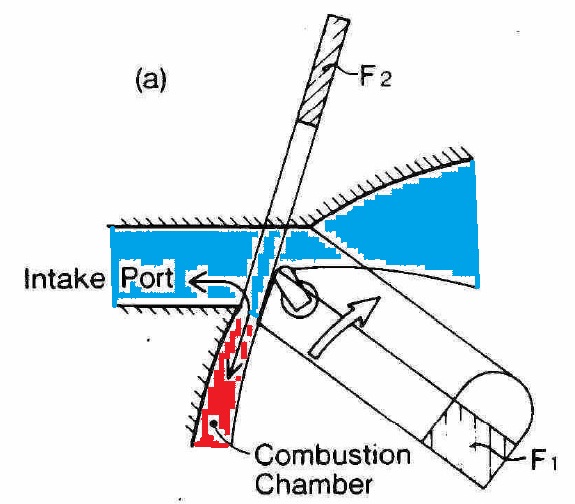
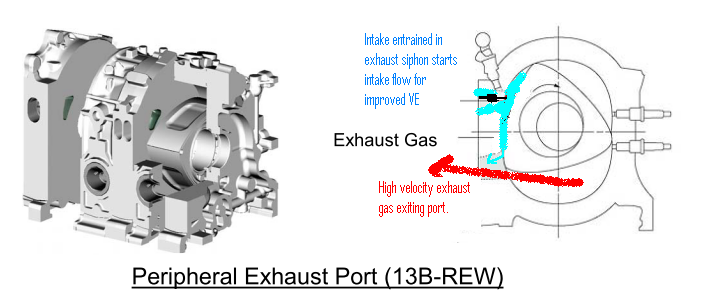
Blue is low pressure, Red is higher pressure exhaust gas, so it's obvious that exhaust pressure gets sucked into the intake. Whack the throttle, intake vaccuum dissapears, and less exhaust gas will leak.
I don't think semi-direct or direct injection will fix the problem, exhaust gas will make it's way to the intake regardless of where fuel is injected. The reason it braps and bucks is that the engine tries to run, but the exhaust gas mess up the combustion mixture enough to misfire. At that point the engine is no longer running, the injectors keep firing though, because ecu doesn't care about the misfire, which causes fuel coming out the exhaust. Because the engine is no longer running this means there is no exhaust gas being produced. No exhaust gas means all is well again, and the engine comes back alive, and repeat. The amount of misfiring is directly linked to the intake vaccuum. At idle at -0,45 bars of vaccuum it braps a lot, it's gone above 8% throttle or so, not sure what the intake vaccuum is at that point, but probably not much.
Good tuning helps a lot, it's kindoff picky though, but I did some testing and I am able to get it to run smoothly at normal cruising speeds. I do have fully sequential injection, currently injecting at 90 deg BTDC, but I'll do some testing with it later. It will always brap at idle and low loads, but as said before it's kindoff what makes this engine so awesome, I'll drive my RX-8 when I want a smooth idle.
I agree with most of the stuff said, it's not that difficult:
Blue is low pressure, Red is higher pressure exhaust gas, so it's obvious that exhaust pressure gets sucked into the intake. Whack the throttle, intake vaccuum dissapears, and less exhaust gas will leak.
I don't think semi-direct or direct injection will fix the problem, exhaust gas will make it's way to the intake regardless of where fuel is injected. The reason it braps and bucks is that the engine tries to run, but the exhaust gas mess up the combustion mixture enough to misfire. At that point the engine is no longer running, the injectors keep firing though, because ecu doesn't care about the misfire, which causes fuel coming out the exhaust. Because the engine is no longer running this means there is no exhaust gas being produced. No exhaust gas means all is well again, and the engine comes back alive, and repeat. The amount of misfiring is directly linked to the intake vaccuum. At idle at -0,45 bars of vaccuum it braps a lot, it's gone above 8% throttle or so, not sure what the intake vaccuum is at that point, but probably not much.
Good tuning helps a lot, it's kindoff picky though, but I did some testing and I am able to get it to run smoothly at normal cruising speeds. I do have fully sequential injection, currently injecting at 90 deg BTDC, but I'll do some testing with it later. It will always brap at idle and low loads, but as said before it's kindoff what makes this engine so awesome, I'll drive my RX-8 when I want a smooth idle.



Joined: Mar 2001
Posts: 31,857
Likes: 3,243
From: https://www2.mazda.com/en/100th/
Joined: Mar 2001
Posts: 31,857
Likes: 3,243
From: https://www2.mazda.com/en/100th/
Wow, quite the discussion going on.
I agree with most of the stuff said, it's not that difficult:
Blue is low pressure, Red is higher pressure exhaust gas, so it's obvious that exhaust pressure gets sucked into the intake. Whack the throttle, intake vaccuum dissapears, and less exhaust gas will leak.
I don't think semi-direct or direct injection will fix the problem, exhaust gas will make it's way to the intake regardless of where fuel is injected. The reason it braps and bucks is that the engine tries to run, but the exhaust gas mess up the combustion mixture enough to misfire. At that point the engine is no longer running, the injectors keep firing though, because ecu doesn't care about the misfire, which causes fuel coming out the exhaust. Because the engine is no longer running this means there is no exhaust gas being produced. No exhaust gas means all is well again, and the engine comes back alive, and repeat. The amount of misfiring is directly linked to the intake vaccuum. At idle at -0,45 bars of vaccuum it braps a lot, it's gone above 8% throttle or so, not sure what the intake vaccuum is at that point, but probably not much.
Good tuning helps a lot, it's kindoff picky though, but I did some testing and I am able to get it to run smoothly at normal cruising speeds. I do have fully sequential injection, currently injecting at 90 deg BTDC, but I'll do some testing with it later. It will always brap at idle and low loads, but as said before it's kindoff what makes this engine so awesome, I'll drive my RX-8 when I want a smooth idle.
I agree with most of the stuff said, it's not that difficult:
Blue is low pressure, Red is higher pressure exhaust gas, so it's obvious that exhaust pressure gets sucked into the intake. Whack the throttle, intake vaccuum dissapears, and less exhaust gas will leak.
I don't think semi-direct or direct injection will fix the problem, exhaust gas will make it's way to the intake regardless of where fuel is injected. The reason it braps and bucks is that the engine tries to run, but the exhaust gas mess up the combustion mixture enough to misfire. At that point the engine is no longer running, the injectors keep firing though, because ecu doesn't care about the misfire, which causes fuel coming out the exhaust. Because the engine is no longer running this means there is no exhaust gas being produced. No exhaust gas means all is well again, and the engine comes back alive, and repeat. The amount of misfiring is directly linked to the intake vaccuum. At idle at -0,45 bars of vaccuum it braps a lot, it's gone above 8% throttle or so, not sure what the intake vaccuum is at that point, but probably not much.
Good tuning helps a lot, it's kindoff picky though, but I did some testing and I am able to get it to run smoothly at normal cruising speeds. I do have fully sequential injection, currently injecting at 90 deg BTDC, but I'll do some testing with it later. It will always brap at idle and low loads, but as said before it's kindoff what makes this engine so awesome, I'll drive my RX-8 when I want a smooth idle.


I don't think semi-direct or direct injection will fix the problem
It can help fix the problem of so much fuel in the exhaust.
You will still dump air/fuel in the exhaust during the misfire events of low load combustion instability (throttle plate closed), but with some load and thus stable combustion you will have less fuel loss to the exhaust during overlap.
We all agree the vacuum of closed throttle plate "sucks" exhaust into the intake stroke.
I maintain that is dynamic set up by the closed throttle plate (lack of intake flow) is a reversal of the normal rotary overlap dynamic which is intake loss to the exhaust port.
You have to zoom out and look at the whole picture to see this dynamic.
It can help fix the problem of so much fuel in the exhaust.
You will still dump air/fuel in the exhaust during the misfire events of low load combustion instability (throttle plate closed), but with some load and thus stable combustion you will have less fuel loss to the exhaust during overlap.
We all agree the vacuum of closed throttle plate "sucks" exhaust into the intake stroke.
I maintain that is dynamic set up by the closed throttle plate (lack of intake flow) is a reversal of the normal rotary overlap dynamic which is intake loss to the exhaust port.
You have to zoom out and look at the whole picture to see this dynamic.
I don't think semi-direct or direct injection will fix the problem
It can help fix the problem of so much fuel in the exhaust.
You will still dump air/fuel in the exhaust during the misfire events of low load combustion instability (throttle plate closed), but with some load and thus stable combustion you will have less fuel loss to the exhaust during overlap.
We all agree the vacuum of closed throttle plate "sucks" exhaust into the intake stroke.
I maintain that is dynamic set up by the closed throttle plate (lack of intake flow) is a reversal of the normal rotary overlap dynamic which is intake loss to the exhaust port.
You have to zoom out and look at the whole picture to see this dynamic.
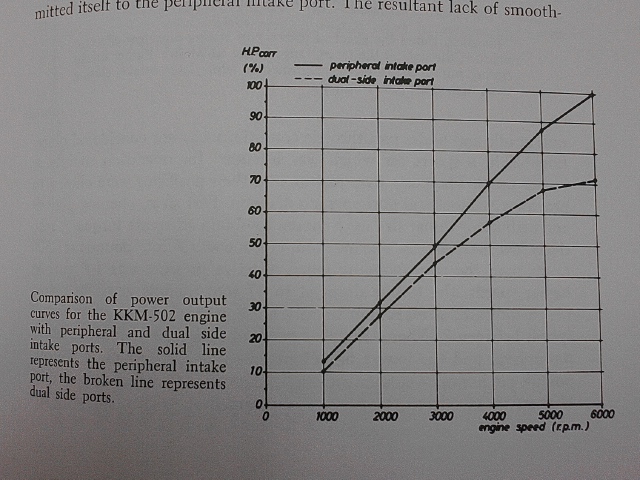
This is a chart of NSU engines. The lower power line is the side port intake and the higher line is the peripheral port intake. As you see , at high load there is no point the overlap from the p-port is not making more power. P-port closes at 50 abdc (same as TII and FD) and it is reported that earlier OR later closing caused a loss of lower rpm power.
Their production engine was p-port.
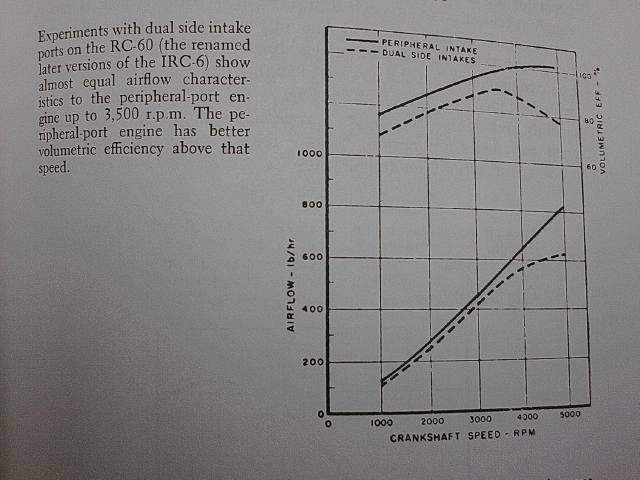
This is a chart of Curtis Wright engines. They opted to develop side port intake and this chart shows with careful development they were almost able to gain as much low end power as their p-port prototype.
It can help fix the problem of so much fuel in the exhaust.
You will still dump air/fuel in the exhaust during the misfire events of low load combustion instability (throttle plate closed), but with some load and thus stable combustion you will have less fuel loss to the exhaust during overlap.
We all agree the vacuum of closed throttle plate "sucks" exhaust into the intake stroke.
I maintain that is dynamic set up by the closed throttle plate (lack of intake flow) is a reversal of the normal rotary overlap dynamic which is intake loss to the exhaust port.
You have to zoom out and look at the whole picture to see this dynamic.
This is a chart of NSU engines. The lower power line is the side port intake and the higher line is the peripheral port intake. As you see , at high load there is no point the overlap from the p-port is not making more power. P-port closes at 50 abdc (same as TII and FD) and it is reported that earlier OR later closing caused a loss of lower rpm power.
Their production engine was p-port.
This is a chart of Curtis Wright engines. They opted to develop side port intake and this chart shows with careful development they were almost able to gain as much low end power as their p-port prototype.
I don't think semi-direct or direct injection will fix the problem
Actually, I just realized that direct injection could fix the problem.
If you delete the throttle plate and vary the rpms with fuel using the direct injection like a diesel you will eliminate the p-port driveability issues.
that would be hard to test. and Ian, you need to do a P port already!
Hopefully I will be developing an NA 2 rotor semi p-port with the dyno shop owner for his Miata.
I will try to push him to use the p-port as the primary for low end power, but he may cheap out and use the available manifolds and 2 injectors at the primary side port location.
As far as testing the exhaust scavenging the intake with overlap, you can follow the fuel. How does the raw fuel (and air) get into the exhaust under load (stable combustion) on a high overlap rotary?
Its a dynamic situation and you can't think of it as static pressures.
With the throttle open you will have the same ~0 intake pressure at low rpm as high rpm. Exhaust manifold pressure will rise with rpm.
Now why is it you are saying the scavenging will be higher at higher rpm if you are arguing your static pressure model.
The scavenging will be higher at higher rpm from more exhaust FLOW.
Actually, I just realized that direct injection could fix the problem.
If you delete the throttle plate and vary the rpms with fuel using the direct injection like a diesel you will eliminate the p-port driveability issues.
that would be hard to test. and Ian, you need to do a P port already!
Hopefully I will be developing an NA 2 rotor semi p-port with the dyno shop owner for his Miata.
I will try to push him to use the p-port as the primary for low end power, but he may cheap out and use the available manifolds and 2 injectors at the primary side port location.
As far as testing the exhaust scavenging the intake with overlap, you can follow the fuel. How does the raw fuel (and air) get into the exhaust under load (stable combustion) on a high overlap rotary?
Its a dynamic situation and you can't think of it as static pressures.
With the throttle open you will have the same ~0 intake pressure at low rpm as high rpm. Exhaust manifold pressure will rise with rpm.
Now why is it you are saying the scavenging will be higher at higher rpm if you are arguing your static pressure model.
The scavenging will be higher at higher rpm from more exhaust FLOW.
Joined: Mar 2001
Posts: 31,857
Likes: 3,243
From: https://www2.mazda.com/en/100th/
Its a dynamic situation and you can't think of it as static pressures.

With the throttle open you will have the same ~0 intake pressure at low rpm as high rpm. Exhaust manifold pressure will rise with rpm.
Now why is it you are saying the scavenging will be higher at higher rpm if you are arguing your static pressure model.
The scavenging will be higher at higher rpm from more exhaust FLOW.
Now why is it you are saying the scavenging will be higher at higher rpm if you are arguing your static pressure model.
The scavenging will be higher at higher rpm from more exhaust FLOW.
the scavenging effect gets bigger, as rpms go up because there starts to be more velocity, and at high rpm, there is backpressure from the muffler to dampen things out.
in a way you're really overthinking this, its really a simple (happy) engine. you just give it fuel, and it does what it does....
Joined: Mar 2001
Posts: 31,857
Likes: 3,243
From: https://www2.mazda.com/en/100th/
so i drilled a series of holes, and idle speed did not noticeably change, but idle quality does, up to the point where there isn't enough vacuum to make the carb work.
it doesn't, once the combustion is stable, the wideband starts reading normal numbers, and the engine will tune (in a narrower range, its more picky) to a normal AFR, and then it just runs like any other engine.
Wideband measures free 02 in the exhaust, the burning eyes of the people behind me on the freeway tell me there is raw fuel in my exhaust @ measured 14:1-16:1 AFRs. Emissions HC count is what we need to be noting.
in a way you're really overthinking this, its really a simple (happy) engine. you just give it fuel, and it does what it does....
Perhaps, though the OP was interested in being able to inject less fuel and have a happy engine. I am sure he will try injection angle (timing) changes and report back.
It will be interesting to see which way Mazda goes with their direct injection peripheral intake rotary!
Will there be a throttle plate?
Are their new lean burn cats good enough for injection throttling?
Wideband measures free 02 in the exhaust, the burning eyes of the people behind me on the freeway tell me there is raw fuel in my exhaust @ measured 14:1-16:1 AFRs. Emissions HC count is what we need to be noting.
in a way you're really overthinking this, its really a simple (happy) engine. you just give it fuel, and it does what it does....
Perhaps, though the OP was interested in being able to inject less fuel and have a happy engine. I am sure he will try injection angle (timing) changes and report back.
It will be interesting to see which way Mazda goes with their direct injection peripheral intake rotary!
Will there be a throttle plate?
Are their new lean burn cats good enough for injection throttling?

Senior Member

Joined: Apr 2007
Posts: 308
Likes: 4
From: WA state
John, are you still running the stock rear-end? If so how about going to 4.77 (like Mad Mike in the MADBUL) or 5.12? Seems like the ratio change would effect where the engine is loading up @...
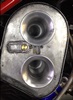
Exhaust Manifold Leak


Joined: Jun 2005
Posts: 815
Likes: 42
From: western europe
this is the reason i wanted to drill the idle plates, i wanted the engine to idle on the idle hole in the carburetor. on mine i needed the hole in the throttle plate to bring the idle speed up by ~300rpm.
so i drilled a series of holes, and idle speed did not noticeably change, but idle quality does, up to the point where there isn't enough vacuum to make the carb work.
so i drilled a series of holes, and idle speed did not noticeably change, but idle quality does, up to the point where there isn't enough vacuum to make the carb work.
Joined: Mar 2001
Posts: 31,857
Likes: 3,243
From: https://www2.mazda.com/en/100th/
with no air pump and no cat, HC's at idle were ~2500
with the airpump they drop to ~1800
with the cat and the air pump they are ~80
granted the stock ecu isn't running 14:1 at idle, but still an Rx8 does, and with no cat, those are over 500 HC's.
we did break the smog machine doing this too...
i wouldn't expect the P port to do any better, but it can't be much worse
actually as an aside the eye burning is nox. if you smog 10 cars a year every year for 20 years, you can actually smell the difference in each gas.
Thread Starter
Joined: Oct 2010
Posts: 605
Likes: 13
From: The Netherlands
I kindoff solved the bucking while cruising issue, it turned out to be those extra DB-killers I used to quite the car down for tech inspection. I removed those, and now it drives very well! It's awesome! Is does make a bit more sound, but the sounds it does make is wicked. I took it up to 6500 or so, and oh boy! It put a big smile on my face that's for sure.
What didn't put a big smile on my face was the gas tank issue I was having. When I was pumping gas the tanking nozzle would shut off, like it does when the tank is full. The only way I could gas in was by tanking verrrryyy slowwly, so it took half an hour to fill the tank up. This meant I had to get up 30 minutes earlier every other day
At first I thought it was some sort of tank venting issue, so I removed the entire gas tank, checked the check and cut valve, and the pressure relief valve. The relief valve was a bit iffy, so I tried removing it to see if that was the issue, but no bueno, filling it up was still a nightmare. So I removed the tank again, and also removed the filler hose with that smaller air tube. Turned out there is a flapper valve in the filler hose that got stuck. Fixed that, fixed the tank vent, put everything back together and now it works nicely
Also spend some time with my dyno. I have an old intertia / water brake dyno with a few friends, but it doesn't get used a lot. The last time it was used was when I dyno-ed my formed FD last year. Needless to say it needs some love to get up and running, as some parts have miraculously gone missing over the winter, and some stuff just plainly stopped working. , I'll get it fixed though
What didn't put a big smile on my face was the gas tank issue I was having. When I was pumping gas the tanking nozzle would shut off, like it does when the tank is full. The only way I could gas in was by tanking verrrryyy slowwly, so it took half an hour to fill the tank up. This meant I had to get up 30 minutes earlier every other day
At first I thought it was some sort of tank venting issue, so I removed the entire gas tank, checked the check and cut valve, and the pressure relief valve. The relief valve was a bit iffy, so I tried removing it to see if that was the issue, but no bueno, filling it up was still a nightmare. So I removed the tank again, and also removed the filler hose with that smaller air tube. Turned out there is a flapper valve in the filler hose that got stuck. Fixed that, fixed the tank vent, put everything back together and now it works nicely
Also spend some time with my dyno. I have an old intertia / water brake dyno with a few friends, but it doesn't get used a lot. The last time it was used was when I dyno-ed my formed FD last year. Needless to say it needs some love to get up and running, as some parts have miraculously gone missing over the winter, and some stuff just plainly stopped working.
, I'll get it fixed though

Senior Member
Joined: Apr 2009
Posts: 606
Likes: 80
From: netherlands
I kindoff solved the bucking while cruising issue, it turned out to be those extra DB-killers I used to quite the car down for tech inspection. I removed those, and now it drives very well! It's awesome! Is does make a bit more sound, but the sounds it does make is wicked. I took it up to 6500 or so, and oh boy! It put a big smile on my face that's for sure.
Can't wait to hear it!

Amazing work, thanks for the great information and getting me interested in my cars again. Any chance you could mount a gopro in your engine bay looking at your headers? It would be really interesting to see that beauty start to glow.
Thread Starter
Joined: Oct 2010
Posts: 605
Likes: 13
From: The Netherlands
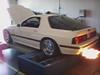
So, I strapped the car to our dyno. It's a bit of a ghetto setup, 2 rollers hooked up to a waterbrake, but most of the time it works.

Here is a little video of some tuning:
The dyno is no match for the 4-rotor though, the waterbrake just isn't able to brake the engine down. Also the cooling fans are not able to keep temps under control, I've seen 150C oil temp, 105C water temp and 60C air intake temp. So I did most of the tuning in the cruising area of the map. Did some sweeps with some throttle applied, and everything looks to be in the ballpark. It runs nicely and seems to be making some power, AFR's are a little rich under load but not too bad. Need to fix some random issues with the car, and then take it to a bigger dyno.
Here is a little video of some tuning:
The dyno is no match for the 4-rotor though, the waterbrake just isn't able to brake the engine down. Also the cooling fans are not able to keep temps under control, I've seen 150C oil temp, 105C water temp and 60C air intake temp. So I did most of the tuning in the cruising area of the map. Did some sweeps with some throttle applied, and everything looks to be in the ballpark. It runs nicely and seems to be making some power, AFR's are a little rich under load but not too bad. Need to fix some random issues with the car, and then take it to a bigger dyno.






I think you know that though.