When you click on links to various merchants on this site and make a purchase, this can result in this site earning a commission. Affiliate programs and affiliations include, but are not limited to, the eBay Partner Network.
...Concerning the watertemperature sensor, do you guys mean the hose to the throttle body marked in the picture (2nd attachement)? This one is only 10mm in diameter, how can you fit a temperature sensor in there?
Originally Posted by DaleClark
OK, got some pics of the brass T I used. I got all this stuff from Lowe's. Can't remember total cost - probably $5-10 or so.
Parts I used -
Brass T with 1/4" NPT ports
2 1/4" NPT hose barbs with (I think) 5/16" hose barbs. The hose barbs were just the size that fit on the TB hoses - I just eyeballed it . The only other sizes were obviously too big or too small.
1/4" NPT to 1/8" NPT adapter/bushing.
As you can see in the pics, teflon tape up the fittings and screw it together. I used the 1/4" NPT to 1/8" NPT adapter to space the water temp sensor up and away. If I would have used a 1/8" NPT brass tee, the tip of the sensor would have interfered with the opposite side of the tee - best case it would have touched the brass and possibly give a false reading, worst case it wouldn't screw in enough to make a watertight seal at the threads.
BTW, all the Japanese temp sensors are 1/8" NPT - I'm not sure what Autometer is, I'm guessing 3/8" NPT. You're on your own there .
I removed the (original?) oil pressure sensor today, it was srewed into an adapter which then was put into the block (left one is the original sensor):
When I tried to screw in my autometer sensor I realized why there was the extra adapter: there is something in the way so you cannot screw it in, the screw thread doesn't reach the block.
So I tried to screw my autometer sensor into the old adapter, but I could turn it in only 1-2 turns, the screw thread is to big or gets to big to early. So I tried to screw the adapter (which goes into the block) into another adapter, which should be 1/8" NPT, the first 5 turns or so the connection was very loose, after some more turns it was tight.
Every other screw thread I tried and that should be 1/8" NPT didn't show the same behaviour, meaning it fits the presumable 1/8" NPT adapter perfectly.
Is the original screw thread in the block really not 1/8" NPT? What is it then?
Another subject. As I wrote recently I found a sensor in the banjo bolt coming from the engine, so I put my autometer sensor in. It badgered me the whole time, because since I just screwed it into the banjo bolt, there was a possibility to block the holes in the bolt. So I removed the banjo bolt today and took a look:
In my opinion it looks ok, since the sensor is only half in front of the hole and there is space around the sensor, meaning the sensor is smaller in diameter then the inside of the banjo bolt. So the oil flow should not be harmed and the sensor is right in the flow, which should be positive. What do you guys think?
It is 1/8 PT (or sometimes called BSPT), not NPT. NPT is an American only standard whilst PT is an international standard (technically British). Mazda uses PT.
For the TB coolant line: After hours of searching I only find 9mm hose barbs, but the inner diameter of the hose is 10mm. Is that a problem or should that work out well?
Its quite difficult in Germany to get this stuff, unless you can wait some weeks (China or UK)..
The picture above does seem to look like the sensor is blocking flow somewhat, though maybe it's just the angle of the picture. The banjo bolts are already a system restriction and 100% of your engine oil has to pass through those holes... any partial blockage compounds the issue. On our oil cooler kits we use a m18 straight adapter so there is no restriction with the banjo gone. Mazda used a banjo for ease of use and packaging, but forcing oil through a couple small holes at a 90* angle is not the most effecient. (Same banjo on the front cover which I'd also replace in favor of a straight fitting personally).
Maybe some washers could temper the problem.. The sensor is, as I wrote, smaller in diameter than the inner diameter of the banjo bolt, so there is room for the oil, you can see this a little bit at the second picture. I think if I would use a bigger spacer than some washers the sensor could be to far away from the oil hence producing to low temperature readings. But you're right, as it is now the flow could be disturbed a little bit.
I just bought an adapter for the oil pressure sensor, 1/8" BSPT (Din 2999) to 1/8" NPT, I can screw it into the old adapter (supposedly 1/8" BSPT on both ends) only 2.5 turns. The new one is an Y-adapter, 1/8" BSPT male and female, one 1/8" NPT female. The original oil pressure sensor screws in perfectly into the female 1/8" BSPT aswell as the old adpater (male) into the same port.
I ordered a thread gauge and am very curious which thread it will be...
Or is it normal, that a male 1/8" BSPT only screws in 2.5 turns into a female 1/8" BSPT?
I just bought an adapter for the oil pressure sensor, 1/8" BSPT (Din 2999) to 1/8" NPT, I can screw it into the old adapter (supposedly 1/8" BSPT on both ends) only 2.5 turns. The new one is an Y-adapter, 1/8" BSPT male and female, one 1/8" NPT female. The original oil pressure sensor screws in perfectly into the female 1/8" BSPT aswell as the old adpater (male) into the same port.
I ordered a thread gauge and am very curious which thread it will be...
Or is it normal, that a male 1/8" BSPT only screws in 2.5 turns into a female 1/8" BSPT?
Again, thank you all very much for your help!
Im sorry but i cannot answer your question. Though i would be much interested in that thread gauge! Im trying to figure out what the threads and size the stock "low coolant level sensor" has. Im going to install my water temp gauge there, but cannot find any information regarding its thread type nor size.
I do however think its wise to "space out" the oil temp sender in such a way that it doesn't potentially mess with the flow of oil. Never mind it doesn't come in direct contact with the flowing oil, if its just above the holes in the banjo bolt, i would dare to say you would get at least a 99% correct reading anyways. The sensor i will install is much smaller than yours, but i will still put an extension of some sort to keep it out of the flow.
I'm really on the verge of just screwing the y-adapter (1/8 BSPT) into the old adapter with force. Maybe I can screw it in 3 turns, shouldn't that be enough?
I'm really on the verge of just screwing the y-adapter (1/8 BSPT) into the old adapter with force. Maybe I can screw it in 3 turns, shouldn't that be enough?
They are like NPT but for British & other country's , angle at 55• .
You don't want to force it (there is a reason why people use JIC 37• when tapping the block and not NPT)
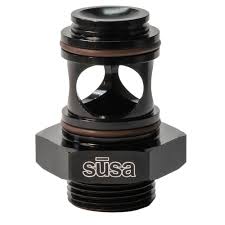
Just as an aside, (sorry I know this is only sort of related) but if you compare the stock banjo fitting to an aftermarket performance banjo... the flow path differences are painfully obvious. Banjo Fittings | susa
Straight fittings at the Oil Filter Pedestal are the way to go! But you've got to replace the stock hard lines.
They are like NPT but for British & other country's , angle at 55• .
You don't want to force it (there is a reason why people use JIC 37• when tapping the block and not NPT)
Opposed of JIC use can use Teflon tape
Hope that helps
Mo
No, not really.. What is JIC 37? Never heard of it before, what does it got to do with the original screw thread in the block?
By screwing it in with force I don't mean to screw it in like crazy. Just to get a little more turns than the the 2.5 I get with my hands. And of course, its only the adapter, not the block itself. So the only thing to loose is the old adapter and the new y-adapter.
I would have use teflon tapeanyway, do you mean to rely on the tape to seal und screw it in not to tight?
@SBGarage: No worries, your inputs are good. I think I will modify the original banjo bolt according to your picture a little bit for the moment and use washers on the sensor to bring it up a little bit. I will keep that in mind and do it right when I finally pull the engine.
Npt is 28 thread and Bspt is 27...or is it the other way around?(Aaron Cake knows this stuff..heh,heh!).
Tapping the best option or getting a conversion adapter to install your part.
I wouldn't trust screwing in a part that is under pressure and not being sure that it would blow out.
I forgot to install a sensor one day..Holy Crap..I lost 4 quarts in 30 seconds..What a MESS!
I just ordered a G1/8" to 1/8" NPT adapter, it was the only one I could find. With this I can at least use the new oil pressure sensor, IF it fits the block. The original oil pressure gauge in the cluster will be dead then, but better than splashing the oil onto the road at 8000rpm..
Most likely yes but it will be slight squeeze. We do have multiple port options and you can always drill/tap the side if you need it to be at a particular location. That said, it probably will work as is, but tapping it is very easily done.
Hey everyone. Sorry to revive this old thread, but need some info. I had a water temp gauge installed years ago and they put it in the lower radiator hose. I see on here that that is an "ok" spot but not necessarily ideal. Is the issue that it reads cooler than it should due to the temp reading after the water goes through the radiator? Is it a decent enough reading to leave alone? Would the upper radiator hose be more accurate?
Hey everyone. Sorry to revive this old thread, but need some info. I had a water temp gauge installed years ago and they put it in the lower radiator hose. I see on here that that is an "ok" spot but not necessarily ideal. Is the issue that it reads cooler than it should due to the temp reading after the water goes through the radiator? Is it a decent enough reading to leave alone? Would the upper radiator hose be more accurate?
Based on my limited experience and from what I've read, you want to see the temperature of the water after its been into the engine. Thats the most accurate way to tell if the engine is running hot or cold. But as you said, most people say its fine to use the "cold side" of the radiator to get a reading from.
It all depends on how hard you run your engine. Just be sure to notice what normal operating temperatures are, and be sure to back off as soon as you see any big variation in temperature since the engine is actually hotter than displayed.
Don't sweat it! But if you get the chance (during winter, when changing coolant or similar), simply tap the water pump housing. Its not really a hard thing to do. Just remove the housing, drill a hole, and use a tap of high quality with plenty of lubrication/cooling since you don't want to crack the aluminium housing.
Placement in the lower hose means no meaningful reading until the t-stat opens. Placement in the housing usually means the same. Not a huge issue but not ideal. Monitoring temps becomes kind of relative after a while. You get to know your car. I think most get a feel for what is an acceptable INDICATED temp under varying circumstances for THEIR car no matter where the sensor is placed or how technically accurate the reading. Still, not sure why you would go to the trouble and risk to drill and tap give the alternatives mentioned earlier in this thread.






 . The only other sizes were obviously too big or too small.