


Vacuum Diagrams(Stock, Simplified Sequential, Non-sequential, Single Turbo




Full Member
Joined: Jul 2010
Posts: 130
Likes: 0
From: sanger, california
i just got a JDM engine and its weird because it did not come with a actuator double throttal control, air control valve, solenoid valve (switching), the yellow vacume hose (from the four) on the inside of the side manifold, and the brown vacume hose coming from the upper manifold on the throtal body side... and when i mean " did not come with" i mean like there is no spot or fitting for them...

What have you been using to control boost up until now? There are multiple boost control options (including ones that are not in these diagrams) and you will find arguments for and against each one.
I would hook the solenoids up like stock then. There's no reason to mess with it right now because you haven't even opened up the exhaust. One port on the actuator goes to the pressure source on the compressor, and then the other port on the actuator goes to the solenoid. The same applies to both precontrol and wastegate.
Full Member
Joined: Jul 2010
Posts: 130
Likes: 0
From: sanger, california
Actualy im sorry, i have a 3'' Bönez Downpipe & High Flow Cat Combo with the Racing Beat "Catback" exhaust but the engine itself is in stock form now with the PFC. I also have the Apexi intake but have not instald it yet.
Full Member
Joined: Jul 2010
Posts: 130
Likes: 0
From: sanger, california
I am having major boost problems and i cant find out what the problem is at all and was hopping that by doing a simplified hose diagram it would help some how. The boost problem i am having is that i am only getting .04bar on my primary turbo i changed all the vacume hose lines to silicone under the upper manifold and the hoses connected to the two actuators where the front turbo is. I dont know what else to do...

Time to do a lot of FAQ reading. It can be a little daunting at first but just break each system down and study each part of the whole until you understand it.
If you plan on keeping the car you pretty much need to learn it yourself unless you're near a good rotary shop.
Also I don't recommend pulling things out of your engine bay as a troubleshooting step, it generally just causes more problems.
That said, the primary sources of boost leaks (and it sounds like you have a huge one) on stock cars are related to the rubber tubing and the Y-pipe coupler. Replacing all that rubber craptastic tubing with aluminum piping is a great step, and it looks 100 times better too.
That said here's a starting point : http://www.autosportracetech.com/RX-7/rx7stuff.htm
Go to the "T" section in the FAQ: https://www.rx7club.com/3rd-generation-specific-1993-2002-16/faq-3rd-gen-other-useful-links-68640/
Also....what silicone tubing did you use? I'd say it's extremely important to use good hose, like from Hose Techniques. The crappy stuff will cause all kind of problems.
If you plan on keeping the car you pretty much need to learn it yourself unless you're near a good rotary shop.
Also I don't recommend pulling things out of your engine bay as a troubleshooting step, it generally just causes more problems.
That said, the primary sources of boost leaks (and it sounds like you have a huge one) on stock cars are related to the rubber tubing and the Y-pipe coupler. Replacing all that rubber craptastic tubing with aluminum piping is a great step, and it looks 100 times better too.
That said here's a starting point : http://www.autosportracetech.com/RX-7/rx7stuff.htm
Go to the "T" section in the FAQ: https://www.rx7club.com/3rd-generation-specific-1993-2002-16/faq-3rd-gen-other-useful-links-68640/
Also....what silicone tubing did you use? I'd say it's extremely important to use good hose, like from Hose Techniques. The crappy stuff will cause all kind of problems.
Full Member
Joined: Jul 2010
Posts: 130
Likes: 0
From: sanger, california
thanks for the info twinsinside, i already installed the Efini Y Piping Upgrade Kit in the car. I keep on forgetting to put down what i already have in the car but i think thats it, the 3'' Bönez Downpipe & High Flow Cat with the Racing Beat "Catback" exhaust, the Efini Y Piping Upgrade Kit, Apexi intake, PFC, and pullly kit. the car was working fine until i changed all the vacume hoses to selicone ones that i got at pepboys, which is prob cheep kinds i bet... ill end up doing all the work myself because i dont really have the money to have someone else work on it and the nearest rotary shop is 3 1/2hrs away from where i live.
thanks again twinsinside and arghx for the help and ill try to keep u posted on the car if you dont mind.
thanks again twinsinside and arghx for the help and ill try to keep u posted on the car if you dont mind.
The problem with the cheap hose is that it pinches off and causes all kinds of problems. this is not a car you want to buy cheap parts for, it will end up costing you a lot more in the long run.
Get a Hose Techniques kit, it takes the guesswork out of determining what size hoses you need.
Also, make sure your checkvalves work and are oriented in the correct direction (one way valves). Dale Clark sells a high quality viton check valve set which is a very good option for a very small cost.
Mityvacs are invaluable when troubleshooting the sequential system as well.
Get a Hose Techniques kit, it takes the guesswork out of determining what size hoses you need.
Also, make sure your checkvalves work and are oriented in the correct direction (one way valves). Dale Clark sells a high quality viton check valve set which is a very good option for a very small cost.
Mityvacs are invaluable when troubleshooting the sequential system as well.
Full Member
Joined: Jul 2010
Posts: 130
Likes: 0
From: sanger, california
ok thanks! i guess ill have to do another vacume hose replacement again and put in the Hose Techniques kit your talking about which im guessing you get online only... i dont mind it though because it wasnt that hard the first time to replace them and i get to know my car that much more.
i already read through a whole lot of the first website you provided me and cant wait till i can go through all the checks tomorrow morning. thanks twinsinside!
i already read through a whole lot of the first website you provided me and cant wait till i can go through all the checks tomorrow morning. thanks twinsinside!
If they are missing you will have the same effect as disconnecting the solenoids that control the wastegate and pre-control (located bolted to the UIM), you will restrict your max boost to about 7 psi.
^ that is a nonsequential diagram, not a single turbo diagram.
If anything, the diagram could be simpler. I don't agree with keeping the fuel pressure regulator control solenoid valve. you can run the stock FPR right to a vacuum/boost source. that solenoid is mostly to prevent vapor lock, which simply doesn't happen.
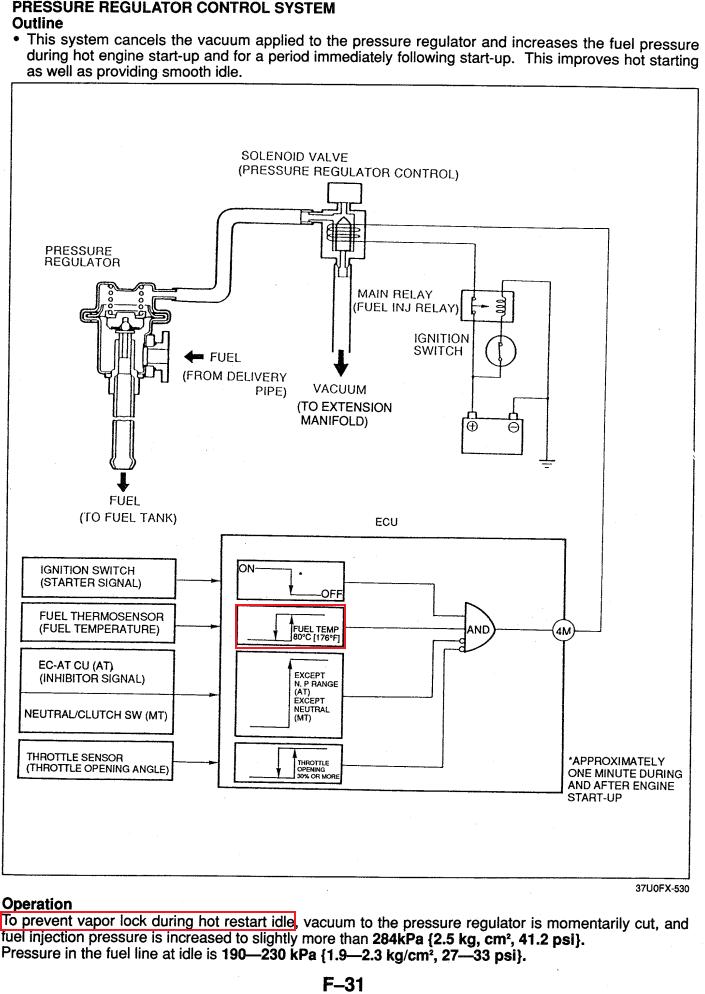
as you can see, it only comes on when fuel temps are over 80 C (which rarely/never happens, ask someone who has hooked up their fuel temp sensor to their water temp sensor connector by accident). The car also has to be left in Neutral for the solenoid to engage. I know it says "except neutral" but if you have ever looked at computer logic diagrams (that is an AND gate), that little circle thing next to the D means there is an inverter there which essentially changes the signal. anyway the solenoid is useless because it never really turns on if you examine the logic circuit, that's all you need to know. just take it out.
the PCV valve is also unnecessary. the filler pipe vent can be routed to before the turbo inlet or to a vented catch can. a PCV valve only draws crankcase vapors out under low engine loads for emissions purposes. Under high load the vapors escape on their own without a PCV valve, and in fact under high load the PCV valve closes. I don't know why the charge relief valve is still there either. if you are premixing the two dark blue lines can go, they are for the OMP.
One thing people do that I don't agree with is removing the TB coolant hose and fast idle system. all that does is make the car idle like crap on cold start, just to save a small amount of plumbing and have a negligible decrease in intake temps.
If anything, the diagram could be simpler. I don't agree with keeping the fuel pressure regulator control solenoid valve. you can run the stock FPR right to a vacuum/boost source. that solenoid is mostly to prevent vapor lock, which simply doesn't happen.
as you can see, it only comes on when fuel temps are over 80 C (which rarely/never happens, ask someone who has hooked up their fuel temp sensor to their water temp sensor connector by accident). The car also has to be left in Neutral for the solenoid to engage. I know it says "except neutral" but if you have ever looked at computer logic diagrams (that is an AND gate), that little circle thing next to the D means there is an inverter there which essentially changes the signal. anyway the solenoid is useless because it never really turns on if you examine the logic circuit, that's all you need to know. just take it out.
the PCV valve is also unnecessary. the filler pipe vent can be routed to before the turbo inlet or to a vented catch can. a PCV valve only draws crankcase vapors out under low engine loads for emissions purposes. Under high load the vapors escape on their own without a PCV valve, and in fact under high load the PCV valve closes. I don't know why the charge relief valve is still there either. if you are premixing the two dark blue lines can go, they are for the OMP.
One thing people do that I don't agree with is removing the TB coolant hose and fast idle system. all that does is make the car idle like crap on cold start, just to save a small amount of plumbing and have a negligible decrease in intake temps.
Are we certain about all of this? I want to get rid of as many solenoids as possible but don't want to have to re-tune and certain don't want to blow my motor.


Yup, you can def do w/o PCV, on later model FDs that was eliminated anyway. I took mine out, never had a problem. Also w.r.t. the pressure regulator solenoid, my hot start on REALLY hot days (as in above 90*F, after driving the car hard and parking it for a bit) has improved a bit by putting it back in; previously, I had it out. All the PRC is supposed to do is bump fuel pressure up a bit on hot start... However, I never had issues starting the car, it would take a little more effort w/o the solenoid but not enough to really make a difference (the car would start every time anyway). No re-tune should be required with either mod. Oh, and I agree with keeping the TB coolant & fast idle system in... when I took mine out my car would run like **** until it was totally warmed up, I attribute a lot of that to the TB bypass. I put it back and it runs just fine even when cold.

tomorrow I plan on changing out all my vacuum lines and doing a simplifed version for the stock twins. I read somewhere that you need two different size hoses. Any idea how many feet of each do you need?
Thank you!
Thank you!



hey guys..
this might be a really silly question..
im kinda new to the FD game and it has me confused..
im going crazy trying to work out the system to fix mine..
Were is the Vacum chamber located. i know the pressure chamber sits behind the alternator...
this might be a really silly question..
im kinda new to the FD game and it has me confused..
im going crazy trying to work out the system to fix mine..
Were is the Vacum chamber located. i know the pressure chamber sits behind the alternator...