


Thermoswitch FD vs. FC, an arguement


Thread Starter

Joined: Aug 2006
Posts: 398
Likes: 8
From: Space Coast Florida
Thermoswitch FD vs. FC, an arguement
I question the need and benefit to perform the long heralded modification to remove the FD thermoswitch and replace with the FC thermoswitch.
For this argument we need to assume the cooling fan system is in the factory configuration and the engine cooling system is operating properly.
Cooling fan operation 101:
The fan system has three speeds in which the speed selection depends upon the engine’s demand for cooling. There are three elements that demand the fans to operate: ECM, AC, and Water Temperature Thermoswitch. Also there was a Mazda recall that added a fan off delay circuit to resolve an underhood temperature problem but we won’t go into that here…
The fans have three separate motor winding taps whereas as voltage is applied via relays to consecutive (in any order) taps the fan speed increases.
The fans can be turned to LOW speed by any ONE of the ECM, AC or Thermoswitch actuating the respective relay(s). Relays 2 and 4 are operated by the ECM, relay 1 by the AC and relay 3 by the water thermoswitch. The ECM uses two relays for fault tolerance (they are redundant).
The fans can be turned to MEDIUM speed by any TWO of the ECM, AC or Thermoswitch closing the appropriate relays.
The fans can be turned to HIGH speed by all THREE (ECM, AC, and Thermoswitch) closing all of the relays.
So typically normal engine cooling is managed by the ECM based upon input from the water thermosenser (not the thermoswitch).
The thermoswitch provides a couple of features: One being the higher fan speed when the sensor temperature threshold is triggered and the other is a redundant cooling means should the ECM relays or wiring fail (highly unlikely). All the relay circuits are fed from the same set of fuses (coils off the 15A meter fuse and contacts off the 60A cooling fan fuse).
ECM demanded cooling is on at (if I remember) 90C (194F). I now have a PFC and have this temperature set a little lower.
AC is on whenever the AC panel fan switch is any speed but off and the AC button is depressed.
FD Thermoswitch is on when engine water temperature reaches 108C (226F). FC thermoswitch is triggered at 95C (203F). The Miata thermoswitch is commonly used also but it’s set points overlap the ECM demand and will cause short term speed cycling.
In summary the Thermoswitch is only needed if the ECM cannot manage the engine cooling.
The various threads and posting in this forum seem to point that the thermoswitch change from FD to FC will lower the operating temperature of the engine. The only thing the lower temperature FC thermoswitch will do is trigger the higher speed fan setting if the engine is threatened by overtemperature. Again, nominal temperature control is managed by the ECM.
Now I have the FC thermoswitch installed; it’s one of the first things I did when I got the car. Would I do it again? No, unless the FD thermoswitch failed and I had to replace it. Some say that the mod relieves engine heat soak but again the engine needs to be boarderline overtemp for the switch to set the next higher fan speed. If I was worried about that I would bridge relay coils together for relays 2, 3, and 4 and always have a minimum of medium fan speed. AC on in this scenario would set the fan speed, obviously, to high.
For this argument we need to assume the cooling fan system is in the factory configuration and the engine cooling system is operating properly.
Cooling fan operation 101:
The fan system has three speeds in which the speed selection depends upon the engine’s demand for cooling. There are three elements that demand the fans to operate: ECM, AC, and Water Temperature Thermoswitch. Also there was a Mazda recall that added a fan off delay circuit to resolve an underhood temperature problem but we won’t go into that here…
The fans have three separate motor winding taps whereas as voltage is applied via relays to consecutive (in any order) taps the fan speed increases.
The fans can be turned to LOW speed by any ONE of the ECM, AC or Thermoswitch actuating the respective relay(s). Relays 2 and 4 are operated by the ECM, relay 1 by the AC and relay 3 by the water thermoswitch. The ECM uses two relays for fault tolerance (they are redundant).
The fans can be turned to MEDIUM speed by any TWO of the ECM, AC or Thermoswitch closing the appropriate relays.
The fans can be turned to HIGH speed by all THREE (ECM, AC, and Thermoswitch) closing all of the relays.
So typically normal engine cooling is managed by the ECM based upon input from the water thermosenser (not the thermoswitch).
The thermoswitch provides a couple of features: One being the higher fan speed when the sensor temperature threshold is triggered and the other is a redundant cooling means should the ECM relays or wiring fail (highly unlikely). All the relay circuits are fed from the same set of fuses (coils off the 15A meter fuse and contacts off the 60A cooling fan fuse).
ECM demanded cooling is on at (if I remember) 90C (194F). I now have a PFC and have this temperature set a little lower.
AC is on whenever the AC panel fan switch is any speed but off and the AC button is depressed.
FD Thermoswitch is on when engine water temperature reaches 108C (226F). FC thermoswitch is triggered at 95C (203F). The Miata thermoswitch is commonly used also but it’s set points overlap the ECM demand and will cause short term speed cycling.
In summary the Thermoswitch is only needed if the ECM cannot manage the engine cooling.
The various threads and posting in this forum seem to point that the thermoswitch change from FD to FC will lower the operating temperature of the engine. The only thing the lower temperature FC thermoswitch will do is trigger the higher speed fan setting if the engine is threatened by overtemperature. Again, nominal temperature control is managed by the ECM.
Now I have the FC thermoswitch installed; it’s one of the first things I did when I got the car. Would I do it again? No, unless the FD thermoswitch failed and I had to replace it. Some say that the mod relieves engine heat soak but again the engine needs to be boarderline overtemp for the switch to set the next higher fan speed. If I was worried about that I would bridge relay coils together for relays 2, 3, and 4 and always have a minimum of medium fan speed. AC on in this scenario would set the fan speed, obviously, to high.
Last edited by ttmott; Dec 21, 2010 at 10:26 PM. Reason: Math Corrections



108 C = 226 F. And the S5 FC thermoswitch triggers at 95 C. (203 F.) The Miata switch was also 95 C. but was abandoned when it was learned the FC switch used the same connector as the OEM FD switch.
I can't give you a reference, but IIRC, most experienced opinions hold that coolant seal degradation starts around 115 C. ( 240 F.) Speaking only for myself, I never installed it thinking it would make my car run cooler by itself. The FC switch simply provides a bit more cushion.


If you doubt it remove it from your car and tell us how the temps are in florida. In the nice warm summers in OK I'll keep the FC thermoswitch as I have had several cars both ways and it runs cooler and the fans stay on longer after shut down. Both good things IMO.
Thread Starter
Joined: Aug 2006
Posts: 398
Likes: 8
From: Space Coast Florida
The ECM does via signal to the fan relays 2 and 4 based upon the thermosensor. The little black box that patches into the harness behind the ECM evaluates ECM commanded fan on time and if the fans were on X amount of time before key switch was turned off the fans will remain on at low speed. Thermoswitch has nothing to do with this function.

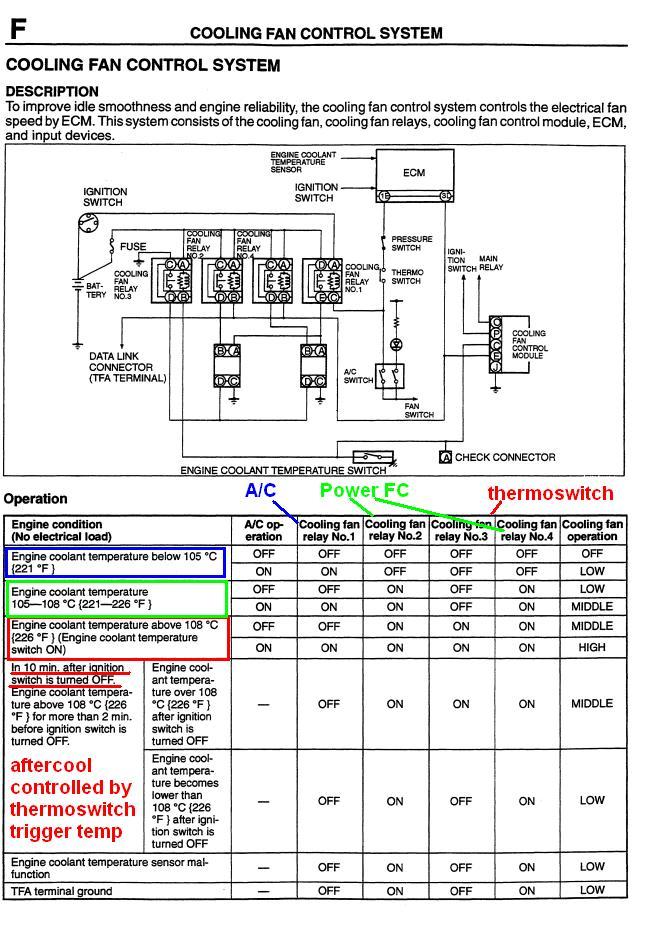
FD Thermoswitch is on when engine water temperature reaches 108C (226F).
FC thermoswitch is triggered at 95C (203F).
In summary the Thermoswitch is only needed if the ECM cannot manage the engine cooling.
The various threads and posting in this forum seem to point that the thermoswitch change from FD to FC will lower the operating temperature of the engine. The only thing the lower temperature FC thermoswitch will do is trigger the higher speed fan setting if the engine is threatened by overtemperature. Again, nominal temperature control is managed by the ECM.
Now I have the FC thermoswitch installed; it’s one of the first things I did when I got the car. Would I do it again? No, unless the FD thermoswitch failed and I had to replace it.
Some say that the mod relieves engine heat soak but again the engine needs to be boarderline overtemp for the switch to set the next higher fan speed. If I was worried about that I would bridge relay coils together for relays 2, 3, and 4 and always have a minimum of medium fan speed. AC on in this scenario would set the fan speed, obviously, to high.

Joined: Jul 2003
Posts: 4,678
Likes: 97
From: Bay Area, CA
As others have stated, the real number is a sky-high 105C, which I think makes your entire argument moot.
Beyond possibly reduced emissions, I am not sure there is any advantage to running at 105C vs. 90C - and certainly a lot of disadvantages.
Beyond possibly reduced emissions, I am not sure there is any advantage to running at 105C vs. 90C - and certainly a lot of disadvantages.

Thread
Thread Starter
Forum
Replies
Last Post
rgordon1979
3rd Generation Specific (1993-2002)
40
Mar 15, 2022 12:04 PM
