


Hot starting issues. What to check?


For those of you curious about what happens when you start the car:
1) As the key is turned to the "START" position, the ECU receives a "START" signal. This tells it to use a cranking fuel map of injector pulsewidth vs coolant temperature. In the Power FC this table is in the "water temp" screen on the commander and the settings 2 tab of the Datalogit software. A peak injector pulsewidth is calculated, which then decays (tapers off) as the engine cranks over. On the factory ECU cranking fuel is modified based on the internal atmospheric pressure sensor; on a Power FC there is no atmospheric pressure sensor.
2) The ECU waits for a "G" signal from the crank angle sensor. The "G" signal tells it that one of the rotors has reached top dead center. Then the "Ne" signal is used to calculate cranking speed. The factory ECU and the Power FC are usually the best and most reliable at reading these signals. Haltech, Megasquirt, AEM EMS, etc can be more temperamental.

3) During cranking the injectors are batch fired according to the G sensor. When a "G" pulse is detected, both primary injectors fire. During normal operation the front injector fires when the G signal is detected and the rear injector fires after 6 Ne pulses have been detected (180 degrees later). The injector timing would then be advanced and retarded based on engine speed.
4) Ignition timing is held constant at 5L 5T on the factory ECU. On the PFC it is based on the P9-P10, N1-N2 cells. On a completely stock car 5L/5T works fine to start the engine up quickly and have good cold start emissions. On a modified engine advancing the cranking timing can improve start up speeds.
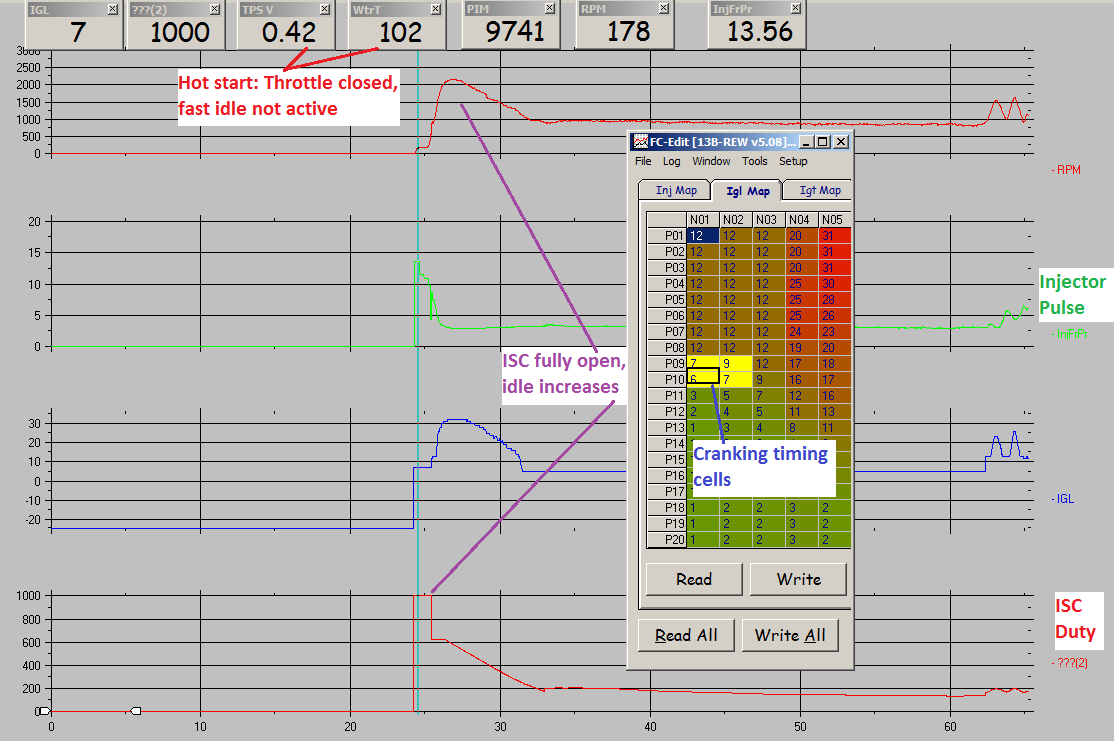
5) ISC valve goes to 100% duty to allow additional air in
6) Throttle angle is normally determined by the adjustment of the stop screws on the throttlebody and the position of the fast idle cam (if still equipped). The fast idle cam is rotated by a thermal wax rod which responds to coolant temperature. It does vary, but once water temperature reaches about 70C the fast idle will rotate away and the throttle will be fully closed.
7) On USDM compliant models with a factory ECU the Accelerated Warmup System will open a solenoid valve that draws a large quantity of air from the TB elbow past the throttle plates and into the intake manifold.
Piston engines from the same era work the same way really, although they usually have a cam position sensor(s) which is used during cranking and maybe a different ISC valve and fast idle design.
1) As the key is turned to the "START" position, the ECU receives a "START" signal. This tells it to use a cranking fuel map of injector pulsewidth vs coolant temperature. In the Power FC this table is in the "water temp" screen on the commander and the settings 2 tab of the Datalogit software. A peak injector pulsewidth is calculated, which then decays (tapers off) as the engine cranks over. On the factory ECU cranking fuel is modified based on the internal atmospheric pressure sensor; on a Power FC there is no atmospheric pressure sensor.
2) The ECU waits for a "G" signal from the crank angle sensor. The "G" signal tells it that one of the rotors has reached top dead center. Then the "Ne" signal is used to calculate cranking speed. The factory ECU and the Power FC are usually the best and most reliable at reading these signals. Haltech, Megasquirt, AEM EMS, etc can be more temperamental.
3) During cranking the injectors are batch fired according to the G sensor. When a "G" pulse is detected, both primary injectors fire. During normal operation the front injector fires when the G signal is detected and the rear injector fires after 6 Ne pulses have been detected (180 degrees later). The injector timing would then be advanced and retarded based on engine speed.
4) Ignition timing is held constant at 5L 5T on the factory ECU. On the PFC it is based on the P9-P10, N1-N2 cells. On a completely stock car 5L/5T works fine to start the engine up quickly and have good cold start emissions. On a modified engine advancing the cranking timing can improve start up speeds.
5) ISC valve goes to 100% duty to allow additional air in
6) Throttle angle is normally determined by the adjustment of the stop screws on the throttlebody and the position of the fast idle cam (if still equipped). The fast idle cam is rotated by a thermal wax rod which responds to coolant temperature. It does vary, but once water temperature reaches about 70C the fast idle will rotate away and the throttle will be fully closed.
7) On USDM compliant models with a factory ECU the Accelerated Warmup System will open a solenoid valve that draws a large quantity of air from the TB elbow past the throttle plates and into the intake manifold.
Piston engines from the same era work the same way really, although they usually have a cam position sensor(s) which is used during cranking and maybe a different ISC valve and fast idle design.

Thread
Thread Starter
Forum
Replies
Last Post
The Shaolin
2nd Generation Specific (1986-1992)
9
Sep 14, 2015 07:50 PM