When you click on links to various merchants on this site and make a purchase, this can result in this site earning a commission. Affiliate programs and affiliations include, but are not limited to, the eBay Partner Network.
I have done several microstructure and hardness testing on a variety of apex seals.. the technology that goes in the oem apex is fantastic. No aftermarket seal have the variation in heat treatment along the length and height like OEM. When the strength/hardness is increased the material becomes brittle (vs ductile). This is why the others warp instead of break.
The hardest one is the RX8 OEM with more than twice the HV than the OEM FD (2 or 3 piece) and 3 times of other aftermarket ones with very apparent results in the microscope .. who ever says otherwise is just full of **** !
Rice contacted me a few days ago to promote his seals after a "dispute" he and someone else had on fb... I highly doubt that the information he has are backed up in any sort of scientific/engineering way.
R-R-R
I find this very interesting and would like to see your findings.
Have you compiled these in some sort of report?
Barry
btw, the factory seals can also gouge up the housings just the same as many of the pictures you see all over of the aftermarket seals. it is however not nearly as common.
btw, the factory seals can also gouge up the housings just the same as many of the pictures you see all over of the aftermarket seals. it is however not nearly as common.
I personally have not seen this yet.
What I have seen with factory seals is chatter marks, most common from over revving.
These are not longitudinal marks following the apex seal's path like galling, but lateral marks (across the shorter width of the housing) from the apex seal oscillating up and down.
yes i've seen chatter from high revs and also grooves with the grain of rotation just like the aftermarket seals can make. but the grooves were shallower and i couldn't determine the cause.
and since i have no way of actually producing such a thing or funding testing and development nor likely would for some time. my idea of the most dynamic and durable apex seal would be a ceramic split bond to a titanium sublayer seal. whether this would work is up to testing, i'm not exactly sure if the ceramic will remain bonded to the steel underneath but the fact that it should absorb most of the heat should prevent the base metal from expanding too much.
anyways i thought it would be interesting, since ceramic's weakness is how brittle it is(extreme hardness). a metallic center would lend it strength and rigidity to detonation while the ceramic surface would deflect heat and wear, the light weight would allow it to rev high without chatter.
i thought about a ceramic coating but so far i haven't seen that work long term for anyone, it just doesn't bond well at all.
but what do i know, i'm just a nobody.
Last edited by RotaryEvolution; Jul 6, 2015 at 08:21 AM.
Bonding harder material that has superior wear properties to a softer tougher material that can withstand shock is the basis of machine tools and it works.
What you have to realize is that it has been used in the 60s already and the process Mazda uses on their apex seals duplicates the results at a much cheaper price.
Tungsten Carbide was called Wolfram in the '60s if you are having trouble finding references to it. I believe it was NSU's final grasp at making a reliable rotary that was to issue replacement Tungsten Carbide tipped steel apex seals.
Mazda quietly put the same technology into production when they started the 2mm ion beam chill quenched steel apex seal in 1985.
i do have to wonder about some of the newer coatings, for instance the Mclaren P1 has a DLC coating on the brake rotor, they look like mirrors. granted its just sliding friction vs sliding friction + combustion, so its different.
considering a 2mm ceramic seal is only marginally weaker than an OEM 2mm cast iron seal, a 6mm ceramic seal would be multiple times stronger and fracture resistant. IMO that could work as a replacement.
with the automation of processes these days there's no real reason why they should cost $2000 a set either. the amount of actual labor given to make each set of seals is roughly the same between steel and ceramic, the cost of materials is roughly $200 for ceramic vs $.10 for steel though.
too bad i gave away one of my 6mm 12a rotors, i have some decent housings too. it would probably even allow you to use the old thin chrome carbon seal rotor housings. the 12a engines actually had the highest power potential for rotaries per litre.
Last edited by RotaryEvolution; Jul 7, 2015 at 08:10 AM.
* Highest fracture ~1000% increase in toughness & very high temperature tolerance
* Un-breakable in the engine, with NO CATASTROPHIC FAILURES
* ULTIMATE DURABILITY, with ZERO RAPE of rotor housings
* Each set certified hardness tested, with signed production certificate
* Hardness is through entire piece, NOT coated or nitride, or cheap OEM hardened tip only
* Bespoke alloy and heat conditioning treatment, engineering a premium APEX SEAL
* Bespoke springs, NOT designed around inferior OEM items like the pretenders
* ONLY seal complete twin springs that will not relax under high temperature or wear out prematurely
$1850 bucks for the apex seals/springs and corners.
Hmmn, thinking about this thread gave me another apex seal construction idea.
I wonder if it would be feasible to create a seal with-
1) A main body of Inconel for high temperature stability and fracture toughness.
2) Then bond granulated Tungsten Carbide (as in Tungsten Carbide abrasives not cutting tools) to the wear surfaces and polish the surface back smooth.
In my mind this would allow the bonded Tungsten Carbide to flex slightly along with the main seal body without fracturing while maintaining a hard working surface.
honestly i think just about anything is worth a try, we all know mazda made plenty of mistakes over the years and they certainly never intended for these engines to see the hp levels they are pushing now. most of the seal manufacturers now are using cheap materials and most of the cost is actually in the labor to mill those cheap materials.
i mean in all their infinite wisdom they did start with a carbon seal that lasted about 30k miles and was intolerant to detonation. the cast iron treated seal was a compromise that worked but not for what we need them to do. even the cast iron seals have stripped many a rotor housing clean of all its chrome. materials like ceramic that have been taken from race engines that run for high revs for long periods of time and for many seasons that i pulled apart the seals and housings were still like new, but when they fail... total domination.
Last edited by RotaryEvolution; Jul 8, 2015 at 10:01 AM.
I have tuned a good amount of cars. most have stock seals, some have aftermarket seals.
The engines that have the lowest knock and best overall feel all have stock seals. I would run the stock OEM 2 piece seals and nothing else in my car.
I would address all other areas of weakness that causes detonation and add in some safety factors.
I.E., adequate cooling of the engine, low intake air temps, ensure fuel gets to the engine and tune slowly to ensure fuel pump is good, maintenance being strict as can be, add in some water injection.
The seal to housing interface is the best with the stock seals. RE-Amemiya and many other tuners and race cars use stock seals only. What makes you think 1-2 engineers or guys who think they know what is best would be better than a seal that a team of highly trained and dedicated engineers specifically having PHD's in material science and many millions of R&D with lawsuits, etc all over the head of the company and millions backing the processes and certification of those processes? What are the chances that a couple of engineers with little testing and not much R&D would make a better seal than a team of engineers at Mazda.
I have tuned a good amount of cars. most have stock seals, some have aftermarket seals.
The engines that have the lowest knock and best overall feel all have stock seals. I would run the stock OEM 2 piece seals and nothing else in my car.
I would address all other areas of weakness that causes detonation and add in some safety factors.
I.E., adequate cooling of the engine, low intake air temps, ensure fuel gets to the engine and tune slowly to ensure fuel pump is good, maintenance being strict as can be, add in some water injection.
The seal to housing interface is the best with the stock seals. RE-Amemiya and many other tuners and race cars use stock seals only. What makes you think 1-2 engineers or guys who think they know what is best would be better than a seal that a team of highly trained and dedicated engineers specifically having PHD's in material science and many millions of R&D with lawsuits, etc all over the head of the company and millions backing the processes and certification of those processes? What are the chances that a couple of engineers with little testing and not much R&D would make a better seal than a team of engineers at Mazda.
because, as i mentioned earlier, when the stock seals break they cause mass destruction. check around the forums and you will see a number of people who lost $3k turbos to a seal blowing right through it. add in at least a rotor and housing and the price adds up. some of these guys are dropping $15k+ into building their engine, R+R labor, fabriction, turbo, tuning, etc and that can turn into a big brick in an instant.
stock seals do well for their intended purpose, but when they break... it sucks.
at the end of the day its all up to personal preference, i prefer to have a safety buffer. i've seen cars develop issues that tend to destroy engines that are just due to normal circumstances or things beyond your control. for someone who builds their own cars it isn't a huge issue to yank and rebuild an engine, for someone who is spending thousands and thousands, well sometimes you need that cushion.
Last edited by RotaryEvolution; Jul 8, 2015 at 11:27 AM.
some of those guys go further and cut the 2 piece Mazda seal into a 3 piece seal.
Any reason (besides apex seal spring wear) not to use a lighter, less resilient material for the bottom piece of a 3 piece seal in order to reduce the seals mass for better sealing/less wear at high rpm?
Anyone see the bottom piece of a 3 piece seal fracture?
because, as i mentioned earlier, when the stock seals break they cause mass destruction. check around the forums and you will see a number of people who lost $3k turbos to a seal blowing right through it. add in at least a rotor and housing and the price adds up. some of these guys are dropping $15k+ into building their engine, R+R labor, fabriction, turbo, tuning, etc and that can turn into a big brick in an instant.
stock seals do well for their intended purpose, but when they break... it sucks.
at the end of the day its all up to personal preference, i prefer to have a safety buffer. i've seen cars develop issues that tend to destroy engines that are just due to normal circumstances or things beyond your control. for someone who builds their own cars it isn't a huge issue to yank and rebuild an engine, for someone who is spending thousands and thousands, well sometimes you need that cushion.
I agree with what your saying to a point. But your putting a band aid to a problem. The best seal interface and wear is had with the stock seals. I see Barry's housings after he used them and they look wonderful. We have a guy here who has built his engine three times in less than probably 40K miles. He has used all aftermarket seals. My current engine has RA super seals from the person who built it before me (lucky 7 did the rebuild). I tuned a fresh engine build from a local member using stock 2 piece seals and I tuned another guys with stock 2 piece seals. We all run single turbo's in the 350-450WHP range. Some with H20 injection some not. The cleanest engine with little knock have all been oem seals. I see knock values around 20-30 max with these and very rarely. Mine just might be more prone to noise but perhaps its from the seals inside the engine knocking around, I don't know. But from what I have seen from the longevity and the housing wear, oem is best. I do understand that a lot of risk comes from tuning these engines, and any problem can cause detonation, I would rather chance my turbo getting eatin with the upside of 50-100K miles out of the engine, then doing 3-4 rebuilds on "softer seals" during the same time frame. each rebuild might be 3K, for a total of 9-12K, one turbo and one rebuild at 50K is only 6-7K. and you get new housings out of the mix. But you have the chance to use it all again and again if things don't go wrong and you don't push the envelope of every component.
Well Atkins seals are cast iron but a treated iron, not sure how they compare versus OEM with the exception that they usually just break the sharp tip off the long seal and that is all. minimal damage and longer longevity.
personally i tore my engine down(using Atkins seals) after about 80k miles with low compression and the housings were tore up, but they were used housings(now they have about 200k, they also still show 100% of the chrome surface, no typical edge wear) 80k miles ago. the seals still were within height spec. i also ran that engine without any internal lubrication for several full tanks of gas about 20k miles before the end.
running the seals dry for periods of time may have started that chain reaction, so i cant even fault the seals. though i dont generally use them anymore in turbo engines because they are still brittle and unforgiving.
Last edited by RotaryEvolution; Jul 8, 2015 at 07:18 PM.
You might want to read "Why apex seals fail".
Most apex seal failures are not caused by detonation, just high cycle fatigue.
When you see dented rotor faces... that is probably related to detonation events.
Barry
it was a good try but you can see the seals lift at any recessed area in the engine. trailing, leading and exhaust port. unfortunately there is no way to fix that, even by cooling down the engine as i have tried through additional modifications on the combustion side of the cooling system inside the rotor housings.
running standard armature plugs actually excerbates the issue by creating a larger buffer pocket for pressure to build and lift to occur. the OEM surface discharge plugs actually help eliminate it best, however we only have 2 heat ranges and neither support high horsepower.
detonation is directly related to why the seals break, but it is interesting to see the methods in which they do break in your analysis. it however still doesn't change much.
Last edited by RotaryEvolution; Jul 9, 2015 at 08:26 AM.
running standard armature plugs actually excerbates the issue by creating a larger buffer pocket for pressure to build and lift to occur. the OEM surface discharge plugs actually help eliminate it best, however we only have 2 heat ranges and neither support high horsepower.
So your thought is the the seal is lifted by the pressure in the spark plug pocket?
Could you please help me understand how this could happen.
I think surface gap plugs are great... but you probably know that their gap is greater than .050" making them unsuitable for high boost.
Have you found some with a smaller gap... say .025" that might work?
Your quote " i have tried through additional modifications on the combustion side of the cooling system inside the rotor housings."
What does your mod look like?
there is no equivalent to the OEM plugs, the theory is that the larger the pocket in the spark plug valley the more of a pressure buffer can be created to allow the seal to be pushed back. the trailing plug hole is small enough that the lift is negligable and in most cases avoided with spring tension. the leading is the problem and moreso with aftermarket plugs that add a larger pocket. closest to any aftermarket surface discharge plugs out there have a huge gap, not good for turbo rotaries.
i can't recall what i listed the cooling system mod under. it was years ago but there's pictures floating around here somewhere. the mod in that case was to double the surface area inside the wall against the combustion chamber to increase the coolant thermal transfer ability by up to 50% (found it but the pictures on this forum are gone now and i have no clue where my camera went that had them stored)
another method i have done to prevent lift is by re-arcing the apex seal springs. this however also increases frictional heat and wear.
Last edited by RotaryEvolution; Jul 9, 2015 at 10:57 AM.
I think surface gap plugs are great... but you probably know that their gap is greater than .050" making them unsuitable for high boost.
Have you found some with a smaller gap... say .025" that might work?
Never had a problem with this myself.
Was able to light off AFRs richer than 9 at 28psi with CDI on surface gap plugs. My final tune was 26psi and AFRs didn't make it onto the widebands 10AFR minimum reading.
I went back to surface gap plugs after losing too many ground straps under detonation on standard style plugs.
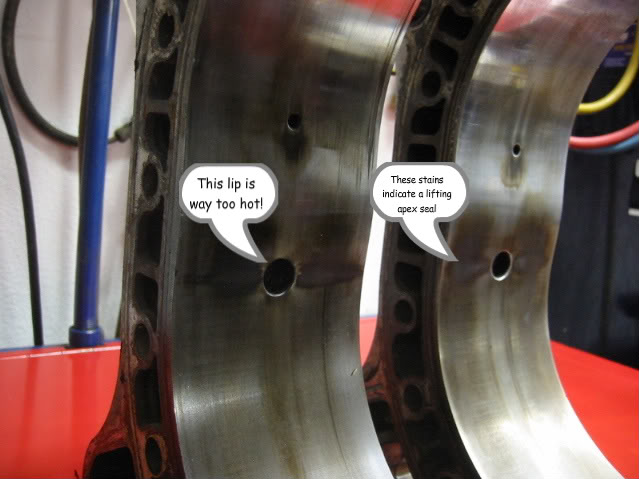
This is what my housings looked like before the cooling mod.
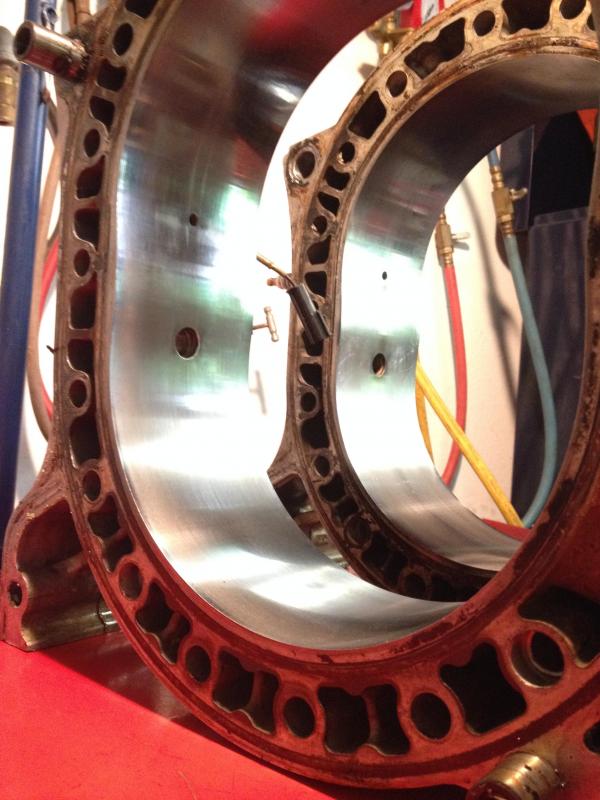
Next is a picture of both housings as removed after the cooling mod.
50k miles since installed, 100k miles since new.
I don't see any indication of "gas pressure lifting of the apex seals"
Barry
I think surface gap plugs are great... but you probably know that their gap is greater than .050" making them unsuitable for high boost.
Have you found some with a smaller gap... say .025" that might work?
Never had a problem with this myself.
Was able to light off AFRs richer than 9 at 28psi with CDI on surface gap plugs. My final tune was 26psi and AFRs didn't make it onto the widebands 10AFR minimum reading.
I went back to surface gap plugs after losing too many ground straps under detonation on standard style plugs.
Blue,
Which CDI are you using with your surface gap plugs?
Barry