


Charcoal canister removal?


Charcoal canister removal?
Hi I have a rx7 that I am rebuilding and it does not have a charcoal canister, can I delete it with no ill effects. I looked online and some people say no and some say yes, so please let me know if its removable and if so how do I go about doing it.
Thanks
Richard
Thanks
Richard


You can remove it I advise against it . Think about it like this ,the charcoal canister is design to neutralize gas fumes that escape thru the fuel tank vents . Fumes are flammable and can build up under the hood , you have wires under the hood ,wires carry electricity , electricity can cause a spark ,a spark can cause ignition of the fumes , and capooie up in flames . I suggest you keep it you can relocated somewhere under the car near the tank if your trying to make you engine bay less cluttered .


You can remove it I advise against it . Think about it like this ,the charcoal canister is design to neutralize gas fumes that escape thru the fuel tank vents . Fumes are flammable and can build up under the hood , you have wires under the hood ,wires carry electricity , electricity can cause a spark ,a spark can cause ignition of the fumes , and capooie up in flames . I suggest you keep it you can relocated somewhere under the car near the tank if your trying to make you engine bay less cluttered .
As you have read, you can delete with one ill side effect, you will smell fuel most of the time. What I did, and most do, was left the canister vented (disconnect the 3rd hardline that runs to the engine bay) which leaves you with another fuel supply line.


Didn't realize the canister was under the car on the FD . But with that said then why remove it? Is there something wrong with it? And sure fumes dissipate rather quickly while moving but how about while sitting in a closed garage for weeks at a time. Fumes can builds up. Sure it's unlikely that it will catch fire and burn chances could be like 1 in a 1,000,000 hell maybe 1 in 1,000,000,000 but do you want to be that 1. Plus the canister is there to help control emissions and help the environment. You should keep it so that I don't feel bad about not having any emission controlling devices on my car . It helps me sleep better at night knowing others do.


The charcoal canister does not "neutralize" the fumes and smell. It stores the vapor, until the ecu decides to activate the vent solenoid, then the vapor is pulled into the intake and consumed by the engine.
If you leave the charcoal canister in place, and have it disconnected/venting to open air back by the fuel tank, you will still smell the fuel evaporation from the tank. Especially parked in the garage.
If you leave the charcoal canister in place, and have it disconnected/venting to open air back by the fuel tank, you will still smell the fuel evaporation from the tank. Especially parked in the garage.


Trending Topics


I safely removed mine when I converted its output line to a fuel return line, and used the stock fuel return line as a secondary fuel supply line.
Just remove the 2 hoses from the tank and push the input rubber hose up into a chassis hole. This allows vapor to still exit but under the rear of the car where it is safe.
Heynorman did not fully analyze the system.
Just remove the 2 hoses from the tank and push the input rubber hose up into a chassis hole. This allows vapor to still exit but under the rear of the car where it is safe.
Heynorman did not fully analyze the system.
The charcoal canister does not "neutralize" the fumes and smell. It stores the vapor, until the ecu decides to activate the vent solenoid, then the vapor is pulled into the intake and consumed by the engine. If you leave the charcoal canister in place, and have it disconnected/venting to open air back by the fuel tank, you will still smell the fuel evaporation from the tank. Especially parked in the garage.

I read something interesting while researching this subject, but I doubt I could find it again. Someone who lived in hot Arizona was saying that when he leaves the car parked in the garage(hot inside) he would get really bad gas smell. And he noticed when he didn't drive it for a while, he was actually losing a noticeable quantity of fuel due to evaporation or vaporization whichever you prefer. Over a period of a couple months he was losing a significant amount, like a gallon or more if I remember correctly.
I'm not sure how accurate his information is, but he did state that this problem didn't happen at all until he did the evap system delete.
I decided to deal with this issue by relocating the vent solenoid to the fuel filler neck location, connected to the tank vent hose, charcoal canister removed. The solenoid will simply be switched on with ignition power so it can vent while driving around and be a sealed system when the car is off. Maybe it will work out, maybe not.
I'm not sure how accurate his information is, but he did state that this problem didn't happen at all until he did the evap system delete.
I decided to deal with this issue by relocating the vent solenoid to the fuel filler neck location, connected to the tank vent hose, charcoal canister removed. The solenoid will simply be switched on with ignition power so it can vent while driving around and be a sealed system when the car is off. Maybe it will work out, maybe not.
Interesting info, BTW I dropped fuel tank today because it has to be cleaned, I did not see a charcoal canister any where. Can anyone confirm were it exactely is also what would you use to clean fuel tank, it does not look very russty but it have a yellow powder substance on every thing not to mention the dust.
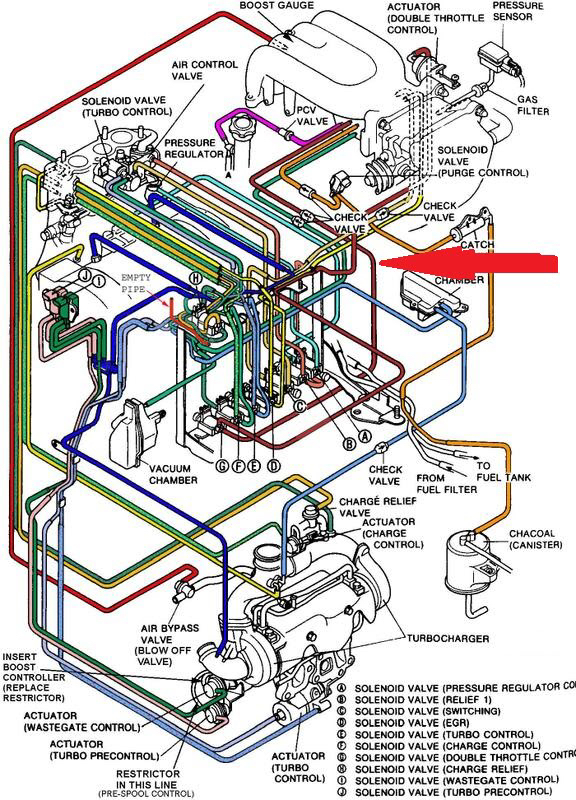
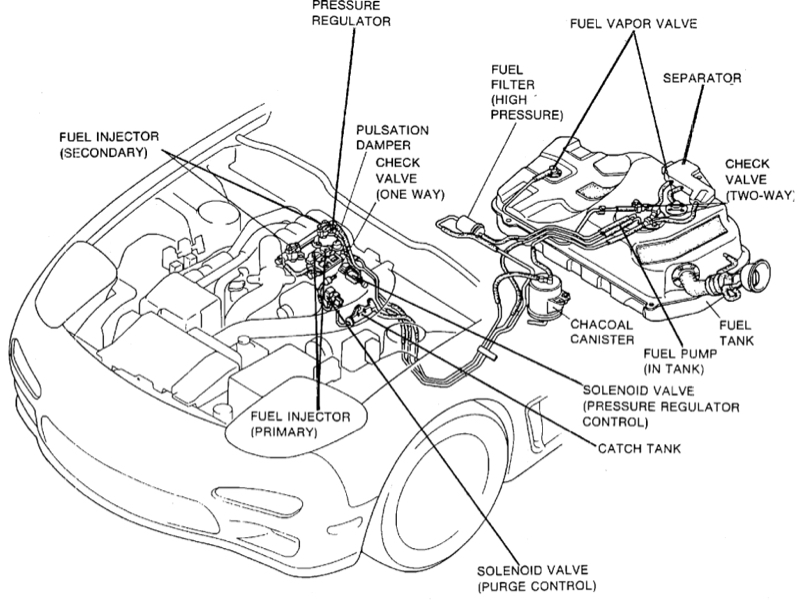
I found to separate diagrams one look to show it in the engine bay other shows it right in front of the fuel tank . Follow the lines you disconnected one of them has to lead to it. Attachment 568482
Attachment 568483
Attachment 568483

Thread
Thread Starter
Forum
Replies
Last Post
scrapmetaljoe
New Member RX-7 Technical
6
Nov 6, 2015 05:48 PM