


5W30 Oil In RX7, Will This Cause Any Damage

Thread Starter
Rotary Enthusiast

Joined: Jul 2003
Posts: 823
Likes: 0
From: Toronto
5W30 Oil In RX7, Will This Cause Any Damage
Hello,
I took my car to the local garage to get a standard oil change.
I have taken it their 2 times now. The last oil change I had i told him to put 10W30, this was at the beggining of July.
This time he decided to put 5W30 into the car, it is starting to get pretty cold outside, and I was wondering if there was any benefit to put 5W30 into the car now, or should I keep using 10W30?
Also will 5W30 do any harm to my car?
I took my car to the local garage to get a standard oil change.
I have taken it their 2 times now. The last oil change I had i told him to put 10W30, this was at the beggining of July.
This time he decided to put 5W30 into the car, it is starting to get pretty cold outside, and I was wondering if there was any benefit to put 5W30 into the car now, or should I keep using 10W30?
Also will 5W30 do any harm to my car?


Senior Member

Joined: Jul 2001
Posts: 734
Likes: 1
From: Oakland, CA
5W30 is the what they usually put in for new cars and colder climates. 5W30 is thinner and a lighter weight oil. I don't know if it's good or bad for the engine. The service manual does say to use 10W30 though. *shrug*
Trending Topics

Originally Posted by wb123
No its not synthetic.
I made sure that he didnt put "synthetic".
What is the difference between 5w30 and 10w30?
Should I not be boosting with 5w30 oil in my car?
I made sure that he didnt put "synthetic".
What is the difference between 5w30 and 10w30?
Should I not be boosting with 5w30 oil in my car?
http://www.nordicgroup.us/oil.htm#Wh...Oil%20to%20Use
5W30 versus 10W30
Virtually all new passenger vehicles sold in the U.S. use either 5W30 or 10W30 oil. The difference between the two is that the 5W30 flows better when cold, so if you live in a cold climate or operate your vehicle in a cold climate during the winter months, you should use 5W30 if it is the preferred oil for your vehicle. If you live in a sub-tropical climate and don't operate your vehicle in cold climates, then 10W30 is acceptable as long as the manufacturer specifies that it is permissible to use it.
Is there a disadvantage to using an oil that flows better when cold, i.e. 5W30 versus 10W30?
Sometimes, but usually not. The crux of the issue is this: the bigger the difference between the cold oil viscosity and the hot oil viscosity, the more the volume of viscosity modifiers and the less the volume of base stock. If you are good about following the manufacturer's recommended oil change interval then stick with the 5W30 if that is the preferred oil for your vehicle, even if 10W30 is acceptable in warmer climates. Older cars may specify 10W30 only. This is because they need a little more viscosity when cold to keep a protective film on the cylinder walls. There have been instances where the larger amount of viscosity modifiers that are present in 5W30 have broken down due to excessive heat and have left carbon deposits on the valves, but this is extremely rare. The proper fix would be to reduce the excessive heat, but the workaround was to use an oil with less viscosity modifiers.
Virtually all new passenger vehicles sold in the U.S. use either 5W30 or 10W30 oil. The difference between the two is that the 5W30 flows better when cold, so if you live in a cold climate or operate your vehicle in a cold climate during the winter months, you should use 5W30 if it is the preferred oil for your vehicle. If you live in a sub-tropical climate and don't operate your vehicle in cold climates, then 10W30 is acceptable as long as the manufacturer specifies that it is permissible to use it.
Is there a disadvantage to using an oil that flows better when cold, i.e. 5W30 versus 10W30?
Sometimes, but usually not. The crux of the issue is this: the bigger the difference between the cold oil viscosity and the hot oil viscosity, the more the volume of viscosity modifiers and the less the volume of base stock. If you are good about following the manufacturer's recommended oil change interval then stick with the 5W30 if that is the preferred oil for your vehicle, even if 10W30 is acceptable in warmer climates. Older cars may specify 10W30 only. This is because they need a little more viscosity when cold to keep a protective film on the cylinder walls. There have been instances where the larger amount of viscosity modifiers that are present in 5W30 have broken down due to excessive heat and have left carbon deposits on the valves, but this is extremely rare. The proper fix would be to reduce the excessive heat, but the workaround was to use an oil with less viscosity modifiers.
Oils with two rating numbers like the one shown above are called "multi-grade" oils, and are designed to work for a wide range of temperature conditions. That's why manufacturers almost always recommend multi-grade oils for their vehicles. 5W-30 and 10W-30 are the most common weights for passenger vehicles, and 20W-50 is the most common weight for motorcycles. The number with the "W" refers to the oil's viscosity under cold or "winter" conditions. The other number refers to the oil's viscosity under warm conditions. The lower these numbers, the thinner the oil.
Lower weights can increase the fuel efficiency of your vehicle. In general, lower weights are also used in colder weather, and higher weights are used in hot climates.
Lower weights can increase the fuel efficiency of your vehicle. In general, lower weights are also used in colder weather, and higher weights are used in hot climates.

Eats, Sleeps, Dreams Rotary

Joined: May 2003
Posts: 3,639
Likes: 0
From: MIA
Originally Posted by Mahjik
Synthetic is fine.]

2/4 wheel cornering fiend
Joined: Nov 2002
Posts: 3,090
Likes: 3
From: Pasadena, CA
I would recommend going with 10W-30 or 40 in colder climates. While I don't think that using 5W-30 will grenade your engine, the engine requirements/demands of a rotary are different than a piston engine (which is what the 5W-30 was designed for-- it's an oil made to maximize fuel economy in newer cars to meet increasingly stringent EPA/DOT regs).
Thread Starter
Rotary Enthusiast
Joined: Jul 2003
Posts: 823
Likes: 0
From: Toronto
Thanks for the information.
I do notice that the oil pressure is much stronger with the 5W30 oil.
The gauge "lbs/in²" is much stronger when I am boosting now.
Is this a good thing???
I do notice that the oil pressure is much stronger with the 5W30 oil.
The gauge "lbs/in²" is much stronger when I am boosting now.
Is this a good thing???


Joined: Oct 2001
Posts: 4,772
Likes: 2
From: My 350Z Roadster kicks my RX7's butt
Just a side note: RX-8 uses 5w-20. The 5w would explain fuel economy but is the 20 for tighter tolerance? You're supposed decide what weight according to pressure but I can't remember how that works.


FD > FB > FC
Joined: Oct 2002
Posts: 3,873
Likes: 3
From: Bothell, WA
The whole deal with lighter weight oils is to reduce engine wear on startup, by building oil pressure faster.
A thinner oil will make oil pressure faster than a thicker one.
90% of all engine wear occours on startup anyway.
A thinner oil will make oil pressure faster than a thicker one.
90% of all engine wear occours on startup anyway.

Super Snuggles
Joined: Feb 2001
Posts: 10,091
Likes: 34
From: Redmond, WA
Kento, 5W-30 is not a new invention, nor is it only for new cars. It was intended for use in colder climates/temperatures where the cold viscosity of 10W or higher would put unecessary stress on the oil pump. 5W-30 will be just fine until the next oil change.
There are only two things you need to really watch where oil is concerned. 1) changing it periodically, and 2) not overheating it excessively. As you can see from the picture below of a ~275k mile LT1 lifter valley, severe overheating and neglect have nasty side effects.
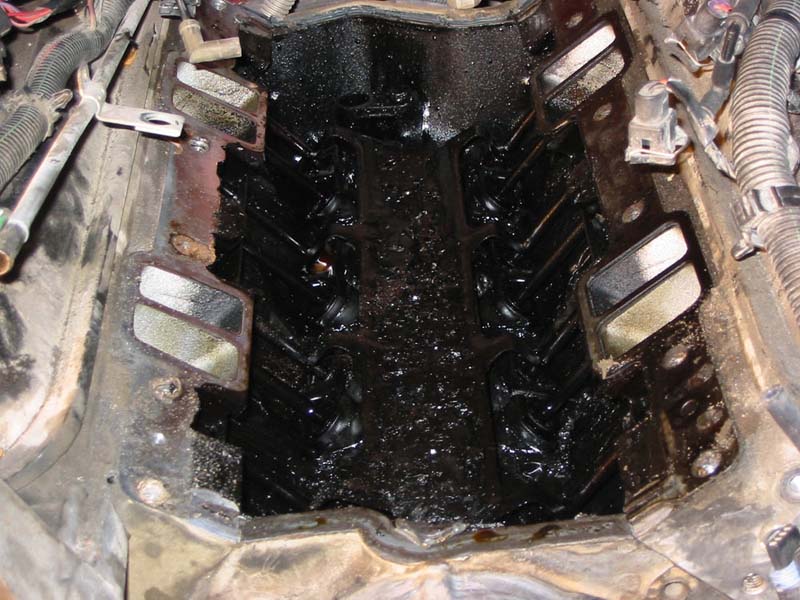
There are only two things you need to really watch where oil is concerned. 1) changing it periodically, and 2) not overheating it excessively. As you can see from the picture below of a ~275k mile LT1 lifter valley, severe overheating and neglect have nasty side effects.


Eats, Sleeps, Dreams Rotary
Joined: May 2003
Posts: 3,639
Likes: 0
From: MIA
Originally Posted by jimlab
If you think that's bad, I wonder how much horsepower this was costing them...  [/IMG]
[/IMG]
Super Snuggles
Joined: Feb 2001
Posts: 10,091
Likes: 34
From: Redmond, WA
Originally Posted by rynberg
The owner's manual only recommends 5w30 for temps below 30F. I would not use it.

Lives on the Forum
Joined: Dec 2001
Posts: 14,716
Likes: 10
From: San Lorenzo, California
Originally Posted by jimlab
Are you insinuating that the rotary engine is so fragile that it can't even handle oil of the wrong viscosity?

2/4 wheel cornering fiend
Joined: Nov 2002
Posts: 3,090
Likes: 3
From: Pasadena, CA
Originally Posted by jimlab
Kento, 5W-30 is not a new invention, nor is it only for new cars. It was intended for use in colder climates/temperatures where the cold viscosity of 10W or higher would put unecessary stress on the oil pump. 5W-30 will be just fine until the next oil change.