When you click on links to various merchants on this site and make a purchase, this can result in this site earning a commission. Affiliate programs and affiliations include, but are not limited to, the eBay Partner Network.
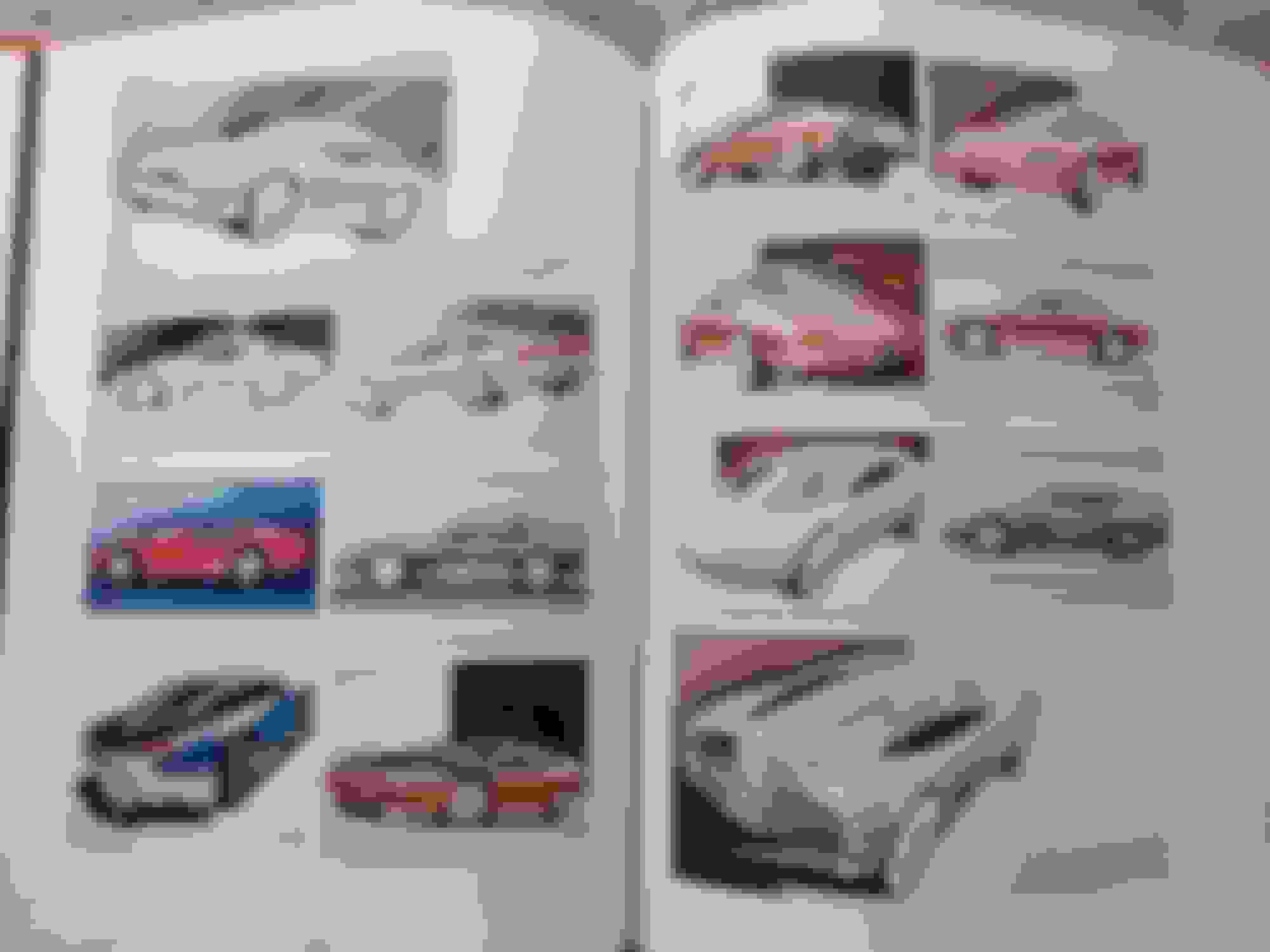
This is a scan from my copy of Jack Yamaguchi's excellent RX-7 book, and it shows the runner-up design for the FD. It is said that executives debated for hours on which design to finalize before eventually settling on the shape we all know and love, which was penned by Taiwanese stylist Wu-huang Chin at Mazda's design studio in Irvine, California. The runner-up design was from Mazda's headquarters in Hiroshima, and the short-nose, long-tail design incorporated the latest aerodynamic technology of the day.
Some of these elements were later incorporated into the final FD design, which originally had a more rounded, tapered rear end. This earlier design of the FD is pictured at the bottom right, below.
Here are a few more avant grade exterior designs that were penciled early in the design process. Mazda eventually chose eight designs to make clay models of, two from each of their major design studios.
What do you think of the runner-up design? Would you like the FD more if they had gone this direction?
First off, everyone should have a copy of the Yamaguchi book. It's SO good.
There's elements of some of the designs that later turned up in the RX-01 and some other Mazda cars (MX-3). Really hard to say since those designs are SO early, they have to go through a lot of refinement.
You can definitely see the Mazda MX-6 in some of those designs.
i used to hate those things when i worked at the dealership, but we race against one, and once you get it down to the shell its a really great looking car. the engine is quite good too, once you replace the distributor with something that doesn't fail all the time
Makes me relieved. Some of the final details added, like the double bubble roof kept it from looking like a bar of soap.
It's funny you mention the double bubble roof, as that was added later in the design process after the aero engineers found that the design of the rear was creating lift. The solution was to create a shallow valley in the surface of the roof, which supposedly accelerated the airflow over the critical area at the rear and eliminated the lift.
Another design guideline according to Yamaguchi was driver visibility - specifically, being able to see the front fenders from the driver's seat.
I read that in the final design approval they were required to widen the car, which then put it offside with certain government guidelines. I try to imagine what a thinner FD may have looked like, and how many Texans you could fit in it. Answer: None.
^ I like how the wheels look like 17s/18s and are basically flush with the fenders. Even Chin knew the stock wheels are sunken battleship status!
There was a recent Road & Track article about Wu-Huang Chin and his design of the FD. Turns out he owns a Brilliant Black '95 PEG. Here's a pic from the article:
Interesting to see what aesthetic choices the actual designer of the car made. Looks like just a set of classic looking wheels, and that's it. No tacked on body kits or giant spoilers, surprisingly. /s
Out for a walk this morning and a huge specialty car hauler pulls up in this complex. Two TVR being delivered from somewhere to someone. One was still out at dinnertime.
The TVR is the one in gunmetal grey.
Last edited by Redbul; Aug 12, 2021 at 09:09 PM.
Reason: added info.
(Seems like as decent of a place as any to include these)
A few years ago, I saw this "Concept Model" for the RX-7 at the Petersen Museum in Los Angeles. It seems like this is another step in the evolution of the FD's design, much closer to the one we know, but clearly showing differences or concept car quirks. The info card for it read as follows:
Fiberglass Shell
1993 Mazda RX-7 Concept Model
The third-generation Mazda RX-7 was powered by the most highly developed Wankel-rotary engine ever installed in a production car. Believing that such advanced engineering called for equally advanced styling, Mazda initiated an internal design competition among its studios in Hiroshima and Yokohama, Japan, and Irvine, California. This model of the winning design was created by Art Center College of Design graduate Wu-Huang Chin at the Mazda Design Center in Irvine, one of the first studios established in Southern California by a Japanese automaker.
This is a scan from my copy of Jack Yamaguchi's excellent RX-7 book
Just to add this to the connective tissue of the internet, is this the book? RX-7: The Mazda RX-7: Mazda's Legendary Sports Car (ISBN 4947659017 / 978-4947659019)?
I wondered if that design is of the narrower version before the final go-ahead mandated a wider car?
Could be, also looks like it doesn't have the double-bubble roof.
Originally Posted by B-Hydra
Just to add this to the connective tissue of the internet, is this the book? RX-7: The Mazda RX-7: Mazda's Legendary Sports Car (ISBN 4947659017 / 978-4947659019)?
Yep, that's it. Yamaguchi also wrote books on other RX generations, but that's the title and number of the one on the FD from which my pictures came.
Could be, also looks like it doesn't have the double-bubble roof.
Oddly, it also looks like it isn't the same side-to-side. The driver's side has a front fender vent and more cut lines, where the passenger side has no vent and fewer cut lines. The production version is somewhere in between the two.