


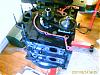
will this turbo2 iron make it


laminar flow is an old terminology that started in the days of carburetors and tumbling the air with the fuel mixture was necessary to create a better atmozide air/fuel mixture.
polishing the last 2" of air flow path i doubt is going to hurt the airflow since it already has travelled about 4 feet to get to its final resting place before ignition death.
IMO it doesn't hurt to polish the irons, that is a severe transitional stage for the air path and creating a smooth surface for the air during this transition is good to have. most of the articles on the airflow are just theories with no real proof that the documentation is true to the word so it should be taken with some criticism. also keep in mind most of those tests were done on valve/piston engines not rotary engines, there is a difference.
polishing the last 2" of air flow path i doubt is going to hurt the airflow since it already has travelled about 4 feet to get to its final resting place before ignition death.
IMO it doesn't hurt to polish the irons, that is a severe transitional stage for the air path and creating a smooth surface for the air during this transition is good to have. most of the articles on the airflow are just theories with no real proof that the documentation is true to the word so it should be taken with some criticism. also keep in mind most of those tests were done on valve/piston engines not rotary engines, there is a difference.

Originally Posted by El Nene 7
POLISHING the whole port hurts flow because you need a little turbulance ,when its smooth the air doesnt all go in fast its more like shoved in
thats just not true. turbulence slows down contained flow. period. maybe it is more helpful to look at it backwards....turbulence is caused by resistance to flow. so if you have turbulence, that means that you have done something which slows the flow down. this is not what you want.
karack is right about turbulence helping to homogenize the air/fuel charge, but in high presure fuel injection systems, it really isnt necessary, and at the engien speeds where flow is a concern, the air is moving so fast that it gets atomized anyway.
pipe flow is generally pretty intuitive...if it looks smoother and more rounded, chances are it will flow better. I dunno where you guys got the idea that polishing si bad for flow, but it simply isnt true, and it should be easy to see why.
when a fluid flows in a pipe, there is a velocity gradient in that starts at the walls and end in the center. right at the wall, the velocity of the fluid is zero, and the closer you get to the center, the faster it moves. the rougher the wall, the thicker this gradient is, which basically means that there is more volume of slow moving air.
one way to look at it is that by smoothing the surface of the pipe, you are effectively increasing the diameter, and im sure all of you would agree that a bigger diameter pipe flows more...
yes, i have. i do it to every engine i build. unfortunately, i also port them, so i cant do a before and after comparison or anything, but i am about to graduate with a dual degrees in mechanical and aerospace engineering, so my opinion has some weight behind it in areas like these...
pat
pat


Joined: Feb 2001
Posts: 29,798
Likes: 128
From: London, Ontario, Canada
Everyone has their style of porting, and it's always a bit different.  I've done engines where I've polished (mine included) and others where I have not touched the runners at all, and others where I've only smoothed slightly. Honestly I can't see any difference but it's such a hard thing to compare since some of those engines have stock ports, some street, and some bridge.
I've always subscribed to the laminar flow theory after some demos I saw at science camp years ago (and I mean years ago). Of course that was in a static situation and not a dynamic one like the rotary.
I've done engines where I've polished (mine included) and others where I have not touched the runners at all, and others where I've only smoothed slightly. Honestly I can't see any difference but it's such a hard thing to compare since some of those engines have stock ports, some street, and some bridge. I've always subscribed to the laminar flow theory after some demos I saw at science camp years ago (and I mean years ago). Of course that was in a static situation and not a dynamic one like the rotary.
and n/a vs turbo is quite different also. compare it to a vacuum vs a leaf blower, pushing air through a cylinder isn't the same as sucking it through. in turbo engines you get both sucking and pushing of air so which is really the best method to go about it? you would really have to use laminar flow across the whole intake runner length to see any real difference, same with polishing and doing that much work for minimal benefit is a waste of time.
piston guys use the laminar example so that they can charge much more for porting where the gains still would likely be less than 2HP to -2HP decrease because the last 2" in the head is going to affect the flow path very little. now porting is a different story because the port openings are the bottleneck so porting is like increasing the duration of a cam or enlarging the port on a rotary and allowing for more charge air to enter during each cycle which is good.
IMO the differences between rough and polished are probably very minimal, like less than 2HP difference as in my example.
piston guys use the laminar example so that they can charge much more for porting where the gains still would likely be less than 2HP to -2HP decrease because the last 2" in the head is going to affect the flow path very little. now porting is a different story because the port openings are the bottleneck so porting is like increasing the duration of a cam or enlarging the port on a rotary and allowing for more charge air to enter during each cycle which is good.
IMO the differences between rough and polished are probably very minimal, like less than 2HP difference as in my example.
Last edited by RotaryEvolution; Jan 21, 2007 at 12:55 PM.


Thread Starter
Rotary Enthusiast

Joined: Feb 2002
Posts: 828
Likes: 0
From: ct
well i have another iron but i probably wont polish that and i have two knew housings so ill dunp them and start fresh thanks for your help srip7 karak ,aaron,is any more tips before i button up this motor fellas
rotor housing is usable but not great. iron i cant tell at all from that pic.
i personally wouldnt bother tearing a motor down without doing at least a slight streetport, as in add about 1/8" to the top and bottom of the port, but thats just personaly preference i spose.
as far as the 2hp from polishing, like i said before, i am big on doing every 2hp mod i can, because they are generally free and relatively easy, and 10 2hp mods is really better than 1 20hp one, because usually the type of thing that gives you 2hp is something that adds efficency as well as power, which means your other mods will do more good, and you will have a better overall system. for you guys it may not be worth an hour to polish them up, but for me it totally is.
i personally wouldnt bother tearing a motor down without doing at least a slight streetport, as in add about 1/8" to the top and bottom of the port, but thats just personaly preference i spose.
as far as the 2hp from polishing, like i said before, i am big on doing every 2hp mod i can, because they are generally free and relatively easy, and 10 2hp mods is really better than 1 20hp one, because usually the type of thing that gives you 2hp is something that adds efficency as well as power, which means your other mods will do more good, and you will have a better overall system. for you guys it may not be worth an hour to polish them up, but for me it totally is.
i do polish the secondary ports but not the primaries, it just seems negligible from both sides but well i guess having one roughed and one smoothed it equals out in the end anyways.
Thread Starter
Rotary Enthusiast
Joined: Feb 2002
Posts: 828
Likes: 0
From: ct
even with that bit of wear on the edges of the housings you think there still good ,they have 120000 miles on them ,i also have some brand knew ones but if you think there still good ill give them to my buddy
Thread Starter
Rotary Enthusiast
Joined: Feb 2002
Posts: 828
Likes: 0
From: ct
housings
even with that bit of wear on the edges of the housings you think there still good ,they have 120000 miles on them ,i also have some brand knew ones but if you think there still good ill give them to my buddy,but i thought if the edges had some wear it would give low compression
nah they just take longer to break in... that little wear at the edges is really common on used housings, if its not too bad you can still reuse them
just a little note.. that intercooler in the pic looks awful close to the radiator....might want to space them out some.... having the ic almost touching a 180* radiator kinda kills the cooling effect somewhat...
just a little note.. that intercooler in the pic looks awful close to the radiator....might want to space them out some.... having the ic almost touching a 180* radiator kinda kills the cooling effect somewhat...

Thread
Thread Starter
Forum
Replies
Last Post
stickmantijuana
20B Forum
8
Aug 18, 2015 02:46 PM

