


my n/a supercharging project complete


Senior Member

Joined: Jul 2003
Posts: 416
Likes: 0
From: Wayne, NJ 07470
Originally posted by vectorminds
assuming WOT (since at any other time the bypass valve is open) and a pully set to give 5 psi of boost
then the plenum is pressurized to 20 psi... i don't see how 14.7 psi vs 20 psi will behave any differently in regard to port area.
I agree that if the boost regulator was set to decrease boost as the rpm went up to push harder at lower rpm then what you are saying would be true... but as far as I know thats not how the bypass valve works (But I may indeed be wrong... if thats how the bypass valve works than I stand corrected... but id think it would have to be tuned to each engine then?)
assuming WOT (since at any other time the bypass valve is open) and a pully set to give 5 psi of boost
then the plenum is pressurized to 20 psi... i don't see how 14.7 psi vs 20 psi will behave any differently in regard to port area.
I agree that if the boost regulator was set to decrease boost as the rpm went up to push harder at lower rpm then what you are saying would be true... but as far as I know thats not how the bypass valve works (But I may indeed be wrong... if thats how the bypass valve works than I stand corrected... but id think it would have to be tuned to each engine then?)
The ports would continue to create the increased flow rate on a roots supercharged engine and it probably wouldn't hurt.
However the roots type SC is pumping (lets say) 2cc of air avery second and the engine can take 1cc of air every second. That will make 14psi of boost. If the engine only takes in .5cc in a second, the extra air will back up in the intake manifold. Now you have 2.5cc of air in the intake manifold on the next second because the SC just dumped 2cc more into the intake manifold.
That means that the boost will suddenly rise inside the intake manifold and higher boost will push harder into the combustion chamber until the pressure drops back down to 14.
On a V8 with the blower right on top of the valves you get huge pulsations because the engine is not sucking a constant amount of air but instead 4 pulses per revolution. Meanwhile the SC is putting out a pulse of air as each lobe comes past the output port.
A pulsation of 1L is huge in a 1L manifold but that same 1L pulse is 1/5 the size in a 5L intake manifold.
I'm just saying that in a relatively small intake manifold the pulsations will automatically compensate for any lack of "suck" from the engine. You just non't need the valves on a roots supercharged rotary.
I believe ENDYN already decided the same thing for VTEC engines.
ed
Senior Member
Joined: Jul 2003
Posts: 416
Likes: 0
From: Wayne, NJ 07470
True, the Eaton blower pulses less and a rotary engine has smoother intake so the size of the pulses can be much smaller but any time the engine fails to take air in, you get an automatic rise in pressure to compensate.






Newbie
Joined: Feb 2002
Posts: 4
Likes: 0
From: Hong Kong
Originally posted by bladz311
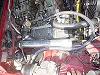
Thats awesome!!! I love those superchargers, because of the price. We just finished a similar project with an Eaton M90. We extended the shaft section to go in front of the engine on my friend's Probe GT (because of it being fwd). It builds 7-8 psi also. Did you use a rising rate fpr or fmu? We used a Vortech FMU to bump the fuel pressure up when there is boost present. The piping is very very tight for the intercooler. Here's a pic of our setup. The engine bay is very dirty in the pic. It was the first time we had the car started. I know it dosen't look like it, but the rad hose clears the pulley (only by like 1/2 an inch, but it clears, haha).

Thats awesome!!! I love those superchargers, because of the price. We just finished a similar project with an Eaton M90. We extended the shaft section to go in front of the engine on my friend's Probe GT (because of it being fwd). It builds 7-8 psi also. Did you use a rising rate fpr or fmu? We used a Vortech FMU to bump the fuel pressure up when there is boost present. The piping is very very tight for the intercooler. Here's a pic of our setup. The engine bay is very dirty in the pic. It was the first time we had the car started. I know it dosen't look like it, but the rad hose clears the pulley (only by like 1/2 an inch, but it clears, haha).
 I want one



Originally posted by EG6
Wow, nice work. How did you extend the shaft? Wouldn't it cause more vibration when the shaft is so long?
Wow, nice work. How did you extend the shaft? Wouldn't it cause more vibration when the shaft is so long?

Newbie
Joined: May 2004
Posts: 1
Likes: 0
From: Columbus
so I don't own an RX7 but ...
Hey guys -- I figured I'd make a post and spell a few things about the eatons, what cars to look for and yes, there's even different and better ones.
For one, ALL thunderbirds from 89 to 95 that were the supercoupe (easy to spot, body kit factory) had an eaton and an intercooler. (some where saying some of them did, some didn't, etc etc etc. Supercoupe = blown = eaton m90, intercooler, special block, intake, heads, crank) The cougar XR7 had one from 89 to 90, exact same setup. However, the 94/95 supercoupes had a better m90 slapped on to it, so if you can swing it, there you go.
Now if you REALLY want to get serious, there's a couple companies out there that will rebuild and port the **** out of your m90. Check this site here. http://www.magnumpowers.com/tbrd_blwr_ser.html
http://www.supercoupeperformance.com
With a blower in good condition and the stock pulley will produce around 13psi of boost which is rather high for a car off the showroom floor. You might want to find a good pulley that'll hold the belt. I saw that little pulley the guy here used -- no way in hell that thing is going to hold -- he'll get mad belt slipage if he goes anywhere over 7. Some of "us" get slipage at 15psi, it'll burn the belt (you can smell it in the car). So a thick belt is always a good idea.
As for upkeep on the eaton, a lot of people commented that they're easy to take care of -- that is right, there's no oil tap BS to do, BUT you still need to change the oil in the m90 every so often (10k miles works just fine) and you can get the oil from plenty of places. The thing that fail the most on the eatons is the bearings at the back of the impellers and the bearing in the nose cone (causes a rattle), nose cone is most common problem.
So how can you tell one from the other when you're in the junk yard...
This is a 89/90 Cougar XR7, note no body kit, but the 7 spoke rims are a good indication.

This is a 89/93 thunderbird, easy way to tell its an SC is the factory body kit.

now a 94/95 is a little harder to find (NOT many were made) The front will tell one way or the other

If you really want to know anything and everything about the SC, ask over on SCCOA or TCCOA. A lot of good people on there that'd be more than happy to answer ....everything.
Hopes this helps.
For one, ALL thunderbirds from 89 to 95 that were the supercoupe (easy to spot, body kit factory) had an eaton and an intercooler. (some where saying some of them did, some didn't, etc etc etc. Supercoupe = blown = eaton m90, intercooler, special block, intake, heads, crank) The cougar XR7 had one from 89 to 90, exact same setup. However, the 94/95 supercoupes had a better m90 slapped on to it, so if you can swing it, there you go.
Now if you REALLY want to get serious, there's a couple companies out there that will rebuild and port the **** out of your m90. Check this site here. http://www.magnumpowers.com/tbrd_blwr_ser.html
http://www.supercoupeperformance.com
With a blower in good condition and the stock pulley will produce around 13psi of boost which is rather high for a car off the showroom floor. You might want to find a good pulley that'll hold the belt. I saw that little pulley the guy here used -- no way in hell that thing is going to hold -- he'll get mad belt slipage if he goes anywhere over 7. Some of "us" get slipage at 15psi, it'll burn the belt (you can smell it in the car). So a thick belt is always a good idea.
As for upkeep on the eaton, a lot of people commented that they're easy to take care of -- that is right, there's no oil tap BS to do, BUT you still need to change the oil in the m90 every so often (10k miles works just fine) and you can get the oil from plenty of places. The thing that fail the most on the eatons is the bearings at the back of the impellers and the bearing in the nose cone (causes a rattle), nose cone is most common problem.
So how can you tell one from the other when you're in the junk yard...
This is a 89/90 Cougar XR7, note no body kit, but the 7 spoke rims are a good indication.
This is a 89/93 thunderbird, easy way to tell its an SC is the factory body kit.
now a 94/95 is a little harder to find (NOT many were made) The front will tell one way or the other
If you really want to know anything and everything about the SC, ask over on SCCOA or TCCOA. A lot of good people on there that'd be more than happy to answer ....everything.
Hopes this helps.




a.k.a. Mike

Joined: May 2004
Posts: 250
Likes: 0
From: new mexico
I heard from someone that you cant run forced induction on n/a engines but i have a safc on my 88 gxl and i was wondering if you or someone can give me ther honest opion on this matter cause if i can Im there. that is a really nice setup on that rx by the way.


Mountain Rotary Mod
Joined: Nov 2003
Posts: 2,411
Likes: 0
From: Freaking Poland!!
Scathcar is the NO2 king here on the forum, search for number of his posts. NO2 can be run on rotary engines. And there is no "correct" pulley for this setup. zbrown calculated a 3 inch pulley on the SC, i don't know the math so you'll have to find someone who does.

Rotary Enthusiast
Joined: Oct 2001
Posts: 898
Likes: 0
From: T.O
ok.. its been a while since I had some time to look this thread over. QUESTION: would the M-62 work on a 13b N/A?
the m90 flows 1.5L/rev and max rpm for the SC is 12000.. and it also flows a max of 520-540 CFM.
the m62 flows 1L/rev and max rpm is 14,000 and flows a max of 440-460CFM.
the m62's came on pontiac gtp's .. bonneville SSEi's, olds LSS's and Park Ave Ultra's. The GTP makes 240hp. So.. if an M62 can provide enough air to not starve that 3.8L GTP engine.. I am assuming that it will work on the 13B. I would like to reasonably make about 240-250 hp.
the m90 flows 1.5L/rev and max rpm for the SC is 12000.. and it also flows a max of 520-540 CFM.
the m62 flows 1L/rev and max rpm is 14,000 and flows a max of 440-460CFM.
the m62's came on pontiac gtp's .. bonneville SSEi's, olds LSS's and Park Ave Ultra's. The GTP makes 240hp. So.. if an M62 can provide enough air to not starve that 3.8L GTP engine.. I am assuming that it will work on the 13B. I would like to reasonably make about 240-250 hp.