


My attempt at Battery Relocation. Advice please?


Thread Starter
Goes *round*round*round*

Joined: Apr 2003
Posts: 718
Likes: 0
From: San Antonio
My attempt at Battery Relocation. Advice please?
I'm pretty sure I got it hooked up right but I didn't get any power after getting everyting hooked up and bolted down. Can anyone see any problems with the way I did it? The circle/slash is where I connected the original positive directly to the new positive.
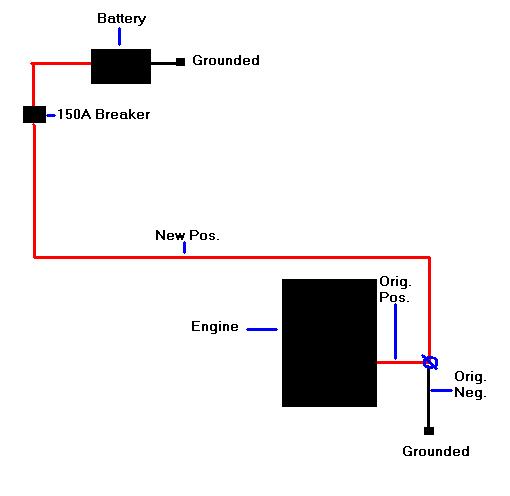
I did read the other Battery Relocation threads, and I thought I got this right, but maybe I missed something.
I did read the other Battery Relocation threads, and I thought I got this right, but maybe I missed something.




On the fasttrack!
iTrader: (22)
Joined: Oct 2006
Posts: 2,494
Likes: 2
From: virginia beach, virginia
MECP cert tech about to happen.
IF you run a new battery, use 4 guage. although it might be overkill, but deff worth it. a 100A breaker, diode, or even a fuse would be sufficiant.
um, use 4 all around, both + and -. use heavy duty connecters too.
that should be all you need.
im soo used to doing a battery relocate WITH aftermarket systems. wow, simplicity for once.
btw, can someone pm me about how to reconnect my speedo cable.
peace
IF you run a new battery, use 4 guage. although it might be overkill, but deff worth it. a 100A breaker, diode, or even a fuse would be sufficiant.
um, use 4 all around, both + and -. use heavy duty connecters too.
that should be all you need.
im soo used to doing a battery relocate WITH aftermarket systems. wow, simplicity for once.
btw, can someone pm me about how to reconnect my speedo cable.
peace
Trending Topics


Lives on the Forum

Joined: Feb 2001
Posts: 26,664
Likes: 22
From: n
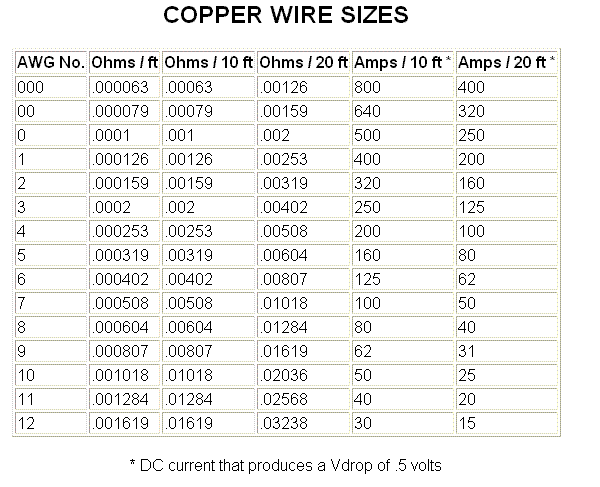
2AWG and 150A minimum breaker...better to use a 200A if you can find one.
I can pop the 150A breaker with just 3 to 4 tries on the starter.
I can't imagine how fast a 100A breaker will trip!
Please people, stop spreading bad info...
-Ted
I can pop the 150A breaker with just 3 to 4 tries on the starter.
I can't imagine how fast a 100A breaker will trip!
Please people, stop spreading bad info...
-Ted
Banned. I got OWNED!!!
Joined: Mar 2006
Posts: 1,970
Likes: 1
From: Connecticut
Thicker the better.
I agree with RETed, people need to stop spreading bad info especially when someone who just wants to increase the size of his internet dick can cost someone else their car. 2 should be the minimum, people run thicker cable for thier stereo's! 4 ga, maybe for a stock alternator.
oh, fwiw, I always use Marine Cable, thinner, tinned copper, more flexible, but the tinning causes resistance so it generally needs to be bumped a size.
I agree with RETed, people need to stop spreading bad info especially when someone who just wants to increase the size of his internet dick can cost someone else their car. 2 should be the minimum, people run thicker cable for thier stereo's! 4 ga, maybe for a stock alternator.
oh, fwiw, I always use Marine Cable, thinner, tinned copper, more flexible, but the tinning causes resistance so it generally needs to be bumped a size.


I out a 100amp breaker in mine at first. It never poped, but would only give 2-3 cracks and just plain shut down. A minute later, juice biult up. I chasses this for a couple days, before figuring it out. Use a 200amp.

Joined: Feb 2001
Posts: 29,798
Likes: 128
From: London, Ontario, Canada
I've always used 150A Bussman breakers and 4 AWG cable, but I would certainly recommend using 2 AWG if you have it. 4 seems to work fine and I see no voltage drop but 2 AWG is what is generally recommended.
I've never tripped a 150A breaker under cranking, even long starter-killing cranking sessions to deflood or start a car on a fresh engine and untuned standalone. That said, going to 200A is not going to hurt but 200A units can be hard to find locally.
What is an MECP cert?
Exactly what is a diode going to do in the event of a short?
Fuses suck because if you blow one at the side of the road (ie. during deflooding) then you're basically hosed. You better have an extra otherwise you are stuck or you must bypass (dangerous). 150A+ DC rated fuses are also not a common item to find in most electrical stores.
I've never tripped a 150A breaker under cranking, even long starter-killing cranking sessions to deflood or start a car on a fresh engine and untuned standalone. That said, going to 200A is not going to hurt but 200A units can be hard to find locally.
Originally Posted by magus2222
MECP cert tech about to happen.
IF you run a new battery, use 4 guage. although it might be overkill, but deff worth it. a 100A breaker, diode, or even a fuse would be sufficiant.
IF you run a new battery, use 4 guage. although it might be overkill, but deff worth it. a 100A breaker, diode, or even a fuse would be sufficiant.
Exactly what is a diode going to do in the event of a short?
Fuses suck because if you blow one at the side of the road (ie. during deflooding) then you're basically hosed. You better have an extra otherwise you are stuck or you must bypass (dangerous). 150A+ DC rated fuses are also not a common item to find in most electrical stores.


Thread Starter
Goes *round*round*round*
Joined: Apr 2003
Posts: 718
Likes: 0
From: San Antonio
Found my problem. My new ground wasn't as "grounded" as it could've been.  It's now working like a champ.
Yeah, I picked up Bussman 150A breaker, like Aaron suggested, at Advanced Autoparts.
It's now working like a champ. Yeah, I picked up Bussman 150A breaker, like Aaron suggested, at Advanced Autoparts.
Banned. I got OWNED!!!
Joined: Mar 2006
Posts: 1,970
Likes: 1
From: Connecticut
Originally Posted by Aaron Cake
I've always used 150A Bussman breakers and 4 AWG cable, but I would certainly recommend using 2 AWG if you have it. 4 seems to work fine and I see no voltage drop but 2 AWG is what is generally recommended.
I've never tripped a 150A breaker under cranking, even long starter-killing cranking sessions to deflood or start a car on a fresh engine and untuned standalone. That said, going to 200A is not going to hurt but 200A units can be hard to find locally.
What is an MECP cert?
Exactly what is a diode going to do in the event of a short?
Fuses suck because if you blow one at the side of the road (ie. during deflooding) then you're basically hosed. You better have an extra otherwise you are stuck or you must bypass (dangerous). 150A+ DC rated fuses are also not a common item to find in most electrical stores.
I've never tripped a 150A breaker under cranking, even long starter-killing cranking sessions to deflood or start a car on a fresh engine and untuned standalone. That said, going to 200A is not going to hurt but 200A units can be hard to find locally.
What is an MECP cert?
Exactly what is a diode going to do in the event of a short?
Fuses suck because if you blow one at the side of the road (ie. during deflooding) then you're basically hosed. You better have an extra otherwise you are stuck or you must bypass (dangerous). 150A+ DC rated fuses are also not a common item to find in most electrical stores.
In MY opinion, just a guy who's wired up a hole crap-load of boats, 200A is too much. Let me explain, A starter will only take as much juice as it needs, it doesn't need 200A. Infact, it needs roughly 1/2 that. By adding a 200A breaker, you are not adding in any saftey, you are actually making it more dangerous. Now you have 100% more current than a 100A and 33% more current than the 150A breaker that can potentially short out. In addition, 4 ga becomes silly. 1ga would be good for 200A Think about if you have a short on the starter thats pulling 199A, your breaker won't pop, but your 4ga will melt and possible cause a fire.
Aaron makes another reeally good point with the hole breaker vs fuse thing. You're srewed it that 150A fuse blows. If the breaker pops, you open the storage bin (where mine is anyway) and flip the breaker and problem solved.
My shameless use marine grade stuff plug. twice as expensive 10 as nice as the Autobone wire.... Here's my setup btw...... all marine, all breaker, all the time
 Oh, I also have a wholesale acct so I'm naturally biased
Arron MECP stands for Mobile Electronics Certified Professional. (I.E. Somewhat like an ASE certification)
Most decent mobile electronics shops will not hire anyone without this certification. It has been around since 1991. There are different levels of certification, just like with the ASE certifications.
Most decent mobile electronics shops will not hire anyone without this certification. It has been around since 1991. There are different levels of certification, just like with the ASE certifications.
Joined: Feb 2001
Posts: 29,798
Likes: 128
From: London, Ontario, Canada
Originally Posted by TitaniumTT
Aaron makes some very good points. Diode? No, diode won't do anything nor have I ever seen a Diode that would take 150 A let alone the fact that its useless.
 Still useless in this application though.
In MY opinion, just a guy who's wired up a hole crap-load of boats, 200A is too much. Let me explain, A starter will only take as much juice as it needs, it doesn't need 200A. Infact, it needs roughly 1/2 that.
By adding a 200A breaker, you are not adding in any saftey, you are actually making it more dangerous. Now you have 100% more current than a 100A and 33% more current than the 150A breaker that can potentially short out.
The datasheets for the Bussman breakers contain a chart showing the amount of time vs. overload needed to trip the breaker. At 200A on the 150A unit, it's something like 10 seconds. If the short is 400A, it's closer to 2 seconds.
In addition, 4 ga becomes silly. 1ga would be good for 200A Think about if you have a short on the starter thats pulling 199A, your breaker won't pop, but your 4ga will melt and possible cause a fire.
Aaron makes another reeally good point with the hole breaker vs fuse thing. You're srewed it that 150A fuse blows. If the breaker pops, you open the storage bin (where mine is anyway) and flip the breaker and problem solved.
My shameless use marine grade stuff plug. twice as expensive 10 as nice as the Autobone wire.... Here's my setup btw...... all marine, all breaker, all the time Oh, I also have a wholesale acct so I'm naturally biased
Oh, I also have a wholesale acct so I'm naturally biased
Originally Posted by turboefini88
Arron MECP stands for Mobile Electronics Certified Professional. (I.E. Somewhat like an ASE certification)
Most decent mobile electronics shops will not hire anyone without this certification. It has been around since 1991. There are different levels of certification, just like with the ASE certifications.
Most decent mobile electronics shops will not hire anyone without this certification. It has been around since 1991. There are different levels of certification, just like with the ASE certifications.
LoL, Aaron. I didnt say they said the holder of said paper was an EXPERT, they just mean they passed the test. I know guys that are ASE Master techs and they always grab me for engine performance diag and electrical diag.
I didnt say they said the holder of said paper was an EXPERT, they just mean they passed the test. I know guys that are ASE Master techs and they always grab me for engine performance diag and electrical diag.

Originally Posted by Aaron Cake
Exactly. And it makes a great security feature as well. Instantly kill the power to the car when you are parked in a questionable area. If you bypass the breaker with a low value fuse (5A) then you won't loose your clock and radio settings.
Lives on the Forum
Joined: Feb 2001
Posts: 26,664
Likes: 22
From: n
Originally Posted by TitaniumTT
In MY opinion, just a guy who's wired up a hole crap-load of boats, 200A is too much. Let me explain, A starter will only take as much juice as it needs, it doesn't need 200A. Infact, it needs roughly 1/2 that. By adding a 200A breaker, you are not adding in any saftey, you are actually making it more dangerous. Now you have 100% more current than a 100A and 33% more current than the 150A breaker that can potentially short out. In addition, 4 ga becomes silly. 1ga would be good for 200A Think about if you have a short on the starter thats pulling 199A, your breaker won't pop, but your 4ga will melt and possible cause a fire.
Your opinion is outright dangerous and downright wrong.
-Ted
Last edited by Aaron Cake; Apr 15, 2007 at 10:30 AM. Reason: Remove insult
Banned. I got OWNED!!!
Joined: Mar 2006
Posts: 1,970
Likes: 1
From: Connecticut
I've re-read that post, I can't find it with the exception of unlikely 199A short. But, if you did run 199A through a long enough stretch of 4ga for long enough, bad things would happen and that's the whole point of breakers and fuses. Make sure bad things don't happen.
I had 100A breaker before I upped to the FD alt, strange, never popped once.
2nd, go look at the ratings for X gauge wire vs length in the West Marine Catalog. 4ga is nowhere near adequate for the ~15' run. 2ga, better would be 1 ga from memory. Every strand is tinned. Tinning creates resistance, resistance creates heat, heat creates resistance and so on. I said marine cable, not automotive cable. Welding cable is the same. Pure copper. Marine cable is tinned. 2 different wires, two different ratings. Marine has MUCH more resistance/ft, but is much less suceptable to corrosion.
Further, in the workboat that I rewired, we have a winch for hauling moorings, I set that up with 2/0, 150A solenoid, & a 150A breaker as it was recomended to me by the windlass manufacturer. Keep in mind this is a CONSTANT duty electric motor ~12" in diameter big som' bitch. Breaker has popped ONCE and that was when a 1000lb'er was stuck in the mud, burried the transom of the boat, and stalled out the motor.
You want to tell me I don't know anything about hauling moorings, call me a ******* idiot and tell me that my actions were dangerous there too?
FWIW - If I know nothing about DC, than niether does the USCG, 3 of the boats I re-wired are launches and subject to an annual Coast Gaurd inspection. All three passed & you want to talk about scrutiny, damn....
I had 100A breaker before I upped to the FD alt, strange, never popped once.
2nd, go look at the ratings for X gauge wire vs length in the West Marine Catalog. 4ga is nowhere near adequate for the ~15' run. 2ga, better would be 1 ga from memory. Every strand is tinned. Tinning creates resistance, resistance creates heat, heat creates resistance and so on. I said marine cable, not automotive cable. Welding cable is the same. Pure copper. Marine cable is tinned. 2 different wires, two different ratings. Marine has MUCH more resistance/ft, but is much less suceptable to corrosion.
Further, in the workboat that I rewired, we have a winch for hauling moorings, I set that up with 2/0, 150A solenoid, & a 150A breaker as it was recomended to me by the windlass manufacturer. Keep in mind this is a CONSTANT duty electric motor ~12" in diameter big som' bitch. Breaker has popped ONCE and that was when a 1000lb'er was stuck in the mud, burried the transom of the boat, and stalled out the motor.
You want to tell me I don't know anything about hauling moorings, call me a ******* idiot and tell me that my actions were dangerous there too?
FWIW - If I know nothing about DC, than niether does the USCG, 3 of the boats I re-wired are launches and subject to an annual Coast Gaurd inspection. All three passed & you want to talk about scrutiny, damn....
Last edited by Aaron Cake; Apr 15, 2007 at 10:31 AM. Reason: Remove reference to insult

Senior Member

Joined: Apr 2004
Posts: 453
Likes: 0
From: South Jordan UT
I ran a 150 amp breaker with 2 ga. wire on both 7's and have never blown the breaker yet, even cranking the ever unpopular V-8. Go both like Ted and Aaron said. I also used connectors that solder on with shrink tubing around the connectors for corrosion protection. Just a thought that I didn't see yet.