


Griffin Race Radiator


Griffin Race Radiator
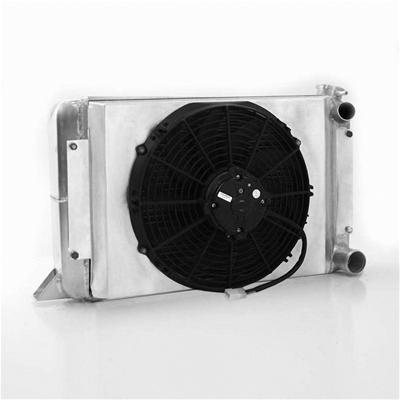
I just wanted to get peoples thoughts of this radiator. I am considering using it for a Custom v-mount set up. I thought it was cool because it has the correct inlet and outlet set up. Its dual core, and crossflow dual pass. comes with a fan and prefitted shoroud. The only thing that would cause me concern is that the height went from a stock 19" or so down to 13". and the fan it comes with flows about 1600 cfm.
costwise, its about the same as getting most other aluminum radiators and fan combo's.
The other benefit i see is due to its size, you could get more a better angle going on the V for a v mount, or horizontal mount for both rad and i/c .
Summit Racing Link
Radiator Style: Crossflow
Overall Width (in): 22.000 in.
Overall Height (in): 13.000 in.
Overall Thickness (in): 3.000 in.
Row Quantity: Dual-row
Radiator Finish: Natural
Radiator Material: Aluminum
Transmission Cooler: No
Inlet Location: Upper passenger side
Inlet Size: 1 1/2 in.
Outlet Location: Lower passenger side
Outlet Size: 1 3/4 in.
Core Height (in): 12.610 in.
Core Thickness (in): 2.500 in.
Core Width (in): 17.000 in.
Tube Size: 1 1/4 in.
Fan Diameter (in): 12.000 in.
Fan Included: Yes
Fan Quantity: Single
Maximum Fan CFM: 1,630 cfm
Blade Color: Black
Blade Material: Plastic
Shroud Color: Polished
Shroud Material: Aluminum
Quantity: Sold as a kit.
Notes: Includes filler neck.
costwise, its about the same as getting most other aluminum radiators and fan combo's.
The other benefit i see is due to its size, you could get more a better angle going on the V for a v mount, or horizontal mount for both rad and i/c .
Summit Racing Link
Radiator Style: Crossflow
Overall Width (in): 22.000 in.
Overall Height (in): 13.000 in.
Overall Thickness (in): 3.000 in.
Row Quantity: Dual-row
Radiator Finish: Natural
Radiator Material: Aluminum
Transmission Cooler: No
Inlet Location: Upper passenger side
Inlet Size: 1 1/2 in.
Outlet Location: Lower passenger side
Outlet Size: 1 3/4 in.
Core Height (in): 12.610 in.
Core Thickness (in): 2.500 in.
Core Width (in): 17.000 in.
Tube Size: 1 1/4 in.
Fan Diameter (in): 12.000 in.
Fan Included: Yes
Fan Quantity: Single
Maximum Fan CFM: 1,630 cfm
Blade Color: Black
Blade Material: Plastic
Shroud Color: Polished
Shroud Material: Aluminum
Quantity: Sold as a kit.
Notes: Includes filler neck.

Rotorhead

Joined: Feb 2001
Posts: 9,136
Likes: 39
From: Charlottesville, Virginia, USA
Griffin makes custom radiators. Just design your own.
http://griffinrad.com/
http://griffinrad.com/

Lives on the Forum

Joined: Feb 2001
Posts: 26,664
Likes: 23
From: n
Why would you want to go smaller cross-sectional area?
If it's for street use, I doubt you'd see a difference.
Get this thing on the track, and you're going to roast it.
I dunno what "crossflow dual pass" means, but they are usually mutually exclusive (crossflow versus "dual pass").
The description you cut&paste only mentions "crossflow", so where did you get "dual pass" from?
Clicking the link, the description explicitly says it's for "drag" use...
-Ted
If it's for street use, I doubt you'd see a difference.
Get this thing on the track, and you're going to roast it.
I dunno what "crossflow dual pass" means, but they are usually mutually exclusive (crossflow versus "dual pass").
The description you cut&paste only mentions "crossflow", so where did you get "dual pass" from?
Clicking the link, the description explicitly says it's for "drag" use...
-Ted
Why would you want to go smaller cross-sectional area?
If it's for street use, I doubt you'd see a difference.
Get this thing on the track, and you're going to roast it.
I dunno what "crossflow dual pass" means, but they are usually mutually exclusive (crossflow versus "dual pass").
The description you cut&paste only mentions "crossflow", so where did you get "dual pass" from?
Clicking the link, the description explicitly says it's for "drag" use...
-Ted
If it's for street use, I doubt you'd see a difference.
Get this thing on the track, and you're going to roast it.
I dunno what "crossflow dual pass" means, but they are usually mutually exclusive (crossflow versus "dual pass").
The description you cut&paste only mentions "crossflow", so where did you get "dual pass" from?
Clicking the link, the description explicitly says it's for "drag" use...
-Ted
Pretty much makes a u turn in the radiator vs one way. Coolant spends more time in the radiator to dissapate heat, yada yada. If you look at Koyo's new radiators, they are tripple pass. Its called "N" flow.
I do see your point about it being for drag race. maybe i'll give griffin a call, they should be able to provide more specifics.
***edit
did some more paraousing online. I guess its not "crossflow" but "scirocco style" and by definition it is dual pass. If not, all the liquid would just flow from one inlet to the to the exit through the tank. The tanks are baffled so that the coolant is flowed properly.
Last edited by huee; Oct 31, 2007 at 11:41 PM.


Lives on the Forum
Joined: Feb 2001
Posts: 26,664
Likes: 23
From: n
When I was researching radiators, "crossflow" meant single-pass or coolant flowing across the radiator core only in one direction; "dual pass" meant doubling back on itself.
It's funny that Summit Racing has it described as a "crossflow", when it's clearly a "dual pass".
Go figure.
Koyo N-flow is just a "triple pass" radiator core design...
$539 is actually not a bad price...
$200 minimum for the radiator itself...
$150 for the 12" electric fan...
It also has a shroud that's integrated into the design, so you need to factor that into the price.
-Ted
It's funny that Summit Racing has it described as a "crossflow", when it's clearly a "dual pass".
Go figure.
Koyo N-flow is just a "triple pass" radiator core design...
$539 is actually not a bad price...
$200 minimum for the radiator itself...
$150 for the 12" electric fan...
It also has a shroud that's integrated into the design, so you need to factor that into the price.
-Ted

Lives on the Forum
Joined: Sep 2003
Posts: 5,707
Likes: 6
From: BC, Canada
The two aren't mutually exclusive. Maybe some people use them as such but that's not really correct.
Crossflow only describes the direction of flow and dual pass only describes the number of times the fluid flows across the core, together they supply the entire description. If you think about what the words are actually saying there's nothing that says that they can't be used together, nothing that says that crossflow means only once.
Crossflow only describes the direction of flow and dual pass only describes the number of times the fluid flows across the core, together they supply the entire description. If you think about what the words are actually saying there's nothing that says that they can't be used together, nothing that says that crossflow means only once.
Trending Topics
Rotorhead
Joined: Feb 2001
Posts: 9,136
Likes: 39
From: Charlottesville, Virginia, USA
Crossflow means the end tanks are on the sides of the core, and the coolant flows across the core. It is the opposite of the Downflow type in which the end tanks are on the top and bottom of the core, and the coolant flows from top to bottom.

Thread
Thread Starter
Forum
Replies
Last Post
rx8volks
Canadian Forum
0
Sep 1, 2015 10:46 PM
