


20b oil route


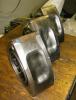
some people are saying that one hole is inlet & the other is outlet... i'm little confused. another reliable source also told me that one hole goes to oil pressure regulator & the other one goes to the engine, meaning they're both inlets to the engine. any inputs are very appreciated. thanks!

Joined: May 2001
Posts: 2,390
Likes: 2
From: San Francisco, CA
As you have it shown, those oil coolers are run in series i.e., through one and then through the other.
To be more effective and to truly take advantage of the dual oil coolers, you should run them in parallel. Run a Y-splitter from the oil t-stat and split the flow to run to both oil coolers seperately and then Y-them back together before the returning to the t-stat.
To be more effective and to truly take advantage of the dual oil coolers, you should run them in parallel. Run a Y-splitter from the oil t-stat and split the flow to run to both oil coolers seperately and then Y-them back together before the returning to the t-stat.


some people are saying that one hole is inlet & the other is outlet... i'm little confused. another reliable source also told me that one hole goes to oil pressure regulator & the other one goes to the engine, meaning they're both inlets to the engine. any inputs are very appreciated. thanks!
They are both inlets, the one closer to the fender feeds the pressure regulator, the other is the feed for the oil galley that serves the stationary gear bearings.
thank you so much!
problem with the parallel oil cooler is that i don't know how to equalize flow to both coolers without sump pump. passenger side cooler is going to have much longer lines so it'll have much more resistance to flow. i may double stack oil coolers on each side, all in series if cooling ever becomes a problem.
problem with the parallel oil cooler is that i don't know how to equalize flow to both coolers without sump pump. passenger side cooler is going to have much longer lines so it'll have much more resistance to flow. i may double stack oil coolers on each side, all in series if cooling ever becomes a problem.

Running them in series will be fine, no worries there and yes both holes are inlets, I'm curious what type of power your after. If the engine is torn down or not etc.
~S~
~S~
Trending Topics

Hmm. . .part of my rebuild effort will include an oil filter relocation. Hence, my setup will look a good bit like this.
At the Y into the pedestal, oil will prefer to take the path of least resistance.
Question: Should one who is using this type of setup try to restrict one of the paths to encourage flow one way or the other? If so, to what extent/ how so?
At the Y into the pedestal, oil will prefer to take the path of least resistance.
Question: Should one who is using this type of setup try to restrict one of the paths to encourage flow one way or the other? If so, to what extent/ how so?
calculon, there is no need for any restrictors. one hole is going into pressure regulator. this means that that inlet will see little or no oil flow anyway to keep the pressure up. that Y-split is just a schematic i drew just to make my point clear. it's actually a hallow box with 3 holes: 2 holes are mating to the 2 inlets & the final hole is the inlet hole from the oil filter.
i just talked with mazdatrix (geoff) about it too and they also agree. i have full understanding of this now, and will post photos in 2-3weeks of the whole thing. i can answer any questions you may have as well.
hey are you the one that bought racelogic tcs with me? how did it work out for you? i still got the tcs box. i'll be installing it but i was surprised to find out that none of you posted the outcome. does it work well with our 3 rotors?
i just talked with mazdatrix (geoff) about it too and they also agree. i have full understanding of this now, and will post photos in 2-3weeks of the whole thing. i can answer any questions you may have as well.
hey are you the one that bought racelogic tcs with me? how did it work out for you? i still got the tcs box. i'll be installing it but i was surprised to find out that none of you posted the outcome. does it work well with our 3 rotors?
1000 years, lost in time.

Joined: Oct 2007
Posts: 178
Likes: 1
From: Australia
Hi all,
A thought to consider:
Running two in parrallel will lead to reduced operation verses two in series. Why? Two reasons...
A) With a parrallel setup you will have reduced pressure and flow per cooler. Yes slower flow will allow greater cooler "of the oil in the coolers" per Moment of Time. But is that what you really want? Higher flow will mean a more stable oil tempreture. Are we talking symantecs here? Possibly. But I'd go for maintaining pressure in the cooler/s any day of the week.
B) With a parrallel setup you ultimately will have flow issues, resulting in one cooler doing more work than the other. Why is simple; as the oil temp changes, the flow resistance will change with it. The important part to note is that the oil will 'always' follow the path of least resistance. So if one cooler is slightly more efficient than the other (due to placement, size, or the luck of the Irish), then this filter will have reduced flow and will result in the less efficient cooler (ie: hotter) getting more flow. In series this is avoided as the oil has no 'path' choice and is just forced to flow. True you could install regulators to control the flow, but in "controlling the flow" you are adding resistance to the flow overall. Never a good thing.
In my 20BT project (https://www.rx7club.com/20b-forum-95/stewie-says-its-boy-i-say-its-fc-20b-were-both-right-though-%3D-854859/) I have a large cross flow oil cooler and radiator. IMHO, I personally think it's more impoartant to maintain water temperature than add a second oil cooler. So long as the oil system has flow and pressure (to get where it's needed) it will do its job. The concern with my build, and any high performance 20BT build is one of water temperature. I'm honestly not beyond adding a second radiator or fan if I have water temp problems. On paper I should be fine, but paper and practice can be two very different things.
Cheers to all - and all the best!
A thought to consider:
Running two in parrallel will lead to reduced operation verses two in series. Why? Two reasons...
A) With a parrallel setup you will have reduced pressure and flow per cooler. Yes slower flow will allow greater cooler "of the oil in the coolers" per Moment of Time. But is that what you really want? Higher flow will mean a more stable oil tempreture. Are we talking symantecs here? Possibly. But I'd go for maintaining pressure in the cooler/s any day of the week.
B) With a parrallel setup you ultimately will have flow issues, resulting in one cooler doing more work than the other. Why is simple; as the oil temp changes, the flow resistance will change with it. The important part to note is that the oil will 'always' follow the path of least resistance. So if one cooler is slightly more efficient than the other (due to placement, size, or the luck of the Irish), then this filter will have reduced flow and will result in the less efficient cooler (ie: hotter) getting more flow. In series this is avoided as the oil has no 'path' choice and is just forced to flow. True you could install regulators to control the flow, but in "controlling the flow" you are adding resistance to the flow overall. Never a good thing.
In my 20BT project (https://www.rx7club.com/20b-forum-95/stewie-says-its-boy-i-say-its-fc-20b-were-both-right-though-%3D-854859/) I have a large cross flow oil cooler and radiator. IMHO, I personally think it's more impoartant to maintain water temperature than add a second oil cooler. So long as the oil system has flow and pressure (to get where it's needed) it will do its job. The concern with my build, and any high performance 20BT build is one of water temperature. I'm honestly not beyond adding a second radiator or fan if I have water temp problems. On paper I should be fine, but paper and practice can be two very different things.
Cheers to all - and all the best!
Last edited by TDIT; Apr 27, 2010 at 12:57 AM. Reason: typo

Thread
Thread Starter
Forum
Replies
Last Post
stickmantijuana
20B Forum
8
Aug 18, 2015 02:46 PM
