When you click on links to various merchants on this site and make a purchase, this can result in this site earning a commission. Affiliate programs and affiliations include, but are not limited to, the eBay Partner Network.
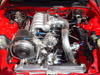
I have a 20B that was buit using new FD housings and 9.7:1 rotors. I am trying to I identify if it is a pre-letter, A, B, C, ect. The only markings I can find are a K on the steel mid plate and what appears to be E046055 on the front steal plate under the alternator. The motor was built for a plane by Bruce Turrentine. The red circle is what appears to be and E, though I am not for sure. Any help would be appreciated.
most 20B's i've seen were stamped around the top of the engine, and the stamps are roughly in a line. they are all 4 numbers with a letter prefix after the first series. so my old engine was 0246, and then there would be an A0246, B0246, C0246, D0246. apparently they stop with the E series. any replacement parts are blank.
the number in the pic is the normal serial number a 13B got, so its probable that your front iron (not to be that guy, but steal means you didn't pay for it, steel is a material, and its made of iron), started life as a 13B cosmo. the 13B and 20B front irons share a casting, the 20B has more drillings for the front facing tension bolts.
The markings on the front iron are the only markings on the motor. The original intake is raw and not black, so I am assuming it is an older motor. Is there any other way to identify what series?
The stampings will be next to the "20B" on the housings, near the pocket on the rear iron, on the lift ear on the front iron, halfway up on the intermediates
the major difference in the engines is the castings of the irons, namely the thick center iron after the C series made the casting thicker and the engine more durable. a picture of where the center thick iron meets the rotor housing will usually tell us if this is an early A/B engine or a late C/D engine. the later C and D code blocks the casting will protrude slightly beyond the rotor housing(not as large of a difference as the front and rear plates), the early engines the casting will nearly match the edge of the rotor housing.
if you look at the dowel castings of an S4 vs an FD you will see the same differences with the early vs late 20B.
the thick iron code is the most critical, since it is the most expensive part of the engine and also what really determines the power that the block can handle without splitting it and modifying it. the other irons, well you can even use FD parts for them with some port matching and they will have the thick castings for more power.
kinda hard to see but you can see the protrusion on the bottom of where the front housing meets the thick iron, this is a C code block:
Last edited by RotaryEvolution; Nov 17, 2015 at 09:09 AM.
The rotor housings are new FD housing so there are no stampings. I will post pictures of the motor this weekend.
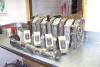
Ok, this weekend turned into a couple of years. LOL. I looked again tonight, and I still cannot find any series numbers. I took more pictures, hopefully this will help with identifying a early or late motor series.
it doesn't really matter anymore. if you're curious for the sake of knowing i get it but otherwise it doesn't really matter in terms of power.
one of our forum members is road racing a 900whp on the regular. he's not mentioned any engine failures - i think he's still on the same build all these years.
Ok, this weekend turned into a couple of years. LOL. I looked again tonight, and I still cannot find any series numbers. I took more pictures, hopefully this will help with identifying a early or late motor series.
They are thick dowel pin lands as found on C and D-Code engines.
They are thick dowel pin lands as found on C and D-Code engines.
Davin, is this the area you are referring to?
'Im mostly curious, but I plan on tearing the motor down soon to check the apex springs, change the rotors and apex seals, and freshen up the o-rings.
This motor was built several, if not almost 10 years ago and never started. It has been turned over every couple of months for the last 4 years though.
'Im mostly curious, but I plan on tearing the motor down soon to check the apex springs, change the rotors and apex seals, and freshen up the o-rings.
This motor was built several, if not almost 10 years ago and never started. It has been turned over every couple of months for the last 4 years though.
Yes, you have thick dowel pin land fat center and rear iron. But the thin center iron is early 20B since it does not have the freeze plug next to the oil filler tube. The front iron I cannot make out if it is thick dowel pin land or not. You can tell by the front of the front iron to the left of the coolant outlet and by the turbo oil feed. Also you can tell by the thick center iron as it has the bigger surface area for the engine stand adapter.
Yes, you have thick dowel pin land fat center and rear iron. But the thin center iron is early 20B since it does not have the freeze plug next to the oil filler tube. The front iron I cannot make out if it is thick dowel pin land or not. You can tell by the front of the front iron to the left of the coolant outlet and by the turbo oil feed. Also you can tell by the thick center iron as it has the bigger surface area for the engine stand adapter.
After comparing the dowel pin area, I see how the rear and fat center have a thicker casting than the thin center iron. It looks like the front iron is from an early motor as well based on the casting size, Davin would you agree?
Last edited by Azhillman; May 31, 2019 at 01:56 PM.
After comparing the dowel pin area, I see how the rear and fat center have a thicker casting than the thin center iron. It looks like the front iron is from an early motor as well based on the casting size, Davin would you agree?
Yeah, that is an early front iron. I have for sale a new 20B front if you're interested.