


What the heck is this on the intake manifold?

Thread Starter
Junior Member
Joined: Feb 2010
Posts: 18
Likes: 0
From: Milwaukee
 What the heck is this on the intake manifold?
On the intake manifold, smack dab in the middle of the picture, the orange plastic piece with the U shaped vac hose. The plastic nipple broke of and now I don't remember where it connects to. What the heck is that?
If that is left open, can that cause my idle to jump around? A picture showing where it connects to would be great.
If that is left open, can that cause my idle to jump around? A picture showing where it connects to would be great.
Last edited by ShawnSA22; Mar 9, 2010 at 11:01 PM. Reason: Title was too vague.


Joined: Jun 2008
Posts: 8,376
Likes: 30
From: Chino Hills, CA
That's the altitude compensator. It connects to a large hoze nipple right next to the mix screw, like this:
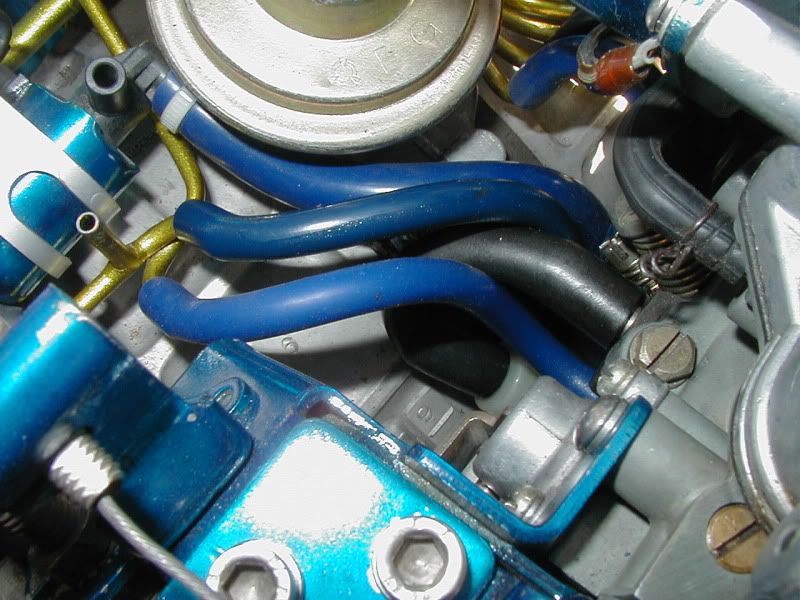
Since it bypasses air around the throttle plates, it could make fora very large or very unstable vacuum leak, depending on how it broke off.
Since it bypasses air around the throttle plates, it could make fora very large or very unstable vacuum leak, depending on how it broke off.


Wrongo! The altitude compensator is up on the carb itself. Sterling took one apart once to see how it works. Kind of a neat little device.
The part the OP is talking about is a PCV valve on his '79-'80 manifold. It pulls vacuum from both primary runners at idle so it needs to be blocked off or fixed and routed correctly. My old school engines have it mainly running to the oil filling tube. This prevents the margerine and water you get condensing under the oil cap.
To the OP, the plastic in normally a natural nylon type color. Yours is old discolored and brittle. An easy fix is to break the rest of the plastic off the metal part, remove the little spring and valve assembly inside, find a piece of hose (1/2" or 5/8", can't remember), zip tie it on the metal part (nipple) and hook the other end of the hose to an aftermarket PCV valve like a Fram FV333 or similar inline style. Run the other end to your oil fill tube nipple (this is an 8mm or 5/16" size so get a smaller hose).
The part the OP is talking about is a PCV valve on his '79-'80 manifold. It pulls vacuum from both primary runners at idle so it needs to be blocked off or fixed and routed correctly. My old school engines have it mainly running to the oil filling tube. This prevents the margerine and water you get condensing under the oil cap.
To the OP, the plastic in normally a natural nylon type color. Yours is old discolored and brittle. An easy fix is to break the rest of the plastic off the metal part, remove the little spring and valve assembly inside, find a piece of hose (1/2" or 5/8", can't remember), zip tie it on the metal part (nipple) and hook the other end of the hose to an aftermarket PCV valve like a Fram FV333 or similar inline style. Run the other end to your oil fill tube nipple (this is an 8mm or 5/16" size so get a smaller hose).
Joined: Jun 2008
Posts: 8,376
Likes: 30
From: Chino Hills, CA
I'm sorry, Jeff, but you are incorrect. The SAs do not have a discrete PCV valve; they use the Ventilation and Check Valve which mounts to the rear of the rat's nest to perform the same function that a PCV does.

The part indicated in the OP is the Altitude Compensator, part # 8761-13-770, connects to the carb using hose 8871-13-775.

Clearer pic of it without the carb in the way here:
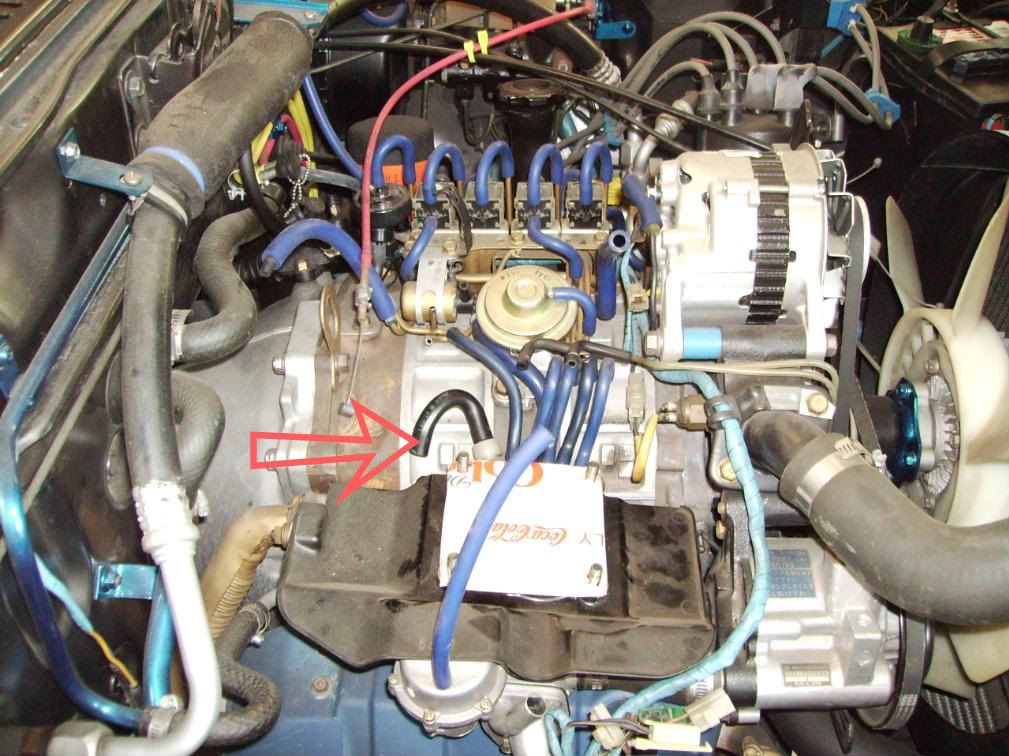
Schematic:

The older-style Altitude Compensators were a bellows-type setup, multiple hoses; the 79 RX-7's started using the simpler one, and the Vent and Check Valve for vapor control. Maybe they re-used the same hole in the manifold that the older PCVs went to? I don't know - - never had an old-school car.
The part indicated in the OP is the Altitude Compensator, part # 8761-13-770, connects to the carb using hose 8871-13-775.
Clearer pic of it without the carb in the way here:
Schematic:
The older-style Altitude Compensators were a bellows-type setup, multiple hoses; the 79 RX-7's started using the simpler one, and the Vent and Check Valve for vapor control. Maybe they re-used the same hole in the manifold that the older PCVs went to? I don't know - - never had an old-school car.


you know, you guys are alright! thumbs up to Jeff and Glen for outstanding and thorough information! glad that was cleared up properly. and i learned something today about the SA!
Thread Starter
Junior Member
Joined: Feb 2010
Posts: 18
Likes: 0
From: Milwaukee
Great info, that's exactly what I'm looking for. Thank you. Without plugging/routing it, I was able to tune my idle at around 750rpm. Not too bad. I'm sure once I correct it I can dial it in better.
Now I drove it around the block today and my temp rose and my "add coolant" warning light came on. I just put in a new thermostat and coolant is flowing but the temp keeps rising to an uncomfortable level. I am completely confused. This is my last problem to figure out.
Now I drove it around the block today and my temp rose and my "add coolant" warning light came on. I just put in a new thermostat and coolant is flowing but the temp keeps rising to an uncomfortable level. I am completely confused. This is my last problem to figure out.
Trending Topics
Joined: Jun 2008
Posts: 8,376
Likes: 30
From: Chino Hills, CA
You've probably got some trapped air in the system. Common problem after changing t-stat or otherwise draining some coolant. Baby may just need burping, heh.
Did the t-stat you used have the "jiggle pin" in it, and did you put it at the top when you installed it?
Did the t-stat you used have the "jiggle pin" in it, and did you put it at the top when you installed it?
Thread Starter
Junior Member
Joined: Feb 2010
Posts: 18
Likes: 0
From: Milwaukee
I have no idea what the "jiggle pin" is. I took the old t stat out and the new one went right in. I also put some "radiator Drain-o" in the system and it's all good now. I must have had a blockage. A new thermostat never hurts though haha
Joined: Jun 2008
Posts: 8,376
Likes: 30
From: Chino Hills, CA
The original rotary t-stats had a small hole in one part of the valve flange, with a little pin valve in it that was meant to let air burp past the t-stat rather than get trapped behind the flange when the t-stat is closed.
The little valve wasn't spring loaded (water flow closed it) so it would jiggle around when you shook the t-stat.
So, "jiggle pin." Still considered by many to be the earmark of the best t-stat for a rotary. But it only works if it's at the top when installed.
Pic:

The little valve wasn't spring loaded (water flow closed it) so it would jiggle around when you shook the t-stat.
So, "jiggle pin." Still considered by many to be the earmark of the best t-stat for a rotary. But it only works if it's at the top when installed.
Pic:

Can Post Only in New Member Section
Joined: Mar 2014
Posts: 1
Likes: 0
From: Hawaii
Great info, that's exactly what I'm looking for. Thank you. Without plugging/routing it, I was able to tune my idle at around 750rpm. Not too bad. I'm sure once I correct it I can dial it in better.
Now I drove it around the block today and my temp rose and my "add coolant" warning light came on. I just put in a new thermostat and coolant is flowing but the temp keeps rising to an uncomfortable level. I am completely confused. This is my last problem to figure out.
Now I drove it around the block today and my temp rose and my "add coolant" warning light came on. I just put in a new thermostat and coolant is flowing but the temp keeps rising to an uncomfortable level. I am completely confused. This is my last problem to figure out.
Joined: Jun 2008
Posts: 8,376
Likes: 30
From: Chino Hills, CA
If you plugged both openings you would probably be all right. Possibly would have to re-tune your idle some.
If you stay below 3000', you won't notice an appreciable RPM change based on the FSM data. But don't some of the islands have some pretty sizeable mountains on them?? I remember Haleakala topping out at like 10,000 feet.
If you stay below 3000', you won't notice an appreciable RPM change based on the FSM data. But don't some of the islands have some pretty sizeable mountains on them?? I remember Haleakala topping out at like 10,000 feet.

Senior Member
Joined: Jul 2013
Posts: 303
Likes: 0
From: South Beach


Thread
Thread Starter
Forum
Replies
Last Post
rgordon1979
3rd Generation Specific (1993-2002)
40
Mar 15, 2022 12:04 PM
