


weber 48ida newb question GSL-SE :)


Thread Starter
O.D.B FB

Joined: Jul 2007
Posts: 46
Likes: 0
From: SoCal
weber 48ida newb question GSL-SE :)
I currently have a stock GSL-SE (my daily) with the exception of a collected RB header, 2.5 glass pack, and 2.5 universal dual tip muffler.
I have a weber 48ida with manifold I bought a while ago (not installed) and have been thinking about installing it in quest of more power. My question is... How frequently do you guys adjust your carbs? Every season? How drastic does the weather affect any settings I would have dialed in? I don't mind spending the extra cash in a wideband. I wanted to get a feel where people are coming from who owns a ida. Thanks!!!
I have a weber 48ida with manifold I bought a while ago (not installed) and have been thinking about installing it in quest of more power. My question is... How frequently do you guys adjust your carbs? Every season? How drastic does the weather affect any settings I would have dialed in? I don't mind spending the extra cash in a wideband. I wanted to get a feel where people are coming from who owns a ida. Thanks!!!

Off the shelf, old school IDAs have VW specs so it needs a lil tweaking to work well with RX. I tune by feel so i dont use wideband or whatever. Before instLling it, write down the specs such as jets venturies and such then bring it over.



Joined: Mar 2001
Posts: 31,835
Likes: 3,233
From: https://www2.mazda.com/en/100th/
i spent a long time tuning mine, but since then i haven't touched it.
wacky's way works, actually i think i did mine the same except i used a wideband to second guess the butt dyno.
wacky's way works, actually i think i did mine the same except i used a wideband to second guess the butt dyno.

Joined: Mar 2001
Posts: 31,835
Likes: 3,233
From: https://www2.mazda.com/en/100th/
the best tuning advise i've ever seen is to give the engine what it wants. on an NA, you (ideally) start too rich and then go too lean, and then go back to where the engine runs the best.
with the weber you start with the idle circuit. you should even pull the main jet stack out, go too rich and then go too lean, put the main jets back in, and then again go too rich and then go lean.
the only caution is that you wanna get to max power, and then go a little richer. a little extra fuel is safer, even on an NA.
Thread Starter
O.D.B FB
Joined: Jul 2007
Posts: 46
Likes: 0
From: SoCal
Nice, Thanks for your input!
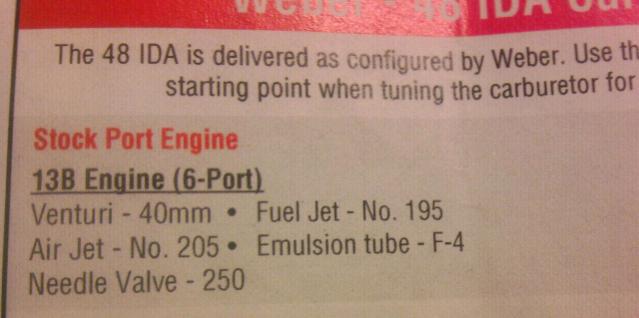
I'm not really asking for specifics, but roughly what range of fuel/air jets, emulsion tubes, needle valves should i have on hand to tune? This is what racing beat recommends as a starting point for a stock 6 port. How many larger/smaller sizes of each should I purchase?
Thank you guys for putting up with my newbie questions. As you can see, I try not to make many new posts because the search button has been my best friend lol.
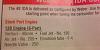
I'm not really asking for specifics, but roughly what range of fuel/air jets, emulsion tubes, needle valves should i have on hand to tune? This is what racing beat recommends as a starting point for a stock 6 port. How many larger/smaller sizes of each should I purchase?
Thank you guys for putting up with my newbie questions. As you can see, I try not to make many new posts because the search button has been my best friend lol.
Trending Topics

So im in the same boat also... Ive got a 13b 6 port which is stock with a 48 IDA.. ive made some 2" headers which go into 3" system..
my setup at present is
Weber 48 IDA
40mm venturis
F-ll Emulsion Tubes
195 fuel jets
160 air jets
65 F10 idle jets
300 Needle
And i am having real real trouble with it running and not killing my eyes from burnt fuel or not...
Can anyone suggest some quick tips onb whats the best to do when changing jets and what you usually do when starting fresh on a motor with a 48 ida.. Ive never owned a carb'd engine as this is all new to me..
cheers
my setup at present is
Weber 48 IDA
40mm venturis
F-ll Emulsion Tubes
195 fuel jets
160 air jets
65 F10 idle jets
300 Needle
And i am having real real trouble with it running and not killing my eyes from burnt fuel or not...
Can anyone suggest some quick tips onb whats the best to do when changing jets and what you usually do when starting fresh on a motor with a 48 ida.. Ive never owned a carb'd engine as this is all new to me..
cheers
Joined: Mar 2001
Posts: 31,835
Likes: 3,233
From: https://www2.mazda.com/en/100th/
So im in the same boat also... Ive got a 13b 6 port which is stock with a 48 IDA.. ive made some 2" headers which go into 3" system..
my setup at present is
Weber 48 IDA
40mm venturis
F-ll Emulsion Tubes
195 fuel jets
160 air jets
65 F10 idle jets
300 Needle
And i am having real real trouble with it running and not killing my eyes from burnt fuel or not...
Can anyone suggest some quick tips onb whats the best to do when changing jets and what you usually do when starting fresh on a motor with a 48 ida.. Ive never owned a carb'd engine as this is all new to me..
cheers
my setup at present is
Weber 48 IDA
40mm venturis
F-ll Emulsion Tubes
195 fuel jets
160 air jets
65 F10 idle jets
300 Needle
And i am having real real trouble with it running and not killing my eyes from burnt fuel or not...
Can anyone suggest some quick tips onb whats the best to do when changing jets and what you usually do when starting fresh on a motor with a 48 ida.. Ive never owned a carb'd engine as this is all new to me..
cheers
basically you want it just when it idles the best, going richer will just smell worse, and going leaner the idle will get "weak" it'll idle, but stall easily. the next step is the transition circuit, the easy way to do this is to pull the whole main jet stack out and go for a drive, be careful though, as you only get 2000ish RPM and 30% throttle. the mixture here is controlled by the idle jet, 65 is in the ballpark but you might try 60, and 70. leaner the better here, leaner than 15:1 it'll probably buck/surge, 14-14.5:1 is pretty ideal, 13:1 might make a little extra torque, 12.5:1 or richer, it might loose power again, and it'll stink and mileage will be bad. i give the mixture numbers as examples, you can use an o2 sensor, but if you run it too lean and then too rich, it'll be pretty obvious what works.
the third step is to put the main stack back in and see how it goes, the main fuel jet meters the total amount of fuel, but the emulsion tube and air jet control WHEN the fuel shows up. smaller air corrector = the main circuit coming on faster, and a bigger one will have it coming on slower. if its too fast OR too slow, the car will bog in the 1800-2500rpm range, i had to try a few with mine, 160 seems big, but its not the number, its whatever the engine is happy with.
i've never tried a different E tube, in my case i run an F7, so i'm not exactly sure what a different one would do. i think you should be able to get the E11 to work ok, but if not i would try an F8. there is a chart of E tube to engine size, and the 654cc chambered 13B is an F8 (you should double check)
so when the main comes on right, then you should try a couple of different main jets, 195 seems like it should be in the ballpark, but it doesn't hurt to try a little richer and a little leaner. the mixture the power chart is close to the one for the idle jet, except that you probably want to find the max power mixture and then be a little richer.
oh and tune for max power on the coldest day, as the air will be denser.
if you still wanna keep playing, try a 42mm venturi
have fun!

Thread Starter
O.D.B FB
Joined: Jul 2007
Posts: 46
Likes: 0
From: SoCal
Freak'n awesome! This is great info all of us can use!
step one is to look down the carb with the engine running, if you're looking at the boosters, at idle they shouldn't be dripping, if they are the float level is too high. basically the float needs to be as high as possible without dripping. once you have that figured out, you start with the idle mixture.
basically you want it just when it idles the best, going richer will just smell worse, and going leaner the idle will get "weak" it'll idle, but stall easily. the next step is the transition circuit, the easy way to do this is to pull the whole main jet stack out and go for a drive, be careful though, as you only get 2000ish RPM and 30% throttle. the mixture here is controlled by the idle jet, 65 is in the ballpark but you might try 60, and 70. leaner the better here, leaner than 15:1 it'll probably buck/surge, 14-14.5:1 is pretty ideal, 13:1 might make a little extra torque, 12.5:1 or richer, it might loose power again, and it'll stink and mileage will be bad. i give the mixture numbers as examples, you can use an o2 sensor, but if you run it too lean and then too rich, it'll be pretty obvious what works.
the third step is to put the main stack back in and see how it goes, the main fuel jet meters the total amount of fuel, but the emulsion tube and air jet control WHEN the fuel shows up. smaller air corrector = the main circuit coming on faster, and a bigger one will have it coming on slower. if its too fast OR too slow, the car will bog in the 1800-2500rpm range, i had to try a few with mine, 160 seems big, but its not the number, its whatever the engine is happy with.
i've never tried a different E tube, in my case i run an F7, so i'm not exactly sure what a different one would do. i think you should be able to get the E11 to work ok, but if not i would try an F8. there is a chart of E tube to engine size, and the 654cc chambered 13B is an F8 (you should double check)
so when the main comes on right, then you should try a couple of different main jets, 195 seems like it should be in the ballpark, but it doesn't hurt to try a little richer and a little leaner. the mixture the power chart is close to the one for the idle jet, except that you probably want to find the max power mixture and then be a little richer.
oh and tune for max power on the coldest day, as the air will be denser.
if you still wanna keep playing, try a 42mm venturi
have fun!
basically you want it just when it idles the best, going richer will just smell worse, and going leaner the idle will get "weak" it'll idle, but stall easily. the next step is the transition circuit, the easy way to do this is to pull the whole main jet stack out and go for a drive, be careful though, as you only get 2000ish RPM and 30% throttle. the mixture here is controlled by the idle jet, 65 is in the ballpark but you might try 60, and 70. leaner the better here, leaner than 15:1 it'll probably buck/surge, 14-14.5:1 is pretty ideal, 13:1 might make a little extra torque, 12.5:1 or richer, it might loose power again, and it'll stink and mileage will be bad. i give the mixture numbers as examples, you can use an o2 sensor, but if you run it too lean and then too rich, it'll be pretty obvious what works.
the third step is to put the main stack back in and see how it goes, the main fuel jet meters the total amount of fuel, but the emulsion tube and air jet control WHEN the fuel shows up. smaller air corrector = the main circuit coming on faster, and a bigger one will have it coming on slower. if its too fast OR too slow, the car will bog in the 1800-2500rpm range, i had to try a few with mine, 160 seems big, but its not the number, its whatever the engine is happy with.
i've never tried a different E tube, in my case i run an F7, so i'm not exactly sure what a different one would do. i think you should be able to get the E11 to work ok, but if not i would try an F8. there is a chart of E tube to engine size, and the 654cc chambered 13B is an F8 (you should double check)
so when the main comes on right, then you should try a couple of different main jets, 195 seems like it should be in the ballpark, but it doesn't hurt to try a little richer and a little leaner. the mixture the power chart is close to the one for the idle jet, except that you probably want to find the max power mixture and then be a little richer.
oh and tune for max power on the coldest day, as the air will be denser.
if you still wanna keep playing, try a 42mm venturi
have fun!

Thread
Thread Starter
Forum
Replies
Last Post
Adaptronic S5 Turbo PNP Unit questions
_Tones_
Adaptronic Engine Mgmt - AUS
10
May 25, 2021 05:37 AM
Jeff20B
1st Generation Specific (1979-1985)
73
Sep 16, 2018 07:16 PM
Nosferatu
2nd Generation Specific (1986-1992)
7
Sep 5, 2015 02:13 PM
