Transistor trick for 2GCDFIS.



Sounds good. I don't think anyone has tried this version yet. I sent a few out after yours. They were all replacements for the last version. A few were unassmbled and a few were assembled. I only know of one that has been delivered for sure.
I wasn't sure on the tach for your cars. Didn't your cars keep the thermal reactors? Our 79/80 cars had the thermal reactors. The tach was connected to leading because the trailing only operated part-time. It sound like it must operate of trailing since it was working with leading disconnected.
I can't seem to find what may be causing this. I see that with the 4538 chip used, pins 1, 8, and 15 are connected internally. I connected them externally as well. That shouldn't cause a problem. They connect to ground. I will keep looking.
Kent
I wasn't sure on the tach for your cars. Didn't your cars keep the thermal reactors? Our 79/80 cars had the thermal reactors. The tach was connected to leading because the trailing only operated part-time. It sound like it must operate of trailing since it was working with leading disconnected.
I can't seem to find what may be causing this. I see that with the 4538 chip used, pins 1, 8, and 15 are connected internally. I connected them externally as well. That shouldn't cause a problem. They connect to ground. I will keep looking.
Kent
Rotary Enthusiast

Joined: Aug 2004
Posts: 1,100
Likes: 0
From: The World
I think Rob is confused and the tach may have been connected to the splice'd line on our loom which splices in with the signal from the ignitor. I gave him a quick rundown of connections before leaving him this arvo. It's nearly 1AM now I think we will find out more tomorrow 
Thanks!!
Paul.
Thanks!!
Paul.

ya that one would prob be I ... lol .. anyhow .. i can't do any testing till about friday or so, blew my rear rotor and getting it rebuilt monday and the guys prmised me that I'll be done by friday. So i'll let you know if i run into any poblems.
Sam: Does your electronics prof have some testing equipment around? Maybe you could hook your circuit to a function generator and an o-scope to help track down the issue. I will ask around here and see if I can find one as well. Doubtful, though.
I still can't figure the problem out. I have went through the data sheets and the simulation. Everything looks good. We know it works fine without R2. This means that the problem is occuring either in the 2nd section in the 4538B IC (However it is connected the same as the fist section with the exception of a different value resistor) or in the NAND gate. The NAND gate is correct on paper and behaves properly in the simulation. I will try to add some delays in the circuit along with a non-ideal square wave to trigger the circuit to see if this makes a difference.
I still can't figure the problem out. I have went through the data sheets and the simulation. Everything looks good. We know it works fine without R2. This means that the problem is occuring either in the 2nd section in the 4538B IC (However it is connected the same as the fist section with the exception of a different value resistor) or in the NAND gate. The NAND gate is correct on paper and behaves properly in the simulation. I will try to add some delays in the circuit along with a non-ideal square wave to trigger the circuit to see if this makes a difference.
Rotary Enthusiast
Joined: Aug 2004
Posts: 1,100
Likes: 0
From: The World
Ok today we tried without R2 in my car. Fantastic!@# My first response was: Holy ****!
It feels like it is pulling harder up top, I can notice based on the increased distance between me and the average driver when taking off from the lights. Just fantastic!
Rob appears to have some problems with his carby - whenever he gets onto the secondaries there are etreme surges and misses. Something's not quite right there lol, so he will need to sort that before we get ignition mod happening on his car.
I just drove around for about 40 minutes with it, I didn't notice any degradation over time. Low end seemed normal if not perhaps a bit smoother (wishful thinking perhaps), top end wow.. really from 6000+ it's just mental First started driving around with Rob in the car, then I drove home on my own and yeah the top end really stands out as having more. I am using the surface discharge type plugs as well.
I got home and the coilpack was pretty hot - I could push my hand onto the base of it for about 4-5 secs before it was too hot to touch. I wouldnt say too hot though.. We still don't know how hot the 2nd gen coils on their stock system get.
So pretty happy with the outcome Just need to figure out the problem with R2 and do more testing next weekend.
Thanks for the help along the way.
I also pulled my dizzy to pieces today and cleaned it all out, regreased etc. to make sure it was running in top form.
Cheers,
Paul.
It feels like it is pulling harder up top, I can notice based on the increased distance between me and the average driver when taking off from the lights. Just fantastic!
Rob appears to have some problems with his carby - whenever he gets onto the secondaries there are etreme surges and misses. Something's not quite right there lol, so he will need to sort that before we get ignition mod happening on his car.
I just drove around for about 40 minutes with it, I didn't notice any degradation over time. Low end seemed normal if not perhaps a bit smoother (wishful thinking perhaps), top end wow.. really from 6000+ it's just mental
First started driving around with Rob in the car, then I drove home on my own and yeah the top end really stands out as having more. I am using the surface discharge type plugs as well.I got home and the coilpack was pretty hot - I could push my hand onto the base of it for about 4-5 secs before it was too hot to touch. I wouldnt say too hot though.. We still don't know how hot the 2nd gen coils on their stock system get.
So pretty happy with the outcome
Just need to figure out the problem with R2 and do more testing next weekend.Thanks for the help along the way.
I also pulled my dizzy to pieces today and cleaned it all out, regreased etc. to make sure it was running in top form.
Cheers,
Paul.
Junior Member

Joined: Sep 2004
Posts: 7
Likes: 0
From: Melbourne
Yep, from the perspective of the passenger, Paul's 7 really surged to the redline from about ~6000rpm, pretty damn strong. Im quite impressed, but of course, the reliability of this mod is questionable as the coilpack definitely heats up, and ultimately it would be best to set a max limit to manage this heating.
Rob
Rob
Junior Member
Joined: Sep 2004
Posts: 7
Likes: 0
From: Melbourne
Hi Kent, had a thought about this problem.
We have been worrying about the limiting function on this circuit which causes surprising behaviour w.r.t timing.
I originally believed that, in the course of early development, the value of 2.2ms was selected to contrast the fixed version with the variable version (as dictated by the J109). It was clear (and is in Pauls 7 too) that the top end was/is excellent, in part because the pulse width with the fixed circuit is greater than the var. version at high rpm. So why dont we simply use the fixed circuit, but change the value? You suggested maybe ~4ms would provide all the low end advantages, so if we used a 39kOhm resistor instead of a 22kOhm resistor in the fixed circuit, would there be any disadvantages, say in the top end? My guess would be no. I am thinking maybe the only thing that needs refining would be correct selection of a fixed pulse width to find that happy reliability(heating)/performance balance
Cheers, Rob
We have been worrying about the limiting function on this circuit which causes surprising behaviour w.r.t timing.
I originally believed that, in the course of early development, the value of 2.2ms was selected to contrast the fixed version with the variable version (as dictated by the J109). It was clear (and is in Pauls 7 too) that the top end was/is excellent, in part because the pulse width with the fixed circuit is greater than the var. version at high rpm. So why dont we simply use the fixed circuit, but change the value? You suggested maybe ~4ms would provide all the low end advantages, so if we used a 39kOhm resistor instead of a 22kOhm resistor in the fixed circuit, would there be any disadvantages, say in the top end? My guess would be no. I am thinking maybe the only thing that needs refining would be correct selection of a fixed pulse width to find that happy reliability(heating)/performance balance
Cheers, Rob
Last edited by Quail Squasher; Feb 26, 2006 at 01:53 AM.
Junior Member
Joined: Sep 2004
Posts: 7
Likes: 0
From: Melbourne
Just read back through the thread, and this has been covered 
Still is there any merit in testing the fixed pulse width version at say 3 or 3.3ms? I rarely rev the engine beyond 8k as it doesnt make as much power up that high anyhow.
Thanks, Rob
Still is there any merit in testing the fixed pulse width version at say 3 or 3.3ms? I rarely rev the engine beyond 8k as it doesnt make as much power up that high anyhow.
Thanks, Rob
Hey guys,
Glad it is working nice how it is. Currently you are experiencing what the others have with the previous design. It is pretty amazing that a stronger spark can make such a difference in performance.
There may be some merit in testing the fixed pulsewidth at other values. Kentetsu really liked the fixed pulsewidth version at 2.2ms. For me, it was fairly weak down low and the idle was worse than stock. This may be because I am running stock timing and his is advanced. Now, one of the main problems with the fixed pulse is the duty cycle of the pulses will get high at high rpm. This may cause ignitor heating problems at high rpm as opposed to low rpm as in the simple circuit case. Maybe increasing from 2.2 to like 2.4 or 2.6 may work well.
In the current circuit, try another 22k for R2 and then a large resistor for R2. This may help figure out what is going on. Another person has received his kit. He does know a person that has some testing equipment. Maybe we will be able to get to the bottom of this.
Rob: I wonder is there is something wrong in the setting of the new carb. Does it behave like this with stock ignition?
Good luck guys. I will work today on this more and see if I can come up with something.
Kent
Glad it is working nice how it is. Currently you are experiencing what the others have with the previous design. It is pretty amazing that a stronger spark can make such a difference in performance.
There may be some merit in testing the fixed pulsewidth at other values. Kentetsu really liked the fixed pulsewidth version at 2.2ms. For me, it was fairly weak down low and the idle was worse than stock. This may be because I am running stock timing and his is advanced. Now, one of the main problems with the fixed pulse is the duty cycle of the pulses will get high at high rpm. This may cause ignitor heating problems at high rpm as opposed to low rpm as in the simple circuit case. Maybe increasing from 2.2 to like 2.4 or 2.6 may work well.
In the current circuit, try another 22k for R2 and then a large resistor for R2. This may help figure out what is going on. Another person has received his kit. He does know a person that has some testing equipment. Maybe we will be able to get to the bottom of this.
Rob: I wonder is there is something wrong in the setting of the new carb. Does it behave like this with stock ignition?
Good luck guys. I will work today on this more and see if I can come up with something.
Kent
He's got he works. He told me that i just need a schematic diagram but i haven't had time to draw one using the circuit board. If anyone can draw one up or already done that. If you post it up here I can send it as soon as possible.
Originally Posted by gsl-se addict
Sam: Does your electronics prof have some testing equipment around? Maybe you could hook your circuit to a function generator and an o-scope to help track down the issue. I will ask around here and see if I can find one as well. Doubtful, though.
I still can't figure the problem out. I have went through the data sheets and the simulation. Everything looks good. We know it works fine without R2. This means that the problem is occuring either in the 2nd section in the 4538B IC (However it is connected the same as the fist section with the exception of a different value resistor) or in the NAND gate. The NAND gate is correct on paper and behaves properly in the simulation. I will try to add some delays in the circuit along with a non-ideal square wave to trigger the circuit to see if this makes a difference.
I still can't figure the problem out. I have went through the data sheets and the simulation. Everything looks good. We know it works fine without R2. This means that the problem is occuring either in the 2nd section in the 4538B IC (However it is connected the same as the fist section with the exception of a different value resistor) or in the NAND gate. The NAND gate is correct on paper and behaves properly in the simulation. I will try to add some delays in the circuit along with a non-ideal square wave to trigger the circuit to see if this makes a difference.
I forgot to mention this before ... but i just remember him saying "I hope that you guys aren't using the 2222" when I showed him a few pages of this thread. I wasn't one 100% if we still were or not so i had to check on that. See if maybe those are causing some problems.
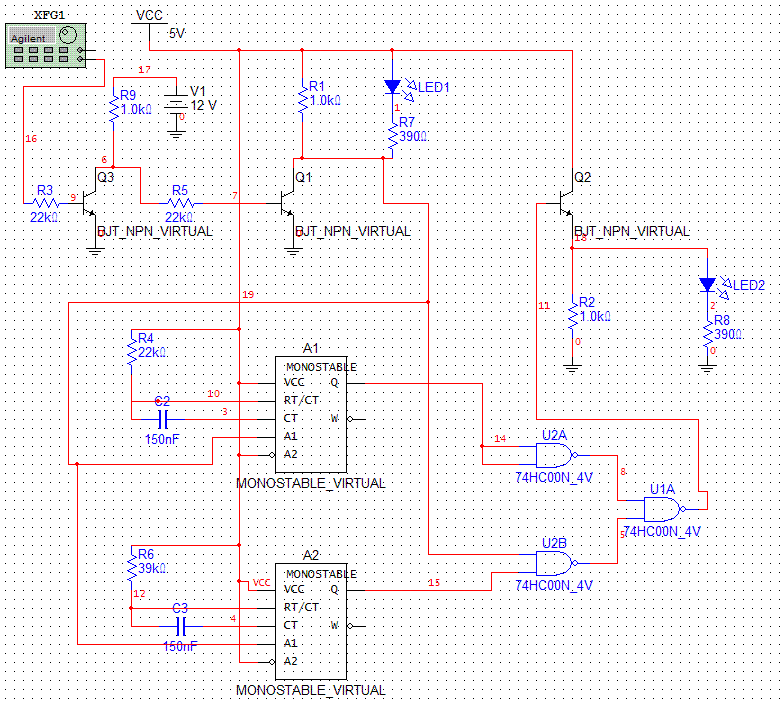
I can post a screen shot of the layout in Electronics Workbench. That should be good enough. The circuit itself is pretty simple. It may help to have another set of eyes to look at it. Like I say, it works perfect in the simulation and on paper. I'll post it in a minute.
Here you go. A few things here:
-The type of multivibrator used in the simulation has an output pulse of 0.7*Rx*Cx instead of tx=Rx*Cx like the one used in the real circuit. I increased capacitance in the circuit to account for the difference.
- Q3 in the layout is to just simulate the J-109. The actual circuit starts at the 22k resistor after Q3.
- The output of the circuit is at LED2 (emitter of Q2)
-The real NAND gates get 5volt instead of 4volts shown on the layout.
The NAND gates should form an AND function between the input pulse and the max pulse. The output of this AND function is then OR'd with the 2.2ms pulse. This should bound the output pulse between 2.2ms and 3.9ms.
-The type of multivibrator used in the simulation has an output pulse of 0.7*Rx*Cx instead of tx=Rx*Cx like the one used in the real circuit. I increased capacitance in the circuit to account for the difference.
- Q3 in the layout is to just simulate the J-109. The actual circuit starts at the 22k resistor after Q3.
- The output of the circuit is at LED2 (emitter of Q2)
-The real NAND gates get 5volt instead of 4volts shown on the layout.
The NAND gates should form an AND function between the input pulse and the max pulse. The output of this AND function is then OR'd with the 2.2ms pulse. This should bound the output pulse between 2.2ms and 3.9ms.

Roll to Heaven in a RX-7
Joined: Feb 2005
Posts: 790
Likes: 0
From: New Westminster, B.C - Canada
Im lost here, I just got all the parts to do the transistor trick this week, and you guys are finding something new to do? Whats the low down, theres 52 pages here
Sounds good. Did he say what the problem with the 2222A was? It is what I used in the last circuits. It can easily handle the power and speed we need. The actual part I am using is MPS2222A.
The Q2 is to act as a voltage follower. This is needed because the 2nd gen ignitor has a very low input impedance. There are other designs of voltage followers that are better, but this one is simple and works with the voltage sources we have available.
The Q2 is to act as a voltage follower. This is needed because the 2nd gen ignitor has a very low input impedance. There are other designs of voltage followers that are better, but this one is simple and works with the voltage sources we have available.
Originally Posted by rxtory
Im lost here, I just got all the parts to do the transistor trick this week, and you guys are finding something new to do? Whats the low down, theres 52 pages here
The Aussie guys were running into some strange behavior. The circuit seems to be fine in the simulation and on paper, though. I am not sure what is causing the strange problems they are having.
Hey kent,
I was just thinking since they're getting like a reversed signal basically, i was thinking back to when we were doing JK flip flops and doing up down counters where we used the q's and q not's. Now i'm assuming that w on there is just a reversed output of q, what if you try tapping from there for the second circuit since that seems to be causin the trouble. See what you get the results to be "on paper". If one of you aussie guys can also try to do this in real life see what you get like that. I'm just thowing ideas out there.
I was just thinking since they're getting like a reversed signal basically, i was thinking back to when we were doing JK flip flops and doing up down counters where we used the q's and q not's. Now i'm assuming that w on there is just a reversed output of q, what if you try tapping from there for the second circuit since that seems to be causin the trouble. See what you get the results to be "on paper". If one of you aussie guys can also try to do this in real life see what you get like that. I'm just thowing ideas out there.
Yeah, the w is the reverse of q on the simulation. If I reverse it, it is all messed up. Reversing both gets the right behavior, but the signal is inverted. The simulation works correctly if I use the Q outputs as shown.

Full Member
Joined: Nov 2005
Posts: 97
Likes: 0
From: NYC
 Solution to Aussie problem
I've figured out whats wrong with the Aussie's cars... well you know how supposedly the water turns in the other direction when you flush a toilet down under? ... that's basically what's happening here, the timing is retarding because they're down under!!! Pure genius huh? LOL
Sorry guys I couldn't resist.
Sorry guys I couldn't resist.
Rotary Enthusiast
Joined: Aug 2004
Posts: 1,100
Likes: 0
From: The World
Hi Guys, I have been running on the latest circuit (minus R2 - so no min pulse width limiting) for a week now with no failures so far. Today Rob & I are dyno-testing, so we shall see how the power/torque is affected.
I don't think the dyno will let us know whether the speed at which the revs go up improves (although a video might do that) - I think there will be a wideband O2 sensor on hand, so we can see how those numbers compare as well between stock and TT.
Should have news/maybe a video within 12 hours.
I don't think the dyno will let us know whether the speed at which the revs go up improves (although a video might do that) - I think there will be a wideband O2 sensor on hand, so we can see how those numbers compare as well between stock and TT.
Should have news/maybe a video within 12 hours.