


estimated top speed


Thread Starter
Rotary Enthusiast

Joined: Jun 2004
Posts: 1,081
Likes: 2
From: Richmond, VA
estimated top speed
What is the top speed (gearing and drag-wise) of a 1st gen? I've estimated it, the best I could, to 145mph (assuming no drag). In my car- '79, 5sp., rb exhaust- the engine is spinning at exactly 3000 rpm at 65mph on a flat road. For every 500 rpm above and below 3000rpm, the speed changes exactly 10mph. So-
5th gear= .825 final drive=3.909
0k= 5 mph
.5k= 15
1k= 25
1.5k= 35
2k= 45
2.5k= 55
3k= 65
3.5k= 75
4k= 85
4.5k= 95
5k= 105
5.5k= 115
6k= 125
6.5k= 135
7k= 145
So- 0rpm in 5th, the car is going 5mph? I know this isn't possible, but is that the drag- (5mph) induced at 65 rpm? If there was no drag on the car, would it be going 70mph at 3k? The equation seems to hold true from 45 to 85 mph, but it gets a little hazy after that. Is there an exponetial amount of drag applied as speed increases, or is it linear? The fastest I've gone is 100mph- the engine was turning at somewhere between 4500 and 5000 rpm (eyes were on the road!), which makes sense.
When the 79 first came out, it was tested to have a 124mph top speed (122 with the lights up). Was this 7k rpm in 5th, or could the engine get there? How much would a factory- type wing make a difference?
What do you guys think? seem legit? This question has been bugging me for awhile.
5th gear= .825 final drive=3.909
0k= 5 mph
.5k= 15
1k= 25
1.5k= 35
2k= 45
2.5k= 55
3k= 65
3.5k= 75
4k= 85
4.5k= 95
5k= 105
5.5k= 115
6k= 125
6.5k= 135
7k= 145
So- 0rpm in 5th, the car is going 5mph? I know this isn't possible, but is that the drag- (5mph) induced at 65 rpm? If there was no drag on the car, would it be going 70mph at 3k? The equation seems to hold true from 45 to 85 mph, but it gets a little hazy after that. Is there an exponetial amount of drag applied as speed increases, or is it linear? The fastest I've gone is 100mph- the engine was turning at somewhere between 4500 and 5000 rpm (eyes were on the road!), which makes sense.
When the 79 first came out, it was tested to have a 124mph top speed (122 with the lights up). Was this 7k rpm in 5th, or could the engine get there? How much would a factory- type wing make a difference?
What do you guys think? seem legit? This question has been bugging me for awhile.
pistons do what?

Joined: Dec 2005
Posts: 93
Likes: 0
From: TX
You have to calculate the top speed based on gearing and tire circumfrence, you cannot just guestamate what speed you would be going basing your guess on what the speedometer (which is inacurate from the factory) says. Drag has no effect on the drive train, I have no clue what you are thinking with that, with no drag at 3k rpm your car cant magicly change from going 65 to 70, and the 5 mph at 0 rpm thing is just you making calculations based on your spedo, at 0 rpm you are going 0 mph. assuming there were no drag calculating using the gear ratios .825 3.909 and stock tire circumfrence 72.9 inches you would be crusing at:
149.84 @ 7000
160.54 @ 7500
171.25 @ 8000
you are adding 10.7 mph for every 500 rpm in 5th gear
149.84 @ 7000
160.54 @ 7500
171.25 @ 8000
you are adding 10.7 mph for every 500 rpm in 5th gear
Last edited by 79rx_7; Jul 18, 2006 at 08:46 PM.

The 1st gen RX-7 is very nearly optimized for top speed in 5th gear. Of course no normal sane person would want to go that fast unless the tires cost more than the car.
To optimize the top speed, you would have to have the aerodynamic drag and rolling friction data. Then, you need to know the peak horsepower, which some say is 100, I have seen 110 published, not sure which is correct, but it occurs at 6,000 rpm on a completely stock car. With a header, revised intake porting, aftermarket intake or whatever, the peak horespower would occur at a higher rpm. My street ported 12a with RB header and an RX-4 carb measured 130 hp to the wheels at 7,000 rpm. With the extra power, I could probably get very close to that rpm in 5th gear.
So to reach the theoretical top speed, whatever it is, you would have to gear the car so that you reach the top speed when the engine reaches the rpm for peak horsepower. If the magazine achieved 124 mph, they were just above the rpm for peak horsepower in 5th, assuming stock tire diameter. You can do some optimizing with tire diameter, of course.
Keep in mind that at high speed, the rolling friction becomes less important and you are primarily fighting aerodynamic drag. The drag goes up as the square of the speed, so if you want to go twice as fast, you need four times the horsepower. This is a simplification of course because the interference of the ground and the airflow going under the car complicates the issue. That is what air dams are for. Without aerodynamic improvements, it is unlikely your car would go 250 mph with only 400 horsepower.
To optimize the top speed, you would have to have the aerodynamic drag and rolling friction data. Then, you need to know the peak horsepower, which some say is 100, I have seen 110 published, not sure which is correct, but it occurs at 6,000 rpm on a completely stock car. With a header, revised intake porting, aftermarket intake or whatever, the peak horespower would occur at a higher rpm. My street ported 12a with RB header and an RX-4 carb measured 130 hp to the wheels at 7,000 rpm. With the extra power, I could probably get very close to that rpm in 5th gear.
So to reach the theoretical top speed, whatever it is, you would have to gear the car so that you reach the top speed when the engine reaches the rpm for peak horsepower. If the magazine achieved 124 mph, they were just above the rpm for peak horsepower in 5th, assuming stock tire diameter. You can do some optimizing with tire diameter, of course.
Keep in mind that at high speed, the rolling friction becomes less important and you are primarily fighting aerodynamic drag. The drag goes up as the square of the speed, so if you want to go twice as fast, you need four times the horsepower. This is a simplification of course because the interference of the ground and the airflow going under the car complicates the issue. That is what air dams are for. Without aerodynamic improvements, it is unlikely your car would go 250 mph with only 400 horsepower.
Last edited by stilettoman; Jul 18, 2006 at 09:19 PM.

standard combustion

Joined: Dec 2001
Posts: 1,374
Likes: 0
From: Twin Cities Minnesota
I know the 7000rpm redline in 5th gear equates to 135mph with a 12a and the stock gearing on a '84 12a tranny with a turbo attached with 7psi boost.  Not exactly safe though ofcourse, H-rated tires are probably a smart minimum tire for this.
Not exactly safe though ofcourse, H-rated tires are probably a smart minimum tire for this.

Lorem ipsum dolor sit ame

Joined: Nov 2003
Posts: 3,262
Likes: 1
From: The Net
Originally Posted by rbf41182gt
When the 79 first came out, it was tested to have a 124mph top speed (122 with the lights up). Was this 7k rpm in 5th, or could the engine get there?

Apprentice Guru
Joined: Oct 2001
Posts: 1,425
Likes: 0
From: Cloud Nine and Peak of God
With a 101hp 12A engine the effective topspeed is 125mph at which speed drag and power are equal.There is insufficient power for the car to achieve maximum rpm in top gear.
With the fastest stock Gen 1, the jdm GT 84-85models with a 12AT engine producing around 145hp, the top speed was 147mph according to a 1984 Japanese review I read.
With the fastest stock Gen 1, the jdm GT 84-85models with a 12AT engine producing around 145hp, the top speed was 147mph according to a 1984 Japanese review I read.
Trending Topics

Too old to act my age
Joined: Feb 2005
Posts: 3,164
Likes: 0
From: Tulsa, Ok.
Originally Posted by cdrad51
It couldn't be in 5th, been as it is that the 79 had 4 speeds.
The 5 speed was standard for the GS and Limited.

Function > Form
Joined: Nov 2002
Posts: 10,890
Likes: 3
From: Catonsville MD (baltimore suburb)
Here are a couple of links for calculators to get better estimates.
http://mr2.phpwerx.net/turbocalc/gea...Fp%2FHWSohAQAA
http://www.geocities.com/z_design_st...ion_z28_6.html
http://mr2.phpwerx.net/turbocalc/gea...Fp%2FHWSohAQAA
http://www.geocities.com/z_design_st...ion_z28_6.html

IIRC, two of Car and Driver's editors took a '79 RX-7 to Bonneville and set a new landspeed record for that class in 1979. I believe the car was stock, except for the required safety modifications, e.g., remove headlights. Does anyone have the issue in which they announced it?

Rotary Freak
Joined: Aug 2001
Posts: 2,267
Likes: 3
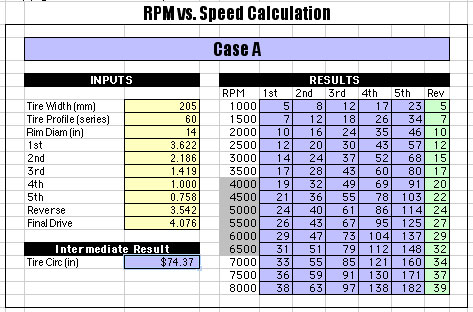
Tire Circumfrence = 3.14 * (2 * width(mm) * profile(series) / 100 + rim diam(in) * 25.4) / 25.4
Speed in gear = RPM * Tire Circumfrence * 60 / (Gear Ratio * Final Drive Ratio * 12 * 5250)
Obviously, this assumes the nominal tire size is actual size and that you are not contemplating the power required to overcome drag and friction.
My GSL-SE, for example, has 205/60R14 tires, giving it a tire circumfrence of 74.37 inches. The 5th gear ratio is 0.758 with a final drive of 4.076. So, with that info, the speed at 7000 RPM works out to be 160 MPH. At 8000 RPM, it is 182.
Speed in gear = RPM * Tire Circumfrence * 60 / (Gear Ratio * Final Drive Ratio * 12 * 5250)
Obviously, this assumes the nominal tire size is actual size and that you are not contemplating the power required to overcome drag and friction.
My GSL-SE, for example, has 205/60R14 tires, giving it a tire circumfrence of 74.37 inches. The 5th gear ratio is 0.758 with a final drive of 4.076. So, with that info, the speed at 7000 RPM works out to be 160 MPH. At 8000 RPM, it is 182.
Lorem ipsum dolor sit ame
Joined: Nov 2003
Posts: 3,262
Likes: 1
From: The Net
Originally Posted by Rogue_Wulff
The base models came standard with a 4 speed, and a 5 speed was optional, as was the auto.
The 5 speed was standard for the GS and Limited.
The 5 speed was standard for the GS and Limited.

Thread
Thread Starter
Forum
Replies
Last Post
Donald Hampton
2nd Generation Specific (1986-1992)
16
Nov 23, 2022 06:38 PM
Mrmatt3465
Interior / Exterior / Audio
8
Sep 17, 2015 01:28 PM
mulcryant
2nd Generation Specific (1986-1992)
10
Sep 9, 2015 05:24 PM
rx8volks
Canadian Forum
0
Sep 1, 2015 10:46 PM