


Braking question: what was this?


Braking question: what was this?
I was at the track yesterday (Shenandoah at summit point), and at the braking zones of the long straights I was getting a squirrelly feel from the car. Braking was still strong, but if fade was just beginning I may not have known. I got this on the last laps of the last session, and I didn't have an instructor at the time. It was the first session where I was clear enough of traffic that I could string together a bunch of full speed laps.
There are two things I'm thinking of:
1) front pads were beginning to green fade and causing a bias issue
2) the extreme load transfer to the front was greatly amplifying even the slightest steering change and I was the source of the issue.
Right now I'm running Hawk HP+ with Ti backing shims, stock calipers and solid rotors, ATE fluid. 250HP, good street tires. (Yes, I'm changing those pads when I next drive a track with more braking loads)
Dave
There are two things I'm thinking of:
1) front pads were beginning to green fade and causing a bias issue
2) the extreme load transfer to the front was greatly amplifying even the slightest steering change and I was the source of the issue.
Right now I'm running Hawk HP+ with Ti backing shims, stock calipers and solid rotors, ATE fluid. 250HP, good street tires. (Yes, I'm changing those pads when I next drive a track with more braking loads)
Dave
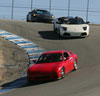

I have had similar symptoms over the last few years with my current FD. Under hard braking, especially at the track, the car was very squirrelly at the front. It went away when I replaced my lower control arm bushings. YMMV.


Was it squirrelly at the front or the rear? The rear end of mine will wag a bit under hard braking from a high speed (e.g the first turn after the straight), and I've always attributed it to one or more of
a) worn pillowballs
b) flex in the rear bushings
c) possible ripples in the asphalt of the braking zone in front of the straight.
It is definitely distracting. I'm currently in the process of installing all new pillows and the SuperPro polyurethane bushes and am hoping that will take care of it.
I hadn't considered a possible change in brake bias caused by the fronts overheating - that's a good thought. I don't think thats it on my car though, because I don't feel the fronts fading, and the front temps seem under control. I haven't been monitoring the rear temps, but am singing the dust boots on the rears, so maybe I should start.
a) worn pillowballs
b) flex in the rear bushings
c) possible ripples in the asphalt of the braking zone in front of the straight.
It is definitely distracting. I'm currently in the process of installing all new pillows and the SuperPro polyurethane bushes and am hoping that will take care of it.
I hadn't considered a possible change in brake bias caused by the fronts overheating - that's a good thought. I don't think thats it on my car though, because I don't feel the fronts fading, and the front temps seem under control. I haven't been monitoring the rear temps, but am singing the dust boots on the rears, so maybe I should start.
I've already replaced the pillowballs. The rear bushings are tight, but like I said before it wasn't ever noticeable at any other time yesterday or any other for that matter.
Dave
Dave

Lives on the Forum

Joined: Feb 2001
Posts: 9,617
Likes: 8
From: Dallas
The harder you brake the more weight transfers to the front and the lighter the rear end gets. You get the rear end light enough and it feels like it's gently rocking side to side because it is  The car won't swap ends in a straight line unless the bias is way out of wack and locks the rears but you do feel the tail float around slightly.
Bias problems will show first with wheel locking. If the rears aren't locking it's safe to say it's not a rear bias problem. If the front pads were fading and the rears weren't this is still a bias problem and the rears would lock. Pad fade is easily noticeable because pedal effort will go way up and the car won't slow any quicker (or at all).
I think you just experienced what hard braking really feels like. Ever closley watched a Superbike brake really hard? You see the rear wag all over the place as their high CG makes them even more prone to unloading the rear tire.
This is another case where an adjustable shock can really help since you can tune how quickly the weight comes off the rears and onto the fronts. Since I run the soft stock springs and get so much dive there are times I swear it feels like the rear tires are in the air
The car won't swap ends in a straight line unless the bias is way out of wack and locks the rears but you do feel the tail float around slightly.Bias problems will show first with wheel locking. If the rears aren't locking it's safe to say it's not a rear bias problem. If the front pads were fading and the rears weren't this is still a bias problem and the rears would lock. Pad fade is easily noticeable because pedal effort will go way up and the car won't slow any quicker (or at all).
I think you just experienced what hard braking really feels like. Ever closley watched a Superbike brake really hard? You see the rear wag all over the place as their high CG makes them even more prone to unloading the rear tire.
This is another case where an adjustable shock can really help since you can tune how quickly the weight comes off the rears and onto the fronts. Since I run the soft stock springs and get so much dive there are times I swear it feels like the rear tires are in the air
Trending Topics
I see, makes plenty of sense. Thanks for answering.
I've stood on the brakes hard before using those tires but this could have been the first time I've really noticed this.
Another thought I had is that I just installed lower springs (Eibach Pro-Kit, 1" drop) on stock dampers instead of stock springs on GAB 8way dampers. It was aligned at about -2° camber f/r, 0 toe, 0 thrust. I have not yet had it realigned, so I expect that camber is even more negative and toe feels like it's now a little outward. From what I can gather by reading, both effects would destabilize hard braking a little bit.
Dave
I've stood on the brakes hard before using those tires but this could have been the first time I've really noticed this.
Another thought I had is that I just installed lower springs (Eibach Pro-Kit, 1" drop) on stock dampers instead of stock springs on GAB 8way dampers. It was aligned at about -2° camber f/r, 0 toe, 0 thrust. I have not yet had it realigned, so I expect that camber is even more negative and toe feels like it's now a little outward. From what I can gather by reading, both effects would destabilize hard braking a little bit.
Dave

Joined: Oct 2001
Posts: 6,279
Likes: 728
From: Florence, Alabama
i agree w everything in post 7... it is on the money.
just a couple of additional points.
"It was the first session where I was clear enough of traffic that I could string together a bunch of full speed laps."
braking is one of the hardest things to do really really well in a racecar. it takes seasons to optimise. some, many, people never do. your comment above leads me to believe you had some clear track and were starting to turn it up. good for you. as Damon correctly states the more Gs you pull in braking the more weight transfers to the front making the rear light and twitchy.
a great part of making a front engine rear drive car go fast on a road course is working w the rear. i run 54% rear weight. that helps add rear braking power.
another dynamic entering the picture is the front negative camber gain on bump. as you transfer more weight onto the front the springs compress and the wheels pick up negative camber. negative camber gain, another of the "real race suspension" aspects that set the FD in a class almost by itself . NCG greatly increases cornering power as the outside wheels, entering the corner gain camber as the suspension compresses thus maintaining the proper camber to generate high amounts of adhesion.
this does work slightly against you under heavy straight-line braking however.
what is your camber set at? tire pressures? toe? castor equal? rear thrust at zero?
howard coleman
just a couple of additional points.
"It was the first session where I was clear enough of traffic that I could string together a bunch of full speed laps."
braking is one of the hardest things to do really really well in a racecar. it takes seasons to optimise. some, many, people never do. your comment above leads me to believe you had some clear track and were starting to turn it up. good for you. as Damon correctly states the more Gs you pull in braking the more weight transfers to the front making the rear light and twitchy.
a great part of making a front engine rear drive car go fast on a road course is working w the rear. i run 54% rear weight. that helps add rear braking power.
another dynamic entering the picture is the front negative camber gain on bump. as you transfer more weight onto the front the springs compress and the wheels pick up negative camber. negative camber gain, another of the "real race suspension" aspects that set the FD in a class almost by itself . NCG greatly increases cornering power as the outside wheels, entering the corner gain camber as the suspension compresses thus maintaining the proper camber to generate high amounts of adhesion.
this does work slightly against you under heavy straight-line braking however.
what is your camber set at? tire pressures? toe? castor equal? rear thrust at zero?
howard coleman
Joined: Oct 2001
Posts: 6,279
Likes: 728
From: Florence, Alabama
if you add a 1 inch drop in rideheight to 2 degrees negative you end up with way too much negative camber.
i recommend anyone tracking their car seriously buy a pyrometer and set their camber w it.
also zero toe promote hunting. either run a touch of toe in or toe out.
i hope you like the Eibachs. i think they work very well on a dual purpose car. yes, you could run more rate and yes you could run stiffer adj shocks but you'd be surprised how fast you can go w stock shocks and the Eibachs especially w the proper suspension settings.
BTW, i LOVE the Warren Wallace picture you have up. the kid is my favorite on the tube.
hc
i recommend anyone tracking their car seriously buy a pyrometer and set their camber w it.
also zero toe promote hunting. either run a touch of toe in or toe out.
i hope you like the Eibachs. i think they work very well on a dual purpose car. yes, you could run more rate and yes you could run stiffer adj shocks but you'd be surprised how fast you can go w stock shocks and the Eibachs especially w the proper suspension settings.
BTW, i LOVE the Warren Wallace picture you have up. the kid is my favorite on the tube.
hc
IIRC, my alignment was -1.8° camber front, -1.5° camber rear, zero rear thrust, stock caster, zero toe. It was done to high accuracy by a good shop, with the goal of being a balance between short track, autocross, and streetable.
Then I dropped the suspension last month with the Pro-Kits. I'm going to have it realigned in spring after replacing some bushings. So with NCG I expect it's more like -2° camber(?). Not sure about the resultant toe, but it definitely likes to turn in when I ask.
Street tires (Goodyear Eagle F1s) on stock wheel. Cold pressure was 30 fr / 30.5 r, and hot I estimate around 38/39. (Another subject entirely, but what tire pressures make sense for track HPDEs on streets? Should I bleed down some before going back out with warm tires?)
Generally it would seem this is a learning experience since yes, it was my first time without an instructor (no distractions), clear track, hot brakes, and going deeper and standing on it harder. So I guess I should remember this happens and keep the wheel good and still next time when "I turn it up".
Regarding my next alignment - I'd love to get it aligned and matchmarked for both a pure track and pure autocross setup (more camber and positive toe for autox on v710s, and less camber and a pinch of toe in for tracking on streets) so I can change back and forth myself. However my alignment guy felt that wouldn't work very well in practice. If I were to consider how serious I am I'd be leaning more toward the 8 autocrosses I do each year over the 2 track days, but since safety is vital on track I don't want to compromise driveabililty too much. I guess zero toe though isn't really a compromise like I thought - would 1/16 or 1/8 toe out work ok on the track?
Then I dropped the suspension last month with the Pro-Kits. I'm going to have it realigned in spring after replacing some bushings. So with NCG I expect it's more like -2° camber(?). Not sure about the resultant toe, but it definitely likes to turn in when I ask.
Street tires (Goodyear Eagle F1s) on stock wheel. Cold pressure was 30 fr / 30.5 r, and hot I estimate around 38/39. (Another subject entirely, but what tire pressures make sense for track HPDEs on streets? Should I bleed down some before going back out with warm tires?)
Generally it would seem this is a learning experience since yes, it was my first time without an instructor (no distractions), clear track, hot brakes, and going deeper and standing on it harder. So I guess I should remember this happens and keep the wheel good and still next time when "I turn it up".
Regarding my next alignment - I'd love to get it aligned and matchmarked for both a pure track and pure autocross setup (more camber and positive toe for autox on v710s, and less camber and a pinch of toe in for tracking on streets) so I can change back and forth myself. However my alignment guy felt that wouldn't work very well in practice. If I were to consider how serious I am I'd be leaning more toward the 8 autocrosses I do each year over the 2 track days, but since safety is vital on track I don't want to compromise driveabililty too much. I guess zero toe though isn't really a compromise like I thought - would 1/16 or 1/8 toe out work ok on the track?
Last edited by dgeesaman; Nov 6, 2007 at 12:00 PM.

Thread
Thread Starter
Forum
Replies
Last Post
Tem120
3rd Generation Specific (1993-2002)
4
Sep 7, 2015 09:53 AM